Home › Sacred Valley & Beyond › Sacred Valley Fruit and Vegetables: Cherry Tomatoes, Strawberries and Sourcing
Sacred Valley Fruit and Vegetables: Cherry Tomatoes, Strawberries and Sourcing
The short answer
Explore Sacred Valley produce through specific growing and sourcing questions. Protected-cover cherry tomato research in Taray and greenhouse strawberry research in Urubamba document real cultivation, but they do not identify today's restaurant supplier. Ask where a batch grew and what is available now. Local does not automatically mean organic, nutritionally superior, or safe to eat raw.

On this page
- Where did the produce grow?
- Are cherry tomatoes cultivated near the valley?
- Does local mean organic or native?
- What do we know about strawberries in Urubamba?
- What about peaches, pears, and other orchard fruit?
- How can you shop without confusing grower and reseller?
- Does a shorter supply route prove better nutrition?
- How should you handle raw fruit and tomatoes?
- Give the ingredients a place in the stay
- Sources
- Continue exploring the table
- Frequently asked questions
- Ask where this batch grew, not just where it was bought
A basket of tomatoes or a beautifully plated fruit dessert can lead to a better question than simply whether the food is local: where did these ingredients grow? The answer may name a nearby community, or it may reveal a wider Peruvian supply route.
This guide follows documented cherry tomato and strawberry growing activity, then helps you discuss fruit, seasonality, and sourcing at the table. It also keeps raw-produce handling in view. A short distance can make a food story interesting without establishing every claim about nutrition or safety.
From distinctive vegetables to a complete Andean meal

Explore 39 ingredient and serving guides, from Romanesco with roast duck to asparagus with lemon and chives, okra with baked trout and Golden Honeymoon honeydew. Each guide begins with a complete meal, then gives the vegetable or fruit its own portrait and a small garden study.

Illustrated serving concepts and imagined gardens, with names documented in the seed photographs. Current harvests, restaurant supply and retreat meal inclusions are not established by these images.
More of Peru at the table
Native potatoes, quinoa, kiwicha and cañihua take a larger role beside cuy, duck and alpaca. Sacha inchi oil is offered as a cold finish; huacatay adds an aromatic leaf sauce.
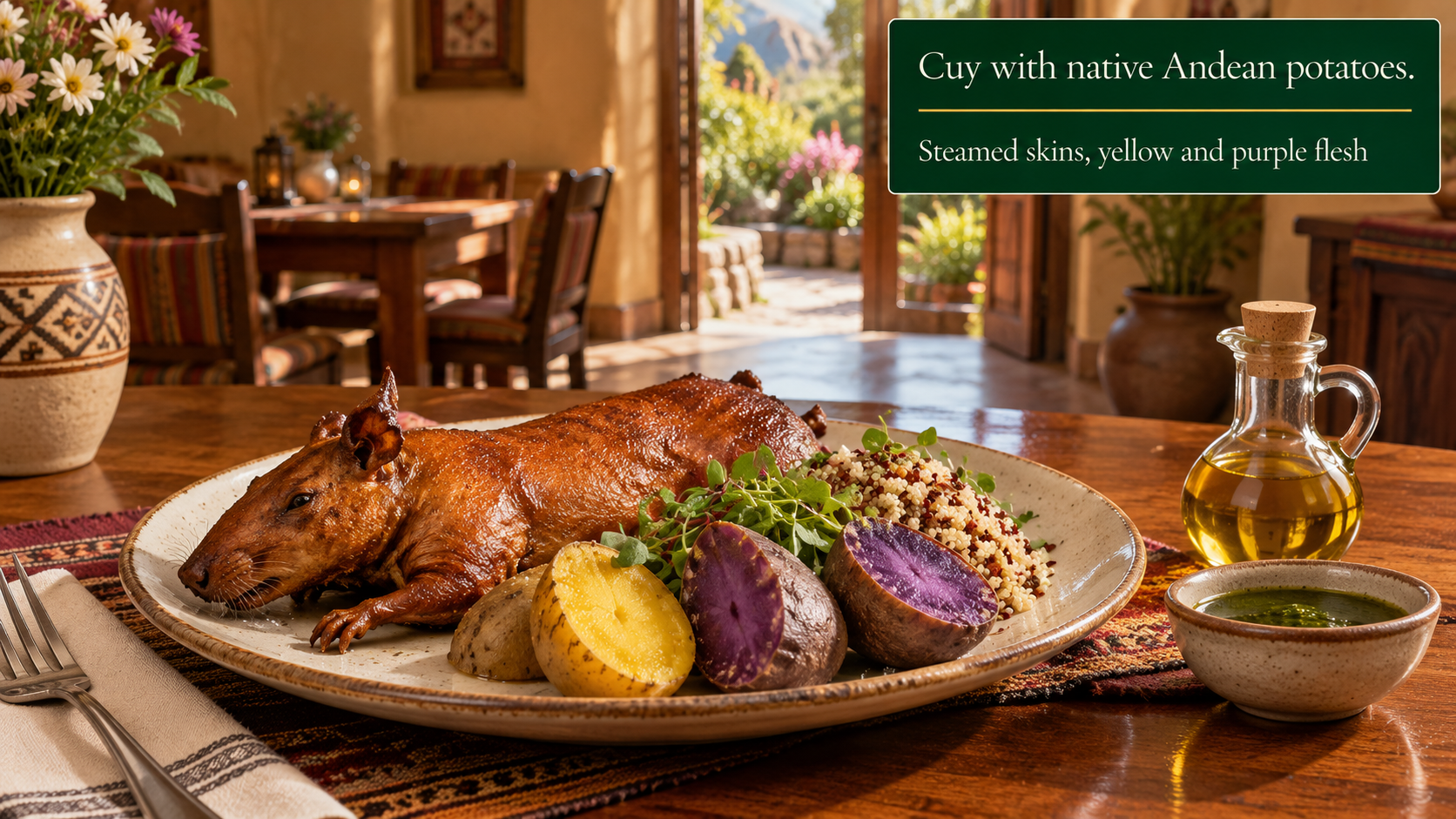
Explore 40 new dishes and six new ingredient guides
Sacha inchi oil at the table · Prepared uncucha · Unsweetened dried Peruvian mango

Trace the produce from market to grower
A restaurant can buy locally without every ingredient growing nearby. A distributor, a regional farm and a hotel garden each tell a different part of the food's story. Keep those distinctions attached to the actual produce in your meal, and an interesting sourcing conversation can stay both courteous and precise.
Follow one ingredient through the description
Choose something visible, such as the tomatoes or grain, and ask where that batch was grown. A named producer or community is useful. A supplier based in Cusco identifies the seller's location, which may differ from the farm. A general answer such as Peru can be accurate without narrowing the origin to the Sacred Valley.
Then ask whether the kitchen knows that information for today's delivery. Menus often describe a general sourcing approach while individual ingredients change. If the staff can identify potatoes from a particular growing area but cannot trace the tomatoes beyond a wholesaler, preserve that difference. It is possible to appreciate both foods without assigning them the same provenance.
Read garden language at the right scale
A property garden may supply a herb, a seasonal vegetable or a portion of the kitchen's needs. That does not establish that the entire dinner was grown there. Ask which components currently come from the garden and which arrive from other producers. The answer can make a plate more interesting than a broad claim that everything is farm to table.
Use the same care with illustrations. A botanical study can show a crop's possible appearance; a seed-packet photograph can record a variety name. Neither documents a current planting, successful harvest or kitchen supply. A chef can work thoughtfully with purchased culinary ingredients while a garden image remains clearly identified as an imagined study.
Keep the labels separate
| Description | What it can tell you | What still needs evidence |
|---|---|---|
| Bought locally | The purchase took place nearby. | The crop's cultivation location. |
| Grown in the region | A stated geographic origin. | The specific producer and whether it applies to this batch. |
| From the hotel garden | A particular ingredient may come from the property. | Which part of today's meal and in what season. |
| Native variety | A crop or variety has a particular heritage. | Where this harvest grew. |
| Organic | A production or certification claim is being made. | The relevant product, producer and applicable verification. |
Choose dinner without requiring a perfect origin story
If the kitchen cannot trace every component, choose on the information it can supply. You may enjoy steamed or roasted vegetables, a clearly described Andean grain and a cooked main even when the distributor supplied some ingredients. A shorter route is not by itself a measured nutrient advantage or a guarantee of food safety.
At the market, ask whether the seller grew the produce or bought it from another grower. A reseller can still be a knowledgeable and useful source. Keep the conversation about the food and respect the seller's time; the absence of a farm narrative is not evidence of wrongdoing.
For the meal itself, preparation remains a separate question. Sourcing detail does not answer how raw leaves were handled, which water entered a drink or whether a sauce is sweetened. Ask those questions when they affect your choice. The result is a meal described at the level the evidence supports, without requiring every appealing ingredient to have grown beside your hotel.
Sources: belmond.com; milcentro.pe
Continue with Fine Dining in the Sacred Valley: Choose the Experience, Then the Table, Quinoa in Peru: Breakfasts, Soups and Savory Plates, Green Juice in the Sacred Valley: Ingredients, Fiber and Freshness, Tomatoes by Variety, with Wild Rocket and Herbs.
Are cherry tomatoes cultivated near the valley?
There is documented cultivation research in Rayanniyoc, Taray, Calca. A UNSAAC agronomy thesis studied cherry tomatoes under a fitotoldo, a protective crop structure, from November 1, 2023, to June 15, 2024. It describes the study site as averaging 3,603 meters in elevation and compares organic and chemical fertilization. UNSAAC cherry tomato trial
That is a specific example of growing activity, rather than a reason to assume cherry tomatoes thrive in every exposed field. Protected cultivation was part of the experiment. Growers' methods matter, particularly when a crop is being discussed in a high-altitude setting.
The trial does not identify the supplier of a particular restaurant or establish present commercial stock. If a host says its tomatoes come from Rayanniyoc, ask about the actual purchasing relationship. A historic experiment and today's restaurant sourcing answer different questions.
What do we know about strawberries in Urubamba?
A Universidad José Carlos Mariátegui thesis documents greenhouse strawberry research in Urubamba city during 2021. It studied Sabrina and San Andreas varieties in semi-hydroponic production. A separate 2017 report from Peru's state news agency described a government initiative supporting Sacred Valley strawberry production. These records give the local growing story a concrete basis. Urubamba strawberry thesis Andina strawberry report
They do not establish what a seller has available today or whether the fruit comes from those producers. Ask where the current batch was harvested. If a restaurant serves strawberries in a dessert, the ingredient's presence on the menu still does not prove its growing location.
For a tasting, let the kitchen explain the preparation as well as the source. Whole fruit, a cooked dessert, and a sweetened sauce give different expressions of an ingredient. Choose the dish you want, then ask how the fruit fits it.
What about peaches, pears, and other orchard fruit?
A historical environmental study for Urubamba lists tomato and orchard trees including plum, pear, apple, quince, and peach in its description of the area's Quechua-zone vegetation. That supports discussing these fruits as part of the landscape. It does not supply a current harvest calendar, a production census, or the origin of an individual purchase. INDECI-hosted Urubamba study
Ask what is in season during your visit and which items actually come from nearby farms. Do not assume a photographed basket represents a year-round selection. A seller's account can help distinguish a local harvest from stock brought through a wider supply network.
If a fruit name is unfamiliar, ask to see the fruit and learn how it is normally prepared. You need not buy a large amount to be interested. A small purchase, when suitable for your food-safety needs, can lead to a better conversation than a long list of supposed superfoods.
Does a shorter supply route prove better nutrition?
No automatic advantage follows from distance alone. A named nearby source can connect your meal to a producer, but it does not establish pesticide-free status, quantified emissions savings, or superior nutrient content. Growing, storage, and preparation would need their own evidence.
USDA guidance identifies fruits as sources of nutrients such as fiber, vitamin C, and potassium, and recognizes vegetables in many forms. That ordinary dietary value is enough reason to include produce in a meal. A local label does not justify promises about detoxification or fertility. USDA fruit guidance USDA vegetable guidance
If you are interested in other regional ingredients, the native potatoes, tarwi, and grains guide offers a separate starting point. Compare preparation and provenance without assigning a medical outcome to a tasting. The moringa guide applies that sourcing conversation to leaf dishes and distinguishes the plant's origin from a grower's current location.

How should you handle raw fruit and tomatoes?
Use safe water and careful handling, while recognizing that washing is not a guarantee. FDA recommends washing produce before preparing or eating it, including before peeling or cutting, and advises against soap, detergent, or commercial produce wash. Washing reduces bacteria but does not eliminate them. FDA produce guidance
Where hygiene and sanitation are unknown, CDC recommends additional precautions. Suitable fruit peeled by the traveler and vegetables cooked thoroughly are generally safer choices than unpeeled raw fruit or salads. Cherry tomatoes cannot conveniently be peeled like an orange, so choosing a cooked preparation can avoid relying on uncertain raw handling. CDC travel food precautions
A higher-priced restaurant does not certify its water, refrigeration, or staff practices. If needed, request cooked vegetables and ask that raw garnishes be omitted. For beverages made from produce, read the green juice guide, where treatment and water introduce additional questions.
Give the ingredients a place in the stay
A hypothetical afternoon might begin with a market conversation and end with a restaurant serving cooked vegetables from a named grower. You can appreciate the connection without assuming every ingredient on the table shares it. Ask which item is local, what preparation suits it, and what has changed with availability.
Choose a base that leaves time for that meal using the Urubamba and Ollantaytambo guide. The most rewarding ingredient story may come from a precise answer about one fruit or tomato, rather than a claim that the entire valley offers the same harvest.
Sources
The agricultural studies establish particular growing examples; MINAM supplies biodiversity context. The historical Urubamba report describes landscape vegetation. FDA, CDC, and USDA address handling and dietary context. None verifies an individual restaurant's current supplier, organic certification, or daily stock.
Continue exploring the table
Try ripe aguaymanto in a savory meal. Recognize fresh lúcuma and plain pulp. Choose and prepare chirimoya. Select palta by ripeness and the whole plate. Keep soursop fruit and leaf evidence separate. Choose the ingredient or preparation that interests you, and use its guide for the details before ordering.
Frequently Asked Questions
Does washing market fruit with bottled water make it safe?
Safe water and peeling suitable fruit yourself can reduce risk, but washing is not a guarantee. FDA states that washing reduces bacteria without eliminating them. CDC favors fruit travelers peel themselves when hygiene is uncertain. A market's reputation or clean appearance cannot independently establish the safety of raw produce.
Sources: FDA: selecting and serving produce safely; CDC Yellow Book: food and water precautions for travelers.
Does a restaurant's price level guarantee raw-produce safety?
Price level and a polished dining room do not verify produce handling. CDC identifies refrigeration, staff practices, water, and raw ingredients as relevant concerns. Where hygiene is unknown, choose vegetables cooked thoroughly and suitable fruit you peel yourself instead of assuming upscale automatically means safe.
Sources: CDC Yellow Book: food and water precautions for travelers.
How can I avoid raw vegetables in restaurant meals?
Ask for vegetables cooked thoroughly and request that raw garnishes or salads be omitted. That is consistent with CDC advice to favor fully cooked food served hot when hygiene is uncertain. Confirm the preparation with the kitchen rather than assuming a familiar dish name describes every ingredient.
Sources: CDC Yellow Book: food and water precautions for travelers.
What are safer food choices at a market?
Where hygiene is uncertain, CDC recommends caution with raw produce and unpasteurized juice. Fully cooked food served steaming hot and suitable fruit you can peel yourself are generally safer choices. Those are travel precautions, not certification that a particular market stall or dish is safe.
Sources: CDC Yellow Book: food and water precautions for travelers.
Should I wash tomatoes and fruit with soap?
FDA does not recommend washing produce with soap, detergent, or commercial produce wash. Use safe running water and careful handling instead. Washing can reduce bacteria without eliminating them, so follow additional CDC precautions with raw produce when food hygiene is unknown during travel.
Sources: FDA: selecting and serving produce safely; CDC Yellow Book: food and water precautions for travelers.
How should I prepare produce before eating it?
FDA recommends washing produce before preparing or eating it, including before peeling. Remove damaged areas, and use a clean brush for firm produce where appropriate. Use safe water during travel and remember that washing alone does not guarantee raw fruit or vegetables are free of pathogens.
Sources: FDA: selecting and serving produce safely; FDA: 7 tips for cleaning fruits and vegetables; CDC Yellow Book: food and water precautions for travelers.
Do I need to wash produce labeled ready-to-eat?
FDA says packaged produce labeled pre-washed or ready-to-eat can be used without further washing. If you wash it anyway, keep it away from unclean surfaces and utensils. That guidance concerns labeled products; it does not establish that loose market produce has received equivalent handling.
Sources: FDA: produce safety guidance (PDF).
Why are these tomatoes ripening unevenly, and are they safe to eat?
The cause cannot be identified without examining the particular tomatoes and growing conditions. Uneven appearance does not establish safety. FDA advises selecting undamaged produce, cutting away damaged or bruised areas before preparation, and discarding produce that looks rotten. Do not transfer a diagnosis from another garden to your purchase. FDA: selecting and serving produce safely
How do grape tomatoes differ from cherry tomatoes?
Delfresco describes grape tomatoes as elongated or oval and cherry tomatoes as round. Both are small tomatoes used for snacking and other dishes. Shape can help you understand a menu or market label, but it does not establish the variety's growing location; ask separately where the particular batch was grown. DelFrescoPure: organic produce
Sources: DelFrescoPure: organic produce.
What can I make with an excess of cherry tomatoes?
The Extension response suggests roasting cherry tomatoes and freezing them for later use, or cooking them into juice and straining out skins and seeds. Those options suit tomatoes you plan to use in cooked dishes. They are preparation ideas, rather than instructions for making shelf-stable canned products. Ask Extension: cherry tomato uses
Sources: Ask Extension: cherry tomato uses.
Which herbs can I pair with cherry tomatoes?
The recipe publisher suggests thyme or rosemary alongside olive oil and garlic when roasting cherry tomatoes. Treat these as flavor options rather than a fixed formula. You can choose a small amount of one herb first and adjust the seasoning to the dish and your preference. ChefsResource: cherry tomato ideas
Sources: ChefsResource: cherry tomato ideas.
How can I reduce pesticide residues when washing produce?
No method removes all pesticide residues. NPIC recommends washing and rubbing produce under safe, potable running water rather than simply dunking it. Scrub firm produce with a clean brush and gently rinse fragile berries in a colander. These steps can reduce surface residues; they do not certify how a particular farm used pesticides. NPIC: washing fruits and vegetables
Sources: NPIC: washing fruits and vegetables.
Can golden berries be eaten raw?
Yes, ripe goldenberries are eaten fresh. University of Arkansas Extension identifies Physalis peruviana as Cape gooseberry or goldenberry and describes fresh fruit in salads as well as cooked chutneys and jelly. That describes culinary use, rather than certifying the hygiene of an individual market batch; follow the produce-preparation guidance above. University of Arkansas Extension: Cape gooseberry and goldenberry
Sources: University of Arkansas Extension: Cape gooseberry and goldenberry.
What are some popular fruits and vegetables in Peru?
PROMPERU's food guide lists aguaymanto, camu camu, chirimoya, lucuma and granadilla among Peru's fruits, alongside vegetables such as asparagus, artichokes and chili peppers, plus native potatoes. These names offer a starting point for reading menus and browsing markets; ask what is in season and where that particular batch was grown. PROMPERU: Peruvian superfoods
Sources: PROMPERU produce names.
Why is it a good idea to buy fruits and vegetables when they are in season?
Seasonal produce can offer better value. Penn State's shopping guidance recommends fruits and vegetables in season because they generally cost less. At a Sacred Valley market, ask what is being harvested nearby and compare the fruit's condition and price. Being in season does not by itself establish where a particular batch was grown. Penn State: buying fruits and vegetables on a budget
What is the wild Peruvian tomato?
Peru's Ministry of Environment documents native tomatoes and wild relatives, including records from Cusco. That biodiversity record does not identify the small tomatoes in a market basket or restaurant dish. If a seller calls a tomato native or wild, ask for the variety and growing location. Its size alone cannot establish either claim.
Sources: MINAM: tomato baseline study.
How does juicing differ from blending the fruit or vegetables I buy?
The difference is whether edible pulp remains in the drink or is separated. NIH's MedlinePlus notes that fruit juice lacks the fiber of whole fruit. For produce bought in the Sacred Valley, ask how a vendor prepares the drink and what ingredients go in it. The green juice guide explains the drink formats in detail.
Sources: MedlinePlus: fruit nutrition quiz.
Which Andean ingredients can I ask about alongside local vegetables in a vegetarian or vegan dish?
Native potatoes, quinoa, kiwicha, cañihua, and properly prepared tarwi are useful ingredients to ask about. A vegetable or grain on the plate does not make the whole dish vegetarian or vegan; check the stock, dairy, eggs, and sauces. The native potatoes and Andean ingredients guide explains these ingredients. Confirm what the kitchen serves now.
Sources: Official Super Foods Peru product list; Inkaterra chef recipes.
Which Sacred Valley restaurants should I ask about local produce?
MIL, Muju, and Hawa describe different dining formats, but their published pages do not verify the origin of every ingredient served today. Choose the experience that interests you, then ask which fruits and vegetables come from named nearby producers and what changes with availability. The Sacred Valley dining guide compares the venues and reservation questions.
Sources: MIL Botanical Path and tasting menu; Rio Sagrado restaurants and bars; Hawa and culinary experiences at Tambo del Inka.
Are aguaje and aguaymanto the same fruit?
No. Aguaje comes from an Amazonian palm; aguaymanto is the goldenberry, Physalis peruviana. If you see either name at a Sacred Valley market, confirm which fruit the seller means and where that batch grew. A fruit sold in the valley was not necessarily grown there. The aguaje guide explains the Amazonian fruit in detail.
Sources: Aguaje commercialization requirements; Goldenberry Name.
Put the plan in one place
Save the route, admission time, station names, and transfer details before you book the next part.
Open the trip-planning checklist