In the Cusco region, sihuayro is a local word worth understanding before treating it as an ingredient name. Regional records describe different animals under related names. Knowing which animal a speaker means, and where the name is used, is the starting point for understanding its food history.
Sihuayro in Cusco: Regional Names, Food History and Sourcing
Sihuayro is a documented regional wildlife name, rather than a reliable one-species ingredient label. Cusco sources apply it to agouti, while an IIAP regional fauna table uses sihuayro de montana for paca relatives. A government-hosted community study records hunting and consumption of an animal called anuje or sihuayro. That history does not establish a lawful present-day food supplier or a dish available to visitors.
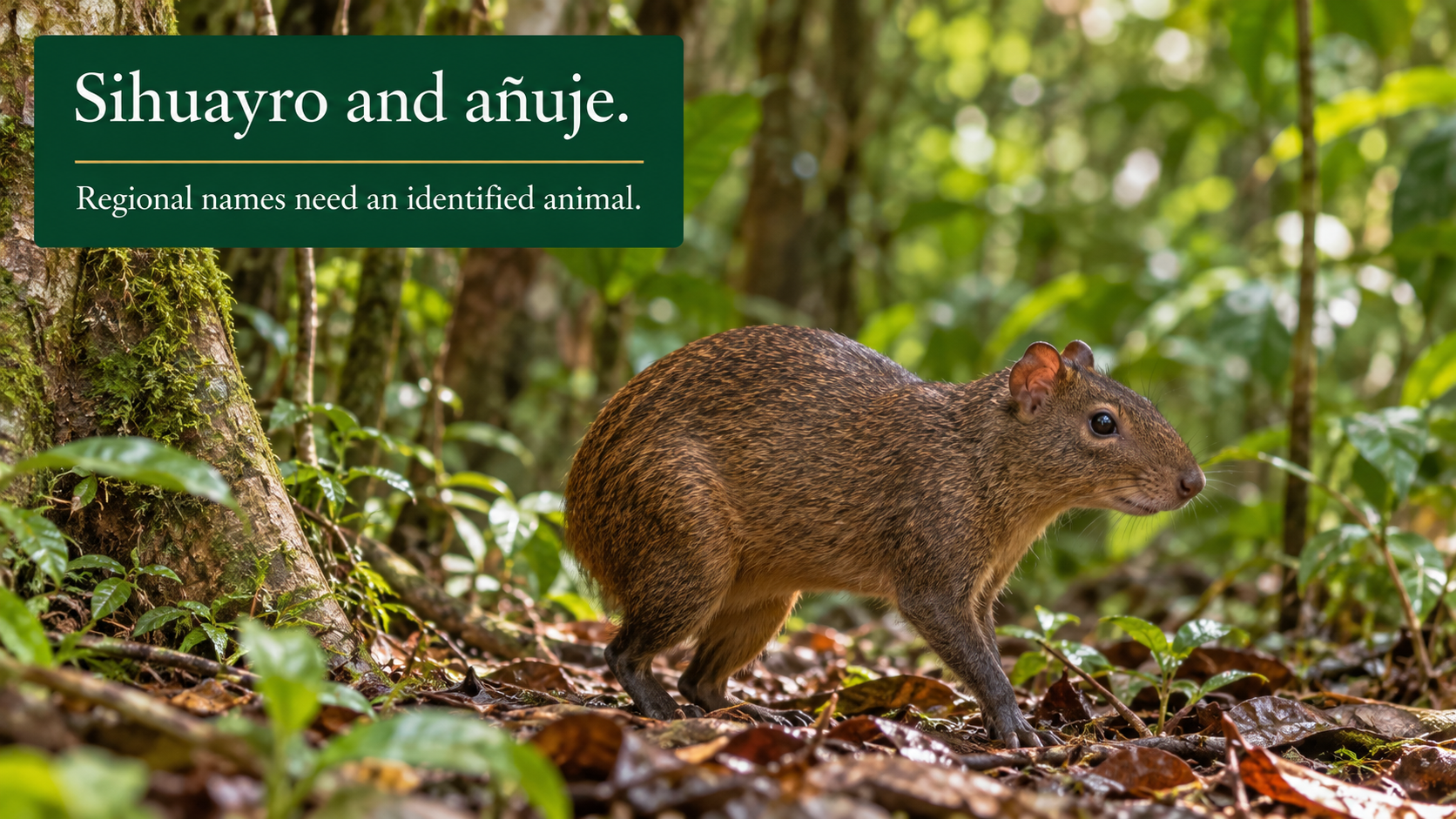
The name has real regional evidence
Inkaterra's September 2014 mammal-observation report from Machu Picchu uses sihuayro and anuje alongside Dasyprocta kalinowskii, Kalinowski's agouti. It describes animals observed around the property's gardening area. That is useful first-party evidence of a local name in use. It is a wildlife observation record, not a restaurant menu or a source of food animals.
A government-hosted community characterization also pairs anuje with sihuayro and later identifies a hunted anuje as Dasyprocta variegata. Together these records support an association with agoutis in particular Cusco-region contexts. They do not establish that every person using the same common name means the same biological species. These common-name records cannot identify an animal offered by a different supplier.
Inkaterra September 2014 mammal observations · MINAM: Chakopishiato incentive management plan, 2021, PDF page 20
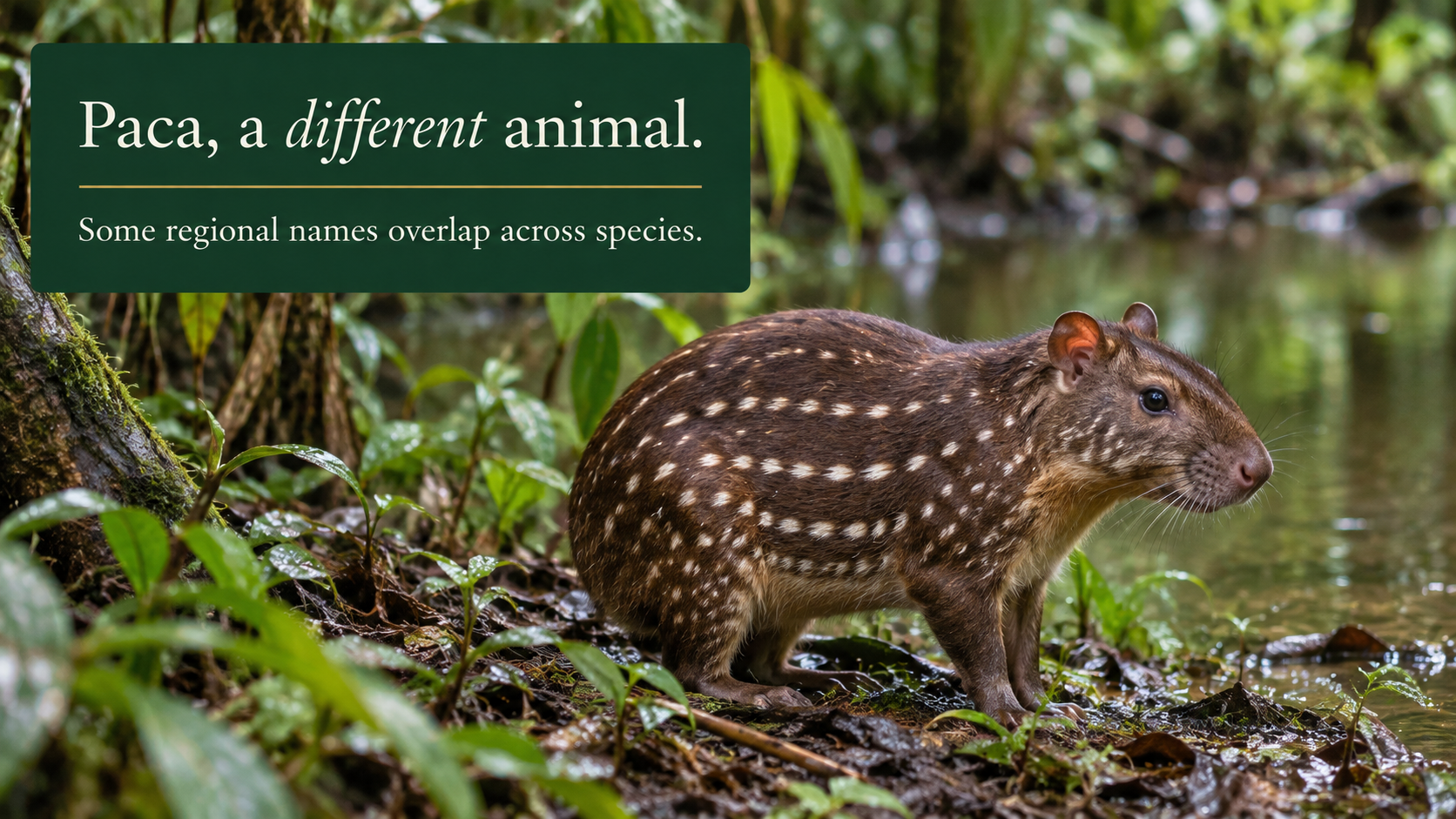
A regional table shows why identification stays open
The IIAP study of fauna in the Rio Apurimac area provides an important counterexample. On printed page 41, its table associates samani or sihuayro de montana with Cuniculus taczanowskii and Cuniculus paca, paca relatives in a different family from agoutis. The table separately lists Dasyprocta kalinowskii as anuje or sihua de montana and Dasyprocta variegata as sihua. Preserve those distinctions when reading the names.
This overlap does not make the regional word wrong. It means that a speaker's place, spelling and intended animal matter. Ask for the name used locally, a documented identification and the source context. A common-name match on a search page cannot safely settle the species in a proposed dish. Domestic cuy is another distinct animal and should never be relabeled sihuayro to make an uncertain ingredient seem familiar.
IIAP: Rio Apurimac fauna study, common-name table, printed page 41
What the food-history record does establish
The 2021 MINAM incentive-management plan for the Matsigenka community of Chakopishiato in Echarati contains a hunting section on PDF page 20. It describes anuje or sihuayro in relation to subsistence crops, including yuca, and records hunting and consumption in the community. The discussion identifies a hunted anuje as Dasyprocta variegata. This is a documented food-use context within La Convencion. These community records do not establish current restaurant availability.
Keep the historical observation attached to its limits. A community characterization is not a current harvest permit, a sanitary inspection or proof of a commercial supply chain. Its account cannot tell a visitor where to order the meat today. A description of past food use can be published responsibly without reconstructing a recipe, asserting a flavor or promising a restaurant experience that the evidence does not establish.
MINAM: Chakopishiato incentive management plan, 2021, PDF page 20
Lawful origin and food handling are separate checks
Peru's wildlife-management framework includes Law 29763 and its regulations. MINAM's record lists D.S. 019-2015-MINAGRI as in force; the regulation addresses wildlife management and controls on legal origin. Later changes also matter: the 2021 sanctions regulation replaced the older sanctions title. An old PDF or an old FAQ should not be treated as a complete current legal opinion about a particular supply.
For a proposed food transaction, the practical questions concern the exact species, the authorized source and the permitted activity. Request the supporting documents from the supplier and have the competent Peruvian authority confirm their relevance. Evidence of lawful source does not by itself establish food handling, storage or suitability for consumption. Those need their own applicable sanitary checks. No verified supplier, chain of custody or food-grade batch has been identified for a sihuayro dish here.
SERFOR SNIFFS: wildlife authorities and legislation · MINAM wildlife regulation record · Peru wildlife management regulation, D.S. 019-2015-MINAGRI · El Peruano: 2021 forestry and wildlife sanctions regulation
Subsistence and sporting rules do not create a restaurant offer
A record that a community hunted an animal does not authorize a visitor to hunt it or a business to sell it. The wildlife regulation treats different activities separately. Its sporting-hunt provisions, for example, limit the hunter's use of the animal and its products to personal use. A license or authorization therefore has to be read for what it actually allows, in the relevant place and period.
The same care applies to animals described as captive-bred. A seller's statement that an animal was raised rather than hunted is not a substitute for the documents required for that activity and transaction. Ask the competent authority about the actual source instead of choosing the most reassuring label. No current sporting calendar, commercial authorization or captive-breeding approval for a specific sihuayro supply is asserted by this guide.
A useful choice for a U.S. visitor
For a visitor, learning the word and its history does not require seeking out wildlife meat. Ask a knowledgeable local guide about the animal's regional names and observe wildlife without assuming it is a food resource. Keep the place and date beside an identification so a future reader can understand which local usage was intended. That small habit preserves useful regional knowledge while leaving room for a specialist to correct an uncertain species name. If a meal is proposed, choose another option while identity, lawful origin or handling remains unresolved.
For a U.S. traveler, taking wildlife meat home is a separate border issue. CDC's bushmeat guidance says bringing bushmeat into the United States is illegal and specifically includes wild rodents in its description. Do not treat a restaurant bill, smoking or drying as permission to carry it home.
Choose a clearly identified cooked meal
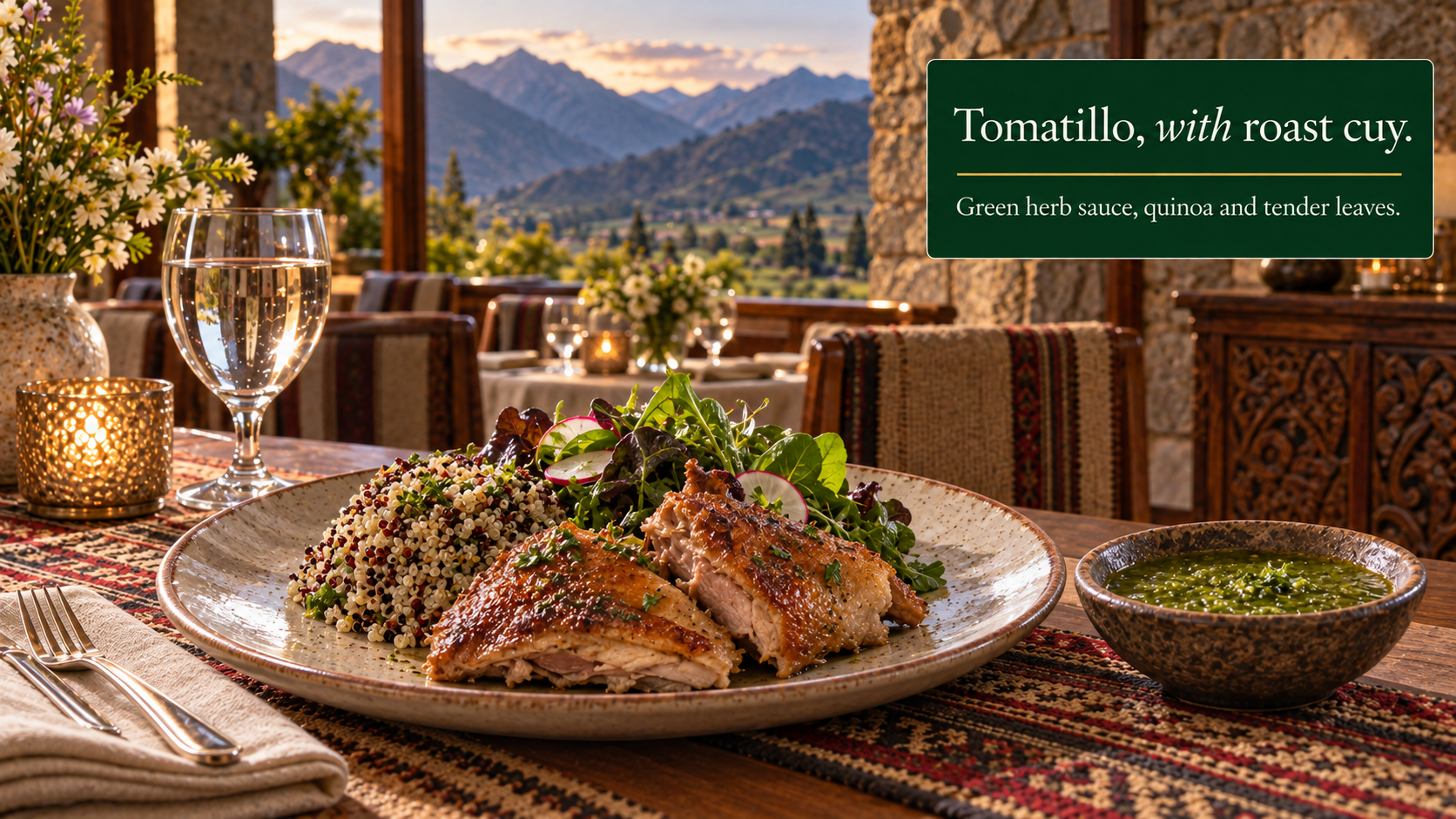
For a familiar Andean meal, the separate cuy guide explains roast preparations and questions to ask about the meat. The plate pictured below depicts cuy with tomatillo, quinoa and greens. It illustrates that established food topic; it does not establish a sihuayro dish or supplier.
The images are editorial illustrations of ingredients and serving ideas. They do not document a named restaurant, a current harvest or an included retreat meal. Preparation guidance is not a tested recipe.
Leave room for the Sacred Valley
A visit to Machu Picchu can leave time for a good meal and a quieter stay in the valley. Ask Florian about The SoulSearching Experience, his five-day Sacred Valley seminar for 8-15 participants. Discuss dates, venue and meal arrangements directly.
Questions readers ask
What kind of animal can sihuayro mean?
Cusco sources use it for agouti; IIAP records the longer name for paca relatives. Confirm the particular animal.
Inkaterra regional agouti observation · IIAP regional common-name table
What is bushmeat?
It means meat from wild animals. CDC includes wild rodents and prohibits bringing bushmeat into the United States.
Which Peruvian laws govern wildlife use?
Law 29763 and its regulations govern wildlife use; the specific activity and later amendments still matter.
Who is Peru's national wildlife authority?
SERFOR is the national forestry and wildlife authority. Regional competence depends on the activity and location.
Which rules address wildlife infringements?
Check the 2021 sanctions regulation and current amendments; earlier regulation titles alone do not provide the complete current rules.
What governs wildlife management authorizations?
Law 29763 and its regulations distinguish management rights and activities. Ask the competent authority about the proposed source.
How do I check wildlife import or export permit requirements?
Identify the species and transaction, then consult the relevant national authorities. This does not override the U.S. bushmeat prohibition.
Does captive breeding remove permit requirements?
No automatic exemption follows from captive breeding. Check the species, source and transaction with the competent authority.
Where can I find the national CITES authority?
Use CITES national contacts. Consult the authorities for both countries when a border crossing is proposed.
What if I do not know the scientific name?
Common names can help search, but sihuayro alone is insufficient here. Resolve the species with qualified local identification.
CITES species-name guidance · IIAP: overlapping regional names
Where can I find information about endangered species?
Use biological and conservation sources for the identified species. A common name or general agouti page cannot establish current status.
Does all wildlife trade threaten species?
The impact depends on management and circumstances. That general distinction does not verify a particular sihuayro supplier.
Does CITES regulate domestic trade?
CITES addresses international trade. Domestic wildlife use in Peru needs its own legal checks.
Does CITES cover every aspect of wildlife conservation?
No. Its focus is international trade in listed species; conservation and domestic sourcing raise additional questions.
Does CITES ban every wildlife transaction?
No blanket ban follows from CITES alone. Applicable domestic law and species-specific restrictions still require checking.
Do CITES lists include every endangered species?
No. CITES lists concern species affected by international trade. They are not a complete conservation-status register.
Are captive-born nondomestic animals still wildlife?
Under the U.S. rules described by FWS, captive birth alone does not make a nondomestic species domestic.
U.S. Fish and Wildlife Service: International Affairs permits FAQ
Does every species need a U.S. wildlife permit?
FWS says not every species needs a permit, while clearance or inspection may apply. Bushmeat remains prohibited by CDC.
What identity details does a U.S. wildlife permit application need?
FWS requires accurate genus and species information, among other details. An unresolved local food name cannot provide that identification.
U.S. Fish and Wildlife Service: International Affairs permits FAQ
Can personal-effects exemptions make bushmeat admissible?
Do not assume that. FWS describes conditional CITES exemptions; CDC separately prohibits bringing bushmeat into the United States.