You sit down to finish a proposal. Before opening the document, you check an AI update someone sent you. Another release, another demonstration, another confident statement about what work will look like soon. You follow a link to understand the implications. When you return to the proposal, the original question has changed. You're wondering whether the service you're offering will still matter.
The proposal still needs finishing. Your concern may also deserve attention. Both can be true.
If you're worried about AI and your future, start with the particular thing you think might happen. Are you concerned about losing work, choosing the wrong skill, making a costly business commitment, protecting confidential information, or spending your days doing work you no longer value? Those questions require different responses. Treating them as one enormous problem makes it difficult to know what to investigate or do.
This article uses the phrase AI anxiety in its everyday sense: worry and uncertainty about a changing technology. It doesn't diagnose you or offer mental health treatment. The practical aim is narrower. Separate what can be checked from what must be decided, identify the assumption that matters, and choose an action you can review.
The evidence doesn't support either a blanket promise of job security or a deadline after which your experience becomes worthless. For example, the ILO's 2025 occupational exposure research assesses potential changes to tasks. It isn't a count of jobs already eliminated.
You can take change seriously without making every headline a verdict on your life. Begin with a sentence specific enough that another person could help you answer it. Then give that question the kind of attention it actually needs.
What exactly are you worried will happen?
AI might change everything is too broad to guide an ordinary Tuesday. Try completing a more concrete sentence: I'm worried that a particular change will happen, and that it will affect something I care about. You might be worried that your employer will need fewer people to prepare reports, that clients will expect lower fees, or that you'll commit to training that doesn't help you do useful work. Each version gives you somewhere to begin.
Keep the wording close to what you actually think. Don't replace a difficult concern with a respectable professional question because the latter feels easier to discuss. I'm worried about our operating model may be accurate. So may I'm worried that I won't know how to contribute in meetings anymore. The first invites investigation of a business process. The second includes a question about your role and what you want to keep contributing.
Next, identify the event that brought the concern into focus. Was there a announced change at work, a client request, a demonstration, or a prediction in a video? An announced change is something you can ask about directly. A demonstration establishes less about your workplace. A prediction may be worth examining, but it doesn't become an organizational decision simply because it sounds confident.
Write what the worry is interrupting. Perhaps you've stopped finishing a qualification, postponed a conversation with your manager, or repeatedly reopened a decision about a new service. Be concrete about the behavior. You intended to ask which tasks the team will automate, but you've spent the last few evenings comparing tools instead. That observation describes an intention-action gap without deciding why it exists.
There's no need to force every concern into a private personal explanation. Your employer may genuinely be unclear about its plans. Your workload may leave little room for learning. A vendor may make its data practices difficult to understand. Before interpreting your hesitation, check whether the practical conditions support the action you're considering.
If several worries appear, choose the one connected to the nearest real decision. You can keep the others on a separate page. Selecting a first question doesn't mean declaring the rest unimportant. It means giving yourself a manageable starting point.
For example, replace Will I become irrelevant? with What does my manager expect me to deliver differently on the next reporting cycle? The narrower question won't settle your whole future. It can reveal whether there is a current expectation, an assumption you've made, or a conversation nobody has yet initiated.
Is this a factual question, a practical decision, or a value conflict?
One sentence can contain three different problems. Consider this concern: If AI prepares our analysis, I don't know whether to remain in this role. There's a factual question about what the system can do and what the organization intends. There's a practical decision about your next professional step. There may also be a value conflict about the kind of work you want your days to contain.
The factual part needs an answer you can check. Which analysis is being discussed? What inputs does it require? Who checks the result? Has anyone approved a change to the team's responsibilities? You might obtain those answers through a written policy, a relevant test, or a conversation with someone who owns the decision. Another broad forecast about the economy may add little to this particular inquiry.
The practical part asks what you will do with the information. You could investigate an internal move, practice an approved task, discuss changing responsibilities, or continue in your role while setting a review point. These options have different costs and consequences. Facts can help you compare them, but facts won't necessarily select one on your behalf.
The value conflict concerns what matters to you. Perhaps you want the stability of your current role and more direct contact with customers. Perhaps you enjoy detailed analysis but don't want to become responsible for supervising automated outputs all day. Neither preference becomes illegitimate because a tool makes one activity faster.
This separation is a reflection tool, not a scientific classification or a diagnostic test. Its usefulness is practical: it helps you stop asking one kind of answer to perform another kind of work. A product benchmark won't tell you how much travel you're willing to accept. A discussion about meaningful work won't establish whether confidential data may enter a particular service.
Sometimes the correct response is to gather missing information. Sometimes it's to acknowledge that two reasonable options serve different priorities. Sometimes it's to negotiate a constraint you cannot resolve alone. You don't need to call all three situations confusion.
Put a short statement beside each part of your worry. For facts, write what needs checking. For the decision, name the choice and its deadline. For values, name what you'd be reluctant to give up. If one category remains empty, leave it empty rather than inventing an issue.
When a consequential choice deserves a fuller process, use the separate discussion of life decisions under uncertainty. Here, the immediate task is to identify which question your next action should answer.
What does the evidence say, and what are you adding to it?
A useful reading of AI evidence begins by keeping capability, exposure, adoption, and outcomes separate. Capability concerns what a system can accomplish under specified conditions. Exposure concerns which tasks could be affected. Adoption concerns whether people or organizations actually use the technology. Outcomes concern what changes afterward, such as work organization, hiring, hours, or earnings. One doesn't automatically establish the next.
The ILO and NASK's 2025 exposure index combines task assessments, expert judgment, and AI predictions. It finds potential generative AI exposure across a substantial portion of occupations and emphasizes that transformation remains an important possible outcome because human input continues to matter. This supports asking which parts of your work could change. It doesn't establish when your employer will adopt a system or whether your position will disappear.
Adoption is another question. A U.S. Census Bureau study covering November 2025 through January 2026 describes considerable differences across firm sizes and sectors. Many adopting firms used AI in a limited number of functions or tasks. Those findings belong to their reference period. They aren't a measurement of every workplace today.
For your decision, the important implication is modest. A strong demonstration elsewhere and limited adoption in your organization can coexist. Equally, limited adoption today doesn't prove that your organization will move slowly tomorrow. You need evidence about the particular decision in front of you.
Now look at what you've added. The observed statement might be Our department is testing automated first drafts. Your added assumption might be First drafts are most of my value. A further prediction might be They will therefore remove my role. Those statements are related, but they're not interchangeable. The first can be checked locally. The second requires an honest inventory of your responsibilities. The third depends on decisions and conditions that may still be unknown.
You don't have to dismiss the prediction. Write it as a prediction and identify the missing steps. Would the organization need to redesign approvals, change customer expectations, establish reliable review, or decide how to use saved time? Asking these questions is more useful than treating the final outcome as already announced.
If the concern is specifically employment, the neighboring article on assessing whether AI could change your job gives that question separate depth. For now, distinguish the evidence you've encountered from the conclusion you've drawn about yourself.
Why can serious labor studies tell different stories?
Different findings don't necessarily mean one study is careless or that the truth lies halfway between them. Researchers may examine different people, countries, technologies, periods, and outcomes. Before using a result to decide what you should do, ask what was measured and what the authors say their result can establish.
The Stanford Digital Economy Lab's analysis revised August 12, 2026 describes a relative employment gap for younger workers in exposed occupations, primarily involving reduced hiring. Its evidence doesn't show widespread economy-level displacement, and experienced workers didn't show a comparable gap. The authors describe indicators rather than causal estimates of jobs lost to AI.
That distinction matters. Reduced hiring can make entering or reentering an occupation more difficult without being the same event as existing employees being laid off. A relative gap against a benchmark isn't a statement that the same share of all young workers lost their jobs. Nor does the absence of a comparable experienced-worker gap establish permanent protection for established professionals.
A different picture appears in the March 13, 2026 version of research on Denmark's exposed occupations. The study documents substantial work reorganization but no measurable average changes in earnings or recorded hours over its observed horizon. Its administrative outcomes run through December 2024. The country, occupations, period, and research design limit what the result tells you about a different workplace later.
The two studies therefore support taking changes seriously while asking a more precise question. Are you investigating hiring opportunities, your current responsibilities, compensation, or how your team allocates work? A result about one outcome may be relevant background for another, but it isn't a direct answer.
For an accomplished adult considering a move, this can change the practical investigation. Instead of asking whether an occupation is generally safe, you might ask how a prospective employer trains new hires, which responsibilities it is redesigning, and what evidence it uses to judge successful work. Those are inquiries into a real opportunity rather than attempts to extract a personal guarantee from a population study.
You can also resist reassurance that asks you to ignore uncomfortable findings. Evidence of limited average effects doesn't erase difficulties faced by particular people. Evidence of a worrying subgroup pattern doesn't establish inevitable harm to everyone. Responsible interpretation allows both concern and uncertainty.
The task is to use each study for the question it can answer. That may leave your own decision partly open. It also prevents a striking finding from carrying more weight than its design supports.

Does a prediction date belong in your personal decision?
A date can make a prediction feel like a deadline you were given. You hear that major change may arrive in a particular year, then begin evaluating today's decisions as though the outcome has already been scheduled. Before doing that, ask what connects the date to the action you're considering.
The Bureau of Labor Statistics' 2025-2035 projections, released August 27, 2026, are conditional scenarios under stated assumptions. Their approach generally assumes technological progress follows historical patterns, and BLS acknowledges that exceptionally rapid change could undermine relationships used in its projections. An official projection therefore deserves attention without becoming a personal promise.
You might use an occupational outlook to investigate demand, training requirements, and alternatives. You shouldn't read it as a guarantee that your position will remain unchanged. The opposite error is treating a dramatic prediction as proof that careful planning no longer matters. Neither response follows from the available evidence.
A useful question is whether your proposed action depends on the exact timetable. Learning to inspect an AI-assisted report may be worthwhile because your team is already using one. You don't need to know when systems will reach a future capability level. Leaving a profession because someone predicts its disappearance is a much larger commitment that depends on far more uncertain premises.
Write the conditional relationship plainly. If our employer expands AI use to this workflow, I will investigate these responsibilities. If a client changes its requirements, I will revisit this service. If the approved tool cannot meet our quality standard, I will keep the existing process while asking what needs improvement. These statements give evidence somewhere to enter the decision.
Don't invent probabilities to make the page look analytical. If you don't have a defensible basis for estimating an outcome, describe the uncertainty in words. You can compare consequences, reversibility, and the cost of waiting without pretending you know the chance of each future.
A review date serves a different purpose from a prediction date. The former is an appointment you control to reassess evidence and commitments. The latter is a claim about what the world may do. Putting a review in your calendar doesn't require believing a forecast.
For more detail on conditional futures, see AI future scenarios and their assumptions. The immediate point is simpler: choose actions for reasons you can explain today, and specify the developments that would make you reconsider.
Does more AI news change what you will do?
Before opening another article or video, write what you're trying to learn. A useful question might concern a tool's approved data use, a changed price, a relevant capability, or your employer's plans. If you can't name the question, you may still choose to read for interest. Be honest that entertainment and decision research are different activities.
In Nick Saraev's commentary about AI news, he recommends choosing what to learn before searching. Elsewhere in the same video, he distinguishes technology news from learning that changes a real workflow. That's his practical advice, not evidence that a particular reading routine reduces distress. His education and implementation businesses also give him commercial interests relevant to evaluating his framing.
You can apply the useful part without adopting complete disengagement. Decide what information belongs in your next research session and what would count as an answer. Perhaps you're checking whether an approved application can compare two public documents. You need its documentation, a suitable trial, and a way to check the output. You probably don't need a survey of every new model announcement.
Give the session an ending tied to the question. Stop when you've answered it, established that the answer isn't available, or reached the time you set aside. If it's unavailable, record the unresolved point and decide who might help. Continuing to refresh a feed isn't the same as obtaining missing evidence.
Keep a one-sentence note afterward: This changed my plan because... or This didn't change my plan. The note isn't a score. It lets you inspect whether repeated research is producing decisions, uncovering constraints, or simply keeping the subject active.
Some information deserves a standing route because of your responsibilities. If you oversee a deployment, important vendor, access, safety, or policy changes may require prompt attention. An information boundary should preserve those signals. It shouldn't become an excuse to avoid information you are accountable for receiving.
If the phone is where you repeatedly lose your intended stopping point, use the controls available on your device or application to limit that particular route. Disable nonessential alerts, remove a shortcut, or keep one deliberate entry point. These are practical environmental changes you can test, not a treatment protocol or a promise that worry will disappear.
The fuller discussion of AI news overload belongs on its own page. Here, ask whether the next piece of information can change your next action.
Hypothetical example: the experienced employee who keeps postponing one conversation
This is a hypothetical example, not a participant story or a reported outcome. An experienced operations manager hears that another company uses AI to prepare supplier summaries. She wonders whether the same change would make her own work less valuable. Her organization hasn't explained its plans. She spends evenings watching demonstrations but keeps postponing a conversation with her director.
Her original worry is that years of experience might stop mattering. The immediate decision is smaller: whether to ask what the organization expects from her team. She writes the known facts without embellishment. She has seen an external demonstration. Her team currently prepares the summaries. She hasn't received an instruction changing that responsibility. She doesn't know whether anyone is evaluating a replacement process.
She then writes the assumptions. She assumes the external system would work with her organization's inputs. She assumes faster preparation would reduce the need for her role. She assumes that raising the subject would make her appear behind. None of these is established by the demonstration.
The first two assumptions invite practical investigation. The third concerns a conversation she hasn't tried. She needn't prove that nobody will judge her before asking a reasonable question. She can prepare a focused agenda: which workflow is under consideration, what standard the output must meet, who would review it, and what responsibilities might change.
Her action is to request that conversation during the coming week. She sets aside time to prepare examples of the actual work, including exceptions that require explanation. She doesn't create a speculative presentation about the future of employment. The aim is to understand an organizational decision, not to defend the permanent importance of her title.
She also gives the conversation a useful ending. If there is no current plan, she'll ask how future changes will be communicated. If a pilot exists, she'll ask whether the team can contribute its quality requirements. If the director cannot answer, she'll ask who owns the issue and when an answer can reasonably be expected.
The action could reveal reassuring information, difficult information, or continued uncertainty. None should be invented in advance. The example's value is that it changes the evidence available to her. Another evening of external demonstrations cannot tell her what her director has decided.
Her review is scheduled for the end of the following workweek. She'll record what she learned, what remains unanswered, and whether another conversation or a task test is appropriate. Her broader concern may remain. She has nevertheless stopped asking a news feed to answer a question that belongs inside her organization.

What can you test while leaving the larger question open?
A useful test doesn't need to settle whether AI will transform your entire profession. It needs to answer one assumption that affects your next decision. You might test whether an approved tool helps with a particular task, whether you understand a result well enough to check it, or whether a conversation reveals a real expectation you hadn't known.
Begin with work you can evaluate. If you're experienced in preparing customer briefings, choose a public or appropriately approved input and define what a good briefing must contain. Identify what would make it unusable: an invented fact, a missing qualification, a misleading recommendation, or a failure to distinguish sources. Then inspect the assisted result against those requirements.
Count the whole task. Preparation, prompting, checking, correction, and handoff all belong in the comparison. Apparent generation speed isn't the same as useful completion. You may find the tool helps with drafting but adds review work, or that it handles routine material while struggling with exceptions. A modest finding like that is more actionable than a sweeping claim about professional replacement.
The OECD's July 2026 skills synthesis distinguishes AI literacy, including critical evaluation, from advanced AI engineering. It also discusses complementary abilities such as communication and problem solving. This supports a broad view of learning. It doesn't establish that any particular skill guarantees employment.
Your experiment can therefore concern understanding rather than speed. After using a tool, explain the result in your own words and identify how you checked it. If you can't, the next learning question becomes clearer. Perhaps you need subject knowledge, familiarity with the tool's limits, or help understanding the original material.
Set stopping conditions before beginning. Stop if the input isn't approved, if you lack the expertise to verify a consequential output, or if the trial would send messages, change records, or commit resources beyond its agreed scope. A bounded test should remain bounded when the system offers to do more.
Choose a review point suited to the task, such as after the next reporting cycle or after several practice sessions. Record what the trial answered and what it didn't. One successful attempt doesn't establish dependable performance across every case. One unsuccessful attempt doesn't prove the whole category is useless.
If your real question is what to learn, use the separate learning discussion. Here, learning is one possible response to worry, chosen because it answers a practical question rather than because staying busy feels compulsory.
Hypothetical example: the owner who feels compelled to replace a working process
This is a hypothetical example, not an account of a client or seminar participant. A business owner repeatedly hears that companies using AI will move ahead of everyone else. His team already delivers a service customers value. He begins investigating automated client follow-ups because he fears appearing slow, but he hasn't identified what is wrong with the current process.
The worry concerns competitive change. The proposed action concerns a specific customer interaction. Those belong on the same page only if he can explain the connection. He writes what he wants the change to accomplish: reduce avoidable preparation work while preserving accurate, appropriate communication. He also writes what he doesn't yet know, including how much time review would require and which follow-ups depend on context that isn't recorded.
He speaks with the people doing the work before selecting a product. They distinguish routine preparation from messages where a customer has raised an unusual concern. The owner can now investigate a narrower question: whether an approved system can prepare a draft from permitted information while the responsible employee retains the decision to send it.
This approach is consistent with the kinds of staged autonomy and human checkpoints described in the OECD's September 2026 practitioner interview research. That study is illustrative evidence from organizations involved with agents. It isn't a certification of this hypothetical workflow or proof of its commercial value.
The owner defines a trial that cannot contact customers. He asks the team to assess drafts against its existing standards and record preparation, review, and correction effort. He sets an end-of-trial meeting. The decision at that meeting is whether to continue investigating, revise the task, or stop. Expansion isn't the default reward for having started.
A plainly useful counterexample sits beside this plan. Suppose the business has no approved data environment, no clear permission to use customer information, and nobody available to review the drafts. In that situation, trying the system on real customer records would be the wrong recommendation. The next action is to resolve those conditions or use a permitted alternative for learning. Feeling behind doesn't provide authorization.
The owner also notices that comparing products has become easier than explaining his objective to the team. That behavior is worth examining, but it doesn't prove a hidden psychological cause. He can ask what the product search is postponing and whether a clearer operating question would end it.
The larger commercial issue belongs in the discussion of AI agents in a business. In this example, the response to worry is a responsible inquiry into one process, with conditions under which the inquiry stops.
When is the worry really asking what you want?
Sometimes you can answer the factual questions and still remain undecided. You've checked what the tool does, learned what the organization intends, and identified several reasonable options. Yet you keep returning to the same concern. At that point, ask whether the unresolved issue includes a preference or tradeoff that information cannot settle.
You may want to remain ambitious without spending every available hour keeping up. You may value detailed craft and also welcome help with repetitive preparation. You may prefer stable responsibilities while feeling drawn toward a different kind of contribution. These are possible conflicts to examine, not explanations that should be imposed on you.
Put the tradeoff into ordinary language. I want to keep leading this team, but I don't want constant tool experimentation to occupy my evenings. I want to investigate a new service, but I don't want to abandon a useful existing one because a commentator sounds urgent. Specific wording makes it easier to discuss a boundary, a test, or a change in expectations.
You don't have to renounce your career to examine its role in your life. Professional achievement can remain important. The question is whether you've asked a job title or a production method to answer every question about contribution and personal worth. This article takes the position that the speed of a machine's output doesn't determine a person's value. That's a philosophical position, not a labor-market finding.
Look at a recent action rather than making a total judgment about yourself. You intended to spend an evening with your family but reopened the same career search. You planned to practice a tool but bought another course instead. You wanted to ask for a different responsibility but continued comparing hypothetical alternatives. What were you trying to obtain or avoid at that moment?
There may be a straightforward answer. Perhaps the conversation carries a real cost. Perhaps you haven't found a suitable course. Perhaps your schedule is unrealistic. Check those possibilities before concluding that the issue lies entirely within you.
If the practical barriers are manageable and the delay continues, reflection can focus on what makes taking the action difficult. You might be trying to avoid choosing between valued options, disappointing someone, or being seen learning. These remain hypotheses until you inspect your own behavior and circumstances.
A question about meaning deserves more room than a quick reassurance about future jobs. See what gives work meaning when its production changes for that discussion. Here, recognizing a value conflict helps you stop requesting another forecast when what you need is to articulate a preference.

What kind of help fits the question you're facing?
Choose help according to the problem that needs answering. If you need to know what your employer permits, begin with the person responsible for that policy. If a tool's limitations matter, obtain relevant documentation and involve someone who can evaluate the task. If you're considering a major career move, speak with people who understand the actual work and requirements. Personal reflection shouldn't be asked to supply missing professional evidence.
The same principle applies to workplace concerns. An unexplained change in duties may call for a management conversation. A disputed decision may need an established organizational process. A concern involving harassment, discrimination, safety, or harmful conduct should be raised through the appropriate formal channel. Don't reinterpret a problem requiring investigation as merely an opportunity to work on your attitude.
That is an important counterexample to advice that always recommends looking inward. Suppose you repeatedly postpone reporting a concrete workplace problem because you're unsure how it will be received. Reflection may help you understand the hesitation, but it doesn't replace documenting the issue and seeking the relevant support. The practical obligation remains outside the reflective exercise.
For serious or persistent distress, this article and a seminar are outside their proper scope. A qualified mental health professional can help assess what support fits your situation. You don't need to determine a diagnosis yourself or first demonstrate that you've tried enough productivity techniques. This is a boundary on what the article offers, not a claim about the cause of your experience.
A different kind of help may fit when you're capable of making decisions, understand the options, and keep delaying an action you want to take. You might benefit from a focused conversation with someone who can question your assumptions without choosing for you. The useful subject is the recurring behavior: what you intend, what you do instead, and what appears to be driving that difference.
AI and the Andes Retreat works within that behavioral and reflective scope. Its method is to decode a behavior, identify what is driving it, change an action, and test the change in ordinary life. It may offer space to find your own answer and define a next step. It cannot predict AI, determine a profession's future, or replace technical, legal, financial, or clinical expertise.
There's no hierarchy in which more personal work is always the deeper answer. Sometimes the right assistance is an advisor, a manager, a technical specialist, or a formal process. Sometimes you need both practical expertise and reflection. Make each person responsible for the question they can actually help you answer.
How will you know when to continue, stop, or reconsider?
A next step becomes more useful when it includes a way to review it. Otherwise, a small experiment can expand into an indefinite obligation, or a reasonable decision can be reopened every time a new headline appears. Write what the action is meant to answer and when you will look at the result.
For a conversation, the evidence might be a clearer account of expectations, identification of the decision owner, or an agreed follow-up. For a task trial, it might be an output you can check, an account of review effort, and a better understanding of limitations. For a learning commitment, it might be your ability to explain and complete a defined task. None requires proving that you have stopped worrying.
Set conditions for continuing. Continue if the action remains permitted, answers the original question, and is worth its demands on time and attention. Modify it if it reveals a more specific obstacle. Stop if its assumptions fail, its costs exceed the boundary you set, or you discover that the work belongs with someone qualified to assess it.
Waiting for a named piece of evidence is different from indefinite delay. Give it an object and a boundary: you're waiting for an employer's answer, a necessary approval, or evidence that isn't yet available. Record what you will do meanwhile and when you'll check again. Waiting indefinitely for certainty about AI's whole future is a different arrangement, because nobody has committed to supplying that certainty.
Choose an actual date on your calendar. If the action is for this week, a review at the end of next week may be practical. If it depends on a reporting cycle or an application decision, choose the relevant milestone. These are suggested planning intervals, not findings about how quickly a person's worry should change.
At the review, separate three observations. What happened? What did you learn? What will you do next? If you didn't act, examine the obstacle without writing a character verdict. Was the step too broad, dependent on someone else, poorly scheduled, or difficult for a reason you haven't articulated? Revise the action accordingly.
You can remain uncertain about the world while becoming specific about your conduct. That doesn't erase genuine risk. It gives you a way to respond that can be inspected and corrected.
Use the exercise below to turn one current concern into a question, an information boundary, and an action. Leave the larger future open where it is genuinely unknown. Give the part you can investigate or influence an appointment in your ordinary week.
Compare your options
| What is unresolved? | A useful question | An appropriate response | What that response cannot establish | Stopping or review condition |
|---|---|---|---|---|
| A factual gap | Has our organization approved this use of AI? | Ask the policy owner and obtain the applicable written guidance. | A policy answer doesn't predict your career or establish that every permitted use is effective. | Stop searching when the responsible source answers the question. Escalate conflicting guidance. |
| An assumption about a task | Can the approved tool produce a briefing that meets our existing standard? | Run a limited trial with permitted inputs and competent review. | One trial doesn't establish whole-role replacement, dependable performance in every case, or business returns. | Stop for unapproved inputs, consequential errors you cannot assess, or actions outside the trial's scope. |
| A practical choice | Should I investigate different responsibilities before committing to retraining? | Compare actual requirements and take a reversible investigative step. | A conversation cannot guarantee an offer or remove every consequence of changing direction. | Review after the agreed conversation or application milestone, using what you actually learned. |
| A value conflict | What kind of work do I want to keep doing, even if its methods change? | Articulate competing priorities and discuss the tradeoff. | Reflection doesn't verify product capability or identify a permanently secure occupation. | End with a specific preference to test, rather than requiring a final answer about your entire life. |
| A recurring delay | Why do I keep postponing an action after I understand the options? | Examine the behavior, practical barriers, and possible driver; choose a changed action. | The pattern doesn't establish a diagnosis, a childhood cause, or a guaranteed seminar outcome. | Review the next occurrence in ordinary life and adjust the action if the obstacle remains. |
| A formal workplace concern | Who should receive this documented issue? | Use the appropriate organizational process and relevant professional support. | Self-reflection doesn't replace investigation, reporting, or an authoritative response. | Follow the process's requirements and escalate unresolved concerns through the appropriate channel. |
| Serious or persistent distress | What qualified support fits what I'm experiencing? | Consult a qualified mental health professional. | This article, a task worksheet, and a personal development seminar cannot assess or treat a condition. | Let the qualified professional help determine the appropriate next steps. |
One worry, one answerable question, one action this week
This is a reflective exercise for ordinary uncertainty and decision-making. It doesn't measure anxiety, diagnose a condition, or calculate your employment risk. Use it for one concern that is consuming attention or postponing an action. Allow enough time to write honestly, but don't turn the worksheet into another research project.
The aim is a usable next step. You may finish with a conversation to request, a fact to verify, a permitted trial to design, or a decision to defer for a specific reason. A responsible pause is a valid result when important conditions aren't met.
A reflection tool for planning your next step, rather than a predictive score.
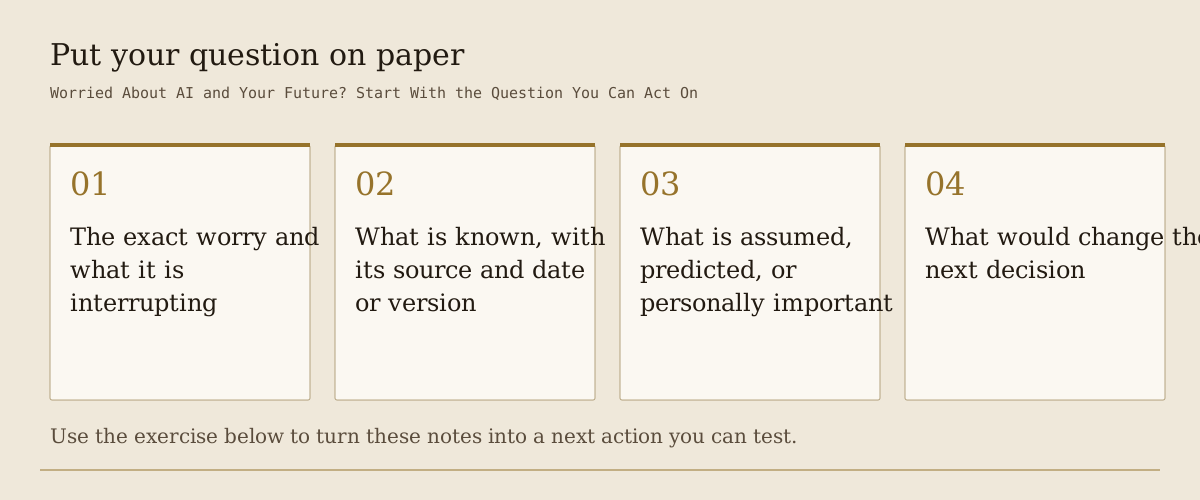
- Write the exact worry in one sentence, including what you think could happen and what it would affect. Identify the immediate task or conversation it is interrupting.
- List what you know from direct observation, an authoritative answer, or a relevant primary source. Beside each fact, record where it came from and the period or version it describes.
- List the assumptions and predictions separately. Mark which concern is a factual question, which is a practical choice, and whether a personal priority is also unresolved.
- Complete the sentence: My next decision would change if I learned that... Name the missing answer and the person, document, or bounded test that could supply it.
- Choose one action for the coming week. Put it in your calendar, name any permission or expertise it requires, and define what it will produce.
- Write when to stop and select a calendar date for review. At that review, record what happened, what remains unknown, and whether to continue, modify, wait, or seek different help.
Completed hypothetical example: An experienced project lead writes: I'm worried that automated project summaries will make my contribution less visible, and I'm postponing a conversation about the next reporting cycle.
Known: The team has discussed testing summary drafts. No change to her responsibilities has been communicated. She currently checks dependencies, exceptions, and commitments before distributing a report. These are observations within this hypothetical situation, not research data.
Assumed: She assumes drafting speed determines how her contribution is judged. She also assumes asking about the pilot will look defensive. Personally important: She wants to keep contributing to decisions rather than spend all her time correcting drafts.
What would change the decision: If the pilot changes who checks dependencies or approves the report, she'll investigate the proposed responsibility split before volunteering for additional work. If the pilot concerns drafting only, she'll ask whether she can help define the review requirements.
Action this week: Request a focused conversation with the pilot owner and prepare one example of the report's decision-relevant checks. She schedules the request during her next workday. Stopping conditions: She won't upload internal reports to an unapproved service or agree to responsibilities she doesn't understand.
Review: She selects the end of the following workweek on her calendar. She'll record the answer, any unanswered question, and the next appropriate conversation. The exercise has produced an action without claiming that her role is secure or that the worry will disappear.
You don't need to settle the future of AI before looking at the choice in front of you. If you're able to name that choice but keep returning to the same unproductive pattern, you can bring it to AI and the Andes Retreat. The five-day seminar in Peru's Sacred Valley gives you space to examine your behavior and choose an action to test at home, with continuing support and accountability. The work is practical inquiry into your own decisions and actions.
Your working notes
Use this page while you think. Your notes stay in this browser tab; download them before you close it.
What does this question change for you?
A practical answer can change how you work. It can also leave a personal decision unresolved: what to learn, what to stop postponing, or which responsibility to take next. Name that decision before collecting another prediction.
Work through your next decision. Your notes stay in the browser tab, and the exercise gives you no predictive score.
If a recurring pattern keeps preventing action, AI and the Andes Retreat offers five days of practical inquiry in Peru's Sacred Valley, followed by support and accountability. Read about the seminar and assess whether that work fits your question.
Frequently asked questions
Search research, audience discussions, and the existing seminar FAQ library informed these questions. Some wording has been adapted to this guide.
Is it normal to be scared of AI?
Concern about a technology that could affect your work doesn't, by itself, tell you that something is wrong with you. This article doesn't establish how common the feeling is or assess whether your experience is clinical. Ask what you're scared will happen and whether there's a current decision attached to it. A specific concern can be investigated more usefully than a judgment about whether you should feel it. Serious or persistent distress deserves qualified support.
Why am I so afraid of AI?
There's no single explanation that can responsibly be assigned to you from that question. You might be concerned about income, competence, privacy, changing responsibilities, or the kind of work you want. Begin with the event that prompted the concern and the particular consequence you imagine. Check practical conditions before assuming a personal cause. If you know the options but keep delaying one action, examine that behavior specifically rather than labeling your whole response.
What should I do if I'm scared of AI?
Write one concrete worry and separate the facts from the assumptions. Then identify the nearest decision: a conversation, a learning commitment, a permitted task trial, or a question that needs professional expertise. Choose a next step small enough to review and specify when to stop. You don't need to begin by using an AI tool. Asking your employer what is actually changing may be more useful than experimenting without an objective or permission.
How do I stop worrying about things that may never happen?
You can't establish that every feared future is impossible, and this article doesn't promise to eliminate worry. For a practical response, ask whether the concern identifies a decision you can make now. If it does, investigate the information that would change that decision. If it doesn't, record the uncertainty and choose when to revisit it. Keep your immediate responsibilities visible so an unanswered future question doesn't automatically become the task for every available hour.
Should I worry about AI in 2027?
A calendar year isn't enough to determine your response. Ask which change could affect a real commitment and what evidence would make you act differently. The BLS 2025-2035 projections are conditional scenarios, not individual guarantees. You can prepare through relevant learning and conversations without treating a year as a replacement deadline. Set your own review date and identify the developments that would justify reconsidering your plan.
Is there evidence of job displacement due to AI?
Some employment indicators deserve attention, but they do not establish a universal count of jobs lost because of AI. The Stanford analysis revised in August 2026 describes a younger-worker employment gap primarily involving reduced hiring and labels its findings descriptive. It doesn't find widespread economy-level displacement in its evidence. Distinguish hiring, layoffs, changed tasks, earnings, and hours before using a result to assess your own situation.
Can we stop AI from taking our jobs?
No individual action can guarantee that an employer or occupation won't change. You can ask how adoption decisions are made, contribute task knowledge, investigate opportunities, and participate in workplace discussions about training and responsibilities. The ILO exposure index describes potential task effects rather than inevitable job elimination. That distinction supports practical participation while leaving the broader employment outcome open. Avoid advice that makes you personally responsible for preventing every structural change.
How can I limit AI news scrolling on Android or iOS?
Use the controls available in your current device and applications to change the route you repeatedly take. You might disable nonessential alerts, remove a feed shortcut, or set an application limit. Exact controls vary, so check your device's own guidance. Pair the change with a defined information question and stopping point. Preserve any essential work alerts through an appropriate channel. Treat this as a practical attention experiment, not a treatment or a guaranteed reduction in worry.
How can I help someone who keeps scrolling AI news?
Start by asking whether they want help and what they are trying to understand. A useful conversation may identify a real concern, such as an employer's plans, that a feed cannot answer. Offer to help find the responsible source or prepare a question. Don't take control of their device or dismiss their concern as irrational. If their distress is serious or persistent, encourage qualified support without presenting your own interpretation as an assessment.
What can I do when I feel the urge to check AI news again?
Before opening the feed, write the question the next visit is supposed to answer. If you have one, choose a source likely to address it and define where you'll stop. If you're returning to a question already recorded for review, look at that note before searching again. You can also change a shortcut or notification that prompts repeated checking. The aim is to inspect and redirect a behavior, without claiming that an urge has a single cause.
What can replace an evening of scrolling AI news?
Choose according to what the scrolling was supposed to accomplish. If you need information, schedule a focused search. If you want relevant competence, practice one permitted task and check the result. If you're postponing a conversation, prepare and request it. You may also choose ordinary time away from the topic without requiring it to become self-improvement. Select a replacement you actually want to do, rather than turning every reclaimed evening into another professional obligation.
How can I be optimistic about AI without ignoring risks?
You don't have to adopt a uniformly positive position. You can welcome a useful application while questioning another deployment. Ask what the benefit is, what could go wrong, who checks the work, and what conditions would make you stop. The OECD practitioner interviews describe both deployments and limitations, including incorrect actions and accountability concerns. A conditional willingness to test something is a workable position even without confidence about the whole future.
What should I do if I'm unsure about my career?
Identify whether you're unsure about current expectations, available alternatives, or what you want from work. Those require different inquiries. Learn the actual requirements of an alternative and speak with someone who understands it before committing to a major change. A reversible investigative step can answer more than continued comparison of hypothetical careers. The career-change article develops that decision separately. An AI headline alone can't establish that you should leave your present role.
How should I approach an AI-related decision I cannot easily reverse?
Give lasting consequences more investigation than a small practice session. Write the commitment, downside, alternatives, and unresolved facts. Obtain appropriate expertise where the choice involves professional requirements, employment terms, or substantial business consequences. A deadline can organize that work, but urgency from a prediction isn't sufficient reason to rush. Look for a smaller investigative action that doesn't make the commitment itself. Responsible waiting should specify what answer you're awaiting and when you'll review it.
How can I start a useful conversation about AI at work?
Begin with a specific workflow rather than a claim about everyone losing their jobs. Ask what is under consideration, what standard the result must meet, who may approve its use, and how responsibilities would change. Bring an example of the actual task, including exceptions that require explanation. If the person you're asking doesn't own the decision, ask who does. Leave with an answer, a named unresolved question, or an agreed follow-up rather than a demand for certainty.
What information should I avoid sharing with AI?
Don't enter information you lack permission to disclose. For work use, check the actual approved environment, data categories, access arrangements, vendor terms, and relevant professional requirements. A general article can't promise confidentiality for a particular service. If approval is unclear, pause that use and ask the responsible person. You can often investigate a task with public or otherwise permitted material instead. The unresolved data question is a reason to establish conditions, not to experiment secretly.
How can ordinary people influence the direction of AI?
Look for decisions where you have actual standing: what you authorize at work, which questions you raise about a deployment, what information you share, and which community or professional discussions you join. Ask for clear objectives, review responsibility, and a route for reporting problems. These are constructive options, not a promise that individual choices determine global outcomes. You don't have to solve every AI risk before participating responsibly in one decision within your reach.
Is AI harmful for the future?
That question is too broad for a supported yes or no. Particular applications can have different benefits, risks, and consequences. The OECD's practitioner research describes actual uses alongside limitations, but it doesn't establish the net outcome of AI's entire future. Ask which deployment concerns you, who could be affected, what evidence is available, and what safeguards or alternatives are being considered. Reject both inevitable catastrophe and guaranteed prosperity as conclusions unsupported here.
What if worry about AI feels like depression?
If distress is serious, persistent, or interfering with daily life, speak with a qualified health professional. The National Institute of Mental Health guide on when to seek help offers a starting point. You don't need to settle the technical debate about AI before seeking support. This article can't determine whether you're experiencing depression. A decision worksheet or personal development seminar also doesn't replace clinical care. The suggestions here concern ordinary uncertainty.
How do I respond when everyone around me says AI will destroy white-collar jobs soon?
Bring the claim down to something you can examine: which tasks, which employers, and what time frame? Repetition doesn't supply the missing evidence. Use the job-risk worksheet to check your own work, then choose a small preparation step. You can acknowledge serious uncertainty without treating every alarming statement as an instruction to resign. If the worry persistently disrupts sleep or ordinary functioning, the NIMH guidance discussed here can help you consider when professional support is appropriate.
Sources and evidence
These guides were drafted with AI assistance and checked against the linked sources. Examples labeled hypothetical illustrate a decision; they are not participant stories or measured results.
Studies answer specific questions about particular people, tasks, and tools. Their dates and limits matter. A result about task assistance is not a forecast for an entire profession.
- Generative AI and Jobs: A Refined Global Index of Occupational Exposure
- Skills in the AI age
- The Microstructure of AI Diffusion: Evidence from Firms, Business Functions, and Worker Tasks
- Employment Projections and Occupational Outlook Handbook: 2025-2035
- Canaries in the Coal Mine? Six Facts about the Recent Employment Effects of Artificial Intelligence, revised August 12, 2026
- Still Waters, Rapid Currents: Early Labor Market Transformation under Generative AI, verified March 13, 2026 author-provided version
- Agentic AI in organisations: Early insights from practitioner interviews
- Nick Saraev: Why You Should Stop Listening To AI News
- Observed comment question concerning fear of judgment and beginning practice
- Observed comment question concerning company information and AI tools
- Observed comment question concerning interpretation of a controlled AI demonstration
- Observed comment question concerning individual and collective action
- Observed comment request concerning practical influence over AI's direction
- The SoulSearching Experience, confirmed offer facts supplied in the packet
- My Mental Health: Do I Need Help?
- Canonical seminar FAQ: Why do I feel unclear even when I already know all the facts?
- Canonical seminar FAQ: What is one thing I can do today to think more clearly?
- Canonical seminar FAQ: When does gathering more information actually help?
- Canonical seminar FAQ: What is the difference between a micro and a macro decision?
- Canonical seminar FAQ: Does mental clarity stay once you have it?
- Canonical seminar FAQ: How do I know if my research is still useful?
- Canonical seminar FAQ: What is the difference between staying informed and doomscrolling?
- Canonical seminar FAQ: Why do I avoid hard conversations even when I know I should have them?
- Canonical seminar FAQ: Why does my research never converge on an answer?
- How Do You Find Your Purpose? A Practical Guide to the Two Kinds You Actually Have
- Why Is Nothing I Achieve Ever Enough? The Gap Between Finishing and Starting Again
- Canonical seminar FAQ: Does being happy mean giving up my ambitions?
- Canonical seminar question: What if I need a co-founder or advisor, not a retreat?
- Canonical seminar FAQ: When should a workplace pattern go to HR instead of self-work?
- Canonical seminar FAQ: Can inner work replace management skill or strategy?
- Canonical seminar FAQ: Who should think twice about a personal development retreat, or skip it?
- Canonical seminar question: Does making a fast decision fix this?
- Canonical seminar question: How do you make a decision you can actually live with?
Where the audience questions came from
These linked discussions and comments supplied questions and wording. They do not establish the truth of the replies, verified professional identities, or how common a concern is.