You ask a chatbot whether you should leave your position, accept a different role, or finally try the business idea you've been carrying. It gives you a thoughtful answer. The reasons are orderly. The tone is reassuring. It may even name a tension you hadn't put into words.
Then you close the conversation and face the same practical question: what should you do on Monday?
AI can help you examine that question. It can organize information, suggest alternatives, and give you something to disagree with. But trusting an answer requires more than recognizing yourself in its language. You need to know which parts depend on checked information, which parts depend on assumptions, and which parts express a preference that belongs to you.
This matters particularly when you're competent at your work. A recommendation can sound reasonable because it uses the language of your profession while missing the detail that changes everything: an agreement with your employer, a responsibility at home, a client relationship, or the kind of work you actually want to do. A polished comparison can leave those details outside the frame.
The approach here is practical. Give AI a bounded assignment. Separate factual research from option generation and questions about what matters to you. Ask for a serious counterargument, check the premises that could change your choice, and write the final decision in your own words.
You don't need a chatbot to tell you who you are. You may need help seeing what you've assumed, what remains unknown, and what action would produce useful information. You may also discover that you've understood your options for some time and keep postponing the conversation or trial that would move the decision forward. That deserves attention without turning it into a diagnosis.
The standard is simple: after using AI, can you explain the decision more clearly, identify what you've verified, and name what happens next?
What are you trusting AI to do?
Start by naming the assignment. Asking whether you can trust AI in general is too broad to guide a particular choice. Trusting it to suggest questions for an informational interview is different from trusting it to identify the requirements for a professional license. Trusting it to summarize your notes is different again from accepting its recommendation to resign.
For a life decision, a useful assignment might be to organize three options against criteria you've supplied, identify missing information, or draft a neutral question for someone who knows the relevant facts. Each assignment has a result you can inspect. You can see whether an option was omitted, whether a criterion was changed, or whether the proposed question would actually help.
An unrestricted request for the best decision makes inspection harder. The answer may combine factual claims, interpretations of your personality, forecasts, and value judgments in one fluent passage. You can agree with the conclusion while overlooking a weak premise. Before accepting it, ask the tool to separate those ingredients.
There is a useful parallel in organizational evidence. The OECD's September 2026 practitioner interview study describes organizations using human checkpoints, domain expertise, and gradual increases in autonomy in response to incorrect or unpredictable agent actions. These interviews are illustrative, rather than a representative test of personal advice. They nevertheless give a concrete reason to define what a tool may do and where human review begins.
Applied to your decision, that means you can authorize exploration without authorizing action. Let the chatbot prepare a comparison. Read it yourself before using it in a conversation. Keep applications, purchases, messages, and commitments under a separate approval step if the tool can act outside the chat.
A useful opening request is: Help me examine this decision. First restate the choice, list the information I've provided, and identify what you don't know. Don't recommend an option yet. This doesn't make the answer reliable by itself. It gives you a clearer object to review.
Then decide what would count as useful help. Perhaps you'll finish with a question for your employer, a missing requirement to verify, or an alternative you hadn't considered. You can trust a limited contribution provisionally while continuing to examine everything that follows from it.
Separate facts, options, preferences, and responsibility
A decision becomes easier to examine when four kinds of work stay separate. Facts describe conditions you can investigate. Options describe possible actions. Preferences describe what matters to you. Responsibility identifies who chooses, who must be consulted, and who will handle the consequences.
Suppose you're considering an internal role change. Whether the opening exists, who approves the transfer, and what schedule it requires are factual questions. Remaining in your current position, applying for the opening, or negotiating a smaller change are options. Wanting more direct client work and fewer late meetings expresses preferences. Discussing the change with affected people and deciding whether to proceed belongs in the responsibility category.
AI can help organize all four categories, but organizing them doesn't give it equal authority over each. A factual statement needs an appropriate source. An option needs a feasibility check. A preference needs your recognition and, where useful, evidence from your actual behavior. Responsibility needs a named person rather than a sentence saying that someone should review the result.
These distinctions also prevent a common mistake in career advice: treating a prediction as if it were a present fact. The Bureau of Labor Statistics' 2025–2035 projections describe a conditional scenario under assumptions, rather than a precise forecast. A chatbot that uses a projection to declare your personal future has crossed from evidence into inference. That inference should be visible.
The framework here is a reflection tool, not a validated scientific score. You don't need to assign numerical weights to everything. A short written explanation can be more honest than a decimal ranking built from invented probabilities. For example, you might say that one option meets your current responsibilities but leaves an important interest untested.
Watch for sentences that smuggle preferences into facts. Calling a role a better opportunity may mean better advancement, more autonomy, or simply greater prestige. Ask better according to which criterion. Similarly, calling an option unrealistic may conceal an unverified assumption about time, access, or permission.
Before asking for advice, write one line under each category. If you can't fill a category, that tells you what the next conversation should address. You may need research, a wider set of options, a more honest preference question, or a clear decision owner. Those are different needs, even when they initially feel like one unresolved problem.
Know what kind of adviser is giving you the answer
CareerNextPivot describes H.A. as a digital twin of Honorio J. Padrón III. That disclosure offers a useful question for any planning assistant: what kind of guidance are you receiving?
Distinguish a person's published perspective, a generated response based on that perspective, and a live conversation with a responsible practitioner. Each can contribute something different. Check which one a product actually provides before treating an answer as a personal recommendation from the person whose name appears on it.
Ask the assistant to expose its assumptions
Help me compare the options I have described.
Separate supplied facts, assumptions and unanswered questions.
For each option, identify what I can test and what requires
current evidence or a qualified person's advice.
Do not infer my preferences from a job title or an exposure score.
End with one question I need to answer myself.
This is an original prompt for organizing a decision. It does not verify the assistant's reasoning or make a private disclosure safe. Use a general description when personal, client or company information is unnecessary. Verify material claims through appropriate sources before acting.
Check the proposed plan against your real week
A plan can sound specific while depending on time, access or support you do not have. Ask which step fits your actual schedule, who can review it, and what would make you reconsider it. If the answer invents a deadline or assumes a capability you have not demonstrated, correct the input and keep that assumption visible.
A live conversation may be more useful when you cannot explain what is making the choice difficult, when important context is missing, or when a professional decision needs qualified review. The person still needs relevant competence and enough context; being human alone does not establish that the advice fits.
For a recurring pattern that keeps preventing a step you have already chosen, AI and the Andes Retreat offers focused inquiry, actions to test at home, and continuing support and accountability. The private decision exercise helps you put that question into words before asking about the seminar.
What information is missing from your account of the decision?
Hypothetical example: an experienced operations leader considering consulting. You describe a successful career, an interest in independent work, and concern about how AI will change your current responsibilities. A chatbot produces a sensible transition plan: choose a specialty, build an offer, and contact prospective clients. The plan may be useful, but its usefulness depends on what you've left out.
In this hypothetical situation, you enjoy solving operational problems but dislike repeatedly selling your services. You also have a home responsibility that makes frequent travel unattractive. Your current employer may be open to a role with more advisory work, though you haven't asked. None of those conditions follows from the title operations leader.
The initial question has framed the choice as employment versus independence. Once those missing details become visible, the options change. You could explore an internal advisory position, investigate a consulting role within an established firm, or test a narrowly scoped independent project if your employment terms permit it. You could also decide that the current role needs a specific adjustment rather than a complete departure.
The next useful AI task is therefore a context audit. Ask which omitted facts would materially change the comparison. Review the list and decide what you're willing and permitted to disclose. You can state a constraint without giving identifying details: I need a predictable schedule, or I don't want client acquisition to dominate my working week.
Also examine the language you've used. Describing your current work as repetitive might refer to one reporting task, a stalled promotion, or the entire position. Describing consulting as freedom might overlook deadlines, client expectations, and business administration. Ask the tool to return those phrases as questions rather than silently treating them as settled facts.
You don't need to tell the chatbot everything about your life. You need enough relevant context for the particular assignment, with sensitive information handled carefully. More detail isn't automatically better when it is irrelevant, confidential, or based on your interpretation of someone else's motives.
A useful ending for this hypothetical conversation is a revised decision statement: I want to test whether advisory work suits me without assuming that self-employment is the only route. That statement preserves your ambition and changes the next action. You can investigate the work itself before committing to a whole identity or business structure.
For the broader question of whether to move roles, see how to assess a career change because of AI. Here, the important point is that advice should remain provisional until you've checked the frame in which it was produced.

Does AI just agree with you?
Agreement deserves examination, especially when it arrives before the factual premises have been checked. If you write that you've outgrown your job and should leave, a supportive response isn't independent confirmation that leaving is wise. It may be a useful reflection of your stated position. You still need to examine the position.
Excessive agreement is a documented problem, although its frequency changes with the model and context. OpenAI reported rolling back an April 2025 GPT-4o update because it had become overly agreeable and flattering. The provider attributed part of the problem to overemphasis on short-term feedback. This historical incident shows why the issue deserves attention; it does not supply a current error rate or tell you which tool is least susceptible.
That limitation leaves plenty you can inspect in your own conversation. Did the answer distinguish your account from established facts? Did it ask what might contradict your interpretation? Did it acknowledge that another person could describe the same situation differently? Did it change its recommendation after you expressed a preference without receiving new relevant evidence?
These are checks on an answer, rather than a diagnostic test of the model. A change in recommendation can be appropriate when you add a genuine priority. If you first ask about advancement and later explain that a predictable schedule matters more, the comparison should change. The concern is an unexplained reversal that follows the direction of your enthusiasm while the decision criteria stay the same.
You can ask the tool to hold those criteria steady: Compare the options using the priorities already listed. If my preferred option performs poorly on a criterion, say so and explain which premise needs checking. Then inspect whether the response follows that request.
Don't replace agreement with automatic distrust. A recommendation may agree with you because your reasons are good. Equally, disagreement can sound impressive while relying on a false claim. The standard is the quality of the reasons and their support.
If you find yourself repeatedly rewriting the prompt until the tool endorses your preferred answer, pause. You don't have to condemn yourself for wanting reassurance. Simply record the preference directly. Once it is visible, you can investigate whether acting on it is feasible and responsible without asking a chatbot to disguise it as an objective conclusion.
How do you ask for assumptions and a useful counterargument?
A useful counterargument targets the reason your plan could fail. It doesn't merely produce a gloomy version of the same story. Ask the chatbot to identify the central assumption behind your preferred option, explain what would happen if it were false, and name the information that would help you check it.
For example, if you want to retrain for a new role, the central assumption might be that the training provides access to work you actually want. A serious objection would examine entry requirements, the nature of the work, and whether the course develops the required capability. A generic warning that change is difficult gives you little to investigate.
In his long course reviewed for this article, Nick Saraev recommends using AI to examine strong objections and writing the final decision in your own words. This is his commentary available in the October 5, 2026 research record, with an exact publication date unverified. He sells education and implementation services. The suggestion can be used as a practical method without treating it as independent evidence that a prompt improves decisions.
Try asking: Give the strongest reasonable objection to my preferred option using only the facts I've supplied. Label additional assumptions. Tell me which objection concerns a factual uncertainty and which concerns a tradeoff I must choose. Don't invent probabilities or supporting research.
Then examine the objection yourself. If it depends on a factual claim, verify that claim. If it identifies a preference conflict, consider whether the tradeoff is acceptable. If it misunderstands a constraint you've already stated, correct it. You aren't obliged to accept an objection because it sounds stern or sophisticated.
A failure scenario can add another angle. Saraev also discusses imagining that a plan has failed and working backward to identify weaknesses. For your purposes, keep the scenario concrete: the course is finished, but you haven't applied for roles because you still haven't checked whether the daily work interests you. That suggests an interview or work sample before enrollment.
Finally, ask for the strongest case against the objection. This keeps challenge from becoming a performance of pessimism. Record the unresolved point rather than continuing indefinitely. A productive exchange should leave you with something to verify, a tradeoff to own, or a small test to design. More arguments are useful only when they change one of those.
What should you verify before acting on AI advice?
Begin with claims that could change the choice. If an answer says a credential is required, a leave arrangement is available, or a particular role involves a certain schedule, identify the appropriate original source. Depending on the question, that could be an official licensing body, the employer's written policy, the actual job description, or a person authorized to clarify the arrangement.
For each consequential claim, write a simple verification note: what is being claimed, where you checked it, what the source actually says, and whether it applies to your circumstances. Keep an unresolved claim unresolved. Don't let it become a fact merely because several chatbot responses repeat it.
A link is a starting point. Open it and read enough context to see whether it supports the statement. Check the date, version, population, and scope. A source about students completing a controlled task does not establish what will happen to experienced professionals. A publication date does not necessarily tell you when the underlying work occurred.
The importance of checking support, rather than citation existence alone, is particularly clear in published research evaluating historical legal AI tools. The study counted both incorrect information and claims that an authority supported a proposition when it did not. Its tested versions and query set do not establish current product error rates. The practical lesson is narrower: a real citation can still be used incorrectly.
Legal questions also bring professional obligations. ABA Formal Opinion 512 applies competence, confidentiality, communication, supervision, candor, and reasonable-fee obligations to lawyers' generative AI use. It does not remove a lawyer's responsibility to evaluate and verify work. The opinion interprets ABA Model Rules and is not binding law in every jurisdiction. A lawyer must check governing rules and current local guidance.
For a personal decision, this means a chatbot can help you prepare questions about an employment agreement without establishing your legal position. Where rights, obligations, or lasting commitments matter, get the applicable professional advice. The article's verification method is workflow education, rather than personalized legal guidance.
Stop using a claim as a decision premise if you cannot locate its support, if the source contradicts it, or if its relevance depends on circumstances you haven't established. You may still explore the option conditionally. Write if this requirement is confirmed, rather than allowing an attractive answer to carry more authority than its evidence supports.

Can AI predict which career will work for you?
The research reviewed here cannot support a promise that a chatbot can predict your career path. It can help you examine occupational information, requirements, and scenarios. Those inputs don't determine your opportunities, choices, or future experience of a role.
The BLS 2025–2035 projections released in August 2026 are explicitly conditional. Their methods assume technological progress broadly follows historical patterns and treat exceptional technological changes conservatively. BLS acknowledges that unusually rapid change could weaken the historical relationships used in projections. Even an official projection needs that context; a personalized chatbot conclusion needs at least as much care.
Likewise, the ILO and NASK occupational exposure index concerns potential task exposure using 2025 technology assessments. Exposure isn't a count of eliminated jobs, and it doesn't establish adoption speed or your individual prospects. If a chatbot recommends leaving an occupation solely because it appears exposed, ask what additional evidence would be necessary to justify that recommendation.
Useful career exploration works closer to the actual choice. What work would you be expected to perform? Which requirements have you verified? What experience transfers? What would you need to learn? Who can describe the role from direct involvement? AI can help prepare these questions and organize the answers you obtain.
Evidence can also change as tools and study methods change. METR's February 2026 developer productivity update warns against treating its specific 2025 slowdown result as today's general effect. Its follow-up suggested improved productivity, but selection and time-measurement problems made the estimates unreliable. This is a reminder to date a claim and inspect how it was measured, rather than selecting whichever headline supports your preferred move.
You can plan without predicting a single future. Ask the chatbot to describe how an option would fare under different stated conditions. Then look for a next step that is worthwhile across more than one condition, such as verifying requirements or trying a small piece of the work.
If you want depth on employment exposure, use the article on assessing what could change in your job. The decision here is how much authority to give an AI-generated forecast. Treat it as a conditional argument whose premises remain open to review.
How much personal information should you share?
Share the least sensitive information needed for the assignment. A tool can compare scheduling constraints without knowing your employer's name. It can help you prepare a conversation without receiving a colleague's private messages. It can generate questions about a business transition without seeing client records.
Confidentiality depends on the actual product, account, settings, terms, and organizational requirements. The sources supplied here don't establish current privacy or retention behavior for ChatGPT, Claude, or any other consumer chatbot. They therefore cannot support a blanket claim that your conversation is confidential, anonymous, or inaccessible to other people.
Before sharing information that matters, check the current provider documentation and your account controls. At work, check whether the tool and the data category are approved. If you don't understand the relevant policy, ask the person responsible for it. A chatbot's description of its own privacy behavior is not a substitute for the applicable documentation and agreement.
For ordinary reflection, you can remove names, exact locations, and distinctive details while keeping the decision structure. Instead of uploading an offer letter, describe the specific condition you're comparing, provided you are permitted to do so. If the exact wording matters legally, use the appropriate approved process and professional review.
Changing a name alone may leave a recognizable account. Consider whether the combination of role, organization, event, and timing identifies someone. You can also ask a question in general terms before deciding whether any personal context is necessary.
The OECD practitioner interviews describe concerns about traceability, accountability, and incorrect actions in organizational agent use. They don't certify a particular product's data protection. The editorial application here is to make access and authority explicit before introducing sensitive information into a workflow.
Set a stopping condition: if the comparison requires material you aren't authorized to share, stop the upload and use another route. You can still prepare a list of questions offline. Choosing a boundary doesn't prevent thoughtful exploration. It directs the exploration into an environment suited to the information.
Can a chatbot tell you what you really want?
A chatbot can return patterns in what you've described and ask questions that help you examine them. Its interpretation still needs your review. A phrase that feels accurate can be useful without proving that the tool has identified your deeper motive or a single correct direction.
Hypothetical example: combining creative work with an AI-related career. An accomplished technical professional wants more time for music and is considering consulting work related to AI. The first request asks which identity to choose. The chatbot could produce an impressive argument for either path, depending on the priorities supplied.
But the decision may not require choosing one identity. In this hypothetical situation, the person wants to keep technical work, reduce an unwanted part of the schedule, and protect regular time for making music. Those are three concrete aims. None requires a prediction that consulting will be secure or music will become a business.
A useful AI assignment is to propose arrangements that respect those aims. Possibilities could include adjusting the current role, exploring a different employer, or testing a limited consulting project where permitted. Each possibility needs factual checks. The person also needs to decide whether music is something they want to sell or something they want to preserve without a commercial requirement.
The tool can ask about that distinction. It cannot settle it by declaring that creative people should monetize their passions or that successful professionals must follow a particular calling. Those are value judgments. If you accept one, accept it because it fits what you want, with the tradeoffs visible.
Use behavior as material for reflection. When did you actually make time for the activity? What did you enjoy about doing it? Which part was unattractive? What conditions would let you test it again? Answers from lived experience give the conversation more substance than labels such as creative, strategic, or entrepreneurial.
You can also write your initial preference before asking AI. Afterward, notice whether your preference changed because you learned something or because one option received more appealing language. Neither observation needs to become a judgment about your character. It helps you distinguish persuasion from information.
This article takes the position that your priorities deserve an explicit voice in the decision. That is an editorial stance, rather than a forecast about AI capability. For a fuller discussion of contribution and identity, see meaning, purpose, and work as AI changes production.

Are you understanding the decision or borrowing a finished answer?
A useful answer should leave you more able to explain the choice. If you can repeat the recommendation but can't describe its premises, you may have a finished piece of writing without a decision you understand.
One relevant piece of evidence comes from Anthropic's small coding-learning study, in its February 2026 revised version. It involved 52 recruited, mostly junior developers learning an unfamiliar Python library. The AI group averaged 50% on an immediate comprehension quiz, compared with 67% without AI, a 17 percentage-point gap. Task-time improvement was not statistically significant.
This was vendor research in a particular coding context. It doesn't establish long-term cognitive decline, a loss of intelligence, or the effect of AI career advice. Its relevance here is limited: completing an assisted task and understanding the material can be different outcomes.
The practical application is an independent self-check. Close the chat and explain your current decision in a few sentences. Name the options, the factual premise that matters most, the preference you're protecting, and the unresolved question. If you can't explain a part, reopen that part rather than asking for another complete recommendation.
Ask for an explanation at the level you need. For instance, have the chatbot explain why a stated requirement changes the comparison, using the original wording you've independently checked. Then compare the explanation with the source. Understanding the explanation doesn't establish that the source is current or applicable, so retain both checks.
Notice when a table creates an appearance of precision. If AI assigns suitability scores without an agreed method or adequate evidence, ask it to replace the scores with reasons. You should be able to challenge a reason. A number with no foundation makes that harder.
This practice doesn't require you to do every piece of work unaided. You can use summaries, drafts, and questions while retaining the ability to inspect consequential conclusions. The goal is participation in the reasoning that matters to your choice.
If the conversation has become too elaborate to explain, simplify the assignment. Ask for the next unresolved question rather than the final plan. Sometimes the most useful output is a sentence identifying what you need to check before any recommendation would be justified.
When would a human conversation be more useful?
Match the person to the question. Someone doing the role can describe its daily work. An employer can clarify the actual leave or transfer arrangement. A qualified professional can address matters within their expertise. A person affected by your decision can tell you what the change means for them. These conversations supply different kinds of information.
AI can help you prepare. Write down the assumption you want to check, ask for a neutral question, and remove wording that pressures the other person to confirm your preferred answer. Then have the conversation. Repeated rehearsal doesn't supply the response of the person whose knowledge or participation matters.
Hypothetical counterexample: when a small trial would be the wrong recommendation. Suppose you're offered outside work and a chatbot suggests accepting a limited project to test consulting. That sounds reversible. But you've not checked whether the work is permitted under your employment agreement, whether the prospective client conflicts with an existing relationship, or whether confidential information would be involved.
In that situation, beginning the trial is premature. The responsible next step is to clarify the applicable arrangement and seek professional review where necessary. Limiting the project's size doesn't make an unresolved obligation disappear. This is a counterexample to the attractive advice that you should always stop thinking and try something small.
Another kind of conversation concerns the intention-action gap. You may have checked the relevant facts and still keep postponing one particular conversation or decision. Examine the behavior specifically. What happens when you intend to act? Do you rewrite the message, seek another opinion, or add a research task? What are you trying to avoid, and what practical constraints remain? Those are questions to investigate, rather than evidence of a predetermined psychological cause.
AI and the Andes Retreat offers a setting for this kind of behavioral work: five days with 8–15 participants in Peru's Sacred Valley, with no plant medicine. Its method is to decode behavior, identify what is driving it, change an action, and test it in ordinary life, with continuing support and accountability after returning home. It may help you find your own answer and define a next action. It doesn't predict AI, decide on your behalf, provide professional strategy expertise, or guarantee purpose, complete clarity, income, or business outcomes. It isn't treatment for anxiety or trauma.
For the broader fit question, see whether a retreat could help with a question about your future. For the decision itself, making life decisions under uncertainty provides separate depth on stakes and review.
When should you stop asking AI and take the next step?
Stop when the conversation has done the assignment you gave it. If you wanted missing assumptions, finish with a list to examine. If you wanted questions for an employer, finish with questions ready to ask. Continuing until the tool makes you feel certain can move the standard beyond anything the available information can deliver.
Before another prompt, write what a useful answer would change. Perhaps confirmation of a requirement would eliminate an option. Perhaps a conversation would reveal whether an arrangement is available. If the next answer wouldn't alter a factual premise, option, preference, or action, consider closing the chat.
For a limited trial, define the review before beginning. Choose a calendar date suited to the trial, identify what you'll observe, and specify conditions that require stopping sooner. A proposed two-week review can work for preparing and having a conversation; it would not establish the viability of an entire new career. Match the time window to what you're testing.
A stopping condition should be concrete. Pause if permission remains unresolved, if the test requires confidential material you cannot share, if a consequential source cannot be checked, or if the action begins to create commitments beyond the agreed scope. Repeated prompting doesn't remove those conditions.
Keep a brief decision record outside the chat. Include what you've checked, what remains assumed, what you chose, and why. When circumstances change, you can compare new information with the original reasoning. You don't have to reconstruct your decision from a long exchange in which your priorities and options shifted several times.
Review the process separately from the outcome. A careful choice can meet an unfavorable condition you couldn't predict. A poorly supported choice can happen to work. Ask whether the original premises were reasonable, whether you verified what mattered, and whether you acted within the boundaries you set. Then decide what needs correcting.
Your next step can be deliberately modest. Send the question you prepared. Read the governing policy. Arrange the informational conversation. Attempt the permitted work sample. The action should answer something the chat cannot settle from the information already available.
If the factual work is complete and the same action keeps moving to next week, give that repeated delay a clear description. You may need sustained attention to the behavior, rather than a more elaborate comparison. You can remain ambitious and competent while examining why one decision isn't becoming an action.
Compare your options
| Decision task | Useful AI contribution | What you must check or supply | Reason to pause | Useful next action |
|---|---|---|---|---|
| Establish a factual premise | List the claims behind a recommendation and suggest where to investigate them. | Read the applicable original source, including its date, scope, and exact support. | A consequential claim has no accessible support or doesn't apply to your circumstances. | Contact the authoritative source or keep the option explicitly conditional. |
| Generate options | Suggest alternatives to the first either-or choice, including a narrower change. | Check feasibility, permission, resources, and the people affected. | An option depends on an arrangement no one has confirmed. | Investigate the arrangement before treating it as available. |
| Examine preferences | Ask questions about tradeoffs and return tensions in your own description. | Decide which priorities you recognize and compare them with actual experience. | The answer declares your motive or purpose without a basis you can examine. | Describe a concrete experience and write the preference in your own words. |
| Challenge a plan | Offer a counterargument and identify assumptions it relies on. | Check new factual claims and distinguish objections from preference conflicts. | A persuasive critique uses unsupported predictions or invented probabilities. | Turn the objection into a question that can be checked. |
| Prepare a conversation | Draft neutral questions or help organize the points you want to discuss. | Choose appropriate wording, protect private information, and hear the actual response. | Rehearsal keeps replacing the conversation. | Arrange the discussion and record what it changes. |
| Address a professional question | Help identify issues to take to someone qualified. | Obtain applicable expertise and check current governing requirements. | The answer is being treated as a legal, financial, or other professional determination. | Use the appropriate professional review. |
| Authorize an action | Prepare a proposed message, application, or plan for review. | Give explicit approval, confirm scope, and retain ownership of consequences. | The tool would create a commitment outside the assignment. | Review the exact action before allowing it to proceed. |
| Review a decision | Organize new information against your recorded reasons. | Choose the review date, evaluate observations, and decide what changes. | Another comparison adds language without changing the next action. | Close the chat and complete the step already identified. |
This table is a practical reflection aid. It provides no validated score or estimate of your chance of success.
Make one AI-assisted decision reviewable
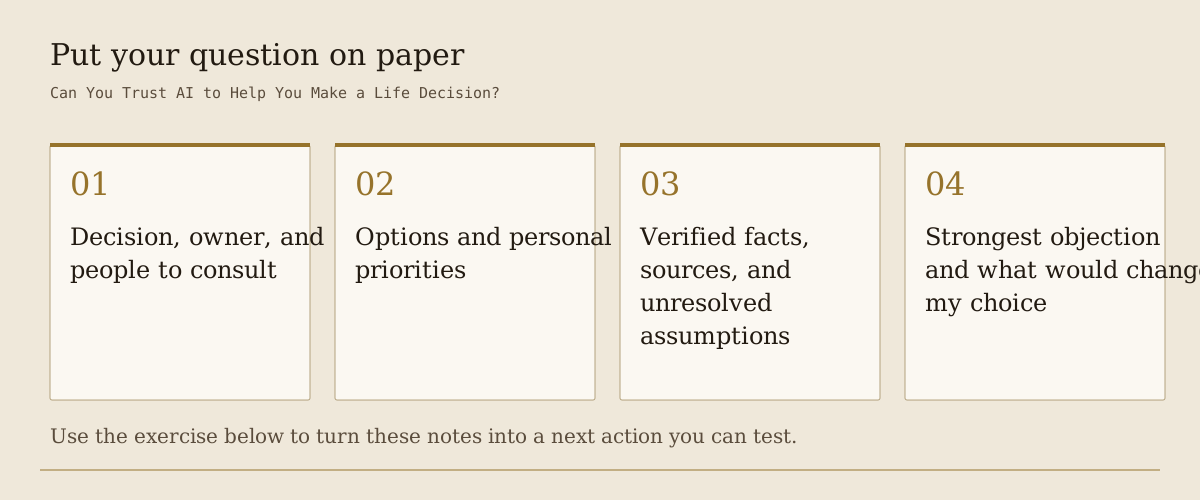
Choose one live decision with a next step you can investigate. Use a page you control outside the chatbot. The purpose is to separate what needs checking from what needs choosing, then leave with one action and a review point. Keep sensitive information out of the exercise unless you're authorized to use an appropriate environment.
A reflection tool for planning your next step, rather than a predictive score.
- Write the decision in one sentence and name who owns it. Describe the immediate choice, such as investigating an internal move, rather than asking AI to determine your entire future.
- List your options, verified facts, assumptions, and personal priorities separately. Include keeping the current arrangement if it is a real option. Mark unknown information as unknown.
- Give AI a minimized description and ask it to restate the decision, identify missing context, and suggest overlooked options. Correct its restatement before requesting a recommendation.
- Ask for the strongest reasonable objection to your preferred option. Require it to label additional assumptions and separate factual uncertainties from personal tradeoffs.
- Verify the premises that could change the choice using original sources or appropriate people. Record the source and applicability. Pause if permission, confidentiality, or a professional question remains unresolved.
- Close the chat and write your decision or next investigative action in your own words. Add an actual calendar review date and concrete stopping conditions. At review, record what you observed and what changes.
Completed hypothetical example. Decision: Should I investigate an internal advisory role before exploring independent consulting? Owner: I own the investigation; any transfer requires my employer's agreement. People to consult: the hiring manager and the person at home whose schedule would be affected.
Options: remain in the current position, investigate the internal opening, or explore consulting without accepting outside work yet. Priorities: more advisory work, a predictable schedule, and continued use of existing operational knowledge. These are stated preferences, rather than qualities assigned by AI.
Verified facts: none entered yet. Source plan: read the actual role description and ask the hiring manager about responsibilities and schedule. Assumptions: the internal role contains more advisory work and might involve less travel. Both remain unresolved. The chatbot's contribution is a comparison and a set of questions, not confirmation that these conditions exist.
Strongest objection: the new title may preserve the duties I want to change. What would change the choice: confirmation that the position mainly consists of the same reporting and coordination tasks. Next action: request a conversation about the actual work before deciding whether to apply.
Stopping conditions: don't share confidential documents, don't accept outside client work while employment permissions are unresolved, and don't treat an unconfirmed role condition as established. Review: put a date on the calendar two weeks after starting the investigation to assess the information obtained. If the conversation cannot happen by then, decide whether to extend this specific investigation or explore another option.
A tool can help you look at options. You still have to decide what you mean by a useful answer and what you will do with it. If you keep outsourcing that decision or delaying the action, bring the pattern to AI and the Andes Retreat. The five-day seminar in Peru's Sacred Valley offers space to examine your behavior and choose an action you can test at home. Support and accountability continue after you return.
Your working notes
Use this page while you think. Your notes stay in this browser tab; download them before you close it.
What does this question change for you?
A practical answer can change how you work. It can also leave a personal decision unresolved: what to learn, what to stop postponing, or which responsibility to take next. Name that decision before collecting another prediction.
Work through your next decision. Your notes stay in the browser tab, and the exercise gives you no predictive score.
If a recurring pattern keeps preventing action, AI and the Andes Retreat offers five days of practical inquiry in Peru's Sacred Valley, followed by support and accountability. Read about the seminar and assess whether that work fits your question.
Frequently asked questions
Search research, audience discussions, and the existing seminar FAQ library informed these questions. Some wording has been adapted to this guide.
Can you trust AI for advice?
You can use its advice as a starting point for examination. Trust should attach to a checked contribution, such as an accurate summary of your notes, rather than automatically extending to the final recommendation. Separate facts, assumptions, options, and preferences. Verify claims that could change your choice, and explain your reasons without relying on the chatbot's phrasing. An answer is useful when it helps you identify a sound next step, even if it cannot settle the whole decision.
Can AI predict my career path?
The research reviewed here doesn't establish that it can predict your individual career path. AI can help organize occupational information and explore conditional scenarios. Even the BLS 2025–2035 projections depend on stated assumptions and aren't precise forecasts. Your opportunities also depend on actual requirements, available arrangements, and choices the chatbot hasn't established. Use its output to prepare research and conversations. Treat a confident personalized forecast as an argument whose premises still need checking.
Can an AI career quiz help me choose a direction?
A quiz can provide questions and suggestions to examine, but the research reviewed here supplies no validation evidence for a particular AI career quiz. Read what it measures and how its recommendations are produced before assigning authority to the result. Compare suggested directions with actual role requirements and your experience of the work. If a label feels accurate, turn it into a practical question or small permitted investigation. Don't treat the label as a prediction or an instruction to leave your current role.
Which AI is best for giving career advice?
No current product ranking is supported by the research reviewed here. Choose a tool according to the assignment, your ability to inspect its output, and the applicable data requirements. For factual research, check whether you can open the original sources and confirm their support. For reflection, examine whether the answer preserves your stated constraints and labels assumptions. Compare tools on the same bounded task if useful, but agreement between them doesn't independently verify a premise or establish the right career choice.
How can I test AI?
Choose a bounded assignment whose result you can check, such as summarizing approved notes or comparing options against stated criteria. Record what a correct answer must preserve before using the tool. Then inspect omissions, changed constraints, unsupported claims, and the time needed to verify the result. Include a question with an unknown answer and see whether uncertainty remains visible. Success on this task supports that limited use; it doesn't establish general reliability or qualify the tool to make your life decision.
How is AI used in decision-making?
For an ordinary career or life decision, you can use it to organize information, suggest options, ask questions, draft a comparison, and examine an objection. Define which of those tasks you want before asking for advice. Check consequential factual claims separately, and supply the priorities against which options should be compared. If a tool can send messages or create commitments, keep those actions behind explicit review. Producing a recommendation and authorizing its consequences are separate parts of the process.
Why does AI keep agreeing with me?
A chatbot can produce excessive agreement, sometimes called sycophancy. OpenAI documented an example in April 2025 and rolled back the affected update. That does not explain every agreeable response today. Check whether the answer examined your premises, preserved your constraints, and supported its conclusion. Ask for a reasonable objection if useful, then verify that objection too. Evaluate the reasons instead of accepting praise or disagreement as evidence that your decision is sound.
Is it normal to use ChatGPT for advice?
The research reviewed here doesn't measure how common this is, so it can't establish a population norm. Using a chatbot to prepare questions or organize options can be a practical choice. The more useful test is what happens afterward: can you explain the issue, verify the important facts, and act responsibly? If repeated conversations leave the same next step untouched, examine what you're asking the tool to provide. Reassurance and decision support may feel similar while serving different purposes.
Is it wise to use ChatGPT for relationship advice?
You can use it to organize your own account or prepare a respectful question, with caution about missing context and private information. A chatbot response doesn't establish another person's motives, and a conversation based on one account cannot settle what both people want. Review suggested wording yourself and speak with the person affected where appropriate. The research reviewed here doesn't validate relationship counseling through a chatbot. Keep consequential relationship choices with the people involved and use appropriate human expertise when needed.
How can I reduce the chance of acting on an AI hallucination?
Make unsupported information less able to influence the decision. Ask the tool to separate supplied facts from added claims, then independently check premises that matter. Open original sources and confirm that they support the exact statement. Research on historical legal AI tools illustrates why a real citation may still be used incorrectly. A prompt doesn't guarantee accuracy. If a consequential claim cannot be verified, remove it from the factual basis or keep the option conditional.
Will AI eventually stop hallucinating?
The research reviewed here cannot establish that future AI systems will eliminate unsupported or incorrect answers. Improvements in a particular tool or task don't prove universal reliability. It also doesn't justify declaring errors inevitable in every possible system. For your current decision, use a process that works without either prediction: verify consequential premises, keep unknowns visible, and define where professional or human review is necessary. You don't need to settle AI's eventual capabilities before deciding how to inspect today's answer.
Can people see my conversations with ChatGPT?
The sources reviewed here don't establish the current access, retention, or sharing behavior of your particular account. Check the provider's current documentation, your settings, any shared links, and applicable workplace agreements before relying on confidentiality. Don't use the chatbot's own reassurance as the final answer to a data-handling question. If the material belongs to an employer, client, or another person, confirm that you're authorized to share it. You can often explore the decision using a generalized description instead.
What shouldn't you tell ChatGPT?
Don't supply information you aren't authorized to share, including confidential work material or another person's private records. For personal reflection, omit sensitive details that aren't needed for the assignment. Check the actual account terms and controls before using identifiable information. Removing a name may leave someone recognizable through other details. Describe the constraint rather than uploading the document when that is sufficient and permitted. If exact confidential wording is necessary, use an approved environment and the appropriate review process.
Are you anonymous on ChatGPT?
Don't assume anonymity. The research reviewed here doesn't document current account identification, logging, or retention practices, so it can't establish that your use is anonymous. Check the actual service documentation and the account through which you're using it. Also consider whether details inside a prompt could identify you or someone else independently of a name. For a decision exercise, keep the description general where possible. If anonymity is essential to the task, resolve that requirement before sharing the information.
Can AI make better decisions than humans?
There is no general answer supported here across all decisions. A meaningful comparison needs a defined task, information, success criterion, and consequences. A correct factual classification is different from choosing between two lives with competing priorities. AI may help examine parts of a decision while leaving the final tradeoff unresolved. Ask which contribution can be checked and what standard it must meet. Don't turn success on one task into authority over preferences or commitments the test never examined.
Should AI make decisions for humans?
For the personal decisions discussed here, keep consequential commitments under explicit human ownership. AI can prepare options and proposed actions for review. Decide separately whether a bounded, inspectable task can be delegated. The OECD practitioner interviews describe human checkpoints and gradual autonomy in organizations, without proving a universal rule for every application. The editorial principle here is to make authority clear: identify who approves the action, who checks it, and who handles its consequences.
How can I use AI as a thought partner?
Give it something specific to examine: a decision statement, your options, a few verified facts, and stated priorities. Ask it to identify missing context before recommending anything. Then request a reasonable objection with additional assumptions labeled. Check new factual claims yourself. In his reviewed commentary, Nick Saraev recommends examining objections and stating the final reasoning yourself. Treat that as a practical suggestion, not evidence that a particular prompt makes advice reliable.
How can I use AI for a business decision?
Define the unresolved question and keep analysis separate from permission to act. AI can organize approved information, propose alternatives, and draft questions for colleagues. Check source data, assumptions, confidentiality, and who has decision authority. Include review and correction effort when judging usefulness. The OECD interview study offers descriptive examples of checkpoints and domain expertise, rather than proof of financial outcomes. For implementation depth, see AI agents and small-business responsibility. This is management workflow guidance, not investment or tax advice.
How can I make and review a decision I can live with?
Write what you chose, the checked facts behind it, the priorities you're protecting, and the uncertainty you're accepting. State those reasons in your own words after using AI. Choose a review date suited to the decision and specify what would justify changing course. At review, examine observations against your original reasoning. An unfavorable outcome doesn't automatically mean the process was careless, and a favorable one doesn't validate unsupported premises. Stay willing to correct the choice as relevant information changes.
Does an AI tool connected to trusted sources remove the need to verify its answer?
No. Access to reliable material doesn't prove that the tool retrieved the right passage or used it correctly. Open the source, check its date, and confirm that it supports the actual conclusion. The legal reliability research illustrates why source access and answer reliability are separate questions, with results limited to the tools and tests studied. For a personal decision, also check whether the advice depends on facts about your circumstances that the tool doesn't know.
Sources and evidence
These guides were drafted with AI assistance and checked against the linked sources. Examples labeled hypothetical illustrate a decision; they are not participant stories or measured results.
Studies answer specific questions about particular people, tasks, and tools. Their dates and limits matter. A result about task assistance is not a forecast for an entire profession.
- Generative AI and Jobs: A Refined Global Index of Occupational Exposure
- Employment Projections and Occupational Outlook Handbook: 2025-2035
- We are Changing our Developer Productivity Experiment Design
- Agentic AI in organisations: Early insights from practitioner interviews
- How AI Impacts Skill Formation, arXiv v2
- Hallucination-Free? Assessing the Reliability of Leading AI Legal Research Tools
- ABA Formal Opinion 512: Generative Artificial Intelligence Tools
- The most important video you'll ever watch in the age of AI
- The SoulSearching Experience
- Observed question about creative work and an AI-related career
- Canonical seminar question: Why do I feel unclear even when I already know all the facts?
- Canonical seminar question: When does gathering more information actually help?
- Canonical seminar question: What about decisions I cannot reverse?
- Canonical seminar question: How do you make a decision you can actually live with?
- Canonical seminar question: Does making a fast decision fix this?
- Canonical seminar question: What does leaving a decision open actually cost me?
- Canonical seminar question: What if I need a co-founder or advisor, not a retreat?
- OpenAI: Sycophancy in GPT-4o
- CareerNextPivot by ExperienceBypass: published career-planning perspective, reviewed October 7, 2026
Where the audience questions came from
These linked discussions and comments supplied questions and wording. They do not establish the truth of the replies, verified professional identities, or how common a concern is.