You finish reviewing a proposal that once would have taken you most of an afternoon to draft. The first version arrived quickly. You corrected the assumptions, removed an unsupported recommendation, and made the language fit the client. The result is useful. Still, a question follows you into the next meeting: if producing this became easier, what exactly am I contributing?
You may have built a good life around being the person who can figure things out, deliver under pressure, or make difficult work look manageable. Those abilities haven't suddenly become irrelevant. But a faster production method can invite a more personal question than a productivity discussion usually allows. What did the effort mean to you? What would you want to preserve if the effort changed?
There are several reasonable answers. You might value the benefit someone receives, the experience of making something, the responsibility you accept, the recognition your work earns, or the independence it supports. You may value all of them in different proportions. This article doesn't ask you to choose an uplifting answer or pretend that income and professional standing don't matter.
It does ask you to separate questions that need different kinds of answers. Whether a task can be assisted or automated is a question about capability and conditions. Whether people will pay for it is a question about demand and alternatives. Whether you want to keep doing it is partly a question about your commitments. Evidence can inform the first two. It cannot select the third on your behalf.
The practical aim is modest: identify a contribution you care about, connect it to an action in an ordinary week, and notice what happens when that action competes with your existing habits. You can take that seriously while continuing to lead a company, pursue a demanding career, or enjoy being very good at your work.
What changes when you separate market value from personal meaning?
Start with three different questions: What can produce this result? What will someone pay for it? Why do I want to participate in producing it? A single piece of work can have a different answer to each. A report might be easier to draft, still valuable because its conclusions are dependable, and meaningful to you because it helps a person make a difficult choice. Alternatively, it might remain commercially useful while no longer holding much personal interest.
Market value concerns what someone will exchange for a result under particular conditions. Personal meaning concerns the significance you give an activity, relationship, or commitment. That distinction is a philosophical starting point for this article. It doesn't establish that markets are unimportant or that every activity you find meaningful can support your livelihood. It makes room to examine both without treating either as a complete measure of your life.
The distinction matters because you could otherwise ask an employment study to answer a personal question it never investigated. The ILO's 2025 occupational exposure index assesses potential task change. Exposure isn't a count of eliminated jobs, and the index cannot establish an individual's prospects. It also doesn't measure whether a particular person finds mentoring, designing, negotiating, or making music worthwhile.
Consider a hypothetical manager preparing instructions for a new employee. If a tool helps draft the document, the manager may spend less time arranging sentences. The contribution might still include deciding what the employee needs, checking that the instructions are accurate, and being available when something goes wrong. Those responsibilities don't prove that the role is permanently protected. They help identify what the manager currently chooses to care for.
There can also be genuine loss. Perhaps you loved writing the instructions yourself, finding a clear structure, and discovering what you thought through the act of composing. An efficient alternative may remove an experience you valued. You don't have to call that progress in every respect. You can acknowledge a useful result and a less satisfying process, then decide whether another part of your week should preserve that practice.
Try naming the change precisely. Is your concern about payment, usefulness, enjoyment, recognition, or responsibility? Each points toward different work. Payment may require a commercial conversation. Enjoyment may require a different production process. Recognition may require an honest examination of whose approval matters. Responsibility may require clearer authority and review. The sentence 'AI makes my work meaningless' combines these questions before you've had a chance to answer any of them.
Your first useful decision may therefore be a distinction rather than a career move. Write down the concern you actually have. A specific concern gives you something to investigate or test. A verdict about your entire worth gives you very little practical room.
What can humans do that AI can't do?
There isn't a responsible permanent list available here. The question needs a task, a system, a setting, and a standard of success. Drafting an answer is different from producing an answer that remains correct under scrutiny. Completing a demonstration is different from operating dependably inside a business. Describing a responsibility is different from establishing who has the authority and knowledge to carry it.
Current evidence gives us useful limits without supplying permanent human exclusivity. The OECD's September 2026 practitioner interview report describes organizations encountering incorrect actions, unpredictable behavior, and difficulties with traceability and accountability. Reported responses include human checkpoints, domain-expert involvement, and gradually increasing autonomy. These interviews illustrate deployment challenges among selected organizations already working with agents. They aren't a representative survey or a timetable for when those challenges will disappear.
The OECD's July 2026 skills synthesis discusses problem solving, communication, creativity, and collaboration alongside foundational and technical skills. It also distinguishes using and critically evaluating AI from specializing in AI engineering. That supports a broad approach to competence. It doesn't establish that a named human skill can never be assisted or automated.
For your present decision, replace 'What can only humans do?' with 'What does this situation require, and what can I responsibly contribute?' You might need to resolve competing priorities, understand information that hasn't been documented, decide what quality means for this client, or have a conversation with someone affected by the decision. These are concrete responsibilities to inspect. They aren't predictions that the associated tasks will remain economically scarce forever.
A second question concerns your participation. A tool might help you prepare for a conversation with your daughter, colleague, or business partner. Whether you want to show up, listen, and accept a commitment is still your decision. That is a statement about the life you choose to conduct, rather than a claim about machine consciousness or the future limits of technology.
You also don't need to settle whether AI could eventually simulate every visible feature of an activity before deciding to do it. You can choose to play an instrument because you want the experience of playing. You can choose to mentor because you care about a particular person's development. The existence of alternatives doesn't logically prohibit those commitments.
If your question is mainly economic, keep it economic. Examine actual requirements, customers, workflow changes, and the evidence relevant to your role. Assessing what could change in your job deserves its own treatment. Here, the aim is to avoid making the meaning of your life depend on winning an argument about a capability boundary nobody can guarantee indefinitely.
Does easier output make your contribution less meaningful?
It depends on what you valued about the work. If you valued the benefit another person received, an easier method could preserve or improve what mattered. If you valued practicing a difficult craft, removing the difficulty could change the experience substantially. If you valued being recognized for doing something few people could do, easier access could challenge that source of satisfaction. These are different answers, and none needs to be hidden beneath a polite statement about embracing change.
One reasonable position centers on outcomes. You care that a colleague understands a decision, a customer receives useful help, or a document becomes accessible to its intended reader. From that position, a tool that reduces unnecessary effort may support the contribution. The work's meaning comes largely from what it makes possible for someone else, rather than from the number of hours required to produce it.
Another position centers on practice. You care about shaping the sentences, hearing the musical phrase, or solving the problem yourself. The finished object matters, but the making matters too. From that position, delegating the central activity may remove something valuable even when the result looks acceptable. You may reasonably reserve some work for direct practice and use assistance elsewhere.
A third position centers on responsibility. You value being someone others can depend on. Assistance changes how you prepare, but you still want to understand the result and stand behind your decision. That can be meaningful without pretending that review requires no effort. If you don't have the expertise or time to check the work, the promise to be accountable needs a more realistic arrangement.
A fourth position includes distinction and recognition. You enjoy excellence partly because other people notice it. That doesn't automatically make your motives shallow. Public recognition can be part of a creative or professional ambition. The useful question is how much of your willingness to continue depends on it, and whether you want that dependence to shape every choice.
You may hold several positions at once. A writer could welcome help with formatting while wanting to develop the argument independently. A business owner could automate preparation and protect time for customer conversations. A musician could use assistance on an administrative task while choosing to practice an instrument without it. There is no requirement to adopt one production philosophy across your entire life.
The counterquestion is equally important: would you still value this contribution if it remained difficult but stopped helping anyone, teaching you anything, or expressing anything you cared about? Effort alone doesn't settle meaning either. Difficulty can belong to valuable practice, unnecessary friction, or an outdated process. Examine what the effort serves before deciding that preserving it is the same as preserving your contribution.
Try completing two sentences separately: 'I want this result because...' and 'I want to do this part myself because...' If the answers differ, you've identified a real choice about process. You can make that choice deliberately instead of treating every shortcut as either liberation or loss.
What happens when competence becomes part of your identity?
Being competent can be a source of pleasure, independence, and genuine contribution. You don't need to become less capable to examine the place competence holds in your life. The question is whether a change in one way of producing results becomes a conclusion about who you are. 'This draft took less of my effort' and 'I no longer matter' are very different statements.
You can inspect that move without diagnosing yourself. Think about a specific recent situation: someone else completed a task you usually handle, a tool produced a useful starting point, or a colleague needed less of your help. What did you do next? Perhaps you welcomed it. Perhaps you checked necessary details. Perhaps you rewrote work that already met the agreed standard. The behavior gives you a more useful starting point than a label about your personality.
Before interpreting the behavior personally, check ordinary explanations. Was the task specified clearly? Did the other person understand the context? Was there a material error? Were you still responsible for a consequence they couldn't see? Taking work back may be appropriate when the arrangement is incomplete. Reflection becomes misleading if it encourages you to ignore genuine risk in order to appear comfortable with delegation.
If those conditions were adequate, you can ask another question: what did doing the task yourself provide beyond the result? It might have offered enjoyment, reassurance, control, recognition, or a familiar place in the team. These are possible meanings to explore, not causes this article can establish. Your answer may be specific to this situation rather than a story about your entire life.
Consider a hypothetical senior professional who says she values developing her team but answers every difficult question before anyone else can attempt it. Her intention and action differ. She could test one change: ask a colleague to bring a recommendation, define the standard, and respond to the reasoning before offering her own solution. The test isn't whether she feels entirely comfortable. It's whether she can support the contribution she says she values while maintaining an appropriate standard.
Your identity can include competence without being confined to a particular task. You might be a skilled professional, a friend who follows through, a parent who listens, an amateur musician, and someone willing to learn. Those descriptions don't need equal amounts of time. They do need some actual expression if you want them to be more than comforting language.
Adding an activity won't automatically change how you experience yourself. But it gives you something concrete to observe. If you claim that friendship matters and repeatedly cancel the only time reserved for it, the next question concerns that action. If you enjoy being excellent at your work and still protect other commitments, there may be no conflict to resolve. Competence is allowed to remain a valued part of your life.

Hypothetical example: the operations leader who misses being the solver
This is a hypothetical example, not a participant account. Consider an operations leader named Elena. She has earned trust by untangling problems quickly. When a delivery process breaks, people call her. She can ask the right questions, assemble the details, and write instructions that get everyone moving. She likes the work, and she likes being needed.
Her team introduces an approved tool to help prepare internal documentation. The first drafts become easier to produce. Elena still needs to review assumptions and decide which exceptions belong in the process. But fewer people need her to start with a blank page. She says this is good for the team. Then she spends an evening rewriting a draft whose content already meets the agreed standard.
The first interpretation could be simple: the standard wasn't actually clear. Elena checks that before drawing a personal conclusion. She distinguishes changes that correct a misleading instruction from changes that merely make the language sound like hers. The misleading instruction needs correction. Several other changes don't alter what the employee can understand or do.
Elena then asks what she misses. Her answer isn't that documentation must always be written manually. She misses the visible moment when others recognize that she has solved something difficult. That answer may be uncomfortable, but it is usable. It doesn't erase her concern for the team or mean that every previous contribution was secretly about approval.
She identifies a different commitment she genuinely values: helping colleagues make good decisions without waiting for her. For a limited trial, she asks one team member to own a recurring internal process document. They agree on what must be correct, which exceptions require Elena's judgment, and when the work will be reviewed. Elena reserves a conversation to examine the colleague's reasoning instead of silently replacing the draft.
The stopping conditions are concrete. If the document introduces a material error, if the colleague lacks information required to complete it, or if review cannot happen before the process is used, the trial pauses. Elena doesn't turn a reflection about recognition into permission to neglect operational responsibility. The scope remains small enough to correct.
She also protects a separate activity she enjoys for its own sake: making something tangible outside work. She doesn't announce that she has discovered a new identity. She simply keeps a commitment that doesn't depend on being the organization's fastest solver. At the review, she looks at whether she followed through and whether the team arrangement worked.
Elena might discover that mentoring matters more than rewriting, that she still wants direct problem-solving work, or that the delegation arrangement needs improvement. She can now distinguish an operational requirement, a preferred activity, and a desire for recognition, and decide what to do about each.
What do you value beyond being efficient?
Efficiency answers a question about the relationship between resources and results. It doesn't tell you which results deserve your resources. You can become very efficient at maintaining commitments you no longer want, producing work nobody needs, or filling every available hour. The missing decision concerns the aim, rather than the speed.
Start with verbs instead of admirable nouns. 'Integrity,' 'creativity,' and 'connection' can mean almost anything until they become actions. You might want to tell a client the uncomfortable truth, make a piece of music, help a colleague understand a decision, or spend an evening listening without checking messages. A verb identifies something you could actually do and something another commitment could displace.
Then name the beneficiary. Sometimes it is another person: your employee, partner, child, customer, or neighbor. Sometimes it is you: you want the experience of making, learning, resting, or being outdoors. You don't have to invent a service mission for every activity you enjoy. But identifying who benefits can clarify whether you're describing a contribution, a personal practice, or an expectation you've inherited.
Ask what you are willing to give the commitment. Time is one resource. Attention, patience, money, and the willingness to be a beginner may also matter. If you say learning is important but choose only situations in which you can appear expert, the conflict becomes visible. If you say family matters but haven't negotiated boundaries around work, the next action might be a conversation rather than another productivity tool.
Values can conflict legitimately. Reliability at work and presence at home may both matter. A creative commitment may compete with a financial obligation. The point isn't to reveal one pure value that defeats everything else. It is to make the tradeoff explicit enough that you can choose it without pretending the displaced commitment has no value.
For example, you might decide that a demanding project deserves extra attention for a limited period. That can be a deliberate expression of responsibility. Write down what makes the period limited and which commitments remain protected. Without those boundaries, an exceptional demand can become the ordinary shape of your week while you continue describing it as temporary.
Use your calendar as evidence of allocation, not a verdict on your character. It may reveal commitments you care about, requirements you can't immediately change, or habits that deserve examination. Caring responsibilities, health limitations, and employment constraints can restrict your options. A values exercise should help you find a workable action inside those conditions, rather than accuse you of failing to live an ideal schedule.
Choose one value that currently has little practical expression. Translate it into a specific action with a person, place, or object attached. The question then becomes smaller and more honest: am I willing to do this, and what will I change to make room? That is where a statement about meaning begins to become a commitment.
What about art, music, and other creative work?
Creative work brings several questions together: what a tool can produce, what you want to experience, what an audience values, and what can support an income. Treating them separately is especially important here. This article doesn't have practitioner or market evidence sufficient to predict the future demand for artists, musicians, or particular creative services.
That leaves room for a useful personal decision. You can ask whether you care about the object, the process, the exchange with an audience, or some combination. A musician may want to play with other people, develop an interpretation, or hear a phrase become more precise through practice. A writer may want to work out an argument in language. A photographer may care about noticing and choosing what to show. These are possible reasons for making things, not universal definitions of creativity.
If a tool helps produce an acceptable result, it doesn't automatically answer whether using it serves your reason for making. Perhaps it removes an administrative obstacle and lets you spend more time on the activity you care about. Perhaps it supplies the central work so completely that the experience you wanted disappears. The answer depends on the purpose of this particular activity.
Audience preference is another question. You might prefer a performance because you know the performer, value live interaction, or appreciate the choices involved. Someone else may care mainly about the sound. Your preference is real without becoming proof that every audience will share it. Equally, someone else's willingness to accept generated output doesn't require you to adopt their taste.
Commercial creative work adds obligations. You need to understand what the customer expects, what process is acceptable, and what standard the result must meet. If a contract, professional rule, or rights question matters, obtain the relevant current guidance. A reflection about meaning doesn't settle those requirements, and this article doesn't supply a general copyright rule.
You also have permission to keep making things that aren't commercially exceptional. The choice to practice an instrument doesn't require proof that you will outperform every alternative. The choice to paint doesn't require an income forecast. You can value participating in an activity while being realistic about whether it should carry your financial obligations.
Conversely, wanting a creative career is a serious ambition. It deserves more than the comforting advice to create for yourself and ignore the market. You would need actual evidence about buyers, opportunities, costs, standards, and the work you are willing to do. A career change because of AI requires that broader investigation.
The decision this page owns is narrower: which part of making matters to you, and how will you preserve or develop it? You could use tools selectively, work without them for a particular practice, or reconsider the activity altogether. None requires declaring creativity permanently protected or announcing that human creativity has become obsolete.
Hypothetical example: choosing between music and an AI-related career
This is a hypothetical example, not a forecast or reported outcome. Imagine Daniel, an experienced technical professional who plays music seriously outside work. He is considering an AI-related consulting role. He enjoys solving useful problems, but he worries that choosing the consulting path would mean admitting that music is no longer worth his time.
A similar choice appears in an observed public question on Nick Saraev's channel: how to choose between artistic work and an AI-related career, or combine them. The comment establishes that someone asked the question. It doesn't establish the writer's circumstances, the commercial prospects of either option, or how common the dilemma is.
Daniel begins by separating three decisions. First, what work will carry his present financial responsibilities? Second, what kind of work does he want to explore commercially? Third, what creative practice does he want in his life even if it doesn't become his main income? Combining those decisions into 'artist or consultant' had made every practical step feel like a permanent statement about his identity.
He investigates consulting through a bounded project rather than a new public title. He chooses an approved, limited problem in a domain he understands and checks whether he likes the actual activities: defining the problem, explaining constraints, examining outputs, and working with the people who would use the result. He doesn't treat enthusiasm for AI news as evidence that he will enjoy client work.
Separately, he protects a music session with a concrete aim: work on one piece and arrange a rehearsal with another musician. He leaves the question of public recognition open. For this trial, he wants to find out whether he is willing to make music when it has a place in the week and no immediate demand to prove a career.
The two commitments have different limits. The consulting experiment stops if it exceeds the agreed scope, requires permissions he doesn't have, or asks him to advise beyond his competence. The music commitment is adjusted if it displaces a responsibility he hasn't negotiated. Neither is allowed to become an unlimited second workload simply because it feels meaningful.
At a review four weeks after starting, Daniel could discover that he enjoys both activities in different roles. He could discover that consulting is less appealing than imagined. He could discover that music deserves a more serious commercial investigation. He could also decide that his existing technical role provides a better foundation while he continues creative practice.
The point isn't that combining paths is always best. Doing both could be wrong if it produces a week he can't sustain or prevents either commitment from receiving enough attention. The useful result of the trial is more specific information about activities and tradeoffs. Daniel can choose a next arrangement without asking one career label to settle every question about meaning, money, and identity.

How do you decide which parts to do yourself?
A useful boundary begins with the aim of the activity. Are you trying to deliver a dependable result, learn a skill, enjoy a practice, or express something in your own way? The same assistance can support one aim and interfere with another. You don't need a single rule about AI use that applies equally to preparing a meeting agenda and practicing a musical phrase.
For delivery, define the standard and the review you can actually perform. You might accept help with organization or a first draft if you understand the subject and can check the result. If you can't evaluate the central claim, a fluent output doesn't establish that you have delivered competent work. The question concerns the whole arrangement, including your knowledge and the consequences of an error.
For learning, reserve some part of the task for your own reasoning. You might attempt the problem before seeking assistance, ask about a specific point, and then explain the solution without looking at the output. That is a practical self-check. It is more informative than deciding that exposure to a good explanation must mean you have understood it.
For enjoyment, consider whether the tool removes an obstacle or removes the activity. If you enjoy choosing and shaping language, handing over the complete composition may be a poor fit. If you enjoy discussing ideas and dislike formatting, assistance with formatting may leave the meaningful part intact. Your preference doesn't need to become a moral rule for everyone else.
For expression, identify the decisions you want to own. Perhaps you want to choose the argument, the examples, the tone, or the final form. Assistance may give you material to assess, but you can ask whether the finished work still reflects decisions you can explain. A piece that looks polished while leaving you unable to say why it takes that form may not serve the expression you intended.
Be honest about what you would disclose when process matters to another person. If someone is paying for a particular method, relying on your competence, or participating in a learning arrangement, clarify expectations before changing the central activity. This is a practical recommendation about shared understanding. Specific contractual, professional, or legal requirements need their own current sources.
There is also a useful stopping question: after this assistance, can I still perform the part I intend to remain responsible for? If the answer is no, change the scope, obtain qualified help, or restore direct practice. Don't preserve the appearance of ownership while quietly losing the ability to carry it.
You can review these boundaries as tools and circumstances change. An activity you once wanted to do manually may later become routine. Another may remain worth protecting because the doing is part of its value. The boundary should serve a chosen commitment, rather than a demand to prove that you are either fully modern or entirely independent of assistance.
Does producing more mean you're still developing your abilities?
A completed task and retained understanding are different outcomes. If competence is part of what makes work meaningful to you, the distinction deserves attention. You might be satisfied with a useful result today and still want to know whether you can explain, adapt, or correct the work tomorrow. Output alone doesn't answer that second question.
In Anthropic's 2026 skill-formation preprint, version 2, 52 recruited, mostly junior developers worked with an unfamiliar Python library. The AI group averaged 50% on an immediate comprehension quiz, compared with 67% without AI. The task-time improvement wasn't statistically significant. This was a small coding-learning experiment conducted by an AI vendor, not evidence that AI causes universal cognitive decline.
The study also reported associations between explanation-seeking or conceptual questions and stronger learning. Those interaction patterns weren't assigned as separate causal interventions. We therefore can't say that asking a particular kind of question guarantees retention. We can use the distinction to design a practical check of our own understanding without pretending that the check is a validated learning treatment.
Choose an ability you actually want to keep. 'Think critically' is too broad for a useful test. You might want to explain the assumptions behind a recommendation, diagnose why a small program fails, or revise a paragraph so the argument becomes clearer. Define what doing that ability would look like without the assistance you usually receive.
Then keep a small part of your practice independent. Attempt it, identify where you become uncertain, and seek help with that point. Afterward, close the output and explain what changed. Where factual accuracy matters, compare the explanation with trusted subject material or a qualified person's review. The aim is to discover a gap while it is still manageable.
This can also change your relationship to being accomplished. You may know a great deal in one area and still need to be a beginner in another. A tool can make the unfamiliar work look complete before you have developed the relevant understanding. You don't have to conceal that difference or interpret it as a failure. You can decide whether the ability deserves deliberate practice.
Not every task needs to become a learning project. If a routine activity is incidental to your goals, competent assistance may be enough within an appropriate arrangement. The decision is where retained skill matters to your responsibilities or your enjoyment. Spend effort there instead of treating every manual action as equally valuable.
For a broader learning plan, choosing what to learn as AI changes is a separate question. Here, the useful commitment is simple: preserve a way to tell the difference between work you can produce with assistance and work you understand well enough to carry yourself.
What would you keep doing if recognition changed?
This question is useful only if you answer it honestly. You don't need to claim that recognition means nothing to you. You may enjoy being respected, publishing excellent work, building a visible business, or receiving credit for a difficult contribution. The point is to understand which commitments you would preserve under different conditions, rather than force yourself into a performance of indifference.
Consider three conditional scenarios. In the first, your work remains useful and well paid, but receives less personal credit. In the second, you keep recognition but lose some financial reward. In the third, the activity remains available as a private practice while its commercial role changes. These are reflection scenarios, not predictions about what AI will do to your work.
Each scenario may reveal a different boundary. You might happily continue helping a client without public recognition but need payment to justify the time. You might continue playing music privately while deciding against an uncertain commercial commitment. You might find that public exchange is central to your writing and that writing only for yourself doesn't meet the same aim.
Money matters in these answers. It can support independence, care, stability, and obligations to others. You don't have to pretend that a lower financial return is spiritually superior. If an activity must support your livelihood, examine its commercial conditions honestly. If it doesn't need to carry that burden, you may have more freedom to choose how you participate.
The same applies to recognition. Ask whose response matters and why. A customer's trust, a colleague's respect, an audience's attention, and strangers' approval aren't interchangeable. You might care deeply that a person you helped finds the work useful while being less interested in public visibility. Or you might want a public creative practice and be willing to do the work required to develop it.
There is a practical trap here: turning an answer into another status project. You decide to make something without chasing recognition, then create an elaborate public identity around being someone who doesn't chase recognition. If you notice that, you don't need a harsher judgment. Return to the activity and the commitment you wanted to test.
A useful trial could be private and limited. Make one thing, help one person, or practice one skill without announcing a new direction. Notice whether you want to continue, what you miss, and what kind of exchange you actually value. The result may confirm that audience response matters to you. That is information, not a failed test.
Professional success can remain part of a meaningful life. The question is whether every activity must earn its place through the same kind of approval. Allow different commitments to have different reasons. A client project, a friendship, and a creative practice don't need to report to an identical measure.

Can you find purpose outside work without withdrawing from work?
Yes, as a practical possibility. Work can remain important while other commitments become more visible in your life. You don't have to resign, reduce your standards, or deny that your career has given you satisfaction. The question is whether work carries responsibilities it can reasonably fulfill and whether the rest of your life has any protected expression.
Start with an activity that has a real place and person attached. 'Spend more time with friends' is an intention. Agreeing to dinner with a friend and keeping the evening available is a commitment. 'Contribute to my community' is an intention. Asking a particular organization what help it needs and deciding whether you can provide it is a next action. Specificity lets you discover whether you want the activity or mainly like the description of yourself it offers.
Family responsibilities can also hold meaning without looking like a new project. Being available for a difficult conversation, sharing an ordinary task, or making a dependable arrangement may matter more to you than an impressive addition to your schedule. You don't need to rename those actions as productivity achievements to take them seriously.
Nor does every meaningful activity need a beneficiary beyond you. Rest, play, curiosity, and making something imperfect can be chosen parts of a life. You may find them worthwhile because you enjoy them. That is a legitimate personal judgment. This article isn't claiming that an unmeasured activity will improve your work performance or that a particular hobby will resolve dissatisfaction.
Be careful with the idea of having many sources of meaning. It can become a demand to excel in more domains. You keep a demanding career, add creative practice, volunteer, pursue ambitious fitness goals, and then wonder why your week has no room. The better question is what you want to sustain and what you're willing to stop or reduce to make it possible.
Your options may be constrained. A caregiver cannot simply allocate evenings as though nobody depends on them. A professional facing a genuine deadline may need a temporary arrangement. The action should fit those conditions. It might be a short conversation, a negotiated boundary, or a smaller version of the activity, rather than the ideal commitment you could make in an entirely different life.
Notice whether outside activities receive only leftover time. If they matter but are always postponed until the inbox is complete, ask what condition would ever allow them to happen. You may need a stopping point for work, an agreement with colleagues, or a change in how you respond to optional requests.
Purpose outside work doesn't have to arrive as a second career or a grand mission. It can begin with a relationship or practice you are willing to give actual attention. Your professional ambition can continue alongside it. The review concerns whether both commitments have a workable place, rather than whether you have achieved perfect balance.
When would an attractive recommendation be wrong?
Hypothetical counterexample: consider a successful professional who feels less satisfied with routine deliverables and is told to quit, follow a creative calling, and let the details work themselves out. The advice sounds freeing. It could also be wrong. The person has obligations, hasn't investigated the proposed work, and doesn't yet know whether dissatisfaction concerns the role, the production process, or the place achievement holds in life.
Leaving might eventually be a good decision. But the present evidence doesn't establish that it is. A new title could preserve the same expectations while adding financial pressure and removing useful support. A small creative practice might answer the personal question without a career change. An actual workplace problem might require a direct conversation. Different causes require different actions, and this article cannot select a cause from the feeling alone.
Another attractive recommendation is to automate everything possible and spend the recovered time on what matters. That could fail if the supposedly recovered time goes straight into additional output, if review costs consume it, or if the automated activity was itself part of what mattered. Before changing the process, identify the time you expect to gain and the commitment you intend to give it.
Conversely, refusing assistance to preserve your sense of contribution could be wrong when it maintains needless friction or prevents someone from receiving timely help. If you care about the result and can responsibly review the assisted work, doing every step manually may serve a different need than the one you state. That possibility deserves examination without assuming it applies to you.
A third recommendation promises a permanent human advantage through creativity, leadership, or consulting. The OECD skills synthesis discusses complementary abilities but doesn't establish permanent immunity. The BLS 2025–2035 projections are a conditional scenario under stated assumptions. BLS warns that exceptionally rapid technological change could undermine historical relationships. Neither source can guarantee that a particular direction will remain secure.
Nick Saraev's commentary titled What I'd Learn Instead of Automation in 2026 recommends understanding how a business creates and delivers value across changing tools. That is his practical advice, rather than independent evidence that one career path will prevail. His education and implementation businesses also give him commercial interests in this discussion. The exact publication date isn't established by the available relative-date record.
The useful alternative is proportionate investigation. Clarify the problem, examine actual requirements, and test what can be tested without making the largest possible commitment first. If the decision concerns resignation, major retraining, or a business change, decisions with lasting consequences deserve a fuller process. Meaning can inform that decision, but an appealing story about meaning should never substitute for its practical conditions.
How do you turn an answer into an ordinary week?
An answer about meaning becomes useful when it changes an action you can recognize. You might decide to preserve direct creative practice, make mentoring part of your role, protect time with someone, or stop treating every available hour as a chance to produce more. Choose one commitment first. Adding several at once can conceal which decision you are actually willing to keep.
Give the commitment a clear beginning and ending. 'Be more present' might become a conversation with your phone put away. 'Keep learning' might become explaining one familiar work problem without assistance, then checking the explanation. 'Make things' might become completing a small piece rather than researching an entire new creative identity. The form should match your present circumstances.
Then identify what the action will displace. If your week is already full, an additional commitment needs a reduction, a boundary, or an agreement. Otherwise, you may be creating a task you can only complete by sacrificing something important and then interpreting the predictable conflict as a lack of motivation.
Write a review date in your calendar before starting. For a small weekly commitment, you could review after two or four weeks, depending on how often the activity occurs. Choose an actual date and time yourself. At the review, ask whether you acted, whether the action expressed what you intended, and whether its cost was reasonable. Don't require a permanent feeling of certainty as the condition for continuing.
Include stopping conditions. Pause if the trial creates an unagreed burden for someone else, exceeds the time or money you set aside, requires competence you don't have, or interferes with a responsibility you need to protect. Stopping a poorly designed trial is different from abandoning a value. You can revise the action while keeping the underlying commitment.
If you repeatedly delay a manageable action despite understanding the options, examine the moment of delay. What happens immediately before you postpone it? Do you accept another request, begin comparing tools, rewrite the plan, or wait to feel more certain? Check practical constraints first. Then consider what the repeated action provides and whether you want to keep choosing it.
In the reviewed portion of his long clear-thinking commentary, Nick Saraev recommends examining career discomfort and borrowed expectations. In another reviewed passage, he recommends stating a final decision and reasoning in your own words. These are attributed reflection suggestions, not validated guarantees of clarity. His exact publication date isn't established here, and the complete five-hour course wasn't reviewed for this article.
You don't need a final theory of human purpose to keep one deliberate commitment. You need an action that fits, a reason you can explain, and a willingness to review it honestly. The exercise below brings those pieces together. It is a reflection tool, not a scientific score or a forecast of your future.
Compare your options
Use this comparison to identify the question you are facing. The rows describe possible sources of meaning and practical tradeoffs. They don't rank people, predict employment, or establish which answer you should prefer.
| What matters to you | What a changed production method could affect | A commitment to test | What to examine at review | When this approach would be wrong |
|---|---|---|---|---|
| Helping someone receive a useful result | You may spend less time producing the first version and more attention deciding what the person needs. | Choose one deliverable and ask the recipient what would make it useful before deciding the production method. | Did the result help with the intended decision? Could you explain and check its consequential claims? | When apparent usefulness substitutes for accuracy, or the recipient's requirements are ignored. |
| Practicing a craft | Assistance may remove the very activity you wanted to experience or improve. | Reserve one bounded session for direct practice, with a small finished piece or demonstrable ability as the aim. | Did you actually practice? Which part did you enjoy or want to develop further? | When preserving manual effort delays an important obligation without providing a valued practice. |
| Being dependable | Preparation may change while the commitment to understand and follow through remains important to you. | Clarify one responsibility, its standard, and the review needed before another person relies on the result. | Was the promise realistic? Did you have the knowledge, time, and authority required? | When you accept responsibility you cannot competently carry or treat review as a formality. |
| Developing other people | Producing the answer yourself may become less central than helping someone reason and decide. | Ask a colleague to bring a recommendation, then discuss the reasoning against an agreed standard. | Did you allow a real attempt? Were information and support adequate? | When delegation transfers risk without preparation, supervision, or permission. |
| Recognition and professional distinction | Credit may attach to different activities or become less visible when production is easier. | Complete one useful contribution without expanding its public presentation, and observe what kind of response matters. | Did you miss acknowledgment, audience exchange, payment, or the activity itself? | When you pretend recognition is irrelevant and stop investigating legitimate commercial needs. |
| Financial independence and obligations | The commercial value of a task may change independently of your enjoyment of it. | Investigate actual requirements and alternatives before making a costly career commitment. | What did you learn about demand, responsibilities, and practical constraints? | When an inspiring purpose story replaces evidence about the proposed work. |
| Relationships and life outside work | A faster workflow may create room only if you deliberately allocate it. | Protect one agreed activity with another person and name the optional work it will displace. | Did you keep the arrangement? Was the boundary workable for everyone affected? | When you add another obligation without changing an already full week. |
You may choose more than one row. If they conflict, name the conflict directly. A creative practice can matter while a paid role supports your obligations. A dependable professional can want recognition and still make room for relationships. The aim is an arrangement you can actually conduct.
The values-to-week exercise
Set aside a short, uninterrupted period with your calendar and a blank page. Choose a real decision about your work or creative practice, rather than trying to define your entire life. This exercise turns a stated value into one bounded commitment and gives you a way to review the gap between intention and action.
There is no score and no correct collection of values. You are examining what you want to contribute, what an ordinary week currently supports, and what you are willing to change. Include constraints honestly. The action should be small enough to test without requiring a resignation, a major purchase, or someone else's unagreed sacrifice.
A reflection tool for planning your next step, rather than a predictive score.
- Write three activities that matter to you, using verbs and naming the person, object, or practice involved. For example: help a colleague reason through a decision, play a piece of music, or keep an evening with a friend.
- For each activity, complete the sentence: 'I value this because...' Separate the useful result, the experience of doing it, recognition, and financial necessity when they differ.
- Look at your most recent ordinary week. Record where each activity actually appeared. Mark one value that had little or no expression without turning that observation into a judgment about your character.
- Choose one action for the coming week. Specify what you will do, where, with whom or with what materials, and what counts as completing it. Identify the optional task or request you will reduce to make room.
- Set practical limits and stopping conditions. State the maximum time or expense, the responsibility you will protect, and the condition that would make you pause or revise the action.
- Put the action and a review appointment in your calendar. At the review, record what happened, what you did when tempted to postpone, and whether you want to continue, adjust, or stop. Select an actual date and time before leaving the exercise.
Completed hypothetical example: imagine Morgan, an accomplished project director who says she values creative practice and helping colleagues develop. Her paid work remains important and she intends to continue it. She is deciding what to preserve as more preparation becomes assisted.
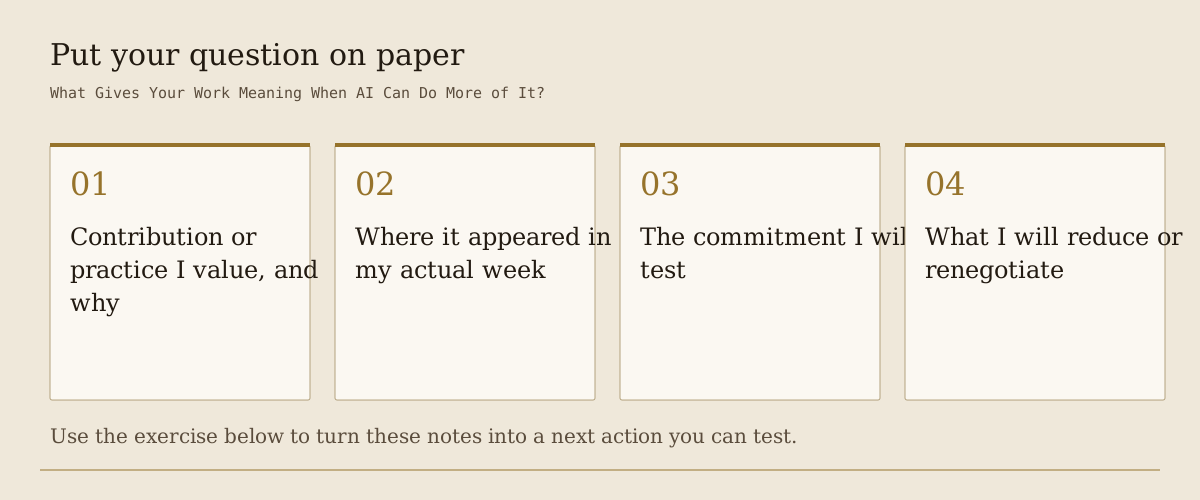
Contribution or practice I value, and why: 'I want to help a colleague make a recommendation they understand. I also want to draw because I enjoy looking carefully and making choices myself. I don't need drawing to become an income source.'
Where it appeared in my actual week: 'I corrected several documents, but I didn't discuss anyone's reasoning. My drawing materials stayed in a drawer. Those observations describe this week; they don't prove why I made those choices.'
The commitment I will test: 'On Thursday after work, I will draw one ordinary object for forty minutes using materials I already own. Completion means making a drawing, not producing something good enough to share. For this first trial I am choosing creative practice; mentoring will remain a separate decision.'
What I will reduce or renegotiate: 'I will move optional browsing about new tools out of that period. I will tell the person I share the evening with about the arrangement so it doesn't quietly become their burden. If the time conflicts with an existing commitment, I will choose another agreed slot before starting.'
Limits and stopping conditions: 'No new equipment or course purchase. I will stop at forty minutes. I will revise the timing if it interferes with an agreed responsibility. A disappointing drawing isn't a stopping condition because the aim is direct practice.'
Review date, observations, and next decision: 'I will enter a specific Friday review appointment in my calendar. I will record whether I drew, whether I began browsing instead, and whether I want another session. If I postponed, I will examine the actual constraint and the choice I made before adding a larger plan.'
Morgan hasn't declared a new purpose or solved her career. She has made a contribution to her own week that she can inspect. If she keeps delaying despite understanding the options, that repeated behavior becomes a specific subject for reflection.
A question about meaningful work can be difficult to answer while you're rushing through the same week. AI and the Andes Retreat gives you five days in Peru's Sacred Valley to bring that question into practical inquiry: how are you behaving, what is driving that behavior, and what action would let you test a different direction? You may find your own answer through that work. You carry the action home, with support and accountability continuing after the seminar.
Your working notes
Use this page while you think. Your notes stay in this browser tab; download them before you close it.
What does this question change for you?
A practical answer can change how you work. It can also leave a personal decision unresolved: what to learn, what to stop postponing, or which responsibility to take next. Name that decision before collecting another prediction.
Work through your next decision. Your notes stay in the browser tab, and the exercise gives you no predictive score.
If a recurring pattern keeps preventing action, AI and the Andes Retreat offers five days of practical inquiry in Peru's Sacred Valley, followed by support and accountability. Read about the seminar and assess whether that work fits your question.
Frequently asked questions
Search research, audience discussions, and the existing seminar FAQ library informed these questions. Some wording has been adapted to this guide.
What can humans do that AI can't do?
Ask about a particular task, system, setting, and standard. The evidence here doesn't establish a permanent list of exclusive human abilities. The OECD's practitioner interviews describe deployment problems and human checkpoints, but those aren't guarantees of lasting job protection. For meaning, ask what you want to participate in and accept responsibility for. You can choose a relationship, craft, or contribution without proving that no machine could ever assist with it.
Will humans become obsolete due to AI?
The premise treats people as though their value were exhausted by producing marketable tasks. That is a philosophical position you don't have to accept. The ILO exposure index concerns potential changes to occupational tasks, not the worth of human beings or a complete replacement forecast. Employment changes can matter greatly. They still don't determine whether relationships, chosen responsibilities, creative practice, or participation in a community are meaningful to you.
Does using AI decrease creativity?
The research reviewed here cannot establish a general increase or decrease in creativity across people and activities. Examine what you are actually doing: choosing among ideas, developing an interpretation, accepting a finished output, or practicing a craft. Assistance could support one aim while removing another activity you value. Try a bounded comparison of your process and ability to explain the choices. Treat that as personal information, rather than proof about creativity everywhere or a scientific score.
How could AI use interfere with my creative practice?
It could interfere if you delegate the part you wanted to practice, accept a direction before considering your own, or spend your available making time comparing tools. These are possible practical failure modes, not measured universal effects. Name the activity you want to preserve, such as composing, drawing, or interpreting. Reserve a small independent session and review whether assistance served that aim. If the central experience disappeared, revise the process rather than declaring all AI use harmful.
How can AI be used creatively?
You could test it as a source of questions, possible structures, or alternatives to assess, while keeping the central creative decisions visible. Choose a tool suited to a bounded task and verify factual material when accuracy matters. Before starting, decide whether your aim is a finished result, exploration, or practice. Afterward, ask which choices you made and which you accepted. A polished artifact alone doesn't show that the process expressed what you intended or developed an ability.
How can I choose between creative work and an AI-related career, or combine them?
Separate the work that supports your obligations from the creative practice you want and the commercial direction you want to investigate. Test actual activities before adopting a new title. Combining paths may fit, but it can also produce an unsustainable week. The source comment establishes this as an observed question, not evidence of either career's prospects. Review your experiment against time, competence, enjoyment, and real requirements before making a larger commitment.
How do I find meaning in my career?
Look at actual activities before judging the career as a whole. Which results do you care about, which practices do you enjoy, and which responsibilities are you willing to carry? Identify a contribution with a real beneficiary and compare it with how your week is arranged. You might need a different task mix, a conversation about your role, or meaning elsewhere in life. Don't assume dissatisfaction automatically requires resignation. Test one change and review its practical effect.
How can I detach my self-worth from my work?
Begin by distinguishing a work result from a conclusion about your whole person. You can care about quality, correct mistakes, and pursue success without treating every output as a complete verdict on your value. Choose another commitment you want to express, then give it a realistic place in your week. This is an ordinary reflection practice, not treatment or a guaranteed psychological change. If the issue extends beyond work reflection, appropriate professional support may be more useful.
How can I keep my job title from carrying my entire identity?
Add a specific relationship or practice you want to sustain rather than trying to renounce your career. You might remain a committed executive while also being a dependable friend or an amateur musician. Those descriptions need some actual expression to become useful. Pick one action, identify what it displaces, and review whether you kept it. You don't need equal time for every role. The question is whether work leaves room for commitments you say matter.
Can I pursue success while changing how I relate to achievement?
Yes, those aims can coexist. You can retain demanding standards and ambition while questioning what you expect a result to establish about you. Be specific: perhaps you want to accept useful assistance, stop rewriting adequate work, or protect a relationship during a busy period. Test the behavior without promising that your performance will improve. Changing your relationship to achievement doesn't require lowering every goal, and continued ambition doesn't prevent you from examining a recurring intention-action gap.
How do I distinguish ambition from needing output to establish my worth?
Notice what you ask a result to provide. Wanting to accomplish something difficult is an ambition. Treating a slow or disappointing week as evidence that you are no longer worth knowing is a broader conclusion. This distinction is a reflection prompt, not a diagnosis. Examine a specific response: what did you tell yourself, and what did you do next? You can keep the goal while deciding whether you want that conclusion to govern your behavior.
Why can questions about meaning remain after professional success?
A successful career may have met important goals without answering every question about how you want to live. You might value the achievement and still want a different activity, relationship, or contribution in your week. That's one possibility, not a universal explanation for successful people. Examine what you expected the result to provide and what remains unanswered. The next step may be a modest change in commitments rather than rejecting everything you have built or pursuing a larger achievement.
Why can a changing professional role reopen questions about what I want?
A role may have supplied a familiar set of aims, activities, and expectations. When those change, you may need to choose again which parts you value. That doesn't establish a crisis or a hidden psychological cause. Ask what changed specifically: the tasks, the recognition, the relationships, or the responsibility. Then identify the decision it creates. A useful answer could be preserving a craft, developing a new task, or giving another commitment room while continuing your career.
What is the difference between primary purpose and secondary purpose?
In Florian's teaching model, primary purpose concerns who you are underneath your job title, role, and habits. Secondary purpose concerns how you express that through your actual work and decisions. You examine the first through self-observation; you test the second through choices in ordinary life. This is a teaching distinction, not an established scientific classification. Its practical use is to help you ask whether a changing job has altered what you do, what matters to you, or both.
How do I find my purpose outside of work?
Choose a relationship, practice, or contribution you want to give attention to, then test a small commitment. It might involve a friend, family responsibility, creative activity, or useful work in your community. You don't have to find one grand mission before participating. Check whether you want the actual activity and what it costs your week. Meaning outside work can coexist with a demanding career. The first task is giving one chosen commitment some real expression.
How can I make room for a life outside work?
Identify a specific commitment and the work boundary it requires. If it receives only leftover time, ask when that time would realistically exist. You may need to decline an optional request, negotiate an availability expectation, or choose a smaller activity. Include caregiving and other constraints honestly. The aim isn't an ideal balance or an additional list of achievements. It is a workable arrangement that gives attention to something you value and respects the people affected by it.
Why do I feel I have no purpose in life?
A sentence like this doesn't identify its cause. You may be questioning a direction, missing activities you value, facing a change, or experiencing something broader than a work decision. Begin with what you can describe specifically: what feels absent, when it appears, and which commitment you want to test. You don't need to force a universal answer. If the feeling is persistent, distressing, or interfering with everyday functioning, appropriate professional help may fit better than purpose reflection alone.
Do I need a final answer about purpose before taking a next step?
No final theory is required for a small, responsible trial. You can choose a useful contribution, protect a creative session, or investigate a role while remaining uncertain about larger questions. Set limits and a review date so the action doesn't become an indefinite obligation. This doesn't mean every major decision should be rushed. A reversible commitment can provide information; a resignation or substantial expense deserves a fuller assessment of consequences and practical conditions.
How do I decide which job to choose when meaning matters?
Compare actual activities, requirements, responsibilities, and conditions, alongside what you want the work to express. A title can sound meaningful while its ordinary tasks don't fit your preferences. Investigate through conversations or a bounded experience where possible. Include financial obligations and competence honestly. AI headlines cannot settle the choice. The career-change guide addresses the larger decision; this article helps clarify the contribution you want to preserve within it.
Should I leave a successful career to find more meaningful work?
You can investigate meaning without making resignation the first experiment. Name what is missing, then test a change within or alongside your current work if that is feasible. Check your obligations before considering a break. A different job may change your daily activities; it may also leave the same behavior or expectation untouched. Neither a stranger's success story nor an AI recommendation can establish what your next chapter should be. Give yourself evidence from a real experiment and a decision you can explain.
Sources and evidence
These guides were drafted with AI assistance and checked against the linked sources. Examples labeled hypothetical illustrate a decision; they are not participant stories or measured results.
Studies answer specific questions about particular people, tasks, and tools. Their dates and limits matter. A result about task assistance is not a forecast for an entire profession.
- Generative AI and Jobs: A Refined Global Index of Occupational Exposure
- Skills in the AI age
- Employment Projections and Occupational Outlook Handbook: 2025-2035
- Agentic AI in organisations: Early insights from practitioner interviews
- How AI Impacts Skill Formation, arXiv version 2
- Nick Saraev: What I'd Learn Instead of Automation in 2026
- Nick Saraev: The most important video you'll ever watch in the age of AI
- Observed public comment question about creative work and an AI-related career
- Observed public comment question about beginning despite fear of judgment
- The SoulSearching Experience: confirmed offer facts supplied in the packet
- How Do You Find Your Purpose? A Practical Guide to the Two Kinds You Actually Have
- Why Is My Worth Tied to What I Produce? Conditional Self-Worth, and Why It Moves With the Scoreboard
- How Do You Find Your Purpose? A Practical Guide to the Two Kinds You Actually Have
- Why Is Nothing I Achieve Ever Enough? The Gap Between Finishing and Starting Again
- Canonical seminar FAQ: Why do I keep controlling details I have already delegated?
- Canonical seminar FAQ: Does being happy mean giving up my ambitions?
- I Have What I Said I Wanted. Why Does None of It Mean Anything? The Private Scorecard Nobody Chose
- Canonical seminar FAQ: What is the difference between feeling lost and not knowing your purpose?
- Canonical seminar question: What about decisions I cannot reverse?
- Canonical seminar FAQ: How do I start over in my career?
- Canonical seminar FAQ: Why do I put off decisions that have no obviously right answer?
- Canonical seminar FAQ: Why do I feel unclear even when I already know all the facts?
- Canonical seminar FAQ: Does mental clarity stay once you have it?
- Canonical seminar FAQ: How long does it usually take to find your purpose?
Where the audience questions came from
These linked discussions and comments supplied questions and wording. They do not establish the truth of the replies, verified professional identities, or how common a concern is.