
You can be good at your work and still wonder whether the ground beneath it is moving. Perhaps your employer has introduced an AI tool. A client now expects a faster turnaround. A vacancy hasn't been filled, and someone suggests the remaining team can handle the work with assistance. Or nothing concrete has changed, but the headlines make your experience feel less dependable than it did.
The question, 'Will AI take my job?' deserves a serious answer. A blanket yes turns several uncertain steps into an inevitable outcome. A blanket no can dismiss changes that are already affecting someone's opportunities. Neither helps you decide what to do on Monday morning.
Start with a narrower distinction. A task that a system can attempt is different from a task it can perform reliably in your workplace. Reliable task performance is different from a redesigned process. A redesigned process is different from an employer deciding to reduce headcount. Those steps can connect, but the connection needs evidence.
Look first at what has changed where you work: tasks, quality standards, hiring, and who approves decisions. Then compare those observations with the research, rather than asking one forecast to settle your whole career.
You don't need to solve the future of employment before taking a useful action. You do need to know which decision you're making: whether to test a tool, ask your manager a direct question, strengthen a capability, widen your search, or reconsider a career direction. Those decisions call for different evidence.
There may also be a quieter difficulty. You understand the options, yet keep postponing the conversation or experiment that could clarify them. We'll make room for that intention-action gap without turning it into a diagnosis. The aim is a clearer assessment and an action you can actually take, with a stopping condition and a review date.
Does AI exposure mean your job will disappear?
Exposure means that some tasks in an occupation could be affected by a technology. It doesn't tell you whether an employer will adopt that technology, whether the work will become cheaper after checking and integration, or whether a position will disappear. The ILO and NASK's May 2025 exposure research explicitly concerns potential task change. Continued human input makes transformation an important possible outcome.
That distinction matters because a job is a bundle of tasks and responsibilities. You may draft reports, interpret conflicting information, negotiate priorities, notice an exception, explain a decision, and remain accountable when something goes wrong. A system's ability to draft a report addresses one part of that bundle. It doesn't establish that the organization can remove everything else, or distribute it without cost.
Separate four employment questions. Layoffs concern people leaving existing positions. Reduced hiring concerns fewer people entering positions. Wage changes concern what work pays. Task reorganization concerns what people do while employed. You can experience any one without the others. A team might stop hiring while retaining everyone currently employed. Another might keep its staffing and expect more output. A third might redirect saved time toward unresolved customer problems.
These are conditional examples, not claims about what your employer will do. Their purpose is to make the uncertainty specific. If you're already employed, a hiring slowdown and a layoff notice have different immediate implications. If you're applying for work, reduced hiring can matter deeply even when existing staff remain in place. An assessment that looks only for mass layoffs can miss a change that affects your next opportunity.
Also distinguish capability from a business decision. Suppose an AI tool produces a usable first draft. Someone must decide whether the draft meets the actual need, whether information may be shared with the tool, and whether review is economical. The organization must then decide how to use any released capacity. It could expand service, shorten delivery, reduce outside spending, reorganize roles, or reduce staffing. None follows automatically from the draft.
A more useful version of your original question is therefore: which parts of my work could be assisted, delegated, or reorganized, and what would my employer have to decide before that affected my position? Write down the answer you currently have, including what you don't know. That gives you a starting point for inquiry. It also prevents a plausible technical demonstration from quietly becoming a personal employment forecast.
What can exposure indexes and occupational forecasts actually tell you?
The ILO and NASK refined global index, published May 20, 2025, estimates that about one quarter of workers globally hold occupations with some potential exposure to generative AI. Its approach combines task assessments, expert judgment, and AI predictions across nearly 30,000 tasks. That is a broad view of technical exposure, not a statement that one quarter of workers will lose their jobs.
Read the denominator carefully. The finding concerns workers in occupations with some exposed tasks. It doesn't mean that every task in those occupations is exposed, that all employers will adopt AI, or that the affected work will become fully autonomous. The assessments reflect 2025 technology and occupational classifications. They can help you notice areas worth examining, but they can't provide your employer's deployment timetable.
Official employment projections answer another question. The Bureau of Labor Statistics' August 27, 2026 release for 2025–2035 presents a conditional scenario under stated assumptions. Its methodology broadly assumes technological progress follows historical patterns and treats exceptional technology adjustments conservatively. BLS acknowledges that exceptionally rapid technological change could undermine historical relationships used in projections.
You can use projections as one part of a decision without treating them as a guarantee. They help frame an occupation within a larger demand picture. Your own assessment should then ask what employers require, which tasks are changing, how your experience fits, and what evidence comes from actual workplaces. A favorable occupational projection doesn't protect a particular position. An unfavorable one doesn't establish that your next move must fail.
Consider the difference between two readers with the same title. One works in an organization with fragmented records, strict review requirements, and unresolved deployment permissions. The other works with a standardized process and an approved system already being tested. An occupation-level measure may place them in the same category while missing the decisions that determine their immediate exposure. This is an editorial illustration of why local context belongs beside broad research.
When you encounter a forecast, ask what it measures, which period it covers, and what assumptions connect the evidence to the conclusion. A replacement year without those details is a weak basis for a major decision. You don't have to dismiss projections altogether. Give them the job they can reasonably do: inform scenarios, identify questions, and suggest what to monitor. They can't settle whether you should resign, retrain, or remain in a specific workplace.
What could you keep doing as the tasks change?
CareerNextPivot starts with a person's role and then connects it to possible next moves. Its task-level perspective is a useful starting question for an experienced professional.
Try describing your work without the title. Which decisions do other people rely on you to make? What information do you reconcile before recommending something? What goes wrong when an output looks correct but its assumptions do not match the business?
That description helps you distinguish a task becoming easier from a responsibility disappearing. The ILO's exposure research examines tasks and occupations; an exposure classification does not calculate your personal probability of losing a job. Your employer's choices, demand for the work, data permissions and implementation conditions still matter. Read the study and its scope.
A constructed finance example
Suppose you oversee a monthly performance report. An AI tool can produce a first narrative from supplied totals. The question for your role is what happens between that draft and a decision the business can defend. Someone must check the entity and reporting period, reconcile conflicting inputs, distinguish a calculation from an explanation, and decide which unresolved claim should reach the board.
Write the draft-preparation task on one row and the approval responsibility on another. Next to each, record a specific observation you could make. For preparation, compare the work needed to produce a usable draft. For approval, ask whether the review catches a deliberately missing input or an unsupported cause. Preserve the review time. A faster first draft alone does not establish that the overall workflow improves.
Give the opportunity a boundary
An adjacent opportunity could be improving that review process in the same role, rather than seeking a different title immediately. It could also be a different responsibility or employer. Treat each as an option to investigate, with its own evidence. Continuing responsibilities do not guarantee continuing headcount, and a role map cannot settle a particular employer's staffing decision.
Download the career-experiment planner. Its examples are constructed. Use the blank row to record the task, the responsibility you retain, and the observation that would change your next step.
Why do the Stanford and Danish findings sound so different?
Different studies can describe different parts of the same changing situation. The Stanford Digital Economy Lab paper revised August 12, 2026, using payroll data through June 2026, found no widespread economy-level displacement in its evidence. It also reported that employment among 22–25-year-olds in exposed occupations was 19% below a benchmark based on less-exposed peers. The divergence primarily involved reduced hiring.
That finding deserves attention, especially if you're seeking an initial opportunity. It must also retain its limits. The authors describe indicators rather than causal estimates of jobs lost to AI. Education controls attenuate the findings, some divergent trends predate generative AI, and the ADP payroll patterns are stronger than national survey benchmarks. The relative gap does not mean that 19% of all young workers lost jobs.
The Danish study revised March 13, 2026 links adoption surveys with administrative labor records. In the exposed occupations studied, it found substantial work reorganization but no measurable average changes in earnings or recorded hours over its observed horizon. Its estimates ruled out average effects larger than 2% two years after ChatGPT's launch. Administrative outcomes ran through December 2024, an earlier endpoint than the Stanford analysis.
The Danish result doesn't prove that AI has no employment consequences. It concerns a particular country, set of occupations, technology period, and research design. Its difference-in-differences approach also depends on identification assumptions. Conversely, the Stanford result doesn't prove that AI caused every employment difference it observed. You can take both seriously without forcing either into a universal verdict.
For your decision, ask which outcome resembles the issue you face. If your employer is changing responsibilities but retaining staff, the Danish evidence helps explain why visible task changes need not immediately produce average pay or hours changes. If you're struggling to enter an exposed occupation, the Stanford finding gives a reason to investigate hiring conditions directly. Neither provides a personal probability of unemployment.
The practical interpretation is to monitor several channels at once. Look at vacancies and entry routes, your team's actual staffing decisions, changes in responsibilities, and the way work is evaluated. A new responsibility may appear before a title changes. A missing vacancy may matter before a layoff occurs. Conflicting headlines become less confusing when you keep the country, population, observation period, and measured outcome attached to each finding.

Is every employer already reorganizing work around AI?
A powerful demonstration tells you what a system attempted under particular conditions. Adoption evidence asks whether businesses are using AI in ordinary work. In the Census Bureau study covering November 2025 through January 2026, 18% of firms reported AI use in a business function, or 32% when weighted by employment. Adoption differed sharply by firm size and sector, and many adopters used it in only a few functions or tasks.
Those figures describe that reference period. They aren't an October 2026 adoption estimate. The survey question broadened in November 2025 from production to any business function, so earlier percentages aren't directly comparable. The analysis also distinguishes workers using tools from formal firm adoption. An employee experimenting with a chatbot and an organization redesigning an approved workflow are different measures.
This gives you a reason to ask local questions rather than assume your employer is moving at the speed of the most dramatic demonstration. What system has actually been approved? Which team uses it? Does it produce internal drafts, recommend actions, or execute them? Is the organization observing results or merely distributing licenses? These distinctions help you understand the change you're preparing for.
A conditional sequence might begin with individual assistance, proceed to a shared pilot, and then reach a redesigned workflow. But an organization could stop at any stage, change direction, or choose a different process. Permission, source information, review capacity, and responsibility all need attention. These are assessment questions, not a claim that every business follows a predictable adoption ladder.
Early organizational evidence reinforces the need for specificity. The OECD's September 16, 2026 interview study describes deployments and pilots across 25 organizations already involved with agents. Practitioners reported problems with unpredictable behavior, incorrect actions, traceability, and accountability. Gradual autonomy, human checkpoints, and domain experts were common responses. The purposive sample is illustrative, not representative, and doesn't independently validate economic outcomes.
If your employer has made a real deployment decision, treat that as relevant evidence even if broad adoption remains uneven. If no one can explain the intended workflow, don't fill the silence with certainty. Ask for the information, document the answer, and set a date to revisit it. Your immediate planning should respond to actual changes in access, responsibility, staffing, and evaluation, while leaving room for developments the organization hasn't yet decided.
How do you assess your actual tasks instead of your job title?
Begin with work you've recently done. Your title may be too broad, your formal description too polished, and your memory too focused on the tasks you enjoy. Review a recent ordinary working week and a less routine period. Identify what you produced, the conversations required, the exceptions handled, and the decisions someone expected you to own. Don't put confidential records into an unapproved tool to make this inventory.
Write tasks at a useful level of detail. 'Manage projects' conceals too much. 'Prepare a status summary from approved updates' can be examined. So can 'resolve a disagreement about whether a deliverable meets the client's requirement.' Separate preparation from judgment and authorization. A task may contain a draftable portion alongside a decision you aren't permitted to delegate.
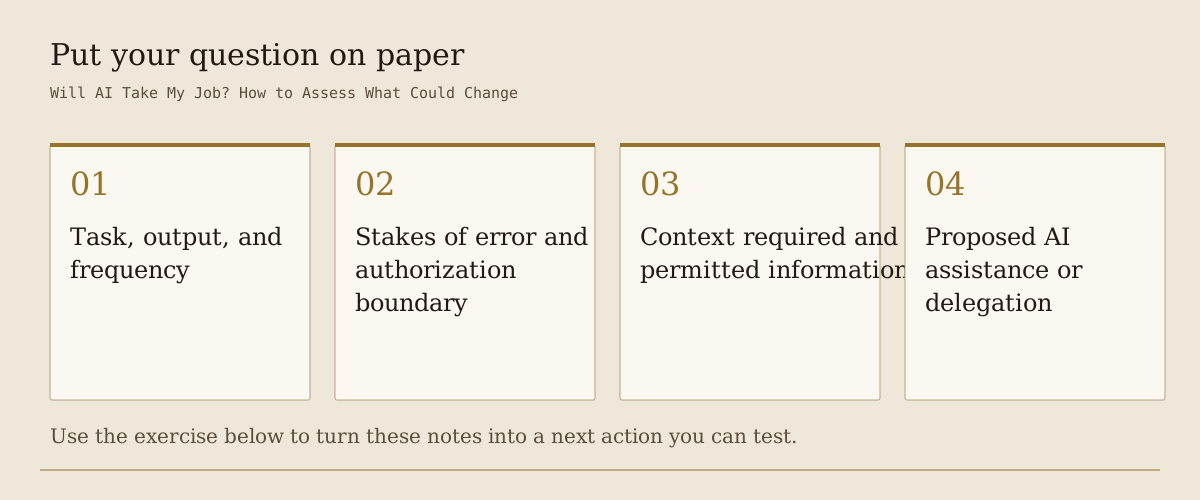
For each task, record frequency, stakes of error, contextual knowledge, possible AI assistance, human verification, and a safe pilot. Frequency tells you whether an improvement would matter repeatedly. Stakes tell you what a mistake could affect. Context tells you what information is needed beyond the visible input. Verification tells you whether someone can independently establish that the result is acceptable. The pilot makes the assessment actionable.
Use plain descriptions instead of a numerical replacement score. An infrequent approval may carry more responsibility than a daily summary. A task that appears simple may involve information you can't share. Another may be repetitive but difficult to verify because the source records are inconsistent. Turning those differences into a single percentage can conceal exactly what you need to understand.
Include the surrounding work. Who supplies the inputs? Who explains the result? Who handles disagreement or an exception? Who repairs an error after it reaches another team? If a tool helps with execution but leaves those responsibilities intact, your role could change rather than disappear. If several tasks become reliably delegated and the remaining responsibilities can be redistributed, a staffing change becomes a scenario worth examining. It still requires an organizational decision.
Finally, keep the inventory small enough to use. Start with the tasks that consume meaningful time or carry important responsibility, then add what the first pass missed. Mark unknowns openly. 'I don't know how this would be checked' is a useful finding. 'My job is 63% replaceable' would imply a precision this reflection tool doesn't have. The inventory should help you select a conversation or test, not deliver a verdict on your future.
When does assistance become delegation, and what still needs verification?
Assistance means you remain closely involved while a tool helps with part of a task. Delegation means you assign a defined task and assess the returned work. Automation can go further by executing steps within an approved process. These are practical distinctions for your inventory, not universal technical classifications. The important question is what the system is allowed to do before a person checks the result.
Consider a proposed customer email. Asking for alternative wording is assistance. Asking for a complete draft based on approved information is bounded delegation. Allowing a system to send the message or change an account introduces execution authority. The risks differ even if the underlying text generation looks similar. Your assessment should identify the point where an output becomes a commitment, an external communication, or a change to a record.
Verification needs more than reading an answer and finding it plausible. Define what would establish correctness. For a factual summary, compare claims with the underlying source. For a calculation, reproduce the important arithmetic and examine inputs. For a recommendation, check assumptions and credible alternatives. For an action, confirm that it was authorized and that the result matches the intended scope. These are editorial testing suggestions, not a certification method.
The OECD's 2026 practitioner interviews describe human checkpoints and domain-expert involvement in response to agent limitations. That doesn't mean every checkpoint is effective. A reviewer needs the competence, access, and time to inspect what matters. If the person approving the result can't explain why it's acceptable, putting a human at the end of the process hasn't resolved the central uncertainty.
Review also has a cost. A task may be faster to generate and slower to establish as correct. Or the tool may move effort from creation into exception handling. Count the full process when you run a pilot: preparation, generation, checking, correction, communication, and any later rework. A shorter drafting stage alone doesn't demonstrate that the entire workflow improved.
Choose stopping conditions before expanding authority. Stop if the tool uses information outside the approved scope, changes something it wasn't authorized to change, produces an error the reviewer can't reliably detect, or leaves no adequate way to trace the result. You can narrow the task or return to the earlier process. The purpose is to learn where assistance is useful and where responsibility requires a different arrangement, without assuming that more autonomy is always better.
Why might entry-level opportunities change before experienced positions?
If you're beginning a career or starting again, reassurance about currently employed professionals may miss your concern. You need an employer to create or maintain an entry route. The Stanford paper revised in August 2026 reports a relative employment gap among 22–25-year-olds in exposed occupations, primarily involving reduced hiring. Experienced workers didn't show a comparable gap in that evidence. This is a serious descriptive signal, not a causal verdict or a guarantee for experienced staff.
One conditional scenario is that an employer delegates parts of routine preparatory work and hires fewer people to perform them. Another is that assistance helps newer workers become useful sooner and supports hiring. Which scenario applies depends on the actual workflow and the employer's decision. The evidence doesn't permit you to classify every young worker, career changer, or returning professional as having the same prospects.
There is evidence for the assistance possibility. In the published customer-support field study, access to an AI assistant increased issues resolved per hour by 15% on average among 5,172 agents. Less experienced and lower-skilled agents benefited more. Experienced high performers had smaller speed gains and some quality tradeoffs. That result concerns one firm, tool, and occupation, using technology from an earlier period.
The support study and hiring evidence answer different questions. A tool can help a newcomer perform a task while an employer chooses to hire fewer newcomers. Improved task performance doesn't automatically create an opening. Equally, reduced hiring in one dataset doesn't establish that training has become pointless. Keep the performance question and the opportunity question separate so you can act on both.
When investigating an entry route, ask what newcomers are expected to learn and how they'll demonstrate it. Does the employer provide supervised work, feedback, and opportunities to understand the underlying process? Is there a path from assisted output to independent judgment? You can ask these questions in interviews or professional conversations without pretending you already know the organization's answer.
For a career changer, distinguish lack of experience in the new field from experience you can transfer. You may know how to clarify a request, coordinate stakeholders, or take responsibility for a deadline while still needing substantial domain training. Show both honestly. A useful preparation plan combines evidence of relevant work with a realistic search for opportunities. It doesn't rely on your age as either a sentence or a shield.

What changes for accounting and other professional work?
Professional work is a useful place to test the difference between executing a task and carrying responsibility. The published 2026 accounting study by Choi and Xie combines a survey of 277 accountants with platform records from 79 U.S. small and medium businesses. The transaction records cover January 2023 through March 2025. Adoption was associated with productivity changes and a shift from routine entry toward communication and quality assurance.
The study also found more granular records and faster close processes, while accountants intervened more when AI confidence was low. A framed classification experiment showed average improvement alongside possible error from overreliance on nonconsensus recommendations. These findings don't establish full-workflow causality, a universal savings figure, or the disappearance of accountants. They show why an assessment should include review and communication as well as routine entry.
Finance leadership involves a broader bundle. The O*NET financial-manager profile includes reports, budgets, cash flow, supervision, controls, and communicating financial information. The treasurer and controller profile includes disbursement authority, statements, audits, and staff training. These are descriptive task profiles, not evidence that any responsibility is permanently beyond AI. They help you avoid assessing the role from transaction classification alone.
Legal work illustrates an additional boundary: professional obligations. ABA Formal Opinion 512, issued July 29, 2024, applies competence, confidentiality, communication, supervision, candor, and reasonable-fee obligations to generative AI use. Assistance doesn't remove the lawyer's responsibility to evaluate and verify work. The opinion interprets Model Rules and isn't binding law everywhere; applicable jurisdictional requirements still need checking.
For either field, a sensible pilot separates draft preparation from decisions and approvals. An approved finance tool might help prepare an explanation that someone reconciles to source records. An approved legal tool might help develop a research starting point that someone checks against original authorities. Whether either use is appropriate depends on the specific work, permissions, and governing requirements. These examples are workflow suggestions, not financial or legal advice.
If your question concerns professional responsibility in depth, continue with the finance-leadership article or the article for experienced attorneys. Here, the decision remains narrower: identify which tasks could change and who must retain authority, context, and verification. A professional title doesn't establish immunity, and successful task assistance doesn't establish whole-role replacement.
Can AI replace managers, consultants, or executive judgment?
A management role can contain work that is readily described and work that is difficult to settle from documents alone. Preparing an agenda is different from deciding which disagreement needs attention. Summarizing updates is different from choosing a priority when two teams cannot both receive the resources they requested. Assess each part without assuming that all judgment is immune or that a polished recommendation settles the decision.
The O*NET chief-executive profile describes policy, strategic direction, resource allocation, budgets, operations, and stakeholder accountability. Reported titles include CFO and CTO, although the profile spans many organizations and sectors. Its task data were updated in 2023. The description helps identify responsibilities to inventory; it doesn't measure AI performance or prove enduring human exclusivity.
Consulting research gives a concrete reason to examine task differences. The field experiment published in Organization Science in March 2026 involved 758 BCG individual-contributor consultants using GPT-4 in June 2023. On 18 tasks within the assessed capability frontier, AI users completed more tasks, worked faster, and produced higher assessed quality. On the task outside that frontier, consultants had to recommend which brand had the greatest growth potential, using financial data alongside details from company interviews. Reading the spreadsheet alone could mislead. AI assistance reduced the likelihood of a correct solution on that specific task.
The capability frontier means the boundary of tasks the tested system handled well under the study conditions. It wasn't a clean division between all creative work and all analytical work. Only one outside-frontier task was tested. The study doesn't establish partner replacement, client demand, fee changes, or profitability. Its practical lesson is that confidence based on one successful task shouldn't silently transfer to a materially different task.
For a manager, ask what a proposed tool would remove and what it would leave. If it drafts status reports, would you spend less time collecting updates, or more time resolving inconsistencies? If it recommends priorities, who supplies the criteria and answers for the tradeoffs? If the organization redistributes coordination responsibilities, what happens to training and escalation? These questions concern the actual design of work rather than the title alone.
A move toward advisory work can be sensible when you have evidence that someone needs and values your judgment. It isn't automatically safer than implementation. Advisors must still understand the problem, substantiate recommendations, and help decisions survive execution. For a deeper examination of that commercial and professional question, read the article on experienced consultants. Here, resist replacing one broad label with another before you've tested the work and its demand.
Does faster code generation mean software experience matters less?
Code generation is an important part of software work, but it isn't the entire role. The O*NET software-developer profile includes understanding user needs, requirements, design constraints, specifications, testing, integration, maintenance, and coordination. Its task data were updated in 2025. That descriptive bundle provides a better starting point than counting how much code a system can produce.
There is published experimental evidence of useful assistance. The Management Science study published February 27, 2026 combines three randomized code-completion experiments involving 4,867 developers. The pooled estimate was a 26.08% increase in completed tasks, with a 10.3 percentage-point standard error. Less-experienced developers adopted more and showed larger gains. The individual experiments were noisy and differed, and some authors had participating-company affiliations.
That estimate doesn't describe autonomous delivery, system quality, firm profit, or the displacement of technical leadership. It also doesn't guarantee a gain for your tasks. For a pilot, count time through accepted completion, including review, tests, integration, and rework. Decide in advance what quality would make a faster result unacceptable. A completed task can be valuable, but only if 'completed' means something relevant to the system you maintain.
Evidence can also become outdated. METR's February 24, 2026 experiment update cautions against treating its specific early-2025 experienced-developer slowdown as today's general effect. Follow-up evidence suggested improved productivity, but participant and task selection, together with concurrent-agent time measurement, made the estimates unreliable. Neither a historical slowdown nor a biased follow-up provides a universal current percentage.
Qualitative work adds another perspective. DORA's March 2026 analysis of 1,110 open-ended responses from Google engineers described faster generation alongside auditing and verification effort. The responses concern Q3 2025 and aren't causal productivity evidence. They give a practical reason to distinguish a rapid prototype from production readiness when defining your own test.
If you're experienced, the useful question is what your experience enables you to specify, detect, explain, and repair as generation changes. Don't assume those abilities preserve your position automatically. Demonstrate how they contribute to accepted work. If you're learning, don't abandon understanding because an output appears quickly. The more detailed senior-software-engineering article examines production ownership and team capability. Your immediate assessment should stay with a bounded task and an honest end-to-end comparison.
Hypothetical example: an experienced business analyst examines a changing role
This example is hypothetical. An experienced business analyst works between an operations team and a software team. She collects requirements, drafts process descriptions, clarifies disputed terms, and checks whether delivered changes meet the agreed need. Her employer approves a limited AI drafting pilot. She hears that requirements documents can now be generated quickly and wonders whether the organization still needs her position.
She begins by separating the document from the work required to make it useful. A draft based on confirmed notes is one task. Discovering that two stakeholders mean different things by 'completed order' is another. Establishing who has authority to resolve that difference is another. Checking whether the delivered change handles the agreed exception is another. She doesn't call any of these permanently human tasks. She asks what the proposed process actually covers.
For the pilot, she chooses a draft process description from already approved, nonconfidential training material. The safe scope excludes live customer records and changes to production systems. Her comparison includes preparing inputs, checking statements against the material, resolving omissions, and explaining the result. She defines an acceptable document as one whose requirements can be traced to the source and whose uncertainties remain visible.
She also asks her manager a question the tool can't answer: what would the organization do if preparation became faster? The manager might want shorter delivery, more projects, different staffing, or a broader role for the analyst. In this hypothetical case, that decision has not yet been made. The analyst records the uncertainty rather than assuming either dismissal or protection. A conversation about planned responsibilities becomes part of the assessment.
Her stopping conditions are concrete. She pauses the pilot if the draft invents a requirement, conceals disagreement, or cannot be traced to approved information. She also stops if the task would require unapproved data. The review date is set for two working weeks after the first permitted trial. At that review she will examine accepted output, checking effort, unresolved errors, and the employer's response about role design.
The possible next moves remain open. If assistance proves useful, she could propose a role that spends less time formatting and more time clarifying needs and evaluating delivery. If the employer intends to reduce positions, she could begin a broader search while still employed. If the pilot is unsuitable, she can retain the earlier process. The value of the exercise is that she now has specific evidence to seek and decisions to make, rather than a title-based prediction.

Hypothetical example and counterexample: a controller tests assistance without giving away approval
This example is hypothetical. A controller in a small business wants to reduce time spent preparing monthly explanations. The team already has approved source records and a review process. A colleague proposes using AI to draft variance explanations, then suggests going further and allowing it to resolve unusual invoices automatically. Both ideas sound like relief from repetitive work, but they involve different authority and consequences.
The controller inventories preparation, reconciliation, exception investigation, approval, and communication separately. The proposed first pilot concerns a draft explanation based on approved information. It doesn't alter records or authorize payment. The controller will compare each factual statement with the source, check calculations, and distinguish a recorded change from an explanation of its cause. If the evidence doesn't establish the cause, the draft must say what remains unknown.
The attractive recommendation would be to automate invoice approval because the task appears frequent and tedious. In this case, that would be the wrong next move. The hypothetical business has unresolved discrepancies and no agreed method for independently checking the unusual items. Moving from suggestions to approvals would give the system authority before the organization had settled the verification process. Convenience doesn't answer that problem.
This counterexample doesn't establish that invoice automation is always inappropriate. It shows why frequency alone isn't a sufficient selection rule. A well-defined, approved process with suitable controls could produce a different assessment. Here, the stopping condition is already met: the responsible reviewer cannot establish a dependable way to verify the proposed automatic decisions. The controller keeps approvals in the existing process and asks for the discrepancies to be resolved.
For the narrower drafting pilot, the review includes preparation time, correction time, traceability, and the usefulness of the final explanation to its intended reader. Any material unsupported statement pauses the trial for examination. The controller schedules a review after the next completed reporting cycle, with the exact date entered in the team's calendar.
This approach fits the distinction suggested by the published accounting evidence: routine work can change while communication and quality assurance remain important. It also keeps the control and approval responsibilities described in the treasurer and controller task profile visible. The controller's decision is about a management workflow. It doesn't determine an investment, tax position, or financial strategy, and it doesn't forecast the future of the profession.
What should you ask your employer, clients, or a prospective employer?
A direct conversation can clarify more than another general prediction. Begin with what has actually been decided. Ask which tasks the organization intends to assist or automate, which systems are approved, and who owns the deployment. Then ask how success will be assessed. Faster generation, accepted output, service quality, and staffing savings are different goals. If people use those terms interchangeably, ask them to make the distinction explicit.
Ask about information before trying a live task. What may be entered into the system? Which account and environment must be used? Who reviews permissions, retention, and vendor terms? What is the route for reporting an unintended disclosure or action? These are practical due-diligence questions, not a claim that a particular product is unsafe or that a specific configuration guarantees protection.
Make verification concrete. Who checks factual accuracy, calculations, completeness, and authorization? What happens when the output is uncertain or disputed? Is checking time included in the workload? What is the fallback when a system is unavailable or produces an unacceptable result? The OECD practitioner interviews make accountability and traceability relevant questions, while stopping short of validating any organization's controls.
Then ask about people. Will training be available? How will newcomers learn the work if some preparation changes? Does the employer expect different responsibilities, fewer openings, or a staffing review? Your manager may not know every answer. That is still useful information. Agree on when the unknowns will be revisited instead of treating an informal reassurance as a permanent commitment.
If you're interviewing, focus on the role you're considering. Ask what an employee will own during the first months, how assisted work is reviewed, and how performance is assessed. You don't need to interrogate every interviewer about the entire company's future. You do need enough information to understand whether the proposed position includes a credible learning path and responsibilities you can realistically fulfill.
With clients, clarify what they are buying and what remains your responsibility. If they expect a faster result, discuss the approved inputs, review, and acceptance criteria. Don't imply that a lower drafting cost automatically removes the effort needed to establish correctness. Likewise, don't use professional responsibility as a vague justification for unchanged work. Explain the actual process. Record important agreements, schedule a review when the workflow changes, and let the conversation inform your next action.
What can you do before making a large career decision?
You may have enough evidence to act without having enough to resign or retrain extensively. Start by naming the decision and its deadline. Testing an approved task, updating a work sample, and speaking with a prospective employer are smaller commitments than leaving a profession. A reversible action can reveal information you currently lack while preserving options. It isn't a promise that waiting is always best.
If there is an announced staffing change, a formal notice, or a loss of client work, respond to that actual situation. You don't need to wait for a perfect causal explanation of AI's contribution. Clarify immediate obligations, available support, and the next employment or client conversations. Broad research helps with interpretation, but your current circumstances should guide the urgency of practical preparation.
For learning, select a capability tied to a task you want to perform better. The OECD's July 2026 skills synthesis distinguishes foundational skills, ICT skills, and complementary abilities such as problem solving, communication, creativity, and collaboration. AI literacy includes using and critically evaluating AI; advanced engineering is a separate specialization. This isn't evidence that any particular skill guarantees employment.
Nick Saraev argues for understanding business value rather than concentrating only on tool operation. He sells education and implementation services; treat his forecasts as opinions, alongside the research and the conditions in your own workplace. his discussion of understanding business value his discussion of training and advisory work.
Take the practical question without adopting a timetable: what problem can you understand, specify, and evaluate well enough to help someone? Technical understanding may be part of the answer. So may communication or domain knowledge. Before making a larger move, use the career-change article to examine the destination and its real requirements. For a focused learning choice, read what to learn as AI changes.
Finally, notice what happens between deciding and doing. You may keep gathering forecasts while avoiding a manager conversation, a modest test, or evidence that your preferred option needs work. Describe the behavior plainly and ask what you're protecting or postponing. Then choose one action with a date. Review after two working weeks, or sooner if a concrete employment change occurs. The next section gives you a worksheet for that action, without pretending a reflection exercise can calculate your future.
Compare your options
| Arrangement | Possible task use | What you still need to establish | Responsibility to identify | Employment implication |
|---|---|---|---|---|
| Assistance | A tool suggests wording while you prepare an internal explanation. | Whether the suggestion fits the facts and saves effort after checking. | You choose and verify the final wording. | A changed method doesn't by itself establish fewer positions. |
| Bounded delegation | A system returns a draft from specified approved sources. | Completeness, traceability, omissions, and total preparation and review effort. | A named reviewer accepts, corrects, or rejects the output. | The task allocation may change; staffing remains an organizational decision. |
| Supervised execution | A system prepares an action that requires approval before it affects a record. | Correct scope, permission, approval criteria, and a usable fallback. | The approver owns the authorization and checks the relevant consequence. | Capacity could be redirected or reduced, depending on deployment and demand. |
| Automatic execution within an approved process | A system performs a defined step under established permissions and controls. | Whether exceptions can be detected, traced, and handled before unacceptable harm. | The organization assigns monitoring, escalation, and recovery ownership. | Reliable automation could support reorganization, but doesn't predict its timing or staffing outcome. |
| Workflow reorganization | Preparation becomes assisted and staff spend more time reviewing exceptions or communicating. | Whether the whole process delivers acceptable work and what new workload appears. | Someone owns the handoffs and the final outcome. | Roles can change even when headcount, hours, or pay don't immediately change. |
| No suitable deployment yet | A task requires unapproved information or lacks a workable verification method. | What must change before a permitted test is possible. | The existing owner retains the task and raises the unresolved condition. | This is a current boundary, not permanent immunity from future change. |
Use these distinctions alongside the task inventory below. They are reflection categories, not validated employment-risk scores. A proposed arrangement should be judged by its actual permissions, checking process, and consequences.
Build a task inventory and choose one safe next action
Set aside one focused session to examine a manageable group of tasks. Use your calendar, completed work, and ordinary process notes as memory aids without copying confidential material into an unapproved system. The objective is a permitted experiment or a specific conversation. You aren't calculating a replacement probability.
For every task, include frequency, stakes of error, contextual knowledge, possible AI assistance, human verification, and a safe pilot. Keep the distinctions visible even if you combine them into worksheet fields. If a task can't be checked or the information can't be used appropriately, the next action is to resolve that boundary.
A reflection tool for planning your next step, rather than a predictive score.
- List six tasks from a recent working week, plus one important exception or approval that occurred less often. Describe each as an action with an identifiable output.
- For each task, record its frequency and the concrete consequences of a mistake. Note any payment, client commitment, external communication, or consequential record change.
- Write down the contextual knowledge required: source records, prior decisions, definitions, stakeholder needs, or rules. Mark information you aren't authorized to share.
- Separate possible assistance from delegation and execution. Identify exactly what the proposed system would produce or be allowed to change.
- Name the human verifier and the independent check. If nobody can explain how correctness would be established, choose a clarification conversation before choosing a live pilot.
- Select one permitted, reversible task. Compare the existing process with assisted work through accepted completion, including preparation, review, correction, and handoff. Stop for unapproved data use, unauthorized action, or an important error you can't reliably detect.
- Put an exact review date in your calendar, preferably two working weeks after the first trial or after the relevant work cycle. At review, decide whether to continue, narrow, stop, or investigate a different task. Write your reason in your own words.
Completed hypothetical example: A project coordinator chooses preparation of an internal status draft. The task occurs weekly. An incorrect statement could mislead the team about a deadline, so the output stays internal until checked. The pilot uses approved training updates rather than live confidential project information.
Task and context: Turn supplied updates into a short draft with progress, open issues, and decisions needed. The coordinator provides agreed definitions and the source for every update. Missing information remains labeled as missing. The system isn't permitted to invent completion dates, assign work, send messages, or change project records.
Verification: The coordinator compares each status statement with its source, checks that every supplied issue appears, and confirms that a proposed decision is clearly distinguished from an agreed one. The comparison includes input preparation, drafting, checking, corrections, and producing the accepted internal document. A pleasant writing style doesn't substitute for these checks.
Stopping conditions: Pause if the draft invents a commitment, uses information outside the approved scope, or makes an important claim that can't be traced. Return to the earlier process while clarifying the cause. No time savings or quality gains are assumed in advance, so the pilot still has to establish whether it is useful.
Review: The coordinator enters an exact date two working weeks after the first trial. At that review, the decision will be whether the limited drafting use is worthwhile, needs a narrower scope, or should stop. The finding won't be described as proof that the coordinator's position is safe or expendable.
Once you've looked honestly at your work, the question may become: what do I want to do with what I've learned? If you keep postponing that decision, bring the specific gap to AI and the Andes Retreat. Over five days in Peru's Sacred Valley, the work is to examine your behavior, identify what is driving it, and choose an action you can test when you return home. You keep responsibility for the answer. Support and accountability continue after the seminar.
Your working notes
Use this page while you think. Your notes stay in this browser tab; download them before you close it.
What does this question change for you?
A practical answer can change how you work. It can also leave a personal decision unresolved: what to learn, what to stop postponing, or which responsibility to take next. Name that decision before collecting another prediction.
Work through your next decision. Your notes stay in the browser tab, and the exercise gives you no predictive score.
If a recurring pattern keeps preventing action, AI and the Andes Retreat offers five days of practical inquiry in Peru's Sacred Valley, followed by support and accountability. Read about the seminar and assess whether that work fits your question.
Frequently asked questions
Search research, audience discussions, and the existing seminar FAQ library informed these questions. Some wording has been adapted to this guide.
Is my job at risk from AI?
It could be affected, but your title alone can't establish the outcome. Identify which tasks might change, whether a system can perform them acceptably, and what your employer plans to do with released capacity. The ILO exposure index concerns potential task change rather than personal job-loss probabilities. Start with a task inventory and a deployment conversation. Treat an announced staffing change as more immediate evidence than a general occupation ranking.
Can my job be done by AI?
Examine the task bundle rather than asking a tool to imitate your title. Drafting, checking, resolving exceptions, communicating, and authorizing actions may have different requirements. A successful output on one task doesn't establish reliable execution of the whole role. Use the ILO's task-level distinction as a starting point, then test a permitted task through accepted completion. Include the effort required to prepare information, verify the result, and handle consequences.
What jobs cannot be taken away by AI?
The research reviewed here doesn't establish permanently immune occupations. Responsibilities involving context, verification, relationships, or authorization deserve examination, but they aren't a scientific guarantee of safety. Even when a task remains with a person, an employer might reorganize how many people perform it. BLS projections are conditional scenarios, not individual protection promises. Look for a role you can perform and keep evaluating its demand, responsibilities, and actual deployment conditions.
Which jobs will be gone by 2030?
No defensible list follows from this evidence. An exposure index doesn't identify a disappearance year, and BLS methods acknowledge assumptions that exceptionally rapid technological change could undermine. Use 2030 as a planning horizon if useful, not a deadline presented as fact. Ask which tasks and employer decisions would have to change, then monitor those conditions. A reviewable scenario is more useful than organizing your career around an unsupported countdown.
What jobs has AI already eliminated?
The research reviewed here doesn't provide a verified occupation-by-occupation elimination ledger. The revised Stanford payroll analysis found no widespread economy-level displacement in its evidence, while reporting a relative gap for young workers in exposed occupations, mainly involving reduced hiring. Those descriptive findings don't identify every position lost because of AI. For a specific employer, distinguish documented layoffs, unfilled vacancies, changing demand, and management's stated reasons before drawing a causal conclusion.
Is AI creating more jobs than it is eliminating?
The supplied studies don't establish a comprehensive net count. They examine exposure, adoption, particular workplace outcomes, and employment patterns in defined settings. The Danish study documents new work involving content, oversight, and integration, but that isn't a global balance sheet of jobs created and eliminated. Keep the larger question open. For your next decision, examine actual vacancies, client demand, and responsibilities you can demonstrate rather than assume either net outcome.
Will AI eventually replace all jobs?
That conclusion isn't established by the research reviewed here. Current studies concern sampled tasks, particular tools, defined populations, and limited observation periods. Moving from those findings to all future work requires assumptions the studies don't verify. The ILO research identifies transformation as an important outcome because human input continues. You can prepare for significant change without treating complete replacement as settled or making an irreversible decision on that premise.
How do I assess AI risk in my own work?
List actual tasks and record frequency, stakes of error, contextual knowledge, possible assistance, human verification, and a safe pilot. Separate an output from the authority to act on it. Ask your employer which deployments and staffing decisions are real. The OECD practitioner interviews make checkpoints and accountability relevant considerations, without validating your process. Use the inventory to select an inquiry or bounded test, not to manufacture a personal replacement percentage.
Can an AI job-risk calculator tell me whether I'll be replaced?
Don't treat a calculator as a personal forecast unless it can substantiate that claim with an appropriate method and evidence. A calculator's output is only as useful as its assumptions. An occupation-based result may miss permissions, review costs, local demand, and employer decisions. Even the ILO's detailed exposure assessment doesn't establish individual prospects. Use a calculator's categories as questions to investigate, then examine your actual work and the assumptions behind its result.
What does it mean when a company says it has an AI manager?
Ask what the system actually does. It might summarize updates, recommend priorities, assign predefined tasks, or execute steps with approval. The label doesn't establish managerial authority or whole-role replacement. OECD interviews describe varied agent deployments and maturity, not a universal definition of an AI manager. Identify permissions, escalation, verification, and the person accountable for consequences. Assess the arrangement from those details rather than accept the title as evidence.
Can AI completely replace middle management roles?
The research reviewed here doesn't establish complete replacement. Break the role into preparation, coordination, priority setting, people responsibilities, and escalation. Some parts could be assisted or redistributed, while others require a workable decision and accountability process. That doesn't guarantee current staffing. The OECD organizational interviews describe continuing checkpoints and domain involvement in their sample. Ask how your employer intends to allocate responsibilities and evaluate outcomes before drawing a conclusion from the management label.
Will AI replace project managers?
No reliable occupation-wide answer follows from the research reviewed here. Examine status preparation, scheduling support, dependencies, disputed requirements, and authorization separately. A proposed system may handle a bounded preparation task while leaving responsibility for commitments elsewhere. It could also support reorganization if the employer chooses that path. Apply the task-exposure distinction and ask who resolves exceptions. A project-management demonstration doesn't establish dependable delivery or the number of positions an organization will retain.
Will AI eventually replace CEOs?
The evidence here doesn't establish that outcome or its timing. The O*NET chief-executive profile includes strategic direction, resource allocation, operations, and stakeholder accountability. It describes work, not permanent human exclusivity. Assistance with analysis or communication doesn't by itself establish transfer of executive authority. Ask what decisions a proposed system can make, under whose authorization, and how consequences are handled. Avoid treating either seniority or a capable demonstration as a complete answer.
Is AI going to replace editors?
The research reviewed here doesn't contain editor-specific employment evidence, so it can't support a replacement forecast. Examine the work your editing role actually includes: proposed wording changes, factual checking, consistency, editorial choices, and responsibility for publication. Treat possible assistance as a candidate for testing rather than an established outcome. The general exposure-versus-elimination distinction still applies. Define acceptance criteria and assess whether any apparent drafting benefit survives verification and revision.
Will AI take over creative jobs?
The research reviewed here doesn't justify a blanket answer about creative occupations. Separate producing a draft or variation from deciding what serves a brief, checking rights and approved use, and delivering work someone values. These are assessment questions rather than claims of permanent immunity. A practical test should examine the accepted result and revision effort, with a clear scope. If the concern also involves identity or satisfaction, the article on meaning and work addresses that separate question.
What healthcare jobs will be replaced by AI?
The workplace studies discussed here do not establish which healthcare roles will disappear. Customer-support, accounting, and software findings cannot settle clinical reliability, professional obligations, or staffing. If you work in healthcare, look for current evidence specific to your role and ask how your organization evaluates any proposed use. You can inventory administrative tasks and their review requirements without treating that exercise as a forecast for patient-facing work.
How can AI benefit workers?
Benefits need to be established for a particular task and setting. In the published customer-support study, access increased issues resolved per hour on average, with larger benefits for less experienced agents and some quality tradeoffs among experienced high performers. That isn't a promise of higher pay or job security. For your work, look for acceptable output with less total effort, better access to assistance, or useful learning, and measure those outcomes directly.
How can a business analyst adapt to AI, and how certain is that path?
Start by separating document preparation from clarifying needs, resolving conflicting definitions, and assessing whether delivery meets the requirement. Test assistance on an approved task and ask how your employer intends to redesign the role. The management-analyst profile provides a broad descriptive reference, not an analyst-specific AI forecast. Bridging business needs and technology may be a useful direction, but it doesn't guarantee continued demand. Review actual responsibilities and opportunities rather than adopt a reassurance period.
Can I trust AI for career advice?
Use it to organize questions or propose alternatives, then verify consequential claims independently. Don't ask it to settle your values or accept an unsupported forecast about a profession. Check requirements with employers, programs, and primary sources, and state your own decision in your own words. This is a practical boundary, not a claim that every answer is wrong. For deeper guidance on separating useful reflection from decision authority, see the article on trusting AI with life decisions.
Does an industry slowdown prove that AI is replacing its workers?
No. Hiring and revenue can change for several reasons, and a slowdown by itself doesn't identify the cause. Look for evidence connecting a specific staffing decision to a changed workflow. Even the employment studies discussed here have limited populations and observation periods. Productivity on a task, fewer openings, and the elimination of an entire role are different findings. Treat claims about your industry as a reason to investigate customers, budgets, and actual work allocation rather than as a verdict on your career.
Sources and evidence
These guides were drafted with AI assistance and checked against the linked sources. Examples labeled hypothetical illustrate a decision; they are not participant stories or measured results.
Studies answer specific questions about particular people, tasks, and tools. Their dates and limits matter. A result about task assistance is not a forecast for an entire profession.
- Generative AI and Jobs: A Refined Global Index of Occupational Exposure
- Skills in the AI age
- The Microstructure of AI Diffusion: Evidence from Firms, Business Functions, and Worker Tasks
- Employment Projections and Occupational Outlook Handbook: 2025-2035
- Canaries in the Coal Mine? Six Facts about the Recent Employment Effects of Artificial Intelligence
- Still Waters, Rapid Currents: Early Labor Market Transformation under Generative AI, March 13, 2026 author-provided revision
- Generative AI at Work
- We are Changing our Developer Productivity Experiment Design
- Agentic AI in organisations: Early insights from practitioner interviews
- The Effects of Generative AI on High-Skilled Work: Evidence from Three Field Experiments with Software Developers
- Balancing AI tensions: Moving from AI adoption to effective SDLC use
- Navigating the Jagged Technological Frontier: Field Experimental Evidence of the Effects of Artificial Intelligence on Knowledge Worker Productivity and Quality
- Human + AI in Accounting: Early Evidence from the Field
- ABA Formal Opinion 512: Generative Artificial Intelligence Tools
- O*NET 15-1252.00: Software Developers
- O*NET 11-1011.00: Chief Executives
- O*NET 13-1111.00: Management Analysts
- O*NET 11-3031.00: Financial Managers
- O*NET 11-3031.01: Treasurers and Controllers
- Nick Saraev: What I'd Learn Instead of Automation in 2026
- Nick Saraev: Here's What I'd Learn Instead of AI Automation in 2027
- Observed comment question about adapting a business analyst role
- Observed comment question about continuing AI engineering education
- Observed comment question about requirements and evaluations for generated code
- Observed comment question about company information and AI tools
- Observed comment question about subscription and API access costs
- CareerNextPivot by ExperienceBypass: published career-planning perspective, reviewed October 7, 2026
Where the audience questions came from
These linked discussions and comments supplied questions and wording. They do not establish the truth of the replies, verified professional identities, or how common a concern is.

