A client asks whether the research phase really needs the time you've proposed. They've already used AI to produce a market overview, a list of competitors, and a presentation that looks surprisingly close to the beginning of your usual engagement. You can see gaps. You can also see that some of the work you once charged for has become easier to produce.
That conversation deserves a serious answer. Defending every familiar deliverable would miss the client's legitimate question. Assuming your experience has become worthless would miss the decisions, relationships, and implementation constraints that a polished presentation may leave unresolved.
The strongest consulting-specific evidence here contains both possibilities. A published field experiment involving BCG consultants found improvements in speed and assessed quality on selected tasks, but reduced correctness on a difficult task outside the system's assessed capability. The experiment used GPT-4 in June 2023. Its 2026 publication date doesn't turn it into a test of every current system or an explanation of today's consulting fees.
So the question isn't settled by either an impressive demonstration or a reassuring list of supposedly irreplaceable human qualities. You need to examine what a client is buying, what the client can now do independently, and which responsibilities your service actually carries.
This guide focuses on that commercial decision. It considers research, diagnosis, recommendations, delivery, pricing, and client accountability without predicting a replacement date. You'll find two extended hypothetical examples, a counterexample where moving toward strategy would be the wrong recommendation, and a short exercise for selecting one change you can test.
You don't need to abandon your professional judgment to take AI seriously. You do need to make that judgment visible, check whether it helps the client, and distinguish what you know from what you hope will remain valuable.
What does the evidence actually say about replacing consultants?
The evidence supports task change much more clearly than it supports the disappearance of consulting. That distinction matters because your business can face pressure even while the profession continues. A client might commission a smaller research engagement, complete preliminary analysis internally, or ask for a different delivery format. None of those changes requires every consultant to lose their job.
The most directly relevant study is the published experiment with 758 BCG individual-contributor consultants. On 18 tasks within the assessed capability frontier, AI users completed more tasks, worked faster, and produced higher assessed quality. On a selected task outside that frontier, AI assistance reduced the likelihood of a correct solution. These are meaningful findings about selected consulting activities. They aren't measurements of partner replacement, client demand, firm profitability, or fee compression.
A capability frontier is the boundary between tasks a system handles adequately under particular conditions and tasks it doesn't. In practice, that boundary may be uneven. A system can draft a strong product idea and still mishandle a recommendation that depends on interpreting contradictory evidence. The study's use of GPT-4 in June 2023 also means you should treat it as evidence of this unevenness, rather than a current ranking of tools.
The broader ILO occupational exposure research similarly distinguishes potential task change from eliminated jobs. Its assessments reflect 2025 technology and occupational classifications. They cannot tell you how quickly a particular client will adopt AI or whether your next proposal will be accepted.
Employment evidence answers another question. The revised Stanford payroll analysis reported no comparable employment gap for experienced workers to the gap it observed among younger workers in exposed occupations. The authors describe these as indicators, not causal estimates of jobs lost to AI. That finding offers context, but it doesn't establish that consulting experience provides indefinite protection.
Even official projections have limits. The BLS 2025-2035 projections are conditional scenarios under stated assumptions. Exceptionally rapid technological change could weaken the historical relationships those projections use.
The practical interpretation is narrower and more useful than a profession-wide verdict: some work can become easier to produce, difficult recommendations still require careful checking, and commercial consequences need separate evidence. If your real concern is personal employment rather than your consulting offer, assessing what could change in your job deserves its own examination.
Which parts of your consulting work are you really selling?
Start with a recent engagement, not your professional title. Write down what happened between the first inquiry and the final handoff. Include the work that appeared on the invoice and the work that made the engagement possible: deciding what to investigate, obtaining usable information, resolving conflicting accounts, preparing recommendations, and helping someone act on them.
The O*NET management analyst profile describes a broad task bundle that includes fact gathering, interviews and observation, analysis, recommendations, coordination, implementation, and training. Its task data were updated in 2022. This is an occupational description, not an AI replacement forecast, but it provides a useful correction to the idea that consulting consists entirely of research summaries and slides.
Now distinguish the artifact from the responsibility. An artifact might be a market map, process diagram, board presentation, or implementation checklist. The associated responsibility might be ensuring that the evidence supports a decision, that competing departments understand the implications, or that a proposed process can operate under the client's constraints. Producing the artifact and meeting the responsibility are related, but they aren't interchangeable.
That distinction shouldn't become an excuse for vague claims about your judgment. If you say the client pays for experience, specify what your experience changes. Does it help you notice that a reported bottleneck is actually a policy conflict? Does it allow you to reject a recommendation that would create a maintenance burden? Can you identify what information is missing before the client commits?
Some tasks may have been bundled into your service mainly because they were expensive to do manually. If a client can now produce a useful first draft, that task may deserve a smaller place in the engagement. Other tasks may become more demanding because there are more drafts to assess, more options to compare, or more systems someone wants to connect. These are possibilities to investigate in your work, not universal predictions.
Pay attention to the quiet tasks you may understate. Preparing a difficult stakeholder conversation, identifying who actually has decision authority, or documenting why an attractive option was rejected can materially shape an engagement. You still need evidence that the client values them. Necessary work doesn't automatically become a separate service people want to buy.
A useful inventory ends with concrete language: what you produce, what you check, what you decide, what the client decides, and what happens after delivery. It should reveal both where AI assistance could be sensible and where your current offer is unclear. You don't need a numerical replacement score to see that a research summary and an implementation commitment call for different forms of evaluation.
Why would a client pay you when they can ask AI?
There isn't one reassuring answer that applies to every engagement. Sometimes the client shouldn't pay you for a task they can complete adequately themselves. If they need a preliminary list of publicly available options, have someone capable of checking it, and face modest consequences if the list is incomplete, self-service may be a reasonable choice.
Your commercial question begins with the client's actual alternative. They might use AI independently, assign the work to an employee, hire a different advisor, postpone the decision, or simplify the problem. Comparing your service only with an unassisted client exaggerates your value. Comparing it only with the output of a tool ignores the client's time, knowledge, and ability to put that output to use.
Ask what remains unresolved after the client receives an acceptable draft. They may have information without agreement about priorities. They may have a plausible recommendation without access to the people who must execute it. They may have several alternatives without a credible way to choose between them. These are possible reasons to hire an advisor, provided your service actually addresses them.
Take an ordinary operations question. A business owner asks how to reduce delays in responding to customers. A generated answer proposes templates, automation, and a dashboard. Before selling implementation, you might discover that staff members are waiting for approvals because nobody knows which promises they're allowed to make. If that is the case, faster drafting alone doesn't address the operating decision. This is an illustrative possibility, not a reported client outcome.
The OECD practitioner interviews describe organizations dealing with incorrect actions, unpredictable behavior, traceability, and accountability. Those interviews support taking implementation responsibility seriously. They don't prove that external consultants are always the people organizations will hire to handle it.
Trust also needs a concrete meaning. It can mean that you explain assumptions, distinguish evidence from inference, admit when something exceeds your expertise, and respond when the recommendation encounters a problem. A long relationship may help that conversation, but it doesn't exempt your work from comparison. A familiar advisor can still deliver an unnecessary engagement.
Speak with buyers about specific purchases. Ask what made a previous engagement worth its cost, which deliverables were used, what they now expect to do internally, and where they would still want outside help. Avoid asking whether consultants are valuable in general. People can agree politely with the profession while declining your offer.
The strongest answer to the client's question is therefore demonstrable: here is the decision your internal work leaves open, here is the contribution this engagement would make, and here is how we'll judge whether that contribution occurred. If you can't state that clearly, revising the offer may matter more than choosing another AI tool.
How do you diagnose the problem before recommending a tool?
A client can arrive with a proposed solution already embedded in the request. They want an AI assistant, an automated reporting process, or training for the entire team. Your first responsibility in scoping the engagement is to understand what they expect to change. Otherwise, you can deliver the requested object successfully while leaving the original problem intact.
Ask the client to describe a recent instance. Who was involved? What information was available? Where did the work stop? What was the consequence? A concrete account helps distinguish a drafting burden from an approval delay, a missing source record, a capacity problem, or disagreement about the standard. You can then ask whether the proposed tool would address the part that caused the difficulty.
This is an editorial practice for consulting, not a scientifically validated diagnostic procedure. It fits the broader task bundle described in the O*NET management analyst profile, which includes interviews, observation, analysis, and implementation. The profile doesn't establish that any particular interviewing method produces better business outcomes.
Define the desired result in terms the client can recognize. A request for better reporting might mean that leaders can explain differences between source records, that a report arrives before a decision meeting, or that staff spend less time correcting inconsistent categories. Those are different objectives. A system optimized for producing reports quickly may not meet the objective of making reports more trustworthy.
Then examine constraints before describing the ideal process. The client may have limited authority to change software, incomplete data, contractual restrictions, or no available reviewer. A recommendation that assumes those constraints away isn't practical just because it is technically possible. Record which constraints are fixed for the engagement and which the client could choose to change.
You should also ask who wants the solution and who will live with it. A sponsor may prioritize speed while the people doing the work prioritize having a clear escalation path. Those preferences don't necessarily conflict, but they need to be discussed. A consultant who only listens to the person approving the budget may miss requirements that emerge during use.
AI can help you draft interview prompts or organize approved notes. Treat proposed explanations as hypotheses until you compare them with the underlying accounts. The consulting experiment's outside-frontier task is relevant here: interview information changed how apparently comprehensive financial data should be interpreted.
Finish scoping with a decision statement rather than a tool statement. Name what the client must decide, the evidence needed, the alternatives under consideration, and the person who owns the choice. Sometimes that process supports an AI implementation. Sometimes it supports changing an approval rule, fixing the information supply, or doing nothing until a prerequisite is met.

How do you catch an impressive but wrong recommendation?
Check the claim that makes the recommendation work. A presentation can contain accurate background information and still depend on one mistaken assumption. If you review only the surrounding facts, the central error can survive inside a document that appears well supported.
In the published BCG experiment, the selected outside-frontier task asked consultants to recommend which hypothetical company brand had the greatest growth potential using financial data and interviews. The interview details changed how the spreadsheet should be interpreted. AI assistance reduced the likelihood of a correct solution on that task. The lesson is specific: an apparently complete quantitative account can be misleading when important context changes its meaning.
You shouldn't conclude that AI always mishandles financial analysis or that every interview overrides a spreadsheet. Only one outside-frontier task was tested. Instead, use the finding to question whether your checking process tests interpretation as well as transcription. Confirming that a number appears in the source is different from confirming that it means what the recommendation says it means.
Before using AI, write down what would make the answer acceptable. For a sourced research summary, that may include correct attribution, current information within the agreed scope, and visible uncertainty. For a recommendation, it may include competing explanations, constraints, and a clear account of what evidence would reverse the proposed choice. These are proposed review criteria, not guarantees of correctness.
Work backward from the decision. If the recommendation is to centralize a process, identify the claims about cost, coordination, authority, and service quality that support centralization. Check each consequential claim against the original material. If evidence is absent, state the assumption rather than letting fluent language make it look like a finding.
Ask a second question: what would a capable critic say? They might point to an implementation dependency, a missing group of stakeholders, or an alternative cause. AI can suggest objections, but a generated objection isn't automatically true either. Verify it when it matters. Having one model critique another model doesn't create independent evidence about the client.
Make omissions visible. A report can be accurate about everything it includes and still fail because it leaves out an important constraint. Compare the draft with your scope, interview coverage, and decision criteria. When you can't confidently assess an area, obtain the right expertise or narrow the recommendation.
Finally, define when checking must stop the work. Pause if a central claim can't be traced, if contradictory information remains unresolved, or if nobody qualified can evaluate a consequential recommendation. A deadline can justify a provisional answer with explicit limits. It can't turn an unsupported conclusion into a checked one.
Will AI reduce your fees, or change what the fee covers?
The research reviewed here doesn't establish a general reduction in consulting fees. It also doesn't justify assuming your current pricing will remain acceptable. Pricing is a commercial question that requires evidence about your buyers, alternatives, scope, and delivery costs. Task productivity is one input to that question, not its answer.
If a substantial part of your fee covers manual preparation, a client may reasonably ask how AI assistance changes the estimate. You should be able to discuss the work honestly. Under a time-based arrangement, distinguish actual work from an estimate made before the process changed. Under a fixed scope, consider whether the original agreement, revised expectations, and delivered contribution still make sense. Check the terms that govern your engagement.
A fixed fee doesn't make weak work valuable. Nor does a shorter production process necessarily make a sound recommendation less valuable. Those arguments become clearer when the fee is connected to a defined decision, deliverable, review responsibility, and implementation boundary rather than a vague claim that you charge for results.
Be careful with value-based pricing language. You may contribute to a decision without controlling its outcome. The client's resources, execution, market conditions, and other choices can shape what follows. If you use an outcome-linked arrangement, the measurement, attribution, dependencies, and conditions need serious attention. This article doesn't supply the commercial or legal terms for such an agreement.
Consider the full cost of your assisted process. Preparing usable inputs takes time. Reviewing sources, correcting drafts, discussing exceptions, and maintaining a workflow take time too. The METR productivity update illustrates how difficult measurement can become when task selection and concurrent agent work affect estimates. It studied developers, not consulting fees, so its relevance here is methodological.
Separate capacity from demand. If you can complete an engagement with less production effort, you may have more available time. Whether that time becomes revenue depends on finding additional work, expanding useful scope, or changing your working schedule. More output capacity doesn't create buyers by itself.
Discuss price alongside alternatives. A client might prefer a smaller diagnostic engagement followed by a separate implementation decision. Another might want a fixed deliverable and no continuing support. Another might value access to advice but resist a broad retainer. You can test those formats without assuming one pricing model belongs to the AI era.
A practical stopping condition is simple: don't change your entire fee structure because one prospect questioned a proposal. Examine that conversation, compare it with other buyer evidence, and identify what needs testing. Likewise, don't dismiss repeated objections as clients failing to appreciate experience. If buyers consistently see the same work as replaceable, that is information about the offer you need to investigate.
What changes for partners, teams, and the development of junior consultants?
A partner's decision involves more than adopting a tool personally. You need to consider which work the team can produce, who can assess it, and how people will acquire the understanding needed to carry greater responsibility. A shorter drafting stage may change staffing choices, but it doesn't automatically explain how the remaining work should be organized.
The consulting experiment studied individual-contributor consultants on selected tasks. It didn't measure the replacement of partners or the development of a consulting team over years. You therefore shouldn't use its productivity findings as a direct staffing formula.
The revised Stanford employment analysis gives a reason to take early-career opportunities seriously. Its observed divergence among younger workers in exposed occupations primarily involved reduced hiring, and experienced workers didn't show a comparable gap. The findings are descriptive, and some divergent trends predated generative AI. They don't establish that your firm should cut junior roles or that a particular apprenticeship structure will protect them.
Still, you can examine a real management question: if AI performs more first-pass research and drafting, what will juniors practice? Research preparation can teach someone to notice weak sources, resolve inconsistencies, and understand how an argument is built. If the process changes, you need a deliberate way to see whether that understanding is still developing.
Ask team members to explain the reasoning behind an assisted deliverable. Have them identify the evidence that would change the recommendation, point out unresolved assumptions, and describe why a plausible alternative was rejected. This is a proposed management practice, not a validated assessment of professional competence. Its value is that it makes understanding observable enough to discuss.
Review work should also be assigned realistically. If every generated draft now requires a partner's attention, apparent production savings may create a new bottleneck. Consider who has the domain knowledge to review each part, what can be checked against known references, and what genuinely requires senior judgment. A label saying human reviewed means little unless the reviewer had time, competence, and a clear standard.
Explain changes to the team without pretending to know future staffing needs. State which pilot is being run, which responsibilities are changing within it, and when the decision will be reviewed. Avoid promising permanent roles or implying that everyone must become a salesperson.
A sensible team design keeps delivery and learning visible together. If a process produces acceptable work while leaving nobody able to explain it, you have a capability question to address. If learning exercises consume more time than they contribute, revise them. The objective is a team that can meet its obligations and develop judgment, not the preservation of every old production step.
Where can an advisor add value in AI governance without overstating expertise?
Governance means deciding how a system may be used, who owns the decisions around it, and what happens when something goes wrong. For a consultant, that can be a legitimate part of an engagement. It becomes misleading when general familiarity with AI is presented as proof of security expertise, regulatory competence, or a complete solution to client risk.
The OECD's interviews with 25 organizations describe varied agent maturity, unpredictable behavior, incorrect actions, and difficulties with traceability and accountability. Practitioners reported responses such as gradual increases in autonomy, human checkpoints, and domain-expert involvement. The sample was selected from organizations already involved with agents, and it provides illustrative evidence rather than representative performance measurements.
A practical contribution is to make unresolved operating questions explicit. What information may the system access? Can it only draft, or can it change records? Which actions need approval? Who can evaluate the output? Where is the record of what happened? How will ordinary work continue if the system isn't available? You can facilitate these decisions without claiming to certify the deployment.
Confidentiality requires specifics. Examine the client's approved data categories, the actual service and account terms, access controls, retention arrangements, and any applicable professional requirements with the people qualified to assess them. A general statement that a product is built for business use doesn't answer every question about a particular configuration or contract.
Keep a clear boundary around your expertise. You might be capable of mapping the process, gathering requirements, and documenting ownership while needing a security specialist to assess access design. You might coordinate a vendor review while needing counsel to interpret terms. Naming those dependencies can be part of competent delivery rather than an admission that you shouldn't be involved.
Don't assume that low-value data is harmless data. A routine support task can still contain confidential information or create a consequential action. Equally, don't turn every internal drafting experiment into a large change program. Scale the work to the information, permissions, consequences, and uncertainty actually present.
A useful pilot boundary is narrower than permission to use AI throughout the business. It might allow a system to summarize a specified set of approved public documents while prohibiting external communication, changes to source records, and access to unrelated files. The boundary should be understandable to the sponsor and reviewer, not buried in technical descriptions.
If governance is becoming a proposed service, test whether the client has a real decision you can help resolve and the expertise available to resolve it properly. For a fuller discussion of operating boundaries and recovery, see what you still need to decide before using business agents. This article's narrower concern is whether those responsibilities belong in your consulting offer.

Hypothetical example: an independent advisor revises a research-heavy offer
This example is hypothetical. An independent operations advisor sells a diagnostic report to established service businesses. The engagement includes interviews, a process map, a written analysis, and a presentation to the owner. The advisor suspects that clients increasingly see the written analysis as something they can obtain themselves.
Instead of replacing the offer immediately, the advisor examines a completed engagement they are permitted to use for internal learning. They separate the public research from confidential client material. The first test uses only approved material and does not upload interview notes. This keeps the initial question narrow: can AI improve preparation of the general background without weakening the source checking?
Before running the test, the advisor writes an acceptance standard. Each consequential background claim must link to an appropriate source. The summary must distinguish sector information from conclusions about the particular business. It must flag uncertainty and avoid inventing evidence about customer behavior. The advisor compares the assisted work with the original preparation process, including time spent checking and revising.
The commercial investigation happens separately. In conversations with former buyers, the advisor asks which parts of the diagnostic they used and what they still found difficult afterward. The questions concern actual decisions: whether they changed responsibilities, whether they could carry out the recommended process, and where they needed clarification. The advisor doesn't ask buyers to predict whether consulting will survive.
Imagine that the conversations reveal a recurring unresolved issue: owners understood the recommendations but hadn't decided who would approve exceptions. This is a conditional result within the hypothetical example, not research evidence. It would suggest testing a different engagement format that includes a focused working session on decision authority and a documented handoff.
The revised offer could reduce emphasis on the length of the report while making the operating decision more explicit. It wouldn't promise to eliminate delays or increase revenue. It would specify the questions the session will address, the people who need to participate, the resulting decisions, and the issues requiring additional expertise.
The advisor sets a review for the Friday at the end of the second pilot week. They will examine whether the deliverable met its source standard, whether preparation and review together were more workable, and whether buyers understood the revised scope. They will pause if the test requires unauthorized data or if they can't verify a central conclusion.
There are several legitimate outcomes. The background process may improve while the existing offer remains useful. The revised scope may interest clients but need further refinement. Buyers may prefer to handle the work internally. None of those outcomes proves the future of the profession. Each provides evidence for the next decision in this advisor's business.
The example puts the consulting study's lesson into practice: check a plausible recommendation against the evidence behind it. It also gives AI use limits and a review point, consistent with practices described in the OECD interviews. consulting study's task-specific lesson. OECD's described practice of bounded autonomy and review.
Hypothetical example: a consulting partner changes delivery without assuming fewer people are needed
This example is hypothetical. A consulting partner leads an engagement in which a client is considering whether to consolidate two internal service processes. The team has approved records, interviews, and competing accounts of why delays occur. The partner wants to use AI to accelerate preparation but is concerned that a confident recommendation could overlook an important exception.
The partner divides the work by purpose. One task organizes approved evidence. Another drafts alternative explanations. A third prepares a presentation of the options. The recommendation itself remains a separate decision requiring review of the source material. This separation makes it easier to see whether the tool is helping with organization while introducing errors in interpretation.
The team writes a shared brief that records the client's objective, the constraints, the questions still open, and the material approved for use. Each draft points back to that brief. If the client changes the objective, the team updates the record rather than allowing different versions of the assignment to continue in parallel.
A junior consultant checks whether factual claims match the supplied records. A manager reviews whether the alternatives reflect the interviews. The partner examines the decision's central assumptions and discusses unresolved tradeoffs with the client. This division is a hypothetical operating design, not a claim that every firm should use those titles or review layers.
Now suppose an assisted draft recommends consolidation because the records show duplicated work. An interview suggests that part of the duplication protects a service commitment the proposed combined process cannot yet meet. The team doesn't treat the interview as automatically decisive. It investigates the commitment, determines whether the source is current, and asks the client what would be required to change it.
That sequence echoes the interpretive problem in the published consulting experiment, where interview details changed how quantitative evidence should be understood. The hypothetical example doesn't reproduce that experiment or claim the same performance effect.
The partner also checks whether review has become the new capacity constraint. If the assisted process produces more drafts than reviewers can examine meaningfully, the team limits the number of outputs and improves the instructions. Producing additional material isn't useful if it makes the decision harder to inspect.
The review meeting occurs four weeks after the pilot starts, with the calendar date written into the engagement plan. The team will examine accepted deliverables, unresolved errors, review effort, and whether the client can explain the options. The pilot pauses immediately if the agreed data boundary is crossed or the team cannot reconstruct why a recommendation changed.
A workable pilot would justify considering a delivery change. It would not establish that fewer consultants are needed across the firm. Staffing depends on the remaining responsibilities, available demand, review capacity, and development needs. The partner's useful next step is to decide which tested process should continue and which assumptions still need evidence.
When would moving from implementation into strategy be the wrong recommendation?
Moving toward strategy sounds attractive when routine production becomes easier. It can also be the wrong move. Strategic advice still needs substance, and a client may have a clear direction but lack someone capable of making the chosen process work. Changing your title doesn't resolve either problem.
Consider this hypothetical counterexample. An experienced systems implementer serves organizations that have already approved their operating requirements. The difficult work is connecting existing systems, handling exceptions, checking permissions, and making sure someone can maintain the result. Clients value the implementer's ability to explain what happened when the process fails.
The implementer hears that AI will make building systems easy and decides to stop offering implementation. They plan to sell workshops about what clients should automate instead. But their buyers already know what they want to improve. Their unresolved problem is that the system needs to operate under real constraints, and nobody internally has time or competence to finish the work.
In that situation, abandoning implementation could remove the part of the service that buyers actually need. The better test might be whether AI can assist preparation, documentation, or a bounded part of the build while the implementer retains the ability to verify, integrate, and recover it. That is a conditional recommendation based on the hypothetical facts, not a forecast about all implementation businesses.
The OECD practitioner interviews describe continuing concerns with incorrect actions, traceability, and accountability. They support examining the operating responsibilities around an agent. They don't establish that strategic workshops will be more profitable than implementation or that technical work will retain its current price.
A second counterexample involves competence. If you can operate a tool but haven't learned how to diagnose a business problem, moving into broad management advice could exceed what you can credibly deliver. You may need narrower assignments, supervised practice, or an experienced collaborator before offering strategic recommendations. Confidence about AI doesn't replace understanding of the client's business.
There is also a personal fit question. You might enjoy making systems work and dislike facilitating group decisions. That preference doesn't guarantee commercial success, but it belongs in the decision. You don't need to select the most fashionable description of future work if a more concrete service matches both client needs and your capabilities.
Use a clear stopping condition before repositioning: don't withdraw a functioning offer until you understand what buyers would purchase instead and whether you can deliver it. You can test an adjacent advisory engagement while continuing existing work, subject to your capacity and commitments.
For the broader decision about leaving a role or making a major pivot, see questions to answer before changing careers because of AI. This article owns the narrower choice about your consulting service. Implementation, strategy, and training should be evaluated against a real buyer problem, rather than ranked as permanent winners and losers.

What should an experienced consultant learn now?
Learn enough to improve a task you understand and to assess the result responsibly. That may involve using an AI tool, reading about the client's operating context, practicing a better interview, or learning how to evaluate a proposed workflow. The appropriate choice depends on the gap in your current work, not on which skill has the most persuasive future-facing description.
The OECD's Skills in the AI Age separates foundational skills, information and communication technology skills, and complementary abilities such as problem solving, communication, creativity, and collaboration. It treats AI literacy as including use and critical evaluation, while advanced AI engineering is a separate specialization. This synthesis doesn't prove that a particular skill guarantees employment.
For an advisor, critical evaluation should be practical. Can you recognize when the tool is answering a different question? Can you distinguish a source-backed claim from an assumption? Can you explain a recommendation without reading the generated draft? Can you identify which parts require expertise you don't have? Those questions give your learning an observable purpose.
Nick Saraev offers a related commercial interpretation. In his commentary about learning instead of AI automation, he recommends business problem definition, workshops, team training, and deciding what to build. In his earlier commentary framed around 2026, he emphasizes understanding how a business creates and delivers value. These are his recommendations, not independent evidence of future demand.
Saraev's advice was available when this article was reviewed on October 6, 2026, but the videos' exact publication dates are unverified. He sells education and implementation services, which is relevant context for his forecast. Consider the advice without treating its timeline as a deadline for abandoning technical skills.
Combine business understanding with the technical depth your service requires. If you advise on production systems, you may need to understand maintenance, access, testing, and failure recovery. If your service is a research diagnostic, your immediate gap may be source evaluation or interviewing. Neither path needs to be presented as permanently protected from AI.
Choose a small learning task that produces evidence of competence. For example, use approved public material to draft a recommendation, then identify its central assumption and explain how you checked it. Ask a qualified colleague to challenge the reasoning. Revise the work and write down what you still cannot assess.
Keep the distinction between learning and buying information. A course can be useful if it addresses a defined requirement and includes practice you will complete. Another course may simply delay the client conversation you need to have. For a fuller learning choice, see what to learn when AI keeps changing. Here, your learning should support the specific offer you're considering.
How do you test a revised offer before changing your whole business?
Separate a delivery test from a demand test. A delivery test asks whether you can produce acceptable work with a revised process. A demand test asks whether a buyer wants the resulting service on the proposed terms. A promising answer to one doesn't establish the other.
Begin with one engagement or task that you understand well enough to assess. Use material you are authorized to use, define the result in advance, and keep the scope small enough that you can return to the existing process. If you need broader permission or specialist assessment before starting, make that prerequisite explicit rather than treating it as a detail to resolve later.
Record the baseline honestly. Include preparation, production, checking, correction, discussion, and handoff. If the old process produced weak work, matching it isn't an adequate standard. Set a quality requirement that fits the task as well as a comparison with previous effort.
The METR update on developer productivity research is useful because it explains why apparent gains can be difficult to measure when participant selection, task selection, and simultaneous agent work complicate the comparison. It doesn't supply a consulting productivity estimate. It suggests being careful about what your own observations can support.
For the commercial test, describe a specific offer to appropriate buyers. Name the decision addressed, the scope, the required client participation, the delivery boundary, and the proposed fee arrangement. Ask what they would change and what alternative they would otherwise choose. A pleasant conversation is informative, but it isn't equivalent to a purchase.
Don't disguise a research conversation as a sales pitch or a sales pitch as neutral research. Be clear about what you're asking. If you offer a paid pilot, agree on its scope and the meaning of completion. If you invite feedback, use it as feedback rather than implying the person has committed.
Write the review date before the pilot begins. A useful short test might be reviewed on the Friday at the end of its second week; a more involved engagement may need a later point tied to an actual delivery milestone. Enter the calendar date and state what evidence should be available then. Don't keep extending the trial because its results are inconvenient.
Pause immediately if unauthorized information is required, a central claim can't be checked, review exceeds the available capacity, or the client changes the objective materially. These are reasons to revise the scope. They don't have to be interpreted as failure of your entire business direction.
At review, choose among continuing, modifying, stopping, or gathering one missing piece of information. Avoid claiming more than the test shows. A successful task trial doesn't predict future consulting demand. A declined offer doesn't prove the field is dying. Both can help you decide what to do next with less dependence on speculation.
What if you understand the options but keep delaying the decision?
You may have enough information to choose a small test and still find yourself postponing it. You know which former client to call, which task to compare, or which offer sentence needs rewriting. Yet the calendar stays unchanged while you continue reading about what might happen to consulting.
That gap deserves attention without a diagnosis. There may be a genuine constraint: a contractual question, limited time, insufficient expertise, or a financial commitment that makes the proposed test impractical. Check those conditions first. A delay can be responsible when it protects against a consequence you haven't understood.
Then describe the behavior precisely. Instead of saying you're bad at adapting, write that you postponed two buyer conversations, reopened a tool comparison after selecting a tool, or kept expanding the offer before asking anyone to assess it. Specific behavior gives you something to examine and change. A broad label makes the problem harder to inspect.
Ask what the next action would expose you to. Perhaps a buyer could say that a familiar service is no longer worth buying. Perhaps a colleague could see you practicing an unfamiliar method. Perhaps you would have to admit that the work you enjoy and the work clients want are becoming different. These are possible questions for reflection, not established explanations of your behavior.
Keep the commercial and personal questions separate enough to answer honestly. Whether buyers want your revised service requires buyer evidence. Whether you want to spend your working life delivering it requires your judgment. One answer can't fully substitute for the other. You might discover a viable offer that you don't want, or a direction you value that still needs a credible business model.
A modest action can test the gap. Send the request for one conversation, draft a clearly limited pilot, or ask a qualified colleague to review a piece of work. Decide in advance what you will do if the response is unenthusiastic. That makes it easier to treat the response as information rather than a verdict on your professional worth.
Personal reflection should remain connected to action. Its practical question is whether you do something differently when the same situation returns. The canonical seminar writing asks how inner work relates to leadership and professional skill; it doesn't provide independent proof that reflection increases business performance. Your expertise, client evidence, and delivery obligations still need their own attention.
The exercise below narrows the decision to one offer and one test. If you're considering a larger life choice, making decisions under uncertainty deserves separate depth. If the difficulty is specifically understanding why your intention repeatedly fails to become action, you can examine that behavior while continuing a capable, ambitious professional life.
Compare your options
Use this comparison to examine an offer you already sell or are considering. The categories are editorial reflection tools, not measured replacement risks. The management analyst task profile describes the broader work bundle, while the consulting experiment supports evaluating performance task by task.
| Work the client is buying | Possible AI assistance | Responsibility to make explicit | Evidence to examine | Reason to pause |
|---|---|---|---|---|
| Background research | Organize approved sources and prepare an initial summary. | Determine whether sources are appropriate and claims match them. | Trace consequential statements and compare the scope with the client's question. | A central source is missing, outdated, or does not support the claim. |
| Client diagnosis | Draft interview prompts and propose possible explanations. | Distinguish the requested solution from the problem supported by evidence. | Compare hypotheses with interviews, observations, and operating constraints. | The explanation depends on an assumption nobody has investigated. |
| Strategic recommendation | Develop alternatives and draft arguments for comparison. | Explain tradeoffs, uncertainty, and what would change the recommendation. | Check the decisive assumption and plausible competing interpretations. | The reviewer cannot assess a consequential part of the reasoning. |
| Presentation preparation | Draft structure, wording, and visual organization. | Ensure the presentation preserves evidence and supports the actual decision. | Compare slides with the approved analysis and unresolved questions. | Persuasive wording conceals uncertainty or changes the meaning of the evidence. |
| Implementation | Assist specified preparation or documentation within approved boundaries. | Identify permissions, dependencies, exceptions, ownership, and recovery. | Observe whether the process works under the agreed conditions. | The test requires unauthorized access or lacks a workable recovery path. |
| Team training | Prepare practice material and variations on approved examples. | Confirm that people can perform and assess the relevant work. | Ask participants to complete a task and explain their reasoning. | Successful completion depends on assistance they won't have in ordinary work. |
| Governance coordination | Organize decisions, responsibilities, and review records. | Distinguish process facilitation from specialist security or legal assessment. | Check that named owners understand approvals, limits, and escalation. | A specialist question is being answered without the necessary competence. |
| Continuing advisory support | Prepare approved briefing material and identify items for discussion. | Define access, scope, response expectations, and the decisions the client retains. | Review which advice was used and which questions remain unresolved. | The arrangement has become undefined access without a clear contribution. |
The same consultant may provide several of these forms of work. The table helps you explain their boundaries rather than forcing every engagement into one category. A client can reasonably buy implementation without a strategy workshop, or a diagnostic without continuing support.
Choose one consulting offer to test
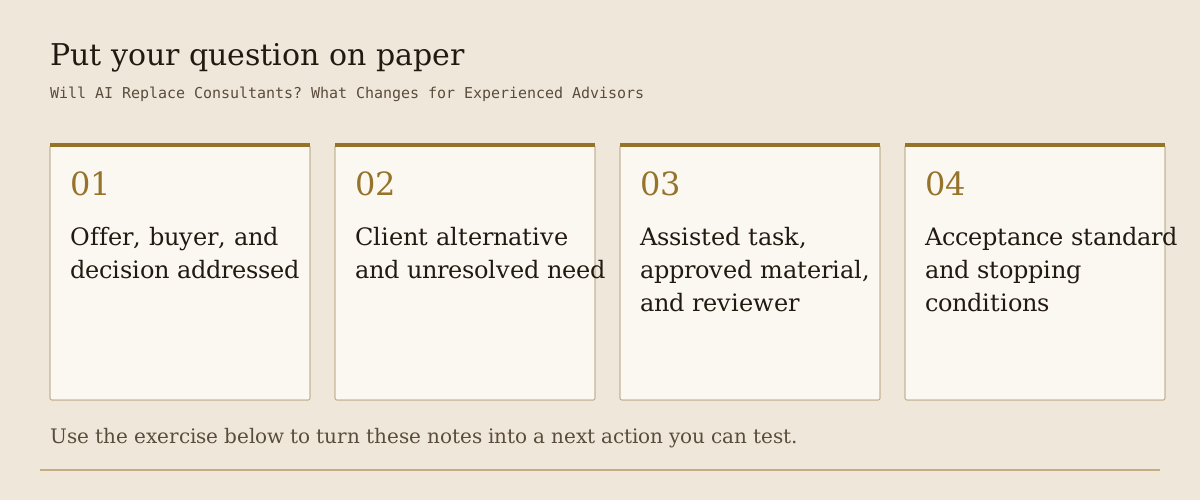
Set aside a short working session and use one existing offer. The purpose is to select a specific action that can produce useful evidence, not to forecast your entire career. Keep the completed worksheet to one page. If a question requires specialist advice or a permission you don't have, record that as a prerequisite.
A reflection tool for planning your next step, rather than a predictive score.
- Name one offer and one buyer decision it addresses. Use a sentence a client could understand, such as deciding how exceptions will be approved in a revised service process.
- Identify the client's realistic alternative. State what they could do with internal staff, AI assistance, another advisor, or postponement, and name the unresolved question your offer would address.
- Separate one production task from the responsibility attached to it. Specify what AI may assist, which material is approved, and what you will independently check.
- Write acceptance and stopping conditions before starting. Include the consequential claims that must be traceable, the reviewer needed, and the information or action boundaries that must not be crossed.
- Choose one delivery test and one buyer conversation. Keep them small enough to complete within your existing commitments, and record preparation, checking, correction, and handoff effort.
- Enter the actual calendar date for review, such as the Friday at the end of the second pilot week. Decide then whether to continue, revise, stop, or investigate one named missing fact.
Completed hypothetical example: An independent advisor selects a process-diagnostic offer for an established service business. The decision addressed is who should approve customer exceptions and under what conditions. The client's alternative is to draft a process internally with AI assistance. The unresolved need is agreement among the owner and team leads about decision authority.
The assisted task is preparing a background summary from approved public sources. Confidential interviews remain outside this initial test. The advisor will verify each consequential background claim and decide whether the summary introduces assumptions about the particular business that the evidence doesn't support.
The acceptance standard is a usable summary with traceable claims, clearly labeled uncertainty, and no unsupported client-specific conclusions. The test stops if it requires unauthorized material or if checking a central statement exceeds the advisor's competence. The advisor will seek the appropriate expertise rather than quietly broadening the claim.
The next actions are to complete the bounded preparation test and ask a former buyer whether a focused decision session would address a need they recognize. The review is booked for the Friday at the end of the second pilot week, with the actual calendar date entered by the advisor. At that meeting, they will examine the accepted work, total preparation and review effort, and the buyer's response.
The completed decision is deliberately provisional: continue investigating a diagnostic-plus-decision-session format if the delivery standard is met and buyer evidence supports the scope; otherwise revise the proposal or retain the current offer. No revenue result, productivity percentage, or buyer commitment is assumed.
You may see how your service needs to change and still hesitate to make the client conversation or test the new offer. If that gap keeps repeating, bring the question to AI and the Andes Retreat. During five days in Peru's Sacred Valley, the work is to examine your behavior, identify what is driving it, and choose an action to test at home. You remain responsible for the business decision, with support and accountability continuing after the seminar.
Your working notes
Use this page while you think. Your notes stay in this browser tab; download them before you close it.
What does this question change for you?
A practical answer can change how you work. It can also leave a personal decision unresolved: what to learn, what to stop postponing, or which responsibility to take next. Name that decision before collecting another prediction.
Work through your next decision. Your notes stay in the browser tab, and the exercise gives you no predictive score.
If a recurring pattern keeps preventing action, AI and the Andes Retreat offers five days of practical inquiry in Peru's Sacred Valley, followed by support and accountability. Read about the seminar and assess whether that work fits your question.
Frequently asked questions
Search research, audience discussions, and the existing seminar FAQ library informed these questions. Some wording has been adapted to this guide.
Is consulting going away with AI?
The research reviewed here doesn't establish that consulting is disappearing. A consulting field experiment found better performance on selected tasks and reduced correctness on another. That supports examining individual activities rather than declaring the profession finished. Your offer can still face pressure if clients can complete useful work internally. Ask which decision your engagement addresses, what the client can now do independently, and what contribution remains worth purchasing.
Will strategy consultants be replaced by AI?
There is no supported replacement timetable here. Strategy work can include research, alternative generation, and drafting that AI may assist, but a recommendation also depends on interpreting evidence and understanding constraints. The published consulting experiment doesn't measure strategy-firm demand or partner replacement. Test whether an assisted process improves the actual recommendation, including its decisive assumptions and review effort. Calling work strategic doesn't establish that it will remain exclusively human.
Is consulting a good career in 2026?
That depends on the clients you can serve, the work you can credibly deliver, and the professional life you want. The sources don't establish a universal answer for 2026. Official occupational projections are conditional scenarios, not guarantees for an individual. Investigate actual buyer needs and role requirements before committing to a change. If you're considering leaving another role, use the separate guide to career change because of AI.
What is an AI consultant?
For this article, an AI consultant is an advisor whose engagement concerns using AI in a defined business process. That might include diagnosis, implementation coordination, training, or governance. The label alone doesn't establish competence in all those areas. Ask what the person delivers, which decisions they can assess, and where specialist expertise is needed. A useful proposal explains scope and responsibility in ordinary terms rather than relying on the title as evidence of capability or future value.
How can an experienced advisor become an AI consultant?
Start with a client problem within your existing competence and learn how AI changes one relevant task. Define the result, approved information, review standard, and delivery limits. The OECD distinguishes AI literacy from advanced engineering, so every advisory role doesn't require the same specialization. Build evidence that you can deliver the proposed work before widening your offer. A new title should describe demonstrated responsibilities, not substitute for the practice needed to meet them.
Which AI is best for consultants?
The research reviewed here cannot identify a universally best current product. The consulting experiment used a particular tool in 2023, and different tasks required different judgments. Choose against your actual requirements: approved data handling, source access, output quality, review effort, cost, and the actions the system may take. Compare tools on the same bounded assignment you can assess. A strong result on a demonstration doesn't establish suitability for confidential client work or a consequential recommendation.
Is there a demand for AI consultants?
The sources here don't provide a representative measure of demand for AI consulting services. The OECD practitioner interviews show organizations working through deployment and accountability questions, but that doesn't prove they'll hire external advisors for them. Investigate a specific buyer, problem, and budget. Conversations, requests for proposals, and paid engagements answer different questions. Treat interest as a reason to test an offer, rather than evidence that every AI consulting business will find clients.
How is AI being used in consulting?
The consulting experiment provides evidence of assistance on selected knowledge-work tasks, with different results depending on the task. Possible applications in your practice include organizing approved sources, drafting alternatives, and preparing presentation material. Those applications still need checking and shouldn't be presented as measured industry-wide adoption patterns. Begin with one assignment whose quality you understand, specify its boundaries, and compare the complete process, including correction and handoff, with your existing method.
How can consultants use AI to prepare presentations?
Use it to propose structure or draft wording from an approved analysis, then compare the presentation with the underlying evidence. Check whether shortened wording removes an important qualification, whether a chart supports the claim beside it, and whether the options still reflect the client's decision. Keep confidential information within approved arrangements. A presentation is ready when a qualified reviewer can explain its consequential claims and uncertainty, not merely when the slides look polished or the narrative sounds persuasive.
Is moving from implementation into management consulting a sensible next step?
It can be, if buyers need the advice and you can deliver it credibly. It can also be wrong when the client's unresolved need is reliable implementation. Compare the proposed engagement with your domain knowledge, advisory competence, and preferences. Don't assume strategy is protected from AI while implementation is finished. Test a limited adjacent assignment before withdrawing work clients already value. The counterexample above shows why a clear direction can still require skilled delivery rather than another workshop.
Where can an experienced advisor add value in company AI governance?
An advisor may help clarify permitted uses, decision owners, approval boundaries, review requirements, and recovery arrangements. The OECD practitioner interviews describe accountability and traceability concerns, but don't establish demand for a particular consulting package. Keep specialist boundaries explicit. Coordinating a process isn't the same as certifying security or interpreting governing legal requirements. A useful engagement identifies the decisions you can help resolve and the qualified people needed for questions beyond your competence.
How can a consultant protect confidential client information when using AI?
Start with the client's approved data practices and the actual service, account terms, access arrangements, and relevant professional requirements. Use only material authorized for the proposed task. A general product description can't settle confidentiality for every engagement. Separate public learning tests from live client work, and obtain qualified assessment where needed. If essential information isn't approved for use, pause or redesign the test. Removing a client's name alone should not be treated as proof that the remaining material is appropriate to upload.
How can consulting teams preserve decisions and context when working with AI?
Keep an approved record of the objective, constraints, decisions, unresolved questions, and current source material. Assign someone to update it when the engagement changes. A conversation history can assist the work, but shouldn't be the only place a consequential decision exists. This is an editorial operating recommendation, not a verified architecture. For implementation detail, see business agent workflows. The consulting responsibility is ensuring that people can reconstruct why the recommendation changed and which version the client approved.
Can personal reflection replace the expertise needed to advise clients through AI change?
No. Reflection may help you notice a postponed conversation or examine why you're avoiding a decision, but it doesn't supply missing technical, commercial, legal, or sector knowledge. The canonical leadership discussion makes that boundary explicit. If the problem is lack of competence or evidence, obtain the relevant help. If you understand the professional next step but repeatedly don't take it, examining your behavior can be a separate and useful part of the work.
Which consulting task should I test with AI first?
Choose a bounded task whose quality you can assess, such as turning permitted source notes into an outline. Keep the original material and your usual output for comparison. Check whether the draft preserves the evidence, answers the client's question, and saves time after review. The BCG experiment found task-dependent results under its study conditions; it doesn't establish that every consulting assignment will improve. Start where an error is recoverable, then use the test to decide whether broader use is justified.
How should a consulting firm rethink junior work if AI assists with research and drafting?
Separate the output from the learning the assignment provides. If AI helps with a first draft, ask how a junior colleague will learn to assess evidence and defend a recommendation. Keep opportunities for supervised work, explain the review standard, and observe whether the person can explain the result without the tool. A change in task allocation may justify a new training approach; the research here doesn't prescribe a universal staffing pyramid or prove that junior consultants are no longer needed.
What does selling a solution mean in practical consulting work?
Describe the client problem, the deliverable, and the decision or change the work is meant to support. Agree on how completion will be assessed and what remains the client's responsibility. For an AI pilot, that might mean testing a defined workflow against agreed quality and review criteria. Avoid calling a collection of generated slides a business result. You can make the offer concrete without promising revenue or productivity gains that you haven't established for that client.
Should I specialize or compete on price as AI changes consulting?
Test what a specific client needs before choosing either strategy. Specialization may help you solve a difficult problem; a lower price may make a defined service easier to buy. Neither creates demand by itself. Ask prospective buyers what they have tried, where they are stuck, and how they would assess useful work. Compare the scope and review burden of a small offer with what you can deliver. A Reddit discussion can reveal this question, but it isn't a representative survey of buyers.
How can I tell whether AI is actually reducing demand for my consulting service?
Look at your service's inquiries, win rate, and the reasons prospects give for declining. Ask whether clients are doing the work internally, spending less overall, or buying a different outcome. Do not attribute every quiet month to AI. Then examine which parts of your delivery the client can now do and which problems remain unresolved. This is a practical investigation of your market, rather than evidence that AI caused a sector-wide decline or that changing your offer will guarantee demand.
How should I judge whether a professional network is worth my time?
Define the kind of relationship you hope to build, then try a bounded period of participation. Record substantive conversations and whether you found people whose problems you understand. Follow up where you have permission and something useful to contribute. Compare the time and fees with alternatives you can actually use. A membership or event doesn't guarantee clients. For an AI-related offer, conversations may help you test demand, but treat interest and a paid engagement as different evidence.
Sources and evidence
These guides were drafted with AI assistance and checked against the linked sources. Examples labeled hypothetical illustrate a decision; they are not participant stories or measured results.
Studies answer specific questions about particular people, tasks, and tools. Their dates and limits matter. A result about task assistance is not a forecast for an entire profession.
- Navigating the Jagged Technological Frontier: Field Experimental Evidence of the Effects of Artificial Intelligence on Knowledge Worker Productivity and Quality
- O*NET 13-1111.00: Management Analysts
- Generative AI and Jobs: A Refined Global Index of Occupational Exposure
- Skills in the AI age
- Employment Projections and Occupational Outlook Handbook: 2025-2035
- Canaries in the Coal Mine? Six Facts about the Recent Employment Effects of Artificial Intelligence
- We are Changing our Developer Productivity Experiment Design
- Agentic AI in organisations: Early insights from practitioner interviews
- Here's What I'd Learn Instead of AI Automation in 2027
- What I'd Learn Instead of Automation in 2026
- The SoulSearching Experience
- Canonical seminar FAQ: Can inner work replace management skill or strategy?
- Canonical seminar FAQ: Does inner work make you soft, or worse at holding a standard?
- Canonical seminar FAQ: Is inner work for leaders just wellness marketing?
- Canonical seminar FAQ: When does gathering more information actually help?
- Canonical seminar FAQ: Why do I feel unclear even when I already know all the facts?
- Observed comment question about valuable skills besides sales
- Observed comment question about learning sales without an expensive course
- Observed comment question about bridging business and AI
- Observed comment question about judgment preventing practice
- Observed comment question about preserving context across human-agent interactions
- Observed comment question about subscription and API costs
- Observed comment question about knowledge bases and task context
- Observed comment question about confidential company information
- Observed comment question about requirements and evaluation of generated code
- Observed comment question about discussing security with businesses
- Observed comment question about practicing sales and marketing
- Observed comment question about applying automation skills inside another business
- Observed comment question about moving into management consulting
- Observed comment question about company-specific AI governance
- Observed comment question about continuing human quality control
Where the audience questions came from
These linked discussions and comments supplied questions and wording. They do not establish the truth of the replies, verified professional identities, or how common a concern is.
- Audience question, r/consulting: AI: The Beginning of the End for Traditional Consulting? Thoughts from a Consultant.
- Audience question, r/consulting: Independent consultants in Boston/New England: has MTLC membership been worth it for a solo practice?
- Audience question, r/consulting: AI: The Beginning of the End for Traditional Consulting? Thoughts from a Consultant.
- Audience question, r/consulting: How is AI impacting consulting, is the industry already slowing down because of it, and how will it develop in the years ahead?
- Audience question, r/consulting: Independent consultants in Boston/New England: has MTLC membership been worth it for a solo practice?