
You finish a client meeting, open your inbox, and find the familiar second shift: notes to organize, a proposal to prepare, appointments to confirm, and a colleague waiting for an answer. Then you watch an AI demonstration that appears to do all of it. The appealing question is immediate: could this system take enough work off your hands that you can finally concentrate on running the business?
Possibly, for some of those tasks. But the demonstration and your Tuesday afternoon contain different kinds of work. Your client changed a requirement without updating the brief. One appointment involves a customer who needs extra time. The proposal depends on a promise you made in conversation. Someone must decide which information is current, which action is authorized, and what happens if the system gets something wrong.
Those decisions deserve attention before you connect an agent to the business. The OECD's September 2026 practitioner report describes organizations using agents with different levels of autonomy, while reporting difficulties with incorrect actions, unpredictable behavior, traceability, and accountability. Its interviews are illustrative rather than a representative performance test. They provide useful questions to ask, not a promise about your results.
You don't have to settle the future of entrepreneurship to make a sensible operating decision. You need a task you understand, a boundary around what the system may do, and a way to compare the assisted process with the current one. You also need an honest answer about what you want to do with any capacity that becomes available.
This article focuses on that decision. It offers a practical way to choose a pilot, protect the information it uses, measure useful work, and decide whether to continue. The goal is a business you can explain and take responsibility for, with assistance that earns its place in the process.
What can an AI agent actually do for a business?
For this article, an AI agent means a system that uses AI to work toward a defined objective through a sequence of steps, potentially using connected tools. This is a working definition, not a claim that every product using the word agent has the same capabilities. A chatbot that drafts an email when you ask is different from a system that retrieves information, creates a draft, checks a condition, and updates a record.
The distinction that matters to an owner is action. A suggested appointment remains a suggestion until someone changes the calendar. A draft invoice remains a draft until it enters an accounting process or reaches a customer. A research summary remains an internal document until its conclusions influence a proposal. Ask what the system can actually change, rather than relying on how independently it appears to speak.
Possible pilot tasks include preparing a summary from approved documents, organizing incoming requests for review, drafting responses from a controlled information set, or proposing updates to a shared task list. These are candidates to investigate, not verified capabilities of an unnamed product. Whether any candidate works depends on the chosen system, its connections, your information, and the quality standard you set.
It helps to separate assistance from delegated action. With assistance, a person chooses the next step and uses AI output as input. With delegated action, the system has permission to perform some next steps itself. You might approve assistance for proposal preparation while withholding permission to send the proposal. Both arrangements can be useful. Greater autonomy is a design choice with consequences, not an automatic sign of a better process.
The OECD interviews with 25 organizations describe deployments, pilots, and varied maturity. They also describe gradual increases in autonomy and human checkpoints. Because the sample deliberately includes organizations already working with agents, it cannot tell you what proportion of all small businesses have dependable agents or what your return will be.
Write the proposed role in ordinary language: the system prepares a draft from these documents; the operations manager checks these fields; only the manager sends it. If you can't finish that sentence without vague words such as everything or automatically, the role needs more definition. You don't need to diminish the technology's potential. You need to identify the specific part of the business you're considering handing over.
That definition makes later decisions easier. You can test a draft-producing system without claiming it runs customer service. You can evaluate scheduling suggestions without claiming it manages operations. A useful task boundary lets you discover what assistance is worth while preserving a clear account of what remains yours.
What separates an impressive demo from a dependable process?
A demonstration answers a narrow question: can this system produce a convincing result under these conditions? A business process answers a harder one: can this arrangement deliver acceptable work repeatedly, including when information is missing, people change their minds, or a connection fails? The second question includes the system and everything around it.
Start with the input. In a demonstration, the request may be clean and complete. In your business, a customer might attach the wrong file, use an old product name, or ask for two things that conflict. A dependable process needs a response to that situation. It might request clarification, route the case to a person, or produce a limited draft that clearly identifies the unresolved point. Quietly filling the gap is not the same as resolving it.
Next consider the output. A polished paragraph is easy to admire. It is harder to establish whether the paragraph reflects current policy, respects a customer-specific agreement, and contains every qualification the reviewer needs. Define the properties of acceptable work before the demonstration, so presentation doesn't become the standard by default.
Then examine the surrounding record. Can you see what information the system used, which actions it attempted, what changed, and who approved the result? Can another employee understand what happened without reconstructing a long conversation? Traceability means being able to follow the work from request to outcome. It matters most when the result looks plausible enough that nobody initially notices a problem.
The OECD practitioner report identifies unpredictable behavior, incorrect actions, traceability, and accountability as reported limitations. Its evidence is qualitative and has no independent quantitative validation of business performance. The practical interpretation here is to treat those issues as acceptance questions for your process, rather than convert the report into a failure rate.
Nick Saraev's company-agent walkthrough, reviewed for this article in October 2026, describes task statuses, shared context, checks, and final human review. It is an example architecture from a creator who sells education and implementation services. It isn't an independent security audit or a universal operating prescription. Its useful prompt is to ask how work becomes ready for an agent and how it becomes accepted afterward.
A process is ready for a limited pilot when you can explain its normal path, its exceptions, its review, and its recovery. A successful demonstration can justify investigating that process. It can't substitute for the investigation. The distinction lets you remain interested in a capable system without asking your customers to absorb an experiment you haven't yet understood.
Which task should you consider first?
Choose a task whose usefulness and correctness you can recognize. The first task doesn't need to be the most advanced or the most time-consuming. It needs to produce information you can use to make the next decision. If you're unfamiliar with the work, you may have difficulty distinguishing genuine assistance from an output that merely looks finished.
Describe the current task from beginning to end. Who requests it? What information arrives? What does the person doing it consult? What decisions occur along the way? Who uses the result? Include the handoff, because a document that saves its author time can still create extra work for the person receiving it. The business pays for the whole process, even when different people carry the costs.
Consider frequency alongside consequence. A repeated internal draft may provide enough opportunities to compare methods without exposing customers to unreviewed work. A rare, important decision may offer little evidence and carry a substantial cost if mishandled. Repetition alone doesn't make a task suitable. Repeated payment approvals, for example, can still have consequences that demand careful controls.
Look for an existing standard. You might already know what a complete meeting summary contains or which fields must appear in an intake record. If the standard lives only in your head, write it down before building the pilot. This may reveal that the first useful intervention is a clearer template or a better form. AI is one possible response to a process problem, not a requirement attached to every inefficiency.
Then ask whether the task requires information you're authorized to provide. A promising research task can be a poor first pilot if it depends on confidential client material whose approved handling is unresolved. You can sometimes narrow the task to public documents or fictional practice material. That tests part of the process while you investigate the real data requirements.
The Census Bureau's 2026 analysis of AI diffusion, using a November 2025 through January 2026 reference period, found uneven adoption across firm sizes and sectors, with many adopters using AI in only a few functions or tasks. That is descriptive evidence about adoption, not proof that a narrow pilot produces better outcomes. It does, however, undermine the assumption that meaningful use must begin with whole-business automation.
Choose one candidate and write why it deserves the trial. A useful reason is that the task is recurring, bounded, checkable, and connected to a real operating problem. A weaker reason is that you saw someone automate it online. Keep a second candidate in reserve, but resist starting several pilots before you can explain what you learned from the first.
What does the customer gain if you automate this?
Time saved inside the business is a possible benefit. It isn't the entire value calculation. Ask what changes for the person buying from you. Do they receive a more accurate answer, a clearer proposal, a faster acknowledgment, or fewer requests to repeat information? If the customer experiences no improvement, the pilot may still be worthwhile, but you should know where its value sits.
A useful distinction is between waiting and working. A response might take little employee time but sit in a queue until the right person is available. Draft assistance could reduce writing time without reducing the wait. Conversely, better routing might reduce the wait without changing the draft itself. Identify which delay you are trying to address before concluding that faster generation solves the problem.
Customer value also includes what should be preserved. A client may appreciate continuity with someone who remembers the context of a previous conversation. They may need an exception considered carefully. They may be asking a simple question because a larger concern is difficult to articulate. These are situations to investigate with customer evidence, not reasons to declare all relationship work permanently human.
Nick Saraev's commentary on business automation argues for examining full-process value rather than labor savings alone. His examples are self-reported and not independently audited. The practical question is sound without treating those anecdotes as a measured general result: what useful contribution would disappear if you removed the current step or person?
You can explore that question through ordinary observation. Review what customers ask after receiving an output. Look at the clarifications your team adds. Ask the person doing the work which exceptions consume attention and which apparently routine interactions reveal something important. Don't make employees defend every minute of their work against a hypothetical machine. Invite them to help distinguish useful judgment from avoidable friction.
Be precise about commercial outcomes. A shorter response time is not the same as more sales. More sales are not the same as more profit. If the pilot affects selling or delivery, examine the work required to fulfill additional commitments and the costs attached to them. A business can become busier without becoming better for its customers or owner.
This is where your intention matters. Perhaps you want a calmer operating week rather than expansion. Perhaps you want employees to spend more time on careful customer conversations. State that preference, then test whether the new arrangement supports it. The customer-value question keeps efficiency connected to the reason the process exists. It also gives you a defensible reason to leave a task unchanged when the current arrangement already serves people well.

How much authority should the agent receive?
Give the system authority that matches the evidence you have and the consequences of an incorrect action. A useful pilot can begin with permission to read approved material and create internal drafts. Permission to send messages, change commitments, alter customer records, or move money is a separate decision. The fact that a connection is technically possible doesn't establish that its full permissions are appropriate.
Write down the difference between preparing and committing. Preparing a proposed appointment allows someone to assess availability and special requirements. Committing changes the calendar and may create an expectation for the customer. Preparing a proposed record update allows comparison with the original. Committing changes what future employees or systems treat as true. These distinctions should appear in the workflow, not depend on everyone remembering them.
An approval needs an identifiable person and a meaningful choice. If an employee receives a large batch with no time or information to examine it, the approval step may become a habit of clicking through. Define what the reviewer sees, what they check, and how they reject or amend the proposed action. Also decide what happens when the reviewer is unavailable. A waiting queue is often preferable to an unstated assumption that silence means consent.
The OECD interviews describe practitioners increasing autonomy gradually and involving domain experts and human checkpoints. Those are reported practices, not a certification that a particular arrangement is safe. Applied to your pilot, the lesson is to earn additional authority with task-specific evidence and keep an explicit owner for each consequential decision.
Specify escalation conditions in language a colleague can understand. The system stops when source documents conflict, required information is absent, the request falls outside the agreed task, or the proposed action exceeds its permission. For a customer-facing process, you might also require escalation when a request concerns a disputed commitment or an unresolved complaint. The exact conditions should reflect your business rather than a generic list copied from a tutorial.
Review authority whenever the scope changes. Adding a new document source may introduce information the original reviewer isn't qualified to interpret. Adding a new destination may turn an internal draft into an external action. Expanding from one department to another may change who can grant permission. A pilot that worked within its original boundary doesn't automatically validate the expanded arrangement.
Finally, make stopping practical. Someone should know how to disable the delegated actions while preserving the work record and returning to the manual process. That person should be available during the pilot's operating period. Authority is easier to grant thoughtfully when you know how it can be withdrawn and what work continues afterward.
What happens to confidential company and client information?
A business label on a product page does not settle confidentiality. Before entering company or customer information, check the service, account arrangement, connected tools, settings, and applicable terms against your obligations. Make the decision for the information and workflow you actually plan to use.
A public question on Saraev's company-agent walkthrough asks how information employees share with applications can remain protected. The question establishes an observed concern, not evidence of a particular breach or a guarantee that one architecture solves it. It is useful because it shifts attention from a model alone to the applications and people around it.
Map the proposed information path. What leaves your systems? What reaches the AI service? What passes through a connector? What appears in logs, task histories, shared folders, or generated files? Which people can see those records? A confidentiality review that considers only the original upload can miss the copies and outputs created during the process.
Classify information before granting access. Public marketing copy differs from client correspondence, employee information, commercial negotiations, and credentials. Decide which categories are permitted for the pilot and who can approve an exception. Use the minimum information necessary for the task. Removing a name may reduce exposure, but don't assume that the remaining details make a record anonymous or suitable to share.
Questions about training use, retention, deletion, subprocessors, access, and incident handling require current official documentation and the relevant agreement. An account setting should be checked against that documentation. If the terms remain unclear, keep sensitive information out of the pilot while someone with the appropriate expertise resolves the uncertainty. A useful experiment can wait for the information it genuinely needs.
Professional settings add their own requirements. For lawyers, ABA Formal Opinion 512 discusses competence, confidentiality, communication, supervision, candor, and fees in generative AI use. It is an interpretation of Model Rules, not binding law in every jurisdiction. A lawyer must check governing rules and current local guidance. This article doesn't determine whether any specific client information may be shared.
Your written pilot boundary should therefore identify permitted data, approved destinations, access holders, and the person responsible for reviewing unresolved requirements. The OECD practitioner evidence supports taking governance and accountability seriously, but cannot promise confidentiality for an unnamed deployment. When you can't explain where the information goes, you haven't yet made a complete delegation decision.
How do you measure whether AI is helping?
Measure the finished process, including the work needed to accept its output. A system that produces a draft quickly may still require substantial preparation, review, correction, and follow-up. Record those activities alongside generation time. Otherwise, the pilot can appear successful because the most visible part became faster while less visible work moved elsewhere.
Begin with a baseline from the current process. Use actual work that reasonably represents the proposed task, including ordinary exceptions. Record active human time, elapsed time until acceptance, quality problems, and the work required after handoff. If you don't have those records, establish them before assigning an estimated savings figure. Your impression of a tedious task is a useful reason to investigate, but isn't a measurement.
Define quality separately from speed. For an intake summary, quality might mean accurate contact details, complete requirements, visible uncertainty, and no invented commitments. For a research brief, it might mean that every consequential statement matches its original source. For a scheduling proposal, it might mean that all constraints are respected and the customer has received the approved information.
Research shows why averages need context. The published Generative AI at Work study found that access to AI increased issues resolved per hour by 15% on average among 5,172 customer-support agents. Less experienced and lower-skilled agents benefited more; experienced high performers had smaller speed gains and some quality tradeoffs. One firm, tool, and occupation cannot supply your expected improvement.
The v4 work-pattern experiment reported less email time among users, while not detecting broader changes in task quantity or composition from individual-level tool provision. Several authors were affiliated with the product vendor. Its practical limit is important: reduced time in one activity doesn't establish better output, increased revenue, or an organizational redesign.
Measurement itself can be difficult. In its February 2026 productivity update, METR described selection effects and challenges measuring work with concurrent agents that made follow-up estimates unreliable. It also cautioned against treating its earlier experienced-developer slowdown result as today's general effect. Neither a favorable feeling nor an old headline settles your process.
At the review, compare accepted work of similar difficulty. Examine errors individually, especially those with meaningful consequences. Identify time saved, time added, and costs moved to another person. Then choose whether to continue, revise, or stop. A modest pilot can support a modest decision. It doesn't need to produce a dramatic percentage to reveal whether a specific arrangement belongs in your business.
Hypothetical example: a consultancy tests research-brief assistance
This is a hypothetical example, not a reported client or a set of measured results. Consider a small consultancy that prepares background briefs before discovery meetings. An experienced consultant currently gathers approved public sources, identifies what they establish, and writes questions for the client. The owner wants to reduce preparation work while preserving the distinction between a documented fact and an interpretation.
The proposed pilot gives an agent a bounded assignment: prepare an internal brief from a specified set of public documents. It may organize information and propose questions. It may not contact the client, add unapproved private material, or present unsupported conclusions as findings. The responsible consultant remains the person who decides what to use in the meeting.
Before starting, the consultant defines the output. Each substantive statement needs an original source. The brief must identify publication dates where they matter, separate findings from assumptions, and show unresolved contradictions. It must also explain why a point could affect the client's decision. A collection of summaries that looks comprehensive but offers no usable distinction wouldn't meet the standard.
The baseline includes the current research time, drafting time, source-checking time, and preparation of meeting questions. The assisted record includes instructions, generation, checking, correction, and final preparation. Both records follow the work until the consultant accepts it. The owner resists counting the first draft as completed simply because it arrives quickly.
Suppose a trial brief cites a genuine report but turns a correlation into a causal claim. That is a hypothetical failure condition, not an observed result. The reviewer returns to the original report, corrects the statement, and records the type of error. If the same unsupported inference keeps appearing, the owner may narrow the assignment to source organization or stop the pilot. A fluent explanation from the agent wouldn't settle whether the source supports the claim.
The pilot also tests an incomplete case. Two documents describe the same issue differently. The expected behavior is to flag the conflict and preserve both sources, rather than silently choose the version that makes the brief read more smoothly. This gives the reviewer evidence about how uncertainty is handled, which matters more than the elegance of a routine summary.
At a review scheduled for two weeks after the pilot begins, the owner examines accepted briefs, review effort, error types, and whether meeting preparation improved. That interval is an illustrative planning choice, not a research-backed universal duration. The decision might be to continue with the same boundary, revise the instructions, or return to the original method. For broader questions about professional service offerings, see how AI may change experienced consulting work.

What should a meaningful human review include?
A human review should establish something the business needs to know. It shouldn't exist simply to make the workflow diagram look reassuring. Name the question the reviewer answers: does the draft match the source, does the proposed action respect the agreement, or does the result satisfy the acceptance criteria? Then provide the information and time required to answer it.
Review has several possible layers. A completeness check asks whether required fields are present. A factual check compares claims with source records. A judgment check considers whether the recommendation fits the situation. An authorization check asks whether the proposed action is permitted. These layers can involve different people. Passing one doesn't automatically establish the others.
For example, a proposed response might contain every required field and still promise something your delivery team cannot provide. A report might reproduce numbers correctly while explaining the wrong cause. A customer update might be accurate but go to the wrong recipient. The reviewer needs to know which problem they are responsible for detecting rather than receive a general instruction to check everything.
The OECD practitioner interviews describe domain-expert involvement and checkpoints among responses to incorrect or unpredictable actions. They don't independently measure the effectiveness of every review arrangement. The editorial recommendation here is to match review to consequence and make the reviewer competent for the question being assigned.
An agent's own checklist can assist this process, but it isn't independent evidence that the output is right. Asking a system whether it followed the instructions may reveal omissions worth examining. Acceptance still requires a check against the relevant standard or source. When accuracy matters, move beyond agreement between generated statements and inspect what the business treats as authoritative.
Keep the reviewer close enough to the original material to recognize changes in meaning. If a summary becomes the only thing anyone reads, the team may lose the ability to identify an important qualification that disappeared. Preserve accessible source references and make returning to them part of the workflow. This doesn't require rereading every document in full for every low-consequence task; it requires a deliberate method suited to the work.
Also examine reviewer capacity. A process that depends on one expert approving everything can create a new queue. If review consumes more time than the pilot can justify, reduce the task, improve its inputs, or choose another candidate. Meaningful review has a cost, and that cost belongs in the decision. For questions about using AI to assess options rather than merely produce work, see using AI while retaining your own decision responsibility.
How do you preserve context without making yourself the messenger?
When work spans several conversations, the business needs a durable record of what has been decided. Don't make one person's memory or a continuing chat the only place where the task makes sense. Preserve the current objective, accepted decisions, unresolved questions, relevant sources, and the status of any proposed action in a record the authorized team can inspect.
A question on Saraev's workflow video asks how context survives repeated human-agent interactions. Another public information request describes wanting several tools to use a shared record rather than pass updates through the owner. These establish observed practical questions. They don't verify the commenter's proposed architecture or prove its outcomes.
Separate standing knowledge from task context. Standing knowledge includes approved policies, recurring definitions, and current service information. Task context includes this customer's request, this revision, and this decision about scope. Mixing them without a clear status can turn a one-off exception into a supposed general rule. It can also cause a superseded instruction to keep influencing new work.
Choose a record your team can maintain. The useful question is not which fashionable application should hold everything. It is whether authorized people can find the current version, identify its owner, see changes, and understand which information has been accepted. The record should fit the work and the team's abilities. A complicated arrangement that only its builder understands may add another dependency.
Write decisions explicitly. Instead of leaving several comments that imply a change, record the current decision and its reason. Preserve earlier material where appropriate, but identify it as superseded. Keep proposed output separate from accepted output. When a new run begins, provide the current task record and the specific sources it needs, rather than assume that all previous discussion will be remembered.
Test a handoff during the pilot. Ask another authorized colleague to explain the task and its next permitted action from the record. If they need you to fill in the essential story, improve the record before expanding autonomy. Use the handoff to identify what the record leaves unclear. It gives you a concrete way to see whether the process still depends on constant interpretation by you.
Finally, identify who updates standing knowledge when the business changes. Old prices, discontinued services, and changed approval rules should not remain quietly available as current guidance. The record needs ownership and a review trigger. Preserving context means maintaining a usable account of the work, rather than collecting an unlimited history that nobody can confidently interpret.
What does the pilot really cost?
The price of the AI service is one line in the operating cost. Include setup, connections, preparation, supervision, correction, maintenance, and the manual work required when the system is unavailable. Some costs arrive as bills. Others arrive as employee time or as a task that someone can no longer complete because they are maintaining the pilot.
Don't assume that one kind of subscription covers every part of an agent workflow. A public question about Saraev's setup asks whether a subscription is sufficient or separate API spending is required. The research reviewed here doesn't answer that product-specific question. Before adoption, verify the actual current plan, usage charges, connected services, and limits in official documentation.
Agree on a spending boundary before the trial. Identify who receives billing notices and who can stop usage. Also define the time the team may spend on setup and troubleshooting. An inexpensive service can become a costly project if nobody is permitted to decide that the configuration effort has exceeded the value of the proposed task.
Separate one-time learning from recurring operation. Initial setup may be worthwhile even if the first assisted task takes longer. But don't hide recurring correction under the heading of learning indefinitely. At each review, ask which costs should decline with experience and which belong to the process every time. Record evidence for that expectation rather than repeatedly moving the point at which the pilot is supposed to become useful.
If you calculate return on investment for the pilot, state the calculation and its boundaries. A basic management calculation divides net financial benefit by the included investment cost, then expresses the result as a percentage. The difficult work is defining credible benefit and cost. Don't count estimated time as cash savings unless the business actually avoids a cost or uses that capacity in a way you can establish.
You can still value time without pretending it became money. Perhaps the owner finishes administration within working hours or an employee has capacity for more careful handoffs. Record that outcome in its own terms. The v4 work-pattern study is a reminder that individual time savings and broader organizational outcomes are different measures. It doesn't establish your revenue effect.
Finally, consider the cost of dependence. Can the team continue if the service changes, the person who built the connection leaves, or the account becomes unavailable? Maintaining a manual alternative may carry effort, but it also keeps the trial reversible. The financial question is whether the whole arrangement serves the business at an acceptable cost, not whether the most visible invoice looks small.
Hypothetical example: a service business tests scheduling support
This second example is hypothetical and contains no claimed results. Consider a small service business where an operations coordinator prepares appointments after receiving customer requests. The work includes checking service area, expected duration, staff availability, and special requirements. The owner sees an opportunity for an agent to organize requests and propose appointments, while the coordinator remains responsible for confirming them.
The first useful discovery is that the existing intake form doesn't collect every scheduling constraint. The owner could immediately ask the agent to infer the missing details. Instead, the team improves the form and creates a clear route for requests that remain incomplete. This is a process decision before it is a technology decision. The agent receives a better-defined task because the business has clarified what scheduling requires.
The proposed pilot uses only information approved for that environment. The agent may extract relevant fields and produce an internal appointment proposal. It cannot send confirmations, move an existing appointment, or override a constraint. The coordinator sees the original request beside the proposed schedule and checks the information before making the commitment.
A useful test case involves a customer whose request sounds routine but includes an access limitation. The expected behavior is to preserve that limitation and route uncertainty to the coordinator. Another case contains two possible times without identifying a preference. The system should leave the choice unresolved rather than write a confident confirmation. These tests investigate the boundary the owner has actually chosen.
For measurement, the coordinator records time spent organizing requests, preparing proposals, reviewing them, and correcting omissions. The owner also examines what happens after confirmation: whether additional clarification is needed and whether the delivery team receives the constraints it needs. No improvement is assumed. The record follows the work into the handoff because scheduling exists to support a service that must be delivered.
The stopping conditions are specific. Pause the pilot if it proposes a time outside an agreed constraint, loses a material customer requirement, changes a live booking without permission, or requires more correction than the team has agreed to accept. A stop triggers investigation and restoration of the manual process. It doesn't require the coordinator to prove that every future run will fail.
The owner puts a review on the calendar for the end of the next two operating weeks and appoints the coordinator to bring both normal and problematic cases. That is an illustrative review period, not a promise that two weeks supplies decisive evidence. If the input mix is too limited, the pilot can remain narrow for longer. The next decision concerns this scheduling support process, not whether every service business should use an autonomous receptionist.

When would an attractive automation recommendation be wrong?
Consider this hypothetical counterexample: an owner wants to replace a sales conversation with an automated interaction because the conversation occupies expensive staff time. The recommendation appears attractive when the comparison includes only the cost of conducting the conversation. It becomes incomplete when that conversation also establishes whether the customer is a good fit, identifies delivery constraints, and prevents a promise the business cannot keep.
Automating the conversation could be the wrong first move if the owner has no reliable way to evaluate those functions in the proposed replacement. The problem isn't a principle that sales must always remain human. It is that the owner would be removing a source of judgment without establishing how the new process handles the same situations. A cheaper interaction may create work later in delivery, refunds, or relationship repair.
Saraev's business-automation commentary uses a self-reported sales example to warn that lost conversion can outweigh labor savings. That example lacks an independently audited method and cannot supply a general prediction. The broader editorial point is to include the contribution of the existing process and the costs of changing it, rather than assume every removed minute is a gain.
An alternative pilot could support the salesperson with preparation, an internal draft, or organization of approved information. That lets the business test assistance without immediately removing the conversation it doesn't yet know how to evaluate. The right alternative depends on the task, permitted data, and review costs. Sometimes the best first action is to observe the current process more carefully.
Another wrong recommendation is to automate an unvalidated offer at scale. If you don't know what customers need or why they decline, producing more messages may simply produce more uncertainty faster. A direct conversation, a clearer offer, or a smaller manual test may provide more useful information. This doesn't prove AI can never help create a new service. It means technical production and customer value need separate evidence.
There are also tasks where a conventional tool is sufficient. If the problem is a fixed reminder, a required field, or an agreed calculation, compare a straightforward rule-based arrangement before adding a system that interprets language. You don't need an agent merely because an agent could be connected. Choose the simplest arrangement that meets the actual requirement and remains maintainable by the team.
The counterexample protects ambition as much as caution. You can pursue a more efficient business while declining an attractive recommendation whose value hasn't been established. Write what evidence would change that decision. Then investigate that evidence directly. A temporary no with a stated reason and review point is an operating decision, not a failure to keep up.
How might your role and your team's work change?
Several outcomes are possible if a pilot helps. You might spend less time producing first drafts and more time defining work. An employee might shift from organizing inputs toward reviewing exceptions. You might preserve the same roles while improving the handoffs between them. These are conditional scenarios for your business, not predictions that every owner becomes an agent manager.
The Census research distinguishes formal firm adoption from worker use and describes adoption concentrated in different functions and tasks. The practical implication is to examine what changes where the work occurs. Someone using a tool privately doesn't automatically mean the business has an approved process, a shared standard, or a plan for the resulting capacity.
Talk with the people involved before drawing staffing conclusions. Explain the task being tested, the information permitted, the approval boundary, and what you intend to measure. Ask which responsibilities the task currently supports. A person may notice an exception that the owner never sees because it has always been resolved before reaching them. That knowledge belongs in the pilot design.
Changes in finance work illustrate the distinction between task assistance and whole-role replacement. The published Human + AI in Accounting study combines survey, platform, and experimental evidence. In its small and medium business setting, adoption was associated with changed workflows, including communication and quality-assurance work. Those associations don't establish full-workflow causality or predict what a finance leader should decide.
For a finance-related pilot, preserve source reconciliation, exception review, and appropriate approval authority as explicit design decisions. An AI draft explaining a variance is different from permission to approve a payment or choose a financial action. Check the professional requirements relevant to your business. The management example here supplies no investment or tax recommendation.
Your own learning should follow responsibility. If you approve a process, learn enough to explain its inputs, outputs, boundaries, and checks. The OECD skills synthesis distinguishes AI literacy, including critical evaluation, from advanced AI engineering. You may need technical assistance without becoming an engineer yourself. You still need to understand the decision you are approving.
Also decide what happens to available capacity. It can support better service, a different workload, or further experiments. It doesn't automatically become free time, revenue, or a staffing reduction. For a fuller learning decision, see what to learn when AI keeps changing. Keep the conversation grounded in the work your team can observe and the choices you are prepared to own.
What if you understand the options but keep postponing the decision?
You may already know enough to choose a limited pilot and still find yourself opening another comparison tab. That doesn't prove a psychological cause. The missing piece might be a real confidentiality answer, an unavailable reviewer, or a budget you haven't agreed on. Identify those practical constraints first. Reflection becomes useful when the same delay continues after you can clearly state what is needed and who can provide it.
Describe the repeated action rather than label yourself. Perhaps you keep changing the candidate task. Perhaps you promise the team a decision and then request another demonstration. Perhaps you approve a draft process but take every task back before anyone can try it. Each pattern raises a different question. An accurate description gives you something specific to examine and change.
Ask what the delay protects in this particular situation. You might dislike admitting that you don't understand the setup. You might be avoiding a conversation about responsibility. You might want an assurance that neither available option can produce a mistake. These are possibilities to consider, not diagnoses. The business may also be functioning well enough that you don't actually want to make this change. That answer deserves room too.
Separate a missing fact from a missing preference. A vendor's retention terms are a fact to investigate. Whether you want to spend more of your week supervising systems is a preference to examine. More product research may help with the first question and leave the second untouched. Write the decision in your own words so you can see which kind of question remains open.
Choose a next action proportionate to the stakes. It could be obtaining the unresolved terms, asking a competent colleague to review the pilot boundary, or declining the project until a stated review date. If the trial is genuinely reversible and its conditions are ready, running it may provide information that another comparison cannot. If it could expose sensitive information or create commitments, waiting for the necessary review is responsible.
Personal reflection cannot supply technical, management, legal, or financial expertise you don't have. It can help you notice how you use the expertise available to you. The useful test is behavioral: did you ask the question, hold the conversation, or make the bounded decision you intended? Don't infer a business outcome from that personal action alone.
This article's operating framework is a reflection and planning tool, not a scientifically validated score. For broader preparation, see preparing for an AI future you cannot predict. If research itself keeps replacing a decision, setting a useful boundary around AI information offers separate depth. The immediate aim is one decision with an owner, a next action, and a review point you can recognize on your calendar.
Compare your options
Use this table to compare possible pilots. Every row is an illustrative task design, not a tested recommendation or a claim about a particular product. Enter actual baseline costs from your business before choosing. The table deliberately keeps customer value, error consequences, and responsibility beside time and spending.
| Task | Current cost to establish | Value to the customer | Error consequence | Data sensitivity | Quality check | Responsible human | Stop condition |
|---|---|---|---|---|---|---|---|
| Internal brief from approved public sources | Measure research, drafting, checking, and meeting preparation. | Better-informed questions and fewer requests to repeat public information. | An unsupported conclusion could distort advice or a proposal. | Public sources only in the initial design; private additions need separate approval. | Compare consequential statements with original sources and preserve uncertainty. | The consultant accepting the brief. | A material unsupported claim, an unapproved source, or review effort beyond the agreed boundary. |
| Draft meeting summary | Measure note preparation, corrections, and follow-up clarification. | A clearer record of requests, commitments, and unresolved questions. | A mistaken commitment could change expectations or delivery. | Depends on meeting content and approved handling. | Compare decisions and commitments with the accepted meeting record. | The meeting owner. | Invented commitments, missing material qualifications, or unresolved data approval. |
| Scheduling proposal | Measure intake, constraint checks, proposal preparation, and confirmation. | A suitable appointment and a complete handoff to the service team. | Incorrect timing or lost requirements could disrupt service. | Customer and operational information; classify before access. | Check original request, availability, duration, and special constraints. | The operations coordinator. | Ignored constraints, unauthorized live changes, or lost material requirements. |
| Customer-response draft | Measure writing, policy checking, approval, and later clarification. | A useful answer consistent with the customer's actual agreement. | An inaccurate promise or wrong recipient could create a dispute. | Customer correspondence and account details may be confidential. | Check policy, customer-specific context, recipient, and commitments. | The designated customer-service reviewer. | Unsupported promises, inappropriate recipients, or requests outside the task boundary. |
| Finance explanation draft | Measure source preparation, reconciliation, drafting, and exception review. | Indirect value through clearer internal decisions and fewer preventable handoff errors. | A wrong explanation could mislead a management decision. | Financial records require an approved environment and access. | Reconcile statements to checked records and review material assumptions. | The appropriate finance professional or authorized manager. | Unreconciled conclusions, unauthorized access, or movement into approval authority. |
| Sales-conversation replacement | Include qualification, relationship work, delivery consequences, and relevant margins. | The business must test whether customer needs are still understood and met. | Lost context, poor fit, or commitments the business cannot fulfill. | Depends on customer information and the proposed interaction. | Requires evaluation of the conversation's full contribution, not message fluency. | The owner and accountable sales leader. | The business cannot check fit, commitments, or downstream consequences. |
A row with unresolved data permission or no competent reviewer isn't ready for live delegation. A row with uncertain economic value may still support a limited learning trial if its costs and consequences are bounded. These are different reasons to pause, and naming the reason helps you choose the appropriate next action.
Write one delegation decision you can review
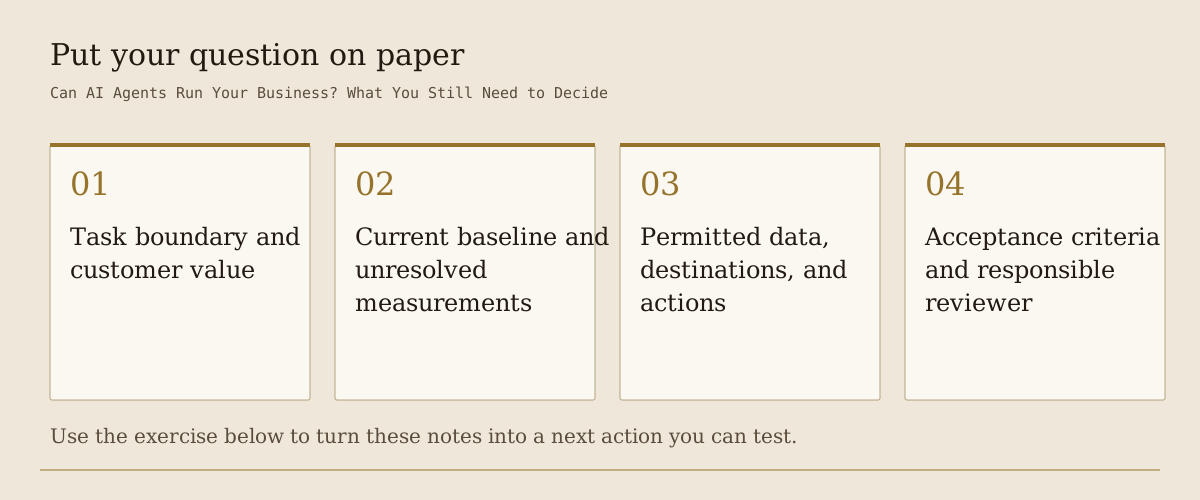
Choose one recurring task and write a one-page pilot decision. Describe the proposed use, who can question it, and what result would make you continue, change, or stop.
Use actual records for costs and existing requirements. Where you don't know something, state the unresolved question and assign someone to answer it. Don't fill uncertainty with a confident estimate merely to finish the page. You can decide to investigate, run a limited trial, or defer the task with a stated reason.
A reflection tool for planning your next step, rather than a predictive score.
- Name one task, its current owner, its input, and its accepted output. Describe where the task begins and ends, including the handoff.
- Record the current process's human time, review effort, recurring cost, and customer value from actual work. Identify any baseline you still need to collect.
- Define permitted information and actions. State what the agent may read or prepare and which changes require a named person's approval.
- Write acceptance criteria and test cases that include a normal request, missing information, conflicting information, and an exception relevant to the task.
- Assign the reviewer and recovery owner. Set a spending boundary and specific stopping conditions, including unauthorized action and material quality failures.
- Choose the next action and put an actual review date in your calendar. At that review, compare accepted work, total effort, costs, and error consequences before expanding scope.
Completed hypothetical example: An owner chooses preparation of internal discovery-meeting briefs from approved public sources. The task begins with a consultant's written research question and ends when that consultant accepts the brief. The customer value is better-informed discussion without asking the client to repeat publicly available information.
The baseline field records that the consultant will document research, drafting, checking, and meeting-preparation time on the current process before comparison. No savings figure is assumed. The permitted-data field specifies the approved public documents and excludes client correspondence, private contracts, and credentials. The permitted-action field allows an internal draft only, with no customer contact or external publishing.
The acceptance criteria require original-source links for consequential statements, visible distinctions between findings and interpretations, and unresolved contradictions kept in view. The test set includes a complete request, a request with missing scope, two conflicting sources, and a document that doesn't support the suggested conclusion. The consultant checks the sources and decides whether the brief is usable.
The owner is responsible for suspending the pilot and returning work to the manual process. Stopping conditions include a material unsupported conclusion, use of an unapproved source, or correction effort that exceeds the boundary agreed before the trial. The spending limit is entered from the actual approved budget rather than invented for this example.
The next action is to collect the baseline and review the pilot specification with the consultant. The owner schedules the first review for two weeks after the trial starts and enters the corresponding calendar date once the start is agreed. The review will decide whether to continue within the same boundary, revise the assignment, or stop. Expansion into private client research would require a separate data and responsibility decision.
Your business may need a clearer process. You may also need to understand why you keep postponing the decision to change it. Those are different questions, and each deserves an honest answer. If the persistent question concerns your own behavior, bring it to AI and the Andes Retreat: five days in Peru's Sacred Valley to examine what is driving the pattern and choose an action to test at home, with continuing support and accountability.
Your working notes
Use this page while you think. Your notes stay in this browser tab; download them before you close it.
What does this question change for you?
A practical answer can change how you work. It can also leave a personal decision unresolved: what to learn, what to stop postponing, or which responsibility to take next. Name that decision before collecting another prediction.
Work through your next decision. Your notes stay in the browser tab, and the exercise gives you no predictive score.
If a recurring pattern keeps preventing action, AI and the Andes Retreat offers five days of practical inquiry in Peru's Sacred Valley, followed by support and accountability. Read about the seminar and assess whether that work fits your question.
Frequently asked questions
Search research, audience discussions, and the existing seminar FAQ library informed these questions. Some wording has been adapted to this guide.
What can AI agents do for businesses?
Consider agents for a defined sequence of work, such as organizing approved information, preparing an internal draft, or proposing a record update. Those are possible pilot designs, not verified capabilities of every product. The important distinction is between producing a suggestion and having permission to act. The OECD practitioner interviews describe varied deployments and levels of autonomy. Evaluate the task, connected tools, review, and consequences before deciding what authority a particular system should receive.
Can I use AI to run my business?
You can investigate AI assistance for parts of your business, but the research reviewed here doesn't establish dependable autonomous operation of an entire company. You still need to define the objective, permit information access, set acceptance standards, and assign responsibility for decisions and mistakes. Start with one process whose result you can check. If it proves useful after supervision and correction costs are included, consider a carefully defined expansion. Don't treat a successful draft or demonstration as evidence that the business no longer needs accountable management.
How do you decide what to automate?
Compare the task's frequency, customer value, current cost, error consequences, data sensitivity, and review requirements. Choose a candidate with an understandable boundary and a result someone competent can assess. Then compare AI assistance with simpler process improvements, including clearer inputs or an ordinary rule-based tool. The decision table above is a planning aid, not a validated score. A task becomes a useful first pilot when its costs and consequences are bounded and the trial can answer a specific operating question.
What should remain manual during an automation pilot?
Keep actions manual where the pilot hasn't established adequate permission, information, or review. A system may prepare a proposed customer response while a person checks the agreement and sends it. It may propose a scheduling change while the coordinator confirms constraints. This is a task-specific boundary, not a permanent list of human-only work. Write which exceptions require escalation and what happens when the reviewer is unavailable. Approval should involve a meaningful assessment, rather than become an automatic step in the interface.
Which AI tool is best for my small business?
The research reviewed here doesn't establish a current product ranking. Choose after defining the task, required connections, permitted data, acceptance standard, and available reviewer. Compare candidates against the same representative work and include setup, checking, correction, and ongoing costs. A tool that produces an impressive demonstration may still fit your operating requirements poorly. Verify current official capability and contract information before adoption. The useful result is a tool suited to your process and team, rather than a general winner detached from the work.
Can I begin a business AI pilot with free tools?
Possibly, if the actual terms, capabilities, and information requirements fit a narrow learning task. Free access doesn't resolve confidentiality, permission, usage limits, or the cost of employee time. Begin with public or fictional practice material when that is appropriate, and verify the current official terms before adding real business information. Don't assume a free demonstration arrangement is suitable for live operations. Evaluate the whole process, including support, recovery, and review, before deciding that an apparently inexpensive tool is the right choice.
How much do AI agents cost?
There is no supported universal price in the research reviewed here. Your cost depends on the actual service, plan, usage, connections, and operating arrangement. Include preparation, setup, review, correction, maintenance, and manual recovery alongside vendor charges. Check current official pricing and set a spending boundary before the pilot. Also distinguish initial learning from recurring work. An inexpensive subscription can still support an expensive process if the team spends substantial time keeping it functioning or correcting outputs that appeared complete when first generated.
How should I calculate ROI for an AI pilot?
For a basic financial calculation, divide net financial benefit by the total investment cost you are accounting for and express the result as a percentage. State the period and which costs you include. The harder question is whether the benefit is real: saved employee time isn't automatically cash savings, and additional revenue isn't automatically profit. Record nonfinancial outcomes, such as improved handoffs or a shorter administrative day, separately. Use measured accepted work and actual costs rather than importing a productivity percentage from a different study.
How can I test and evaluate an AI agent?
Define acceptable work before testing, then use cases representing normal requests, missing information, contradictions, and relevant exceptions. Compare outputs with trusted sources or an independently checked baseline. Record preparation, review, correction, accepted results, and any unauthorized actions. Don't evaluate only the cases that make the system look capable. Keep the pilot's scope small enough to inspect, and name the conditions that require a pause. This practical evaluation method supports your operating decision; it doesn't certify the system for every task or environment.
How should an AI agent's access be authenticated?
The correct implementation depends on the actual systems and their current official documentation. Establish which account or service identity performs the work, how access is granted, and who can revoke it. Keep secrets out of ordinary prompts and shared task records, and have a qualified person review the credential arrangement. Authentication establishes an identity's access; it doesn't establish that every action is appropriate. Define authorization separately, including what the identity may read, change, or send, and preserve a record of consequential actions.
How can I use AI agents more securely in a business?
Begin with a written task boundary, approved data, limited permissions, a competent reviewer, and a recovery owner. Map the connected systems and verify their current requirements with appropriate technical expertise. The OECD report describes checkpoints and gradual autonomy among practitioner responses to reported limitations, but it doesn't certify your deployment. Avoid a general assurance that an agent is secure. Ask instead which actions and information are exposed, what checks exist, and how the team stops or recovers the process.
How can a company protect confidential information when using AI tools?
Identify the information categories, approved destinations, access holders, retention arrangements, and copies created during the workflow. Verify current official terms and relevant agreements before supplying sensitive material. Removing a name doesn't by itself establish that the remaining record is suitable to share. If permission or handling remains unresolved, keep that data out of the pilot. The observed comment behind this question raises a real concern, but neither the comment nor a general agent walkthrough proves that any particular architecture protects your information.
How can I prevent an AI service from using my data for training?
Check the controls for your actual provider, account, and workspace. For example, ChatGPT data controls let eligible users turn off Improve the model for everyone for new conversations; that does not delete saved chats. OpenAI says business and API data are not used for training by default. Training use is only one question. Also examine retention, sharing, integrations, workplace permissions, and any feedback exceptions before entering confidential material.
How do teams preserve decisions across repeated human-agent interactions?
Keep a durable task record containing the current objective, accepted decisions, unresolved questions, source references, and permitted next action. Mark superseded instructions clearly and distinguish proposed work from accepted work. Give each new run the current record it needs rather than depend on an uninterrupted conversation. Test whether another authorized colleague can understand the task from that record. This is an editorial operating practice responding to an observed context-persistence question, not evidence that a particular project-management application reliably solves every long-running task.
Where should a team's AI knowledge base live?
Choose a location the authorized team can maintain, search, and review, with clear ownership and version status. The research reviewed here doesn't establish that one named application is the best destination. Separate current approved guidance from drafts and historical material, and decide who updates information when policies or services change. A knowledge base is useful only if people can identify what is authoritative. Adding more documents without maintaining their status may make the record harder to interpret rather than give an agent dependable business knowledge.
How is a knowledge base different from task context?
A knowledge base holds standing information, such as approved policies and current service definitions. Task context explains the particular request, customer constraints, decisions, and revisions for the work underway. This is a practical distinction for organizing the pilot, not a claim about every product's architecture. Keep the two connected without allowing a one-time exception to become general guidance. Identify owners and current versions, and supply only the information the task needs. Both standing knowledge and task context require maintenance and appropriate access.
What setup is required before a company can use AI agents reliably?
You need more than a model connection: a defined task, approved information, appropriate access, acceptance criteria, an operating record, review ownership, and a recovery process. The precise technical setup depends on your systems and should be checked against current official documentation. Begin with the smallest arrangement that tests the task. Saraev's walkthrough offers one architecture, but the video isn't an independent audit of its security or reliability. Don't copy its components without examining whether your business needs and can maintain them.
How can several AI tools use the same decisions without routing every update through me?
Create an approved shared task record and define which people or systems may read or update each part. Keep accepted decisions distinct from proposals, preserve change history, and make the current status easy to identify. Test whether a new participant can continue from the record without your explanation. The source comment describes an experiment, not independently verified results. You don't need to adopt its particular technology. Choose a maintainable arrangement that reduces repeated interpretation while preserving clear authority over changes and commitments.
How should a team recover when an agent session is lost or changed?
Preserve the current objective, accepted work, remaining questions, and action history outside the session. Before restarting, establish which actions actually completed and which were only proposed. Don't blindly repeat consequential steps. Assign someone to assess the record and restore the appropriate manual or assisted process. Test recovery while the pilot is still bounded. These are general operating recommendations, not a verified recovery recipe for an unnamed product. The important requirement is that a session failure doesn't erase the team's account of the work.
How can a small team keep AI usage costs from getting out of hand?
Set a pilot budget and review actual use before extending access. Separate seat charges from metered usage, and count any connected services and human review. Give someone responsibility for checking the billing dashboard and investigating unexpected activity. Confirm what the provider's limits control; an alert may simply notify you rather than stop spending. Test the service on a bounded workflow before connecting it to repeated or unattended work. Estimate value from accepted outputs, not from the number of requests the team makes.
Sources and evidence
These guides were drafted with AI assistance and checked against the linked sources. Examples labeled hypothetical illustrate a decision; they are not participant stories or measured results.
Studies answer specific questions about particular people, tasks, and tools. Their dates and limits matter. A result about task assistance is not a forecast for an entire profession.
- Skills in the AI age
- The Microstructure of AI Diffusion: Evidence from Firms, Business Functions, and Worker Tasks
- Generative AI at Work
- Shifting Work Patterns with Generative AI, arXiv v4
- We are Changing our Developer Productivity Experiment Design
- Agentic AI in organisations: Early insights from practitioner interviews
- Human + AI in Accounting: Early Evidence from the Field
- ABA Formal Opinion 512: Generative Artificial Intelligence Tools
- A Practical AI Agent Workflow For Companies In 2027 (Guide)
- How to destroy your business with AI in 10 minutes
- The SoulSearching Experience
- Observed public question about preserving agent context
- Observed recovery question in the same context-persistence comment
- Observed public question about knowledge-base location
- Observed public question about subscription and API costs
- Observed public question about knowledge and task context
- Observed public request about practical agent setup
- Observed public request about a shared operational record
- Observed public question about an accurate and current codebase map
- Observed public question about protecting company information
- Observed public question about discussing security without specialist expertise
- Observed public question about using automation skills inside another business
- Observed public question about company-specific AI governance
- OpenAI Help: Data controls in ChatGPT
- OpenAI: Business data privacy
- Canonical seminar FAQ: Why do I keep controlling details I have already delegated?
- Canonical seminar FAQ: Why do I avoid hard conversations even when I know I should have them?
- Canonical seminar FAQ: When does gathering more information actually help?
Where the audience questions came from
These linked discussions and comments supplied questions and wording. They do not establish the truth of the replies, verified professional identities, or how common a concern is.
