You open an AI update before starting the proposal. A new model has appeared. Someone says your current tool is already outdated. Another person explains why the entire way you work needs to change. By the time you return to the proposal, you have several possible improvements and the same unfinished opening paragraph.
Perhaps the update was useful. It might have revealed a feature that removes a real obstacle, a change in data handling you need to check, or an important limitation in a tool your team uses. The question is what it changed. Did you revise the proposal process, schedule a test, or contact the person responsible for approving the tool? Or did your next action remain exactly where it was?
You don't have to stop caring about AI to ask that question. If you're responsible for clients, colleagues, or a business, ignoring relevant developments could be careless. Following every development is a different demand, and you can decide whether it belongs in your workday.
A useful information routine begins with a responsibility rather than a feed. It makes room for broad awareness, specific research, and occasional exploration, while giving each an ending. It also distinguishes a headline about technical capability from evidence that a change will help in your particular setting.
This article offers a practical way to make those distinctions. You'll build a small information log around the news item, the work it affects, the action it changes, and a review date. Use your own entries from an ordinary week. They can show whether your reading supports action, supplies necessary caution, or keeps replacing a decision you already understand. The log is a reflection tool, not a scientific score. Its purpose is to help you choose what deserves your attention next.
Which update would actually change your next action?
Start with a sentence that names something you need to do: prepare a client briefing, review a supplier proposal, document a team process, or decide whether an approved tool deserves a trial. A sentence like 'I need to understand AI' is too broad to tell you when today's research is finished. 'I need to decide whether this tool can draft a briefing from approved materials without adding unsupported claims' gives your reading a job.
That sentence creates useful boundaries. News about a different kind of output may be interesting, but it doesn't automatically belong in the briefing decision. A change in how the tool cites documents could belong. A change in who can access uploaded materials could belong. A demonstration of impressive writing might raise a question without answering it.
Then ask what information could change your plan. Perhaps you'd proceed only if the tool is available through your organization's approved account. Perhaps you'd stop if the source documents can't be traced in the output. Perhaps the decision is already made, and what remains is arranging a test with the colleague who will review the result. Those are different situations. More general news won't resolve all of them.
The existing seminar article on researching instead of starting proposes examining whether research changes what you would actually do. That is a practical reflection question, not a finding about the psychological cause of your behavior. Apply it literally. Write the action before reading, then write the action afterward. A change might be a revised requirement, an eliminated option, or a decision to wait for a specific answer.
Useful reading can also confirm that no change is warranted. You may investigate a release and discover that it doesn't address your problem. Record that conclusion so you don't investigate the same promise again next week. The purpose isn't to manufacture action after every article. It's to make the relationship between information and responsibility visible.
If you cannot name a work decision, you can still read out of curiosity. Give that activity its own place. You don't need to dress an enjoyable technology discussion as preparation for a task it never affects.
What is Nick Saraev's argument for following less news?
In Why You Should Stop Listening To AI News, Nick Saraev distinguishes entertaining technology coverage from learning that improves an actual workflow. His practical question is whether a release changes the task in front of you. Later, he recommends choosing what to learn before searching, so a feed doesn't become the person deciding your curriculum.
That advice is useful when your information routine has no relationship to your responsibilities. You might spend the morning comparing agents even though your current obstacle is an unclear client requirement. You might watch several tutorials about a capability you already have, while postponing the conversation needed to use it. In those cases, reducing general coverage creates an opportunity to address the actual obstacle. It doesn't guarantee that you'll take it.
Saraev also discusses promotional incentives and acknowledges his own use of clickbait. Treat that as a reason to inspect a claim, its source, and its relevance. It isn't evidence that a particular creator is secretly paid or that every dramatic headline is false. Saraev sells education and implementation services himself. His framing deserves the same scrutiny you would apply to another commercially involved commentator.
His experience and recommendations are commentary, rather than an independent measurement of how much news professionals need. A person responsible for a company's approved AI systems may need updates that don't matter to his workflow. Someone working with accessibility requirements may reasonably care about a release that changes access. A procurement decision can turn on availability or price without producing a more impressive demonstration.
The strongest version of the advice is therefore selective: decide what the information is for, then choose sources that serve that purpose. The weaker version would be a blanket instruction to disengage. That would remove useful information along with distracting information.
You can agree with his distinction without adopting all his career recommendations. His emphasis on communication and sales doesn't establish that those skills are permanently protected from technological change. For a broader learning decision, see what to learn when AI keeps changing. Here, the decision is narrower: which information belongs in the routine that supports your existing work?
What should you still monitor when you reduce the noise?
Make a short list of the systems and responsibilities that actually depend on AI. If you use an approved assistant to draft internal documents, monitor the information needed to use that assistant responsibly. If you advise colleagues about new tools, retain a way to notice material developments and route questions to the right people. If AI isn't part of your current workflow, broad awareness may be sufficient until a specific opportunity or requirement appears.
For a system you rely on, official documentation can answer questions that commentary leaves open. What is available in your account? What permissions does the feature require? What does the provider say about the relevant data settings? Has an existing feature changed or been withdrawn? These are questions to check in the actual documentation and organizational guidance. A general article cannot establish the answers for your deployment.
Keep research revisions in view when an important decision depends on a study. A widely shared result may be qualified by its authors later. You don't need to follow every research discussion. You do need a way to revisit the evidence you used when its interpretation is consequential.
There is also a difference between personal learning and organizational responsibility. OECD interviews with 25 organizations describe practitioners dealing with unpredictable behavior, incorrect actions, traceability, and accountability. Reported responses include gradual increases in autonomy, human checkpoints, and domain-expert involvement. The sample is illustrative, not representative, and it doesn't establish a universal operating model. It does give a concrete reason to keep relevant operational information in your routine.
My recommendation is to identify an owner for material updates. That might be you, an IT colleague, a security team, or a supplier contact. Decide which developments they should bring forward and through which existing channel. This is an editorial workflow suggestion, not a certification of safety. Its value depends on whether the person has the authority, information, and time to do it.
Reducing news should leave you with a clearer route for important information. If it leaves you unable to answer who watches the systems your team uses, you've removed too much. A quiet feed and a responsible monitoring arrangement can coexist.
How do you evaluate a headline without turning it into another afternoon?
Use a short sequence before committing to a long investigation. First, identify the actual claim. A headline may suggest that a system can handle an entire business process, while the demonstration shows one selected task. Write the narrower statement that the evidence would need to support. This prevents you from spending time debating an implication the source never tested.
Second, locate the original material. For a product announcement, that means the provider's description and documentation. For research, it means the paper or the authors' report. For a forecast, it means the assumptions behind the forecast. If the original material isn't available, you may have a lead worth following later, but you don't yet have a basis for a consequential change.
Third, ask what was measured. Was it task completion, time spent, assessed quality, adoption, or employment? Those outcomes answer different questions. A result about one task doesn't automatically answer whether you should change a whole workflow. You can see why this matters in Shifting Work Patterns with Generative AI, version 4: the experiment reported individual time savings but did not detect changes in task quantity or composition from individual-level tool provision. Several authors worked for the product vendor, a disclosed conflict worth keeping visible.
Fourth, check fit. Your task may involve different materials, different reviewers, or different consequences. A source can be credible and still have limited relevance to your decision. You don't need to reject it. You need to state the gap between what it shows and what you need to know.
Finally, choose a disposition: relevant enough to investigate, suitable for a bounded test, worth retaining for a later decision, or outside your current scope. Avoid creating a separate backlog entry for every interesting possibility. A backlog without a live question can become another feed you feel obliged to finish.
Set a stopping condition before reading deeply. For example: 'I will check whether the original claim concerns source-grounded drafting. If it doesn't, this item won't enter the current test.' If it does, continue to the question that matters. A boundary should shorten irrelevant investigation while allowing relevant investigation to become more careful.

Does a benchmark milestone tell you that your work has changed?
A benchmark is a structured test. It can provide evidence about performance on the tasks and conditions it includes. To use it well, you need to know the task domain, the success criterion, and the limits of the comparison. The phrase 'AI can do longer tasks' leaves those details unresolved.
METR's Time Horizon 1.1 measures the human-estimated length of sampled software tasks a system can complete at a specified success probability. That is different from the system's elapsed runtime. It is also different from dependable performance across the changing responsibilities of an entire role. A horizon reported at 50% success doesn't mean you can rely on successful completion every time.
The January 2026 release expanded the task set, and the March modeling-assumption audit reported substantial uncertainty and corrections. Task selection and modeling choices affect both point estimates and trends. The audit is a less-reviewed researcher note, so it should inform caution rather than become a new source of confident predictions.
For your information routine, the useful question is whether the result changes an assumption worth testing. Suppose you've assumed that a certain approved software task is beyond the tools available to your team. A relevant capability result could justify revisiting that assumption. It doesn't settle whether the tool can handle your codebase, your instructions, your review requirements, or your recovery process.
Keep the distinction in your note. 'Capability signal worth examining' is a reasonable conclusion. 'Our team should reorganize immediately' requires additional evidence and a decision process. You don't need to convert every technical milestone into an employment forecast to take progress seriously.
A benchmark can also be outside your immediate task and still matter to longer-term planning. Put it in a scheduled planning review instead of allowing it to interrupt today's deliverable. If your real question concerns future scenarios, the article on possible AI changes by 2030 gives that question separate room. This page's task is deciding how a signal enters your routine.
How should you respond when research changes its own conclusion?
Good information routines make room for correction. Otherwise, a memorable result can remain in your thinking long after the original source has explained why it shouldn't be used so broadly. You may remember the number and forget the task, the participants, or the technology involved.
METR's February 24, 2026 productivity update is a useful example. Its 2025 experiment found a 19% slowdown in a particular setting involving experienced developers. The update explicitly cautions against treating that result as today's general effect. Follow-up evidence suggested improved productivity, but selection of participants and tasks, together with difficulties measuring concurrent-agent work, made the estimates unreliable.
That doesn't give you a clean replacement number. It gives you a better understanding of the uncertainty. Repeating the old slowdown as a universal current fact would be misleading. Replacing it with a confident universal speedup would also exceed the evidence. The professional response is to narrow the claim and reconsider what it means for the decision at hand.
When you save a consequential research item, record its version or date and the part of your reasoning that depends on it. You don't need an elaborate citation system for every article. A note such as 'This shaped our choice to test rather than expand; revisit before approving a wider rollout' can be enough to establish a purpose.
At the review, ask whether the revision changes the decision, changes the level of confidence, or simply explains the finding more carefully. Those are different effects. A revised method may justify a fresh test without requiring you to abandon a useful tool. A correction may remove the main support for a proposal and require a pause.
Don't make continuous checking the new obligation. Attach evidence review to an actual decision date, a material source correction, or a relevant change in your system. The point is to keep important reasoning current. It isn't to spend each morning searching for a reason yesterday's decision might be wrong.
When does a new tool deserve a test?
A tool deserves a test when you can connect its claimed capability to a problem you are willing and permitted to examine. Start with the result you need, not the product you want to try. If you can't describe what an acceptable result would look like, you may be testing novelty rather than usefulness.
Choose a bounded task with materials you are allowed to use. Keep the output small enough that a qualified person can inspect it. A first draft of an internal briefing might be a manageable trial. Granting a system authority to change a live customer process introduces a different level of consequence. A short demonstration doesn't make those decisions equivalent.
Write down the baseline. How do you currently produce and review this work? What makes it acceptable? What mistakes would require stopping? You can then compare the assisted process with the existing one, including setup, checking, correction, and handoff. Apparent generation speed is only one part of that comparison.
This measurement recommendation is an editorial application of the evidence. METR's productivity update illustrates how difficult measuring real work can be. OECD practitioner interviews describe organizations using checkpoints and domain expertise to address incorrect or unpredictable actions. Neither source validates a universal test procedure or guarantees a gain from your trial.
Set concrete stopping conditions. Stop if the trial would require unapproved data, if nobody can judge the output, or if the tool needs authority beyond the agreed boundary. During the trial, stop and investigate if a material claim can't be verified or a correction cannot be traced. These conditions should reflect the work's actual consequences, rather than an invented risk percentage.
Give the test a review date and a decision: continue, change the setup, expand carefully, or stop. A completed trial doesn't create an obligation to adopt. It may show that your existing process remains preferable. If selecting learning tasks is the larger issue, use the learning article. If you need a broader preparation plan, see preparing for an uncertain AI future.

Hypothetical example: a consulting partner with a briefing to deliver
Consider a hypothetical consulting partner preparing a briefing for a client meeting. This is a designed example, not a participant story or a report of measured results. The partner follows several AI channels and keeps hearing that better research agents could transform the briefing process. The immediate responsibility is narrower: deliver a useful, accurate briefing from materials the team is authorized to use.
The partner writes the decision before opening another update: 'Should we test assisted drafting for the background section of this briefing?' That excludes the client's final recommendation and any private materials that haven't been approved for the test. It also separates the question from a larger debate about the future of consulting.
Next, the partner names the missing information. Can the proposed process use the approved documents? Can the reviewer trace consequential statements back to them? Is the feature available in the account the team would actually use? An announcement might suggest that the tool is worth investigating, but those questions require documentation and a controlled trial.
The partner then defines an acceptable test. A team member prepares a limited background draft using approved materials. A reviewer compares it with the sources, checks omissions and unsupported statements, and records the work needed to make it usable. The trial includes the effort of preparing instructions and reviewing the result. It doesn't count an attractive first draft as a finished briefing.
Several possible decisions remain open. If the output is difficult to verify, the partner can stop or change the process. If the relevant feature isn't available, the team can retain its current method and revisit the issue when availability changes. If the process appears useful after review, the next decision can concern another similarly bounded task. None of these outcomes is assumed in the example.
Meanwhile, news about unrelated image generation can remain optional reading. A benchmark about longer software tasks can go into a later planning review. An official change affecting the approved account belongs in the operational routine. The filter follows the responsibility rather than the excitement of the announcement.
The example also reveals a possible intention-action gap. If the partner has answered the documentation questions and arranged an appropriate test, yet keeps postponing the instruction to the team, another news item may add little. The next useful question might be why authorizing this small trial is difficult, or whether an organizational obstacle remains unnamed.
Hypothetical counterexample: when following less would be the wrong recommendation
Consider a hypothetical operations leader deciding whether employees can use an AI service with company materials. After considerable reading, a colleague urges the leader to stop researching and try it. The decision still depends on whether the proposed data use is approved and the results can be reviewed.
That recommendation would be wrong if essential questions remain unresolved. The leader may still need confirmation about the approved data categories, the account configuration, who has access, and the authority the service would receive. A broad promise of security in a video doesn't answer those questions. Neither does the leader's confidence or willingness to act.
The OECD's practitioner interviews describe concerns about incorrect actions, traceability, and accountability. They don't verify this hypothetical supplier or establish the right terms for this organization. The practical implication is to gather the actual documentation and involve the people qualified to assess the proposed use.
The leader can still reduce irrelevant news. Instead of comparing every newly announced service, they can send a specific question to the supplier, request review from the appropriate internal owner, and set a date to assess the responses. The decision stays paused until the needed conditions are met. That is an active information process with a boundary, even though deployment hasn't begun.
The stopping conditions matter. If an essential question remains unanswered at the review, the leader can defer adoption or reject the proposal. If the supplier's answer introduces a new material concern, further inquiry is justified. The information routine should allow that concern through. A rigid rule to finish research after a set number of articles would be a poor substitute for judgment.
This counterexample helps distinguish necessary diligence from reading that has lost its purpose. In both cases, the person may have many tabs open. The difference is whether the tabs address identifiable requirements and lead toward a decision. Appearance alone doesn't tell you what the behavior means.
If your situation looks like this, focus on resolving the missing requirement rather than proving you can act quickly. For broader workflow design, the article on AI agents in a small business takes up permissions, review, and recovery in more depth.
Are you learning something, or collecting explanations?
News can introduce a useful learning question. It rarely demonstrates that you can perform the work yourself. After watching a clear explanation, ask what you can now do, explain, or check that you couldn't do before. If the answer is only that the topic feels more familiar, you may need practice rather than another explanation.
The OECD's July 2026 skills synthesis describes AI literacy as including both use and critical evaluation. It treats advanced AI engineering as a separate specialization and discusses foundational, ICT, and complementary skills such as communication and problem solving. This is a useful distinction for an experienced professional: you can pursue competence relevant to your work without treating every technical subject as your next specialization.
A small study also shows why completion and comprehension deserve separate attention. Anthropic's How AI Impacts Skill Formation, version 2, studied 52 recruited, mostly junior developers learning an unfamiliar Python library. The AI group averaged 50% on an immediate comprehension quiz, compared with 67% without AI. That is a 17 percentage-point gap in this setting. Task-time improvement was not statistically significant.
The study doesn't establish long-term cognitive decline or a result across professions. Explanation-seeking and conceptual questions were associated with stronger learning, but those interaction-pattern associations weren't causal estimates. The researchers' affiliation with an AI vendor should also remain visible.
A practical response is to add an independent self-check to a learning session. Try the relevant task, identify where you need help, verify an explanation against trusted material, and explain the important part in your own words. Treat this as a suggested practice, not a method proven to guarantee retention. Your evidence is what you can demonstrate afterward.
For example, if you're learning to prepare a source-grounded summary, can you identify which statements need support and check whether the cited material supports them? If you can't yet do that, watching a more advanced agent demonstration may be premature. You can return to the specific missing skill. Keep the news routine short enough that the learning task has time to become actual work.

How might you run a smaller information routine for one week?
Try a routine you can review after an ordinary week. Choose the boundaries yourself. You might use a planned briefing period, keep official operational alerts separate, and reserve another block for a specific test or learning task. The arrangement should fit your role. There is no universal number of minutes that proves you've consumed the right amount of AI news.
Before the week begins, write down the decisions that information might affect. Keep the list short enough to recognize each decision when an update arrives. Add a place for material system changes and a place for optional exploration. That prevents necessary monitoring, decision research, and curiosity from becoming one undifferentiated obligation.
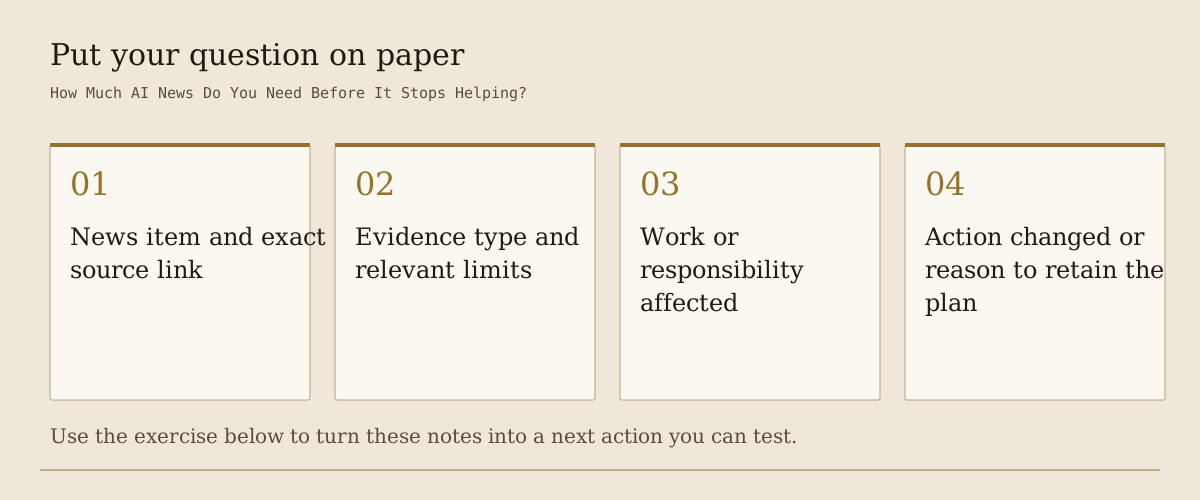
During the week, record your actual entries. Use the news item, the work it affects, the action it changes, and a review date. Add a source link and any unresolved question. Don't try to capture every headline you pass. Record the items that take meaningful attention or enter your reasoning. The exercise below provides a compact format.
At the review, examine the entries before judging the routine. Which items changed a requirement, led to a test, or justified waiting? Which repeatedly introduced new options without helping you assess the current ones? Which information was missing when you needed it? An unhelpful entry doesn't prove the source is poor. It may show that the source serves a different purpose.
Then change one part of the routine. You could remove a duplicative feed, move broad exploration out of the work block, or give a relevant official source a clearer place. If something important arrived too late, revise the alert route. If your research sessions kept expanding, make the opening question and ending condition more specific.
Don't claim a productivity improvement from a feeling of relief or a quieter inbox. You can observe whether the planned task happened and whether the information you needed was available. Even then, a week is a local trial with many other influences. Use it to make an informed adjustment rather than to announce a general result.
The routine succeeds when it remains useful under your actual responsibilities. A demanding procurement week may require more inquiry than a week of familiar delivery. Let the question change the information budget.
What if you understand the options and still keep postponing the decision?
Sometimes the information log shows that the plan has stopped changing. You know which approved task to test. You know who needs to review it. You have a manageable next action, but you keep opening another update before doing it. That observation deserves attention without becoming a diagnosis.
First, check the practical conditions. Is the task genuinely clear? Do you have the authority to begin? Is the reviewer available? Are you being asked to own a consequence without adequate support? More personal reflection won't fix an unresolved permission or a missing professional capability. The existing article on inner work and leadership explicitly distinguishes reflection from the expertise required to manage well.
If those conditions are adequate, examine one moment in the repeated behavior. What happens immediately before you choose another article? Perhaps you expect to have to explain a decision to colleagues. Perhaps you dislike choosing an option that could later look ordinary beside a newer one. Perhaps the next step is a conversation, and researching feels easier than asking for a clear answer. These are possibilities to investigate, not established causes.
Write the sequence in concrete terms: the task, the moment you leave it, the information you seek, and what remains undone. Then change a small part you can observe. You could draft the question for your colleague before opening the feed, put the trial instruction on the calendar, or complete the agreed test before reconsidering tools. Keep material operational alerts available.
The point is to learn whether a changed action helps you address this particular gap. You don't need to predict AI's future or settle your entire career to notice what happens when you follow through once.
If the real question is ordinary worry about possibilities rather than information selection, the article on worry about AI and your future gives that question separate space. If it concerns a major personal choice, the article on decisions under uncertainty addresses the stakes and review process. Here, finish with the responsibility in front of you: what will you do with the information you already have, and what specific question remains?
Compare your options
| What arrives | Question to ask | Useful response | Stopping condition | Review point |
|---|---|---|---|---|
| A general model announcement | Does the described capability address a task I actually need to perform? | Check the original description if the connection is concrete. Otherwise leave it as optional awareness. | No relevant task or decision can be named. | Revisit when a matching task becomes active. |
| An official update to a system you use | Does this change access, permissions, availability, or the agreed process? | Read the relevant documentation and route material questions to the responsible owner. | The operational implications are understood and assigned. | Before the affected change or next use. |
| A benchmark result | What tasks, conditions, and success threshold does it cover? | Record a capability signal and decide whether it warrants a bounded test. | The result doesn't address the assumption behind your decision. | At the next relevant test or planning review. |
| A revision to research you relied on | Which part of our reasoning changes? | Update the claim, its confidence, and any decision that depends on it. | The corrected interpretation has been incorporated. | Before extending the affected decision. |
| A persuasive workflow demonstration | What remains unseen about inputs, review, corrections, and authority? | Investigate the relevant gap or design a limited trial with approved materials. | The next useful answer requires testing rather than more demonstrations. | On the trial's chosen review date. |
| An unresolved data-handling question | What exact documentation or qualified review is missing? | Keep adoption paused while obtaining the necessary answer. | The requirement is satisfied, or the proposal is deferred or rejected. | At the agreed procurement checkpoint. |
| Another tutorial on something you understand | Would practice reveal more than another explanation? | Attempt the task and check what you can explain independently. | A specific learning gap or acceptable performance is visible. | After the practice attempt. |
| Interesting news with no work connection | Am I choosing this as recreation or calling it preparation? | Read deliberately within an optional exploration period. | The chosen period ends. | Only if its purpose changes. |
Build a news-to-action log from your own week
Use a week of your own information choices to design a routine that fits your responsibilities. Don't supply imagined results or compare yourself with an invented ideal reader. This exercise asks what the information did in your work, including when it correctly led you to wait. You can begin with one current entry and complete the review after the week.
A reflection tool for planning your next step, rather than a predictive score.
- Name one live responsibility or decision before collecting entries. Write the next action you currently expect to take, such as requesting a tool review or preparing a limited draft.
- For each item that takes meaningful attention, record its title or description and exact source link. Note whether it is documentation, research, commentary, or a demonstration.
- Write the specific work the item affects. If you can't identify a connection, mark it as optional exploration rather than inventing a work purpose.
- Record what changes in your next action. Include a confirmed reason to keep the current plan, a requirement to investigate, or a justified pause. State any missing answer in one sentence.
- Choose a stopping condition and put a real review date on your calendar. Keep urgent operational alerts outside the ordinary reading limit and identify who will handle them.
- At the end of the week, review your actual entries. Keep sources that served a responsibility, adjust any missing alert route, and change one part of the routine before testing it again.
Hypothetical completed entry, not an observed result: News item: an announcement claiming improved drafting from documents. Evidence type: product announcement; performance on our materials remains untested. Work affected: the background section of an internal project briefing. Action changed: check whether the feature is available in our approved account, then request a limited trial using approved documents.
Missing answer: can the reviewer trace consequential statements to the sources reviewed heres? Stopping condition: do not begin if the data use isn't approved or no qualified reviewer is available; stop the trial for an unverifiable material claim. Owner: the person preparing the briefing, with the designated reviewer. Review date: next Friday, entered in the hypothetical planner's calendar. The decision at review will be to continue, revise, or stop. No gain in speed or quality is assumed.
This entry turns a broad promise into an answerable question. Your completed week may show a different pattern. It may contain valuable operational updates, several justified pauses, or repeated reading that leaves one action untouched.
If you know the next useful action but keep opening another update instead, the question has moved beyond which channel to follow. It concerns your behavior. AI and the Andes Retreat offers five days in Peru's Sacred Valley to examine that pattern, identify what is driving it, and choose an action to test when you return home. You can bring the question you keep circling, with support and accountability continuing afterward.
Your working notes
Use this page while you think. Your notes stay in this browser tab; download them before you close it.
What does this question change for you?
A practical answer can change how you work. It can also leave a personal decision unresolved: what to learn, what to stop postponing, or which responsibility to take next. Name that decision before collecting another prediction.
Work through your next decision. Your notes stay in the browser tab, and the exercise gives you no predictive score.
If a recurring pattern keeps preventing action, AI and the Andes Retreat offers five days of practical inquiry in Peru's Sacred Valley, followed by support and accountability. Read about the seminar and assess whether that work fits your question.
Frequently asked questions
Search research, audience discussions, and the existing seminar FAQ library informed these questions. Some wording has been adapted to this guide.
How do I know if my research is still useful?
Look for a specific effect on your plan. Research can reveal a constraint, eliminate an option, change a requirement, or confirm a reason to wait. Write what you expected to do before the session and what you will do afterward. If several sessions leave the same next action untouched, check whether a test or conversation would answer more. This is a reflection practice from the existing seminar article, not a measured productivity intervention.
Am I researching the wrong question?
Try finishing this sentence: 'A useful answer would let me do this differently.' If the sentence stays vague, make the question more concrete before searching again. You may be asking which tool is best when the unresolved issue is what output you need or who can approve its use. A clear question can still require substantial investigation. The point is to give that investigation a purpose you can recognize, rather than assume that every unanswered question deserves another search.
Why do I keep comparing tools without choosing one?
Your selection criteria may still be unresolved. Tools are difficult to compare when you haven't defined the task, acceptable output, data constraints, and available reviewer. Write those criteria first, then compare a limited set of relevant options. Also check whether you actually want to undertake the project the tool would serve. Repeated comparison alone doesn't reveal a psychological cause. It can reflect a missing requirement, insufficient authority, or a personal choice that product information cannot settle.
What if I genuinely need the information?
Gather it deliberately. Name the missing answer, identify the source or person able to provide it, and explain what you will do with the answer. Keep the current decision paused if an essential requirement remains unmet. You can reduce unrelated news while continuing necessary inquiry. A smaller routine should never force you to ignore a material question simply because your reading period ended. Give the inquiry an owner and a review date so it remains active and accountable.
What is the difference between staying informed and doomscrolling?
For this article, examine purpose, stopping, and consequence. Can you say why you're reading, when the session will end, and what you learned or changed? A useful session may produce understanding without immediate action, especially during planned exploration. Repeated scrolling becomes worth reconsidering when it has no chosen endpoint and displaces work you intended to do. These are practical observations, not diagnostic criteria. You don't need a label before changing one part of your information routine.
Why does AI feel overwhelming?
You may be treating several different demands as one: keeping up with tools, choosing what to learn, monitoring systems, and deciding what change means for your future. Separate the immediate responsibility from broader questions. Identify one task and the information it requires, then give the other questions their own review periods. This is a way to organize ordinary uncertainty, not an explanation of a mental health condition. The research reviewed here doesn't establish why a particular reader feels overwhelmed.
How can I stop repeatedly checking AI news when I intend to work?
Define the work action before opening the feed, and keep necessary operational alerts in a separate route. When you reach for another update, note what question you expect it to answer. If the question is already answered, return to a small, concrete task or identify the conversation you're avoiding. Try the change and review your own entries after a week. This addresses an ordinary work habit; it doesn't diagnose obsessive behavior or promise treatment for distress.
What does shiny object syndrome mean when choosing AI tools?
Use the phrase informally for repeatedly moving toward a new option before evaluating the current one. It isn't a diagnosis here. A new tool can deserve attention if it removes a real constraint or changes an important requirement. The practical distinction is whether you can explain what the switch would improve and how you'll check it. Keep a trial's review date intact unless material evidence justifies reopening the choice. Novelty alone doesn't tell you which process serves your work.
Can free apps help me limit AI news on my phone?
A phone setting or app may be worth testing if it supports a boundary you've already chosen. Check what your current device offers, whether the option is free, and what permissions it requests. This article doesn't have verified current app comparisons for Android or iOS, so it can't recommend a winner. Keep work alerts that matter available. At review, ask whether the boundary helped you complete the intended task, rather than assuming that less screen time alone proves usefulness.
How should I choose an AI news app or aggregator?
Choose around your information needs: access to original links, visible dates, relevant topics, and a reading experience you can end deliberately. Check whether the service distinguishes reporting, announcements, and commentary. You don't need the largest possible stream. The sources reviewed here don't compare current aggregators, so there is no supported best-product ranking here. Try one against your information log and assess whether it helped you find necessary evidence without creating another backlog of stories you feel obliged to finish.
Is there any good news about AI?
There is evidence of useful assistance in particular settings. Shifting Work Patterns with Generative AI, version 4, reported individual time savings, while not detecting broader changes in task quantity or composition from individual tool provision. Several authors were affiliated with the product vendor. The useful response is to examine where a benefit might fit your work and test it. Positive findings don't guarantee your outcome, but uncertainty doesn't require you to dismiss practical possibilities either.
How intelligent is AI right now?
A broad intelligence label doesn't answer whether a system can do your task dependably. Ask about the task, conditions, success criterion, and evidence. METR's software-task time horizons describe performance on sampled tasks at specified success probabilities, not general competence across all work. The research reviewed here cannot rank today's models comprehensively. For a work decision, examine a relevant capability claim and then test the approved system against requirements you can actually review.
How should I choose which AI tool to learn next?
Start with a task you need to perform and the capability missing from your current process. Check access, approved data use, and how you will review the result before committing to learning the tool. A future-facing recommendation from a commentator can't establish the best choice for your responsibilities. Use a limited trial and review what you can demonstrate afterward. The learning article develops this decision further without offering a list of permanently protected tools or skills.
How can a beginner move from AI news to practical use?
Choose a small task you understand well enough to check, using materials you're permitted to share. Describe the result you need, inspect the output, and note what required correction. Keep the first attempt separate from consequential live work. You don't need to master every tool before starting this kind of trial. You do need an approved environment and a way to judge the result. If you can't review it, seek appropriate help or choose a simpler task.
How can I create an AI learning routine without paying for another course?
Begin with an existing work question, relevant official materials, and a scheduled practice attempt. Write what you want to be able to do, then check whether the resources and tool access available to you are sufficient. Free access and terms need current verification. Keep a note of questions that remain unanswered instead of collecting more resources indiscriminately. Review your actual performance at the end of the trial. A paid course becomes a separate decision if a specific learning gap remains.
How should I estimate the time to learn an automation tool for one use case?
Define the use case before estimating. Include the time needed to understand inputs, permissions, errors, checking, and recovery, alongside building the visible workflow. Start with a limited attempt and use your own experience to revise the estimate. The research reviewed here doesn't establish a universal learning duration. A demonstration may omit work you'll need to do independently. Keep the estimate tied to the standard you need to meet, and distinguish learning one task from being ready to maintain a broader system.
What costs should I check before adopting a workflow from an AI demonstration?
Check current account requirements, usage charges, necessary integrations, and the work needed for setup, review, correction, and maintenance. A subscription mentioned in a video may not cover every part of the demonstrated workflow. Verify actual terms with the provider and your organization. The research reviewed here doesn't establish current prices or account entitlements. Keep the cost inquiry tied to the task you want to test, and avoid buying the full demonstrated setup before understanding which parts your use case requires.
How should I interpret a controlled AI safety demonstration?
Locate the original study and distinguish the setup, instructions, observed behavior, and interpretation. Check what the system could actually do and what the demonstration was designed to test. A selected clip doesn't establish the frequency or consequences of behavior outside those conditions. The supplied material doesn't independently verify the dramatic demonstration behind this source question, so no conclusion about that event is offered here. You can retain a concern while waiting for the evidence needed to assess it responsibly.
Why am I postponing my team's AI conversation while reading more updates?
Check what the conversation requires: a clear question, the right participants, adequate authority, and honest limits on what is known. If those are missing, address them. If they're available, notice what you expect the conversation to expose, such as disagreement or a decision you must own. Those are possibilities to examine, not established causes. Draft the opening question and schedule an appropriate discussion. More news may help with a specific fact, but it can't conduct the conversation for you.
Do I need a daily AI newsletter to stay useful in my profession?
No daily reading schedule can guarantee that. Choose sources according to the decisions you need to make. If an update changes a tool you use or a requirement in your work, it may deserve attention. Otherwise, a scheduled review can be enough for your current purpose. Try a short period with fewer subscriptions and protect time for a practical project. Measure what you learn and apply. Reading more headlines is a poor substitute for checking whether you can perform the task that matters.
Sources and evidence
These guides were drafted with AI assistance and checked against the linked sources. Examples labeled hypothetical illustrate a decision; they are not participant stories or measured results.
Studies answer specific questions about particular people, tasks, and tools. Their dates and limits matter. A result about task assistance is not a forecast for an entire profession.
- OECD: Skills in the AI age, July 8, 2026
- Shifting Work Patterns with Generative AI, arXiv version 4, November 13, 2025
- METR: We are Changing our Developer Productivity Experiment Design, February 24, 2026
- METR: Time Horizon 1.1, with March 2026 modeling-assumption audit
- OECD: Agentic AI in organisations: Early insights from practitioner interviews, September 16, 2026
- Anthropic research: How AI Impacts Skill Formation, arXiv version 2, February 1, 2026
- Nick Saraev: Why You Should Stop Listening To AI News
- The SoulSearching Experience: confirmed offer facts supplied in the packet
- Canonical seminar FAQ: How do I know if my research is still useful?
- Canonical seminar FAQ: Am I researching the wrong question?
- Canonical seminar FAQ: Why does my research never converge on an answer?
- Canonical seminar FAQ: How much research is actually enough?
- Canonical seminar FAQ: What if I genuinely need the information?
- Canonical seminar FAQ: What is the difference between staying informed and doomscrolling?
- Canonical seminar FAQ: Does mental clarity stay once you have it?
- Canonical seminar FAQ: Why do I feel unclear even when I already know all the facts?
- Canonical seminar FAQ: Does making a fast decision fix this?
- Canonical seminar FAQ: Can inner work replace management skill or strategy?
- Canonical seminar FAQ: Why do I avoid hard conversations even when I know I should have them?
- Canonical seminar FAQ: What is the difference between a personal development retreat and a personal development course?
- Observed public comment question about choosing tools to learn
- Observed public comment question about time needed to learn automation
- Observed public comment question about beginning practice despite fear of judgment
- Observed public comment question about subscription and API requirements
- Observed public comment question about confidential company information
- Observed public comment question about discussing AI security
- Observed public comment question about interpreting a controlled safety demonstration
- Observed public comment question about AI improvement and repair
- Observed public comment question about skills besides sales
Where the audience questions came from
These linked discussions and comments supplied questions and wording. They do not establish the truth of the replies, verified professional identities, or how common a concern is.