
You can be competent at making decisions all day and still leave one important question unanswered for months. You approve a project, resolve a disagreement, and tell a colleague what needs to happen next. Then someone asks whether you're staying in your current role, changing direction, or taking time away. You explain the options clearly. You still haven't chosen.
AI can make that private question feel larger. A demonstration suggests that work you understand is changing. A confident commentator says you should learn something else. Another says the predictions are exaggerated. You begin wondering whether your next decision requires an answer about the entire future of work.
It doesn't. You need enough understanding to make the particular choice in front of you responsibly. That might mean investigating an offer, asking for a different assignment, testing a possible business, or deliberately staying while you collect specific evidence. Each has different consequences. None requires pretending that the future is settled.
Even official projections have boundaries. The Bureau of Labor Statistics' 2025-2035 employment projections describe a conditional scenario under stated assumptions, rather than a precise forecast. They cannot tell you whether your own next move will work. That limitation doesn't make planning pointless. It tells you what planning needs to include: assumptions you can see, consequences you can examine, and reasons to revisit your choice.
This article offers a practical reflection framework, not a scientifically validated decision score. You'll name your decision, distinguish facts from expectations, compare options, and identify a next action that can produce useful evidence. We'll also examine when a small experiment would be the wrong recommendation.
You may finish with a choice. You may finish with a precise question for an employer, partner, or qualified advisor. Either is more usable than keeping every possibility open while waiting for someone else to make uncertainty disappear.
What is the decision you are actually making?
Start by writing a sentence that contains a choice you have authority to make. The difference between a concern and a decision matters here. You may be concerned that AI will change your profession. Your decision might be whether to accept a particular role, request training, explore another field, or continue your current work through a defined review period. The concern explains the context. The decision identifies what you can do.
A useful sentence includes the action, its scope, and the point at which you need to choose. For example: “I need to decide whether to accept this offer before its stated deadline.” Or: “I need to decide whether to ask my employer about a temporary change in responsibilities.” These sentences expose practical questions. What are the actual terms? Who approves the change? What happens if you decline? A sentence such as “I need to figure out my future” has no comparable stopping point.
Check whether you've combined several decisions. Leaving a job, moving cities, starting a business, and changing how you spend your evenings may appear in one imagined new life. They don't necessarily need to happen together. You might investigate the business without moving. You might change your responsibilities without resigning. You might protect time for something important while keeping the career you've built. Separating these choices can reveal options that a single dramatic question conceals.
Also ask whose decision it is. You can decide to propose a different working arrangement. You cannot decide that your employer will approve it. You can ask a partner to discuss a move. You cannot decide their willingness on their behalf. Write the action you control separately from the response you hope to receive. Otherwise, a plan may quietly depend on other people agreeing to something they haven't considered.
The decision should be narrow enough to examine without making it trivial. “Should I email someone?” may be too small if the real issue is whether you're willing to explore a new direction. “Should I leave everything behind?” may be too broad if you haven't investigated an ordinary alternative. Find the level at which a choice changes what you do next and deserves deliberate consideration.
Finally, name what would count as completing this round of deciding. It could be accepting or declining an offer. It could be agreeing to a limited trial. It could be postponing a commitment until a specified answer arrives. Completion doesn't mean you have settled your whole life. It means this question has an owner, a defined outcome, and a next step. If your main concern is broader preparation, preparing for an AI future you cannot predict deserves its own treatment. Keep this page focused on the choice you're making now.
What do you know, what are you assuming, and what matters to you?
Put these inputs in separate places on the page. A fact, an assumption, and a personal priority can all matter to a decision, but they do different work. If you blend them into one paragraph, an expectation may acquire the authority of a verified fact. A preference may look like a forecast. A missing answer may disappear beneath a confident conclusion.
A fact is something you have an adequate basis to treat as established for this decision. An offer's written location requirement can be a fact. An employer's documented leave policy can be a fact, although whether your request will be approved remains separate. “My manager probably won't support this” is an assumption until you have relevant evidence. “I want fewer evenings interrupted by work” is a priority. It doesn't require a labor-market study to become legitimate.
| Input | Hypothetical entry | How to handle it |
|---|---|---|
| Verified fact | The written offer requires working from the employer's office. | Confirm what the requirement means before comparing options. |
| Assumption | The new role would leave more time for family. | Investigate workload and availability expectations. |
| Personal priority | Regular family time matters more than a more impressive title. | Use it explicitly when judging the tradeoff. |
| Unknown | The current employer might approve a different assignment. | Ask the appropriate person rather than treating either answer as settled. |
Keep the source and scope of a fact visible. A broad study may establish something about occupational tasks without establishing it about your employer. The ILO's 2025 occupational exposure index assesses potential task exposure to generative AI. Exposure isn't a count of eliminated jobs, and it doesn't determine your personal prospects. If you use that research, write the bounded finding rather than converting it into “my role is disappearing.”
Assumptions aren't mistakes to eliminate. Some are unavoidable. You may have to act before knowing whether a new team will suit you or whether a possible customer will buy. The useful question is whether you've named the assumption, considered what happens if it's wrong, and identified a way to investigate it. An assumption becomes dangerous when the plan needs it to be true but nobody has noticed that dependence.
You can also distinguish an assumption from an unknown that has a reachable answer. A contract term may be unclear to you but answerable through the document and appropriate advice. A future market condition may remain uncertain after careful research. Treating both as an invitation to read indefinitely wastes attention. One needs a specific answer. The other needs a plan that acknowledges several possibilities.
At the end of this separation, you should be able to point to each important input and explain its role. That doesn't settle the choice automatically. It gives you a more honest basis for choosing.
Which priorities are you willing to protect when they conflict?
Values become useful in a decision when they describe a tradeoff you are prepared to make. Almost everyone can endorse meaningful work, stability, freedom, family, contribution, and growth. The harder question is what you will protect when one option offers more of one and less of another. A list of admirable words won't tell you that.
Translate each priority into an ordinary condition. If you say autonomy matters, does that mean choosing your schedule, having authority over a project, or being able to decline clients? Those are different forms of autonomy. If you say security matters, do you mean reliable income, predictable hours, a familiar team, or confidence that you can find another role? A new position might improve one while weakening another. Be specific enough to recognize the difference.
Consider the week each option would ask you to live. Consider an ordinary morning, a difficult deadline, and an evening when someone close to you needs your attention. Who sets your priorities? What must you deliver? What can interrupt you? What work would you enjoy doing even when it attracts little recognition? Use the exercise to examine what you want to do, without assuming how you will feel afterward. Its purpose is to keep the decision connected to actual activities rather than an attractive title.
Separate a preference from a requirement. You may prefer a shorter commute while requiring an arrangement that fits a caregiving responsibility. You may prefer an opportunity to learn while requiring a verified professional qualification for the role. Requirements should eliminate options that cannot meet them. Preferences help compare the options that remain. If every preference becomes a requirement, you may create a choice that no real opportunity can satisfy.
Borrowed expectations also deserve examination. Perhaps a colleague thinks consulting is the sensible next move. Perhaps your family associates progress with a more senior title. Their views may contain useful information, but they don't automatically become your priorities. Ask what you would still want if nobody were impressed by the decision. Then ask what responsibilities remain even if nobody were disappointed by it. Both questions matter. Personal agency includes obligations as well as preferences.
You don't have to abandon ambition to inspect what it is asking of you. Wanting to do excellent work, build a business, or lead a team can remain central. You may simply decide that a particular version of success asks for a cost you no longer want to pay. Equally, you might accept a demanding period because the work matters to you and the arrangement is workable. Neither choice is automatically more mature.
If your priorities genuinely conflict, write the loss you accept with each option. That sentence is often more informative than another advantages list. You may not enjoy the loss, but you can decide whether it is a cost you are willing to carry. Questions about your broader relationship to work belong in meaning, purpose, and AI. Here, use that reflection to clarify the criteria for this particular choice.
Are staying, changing, and waiting your only options?
A choice can become harder because its options are poorly described. “Stay or leave” may place a familiar but frustrating situation beside a completely unspecified alternative. “Change direction or wait” may make action sound bold and waiting sound passive. Before comparing options, describe what each one actually involves.
Staying can mean continuing exactly as before. It can also mean staying while changing responsibilities, making a request, investigating another opportunity, or protecting time for a limited test. These aren't equivalent plans. If the problem concerns how work is organized, staying with a concrete adjustment may address it. If the problem concerns a condition that won't change, the same adjustment may avoid the central issue. The label doesn't decide which is true.
Changing direction also needs a destination and a first commitment. Accepting a verified offer differs from resigning to explore an idea. Enrolling in an expensive program differs from examining a sample of the work it prepares you to do. Moving into a familiar adjacent role differs from entering a field whose requirements you haven't checked. You can't compare these alternatives responsibly as one general option called change.
Waiting deserves the same precision. Define what you're waiting for, who can supply it, and what you will do meanwhile. A deliberate wait might allow a written offer to arrive, a professional advisor to explain an obligation, or an employer to respond to a request. A wait for certainty about the entire economy has no such completion condition. Its duration can expand without producing a different decision.
Include the current course as an option with consequences. Keeping things unchanged isn't outside the comparison. It may preserve valuable relationships and a workable routine. It may also leave a known problem in place or allow a time-limited opportunity to expire. Write both. Avoid assuming that action alone carries risk while continuation is free.
At the same time, don't expand the options until comparison becomes its own occupation. A useful set contains alternatives that you could plausibly pursue and that differ in a meaningful way. If two options ask for nearly identical actions and commitments, combine them. If one depends on approval you haven't sought, label it conditional. If an option cannot meet a genuine requirement, explain why it has been excluded.
One practical move is to distinguish the immediate choice from a later commitment. You might decide now to investigate an opportunity, while reserving the decision to accept it. That creates progress without pretending that investigation is endorsement. However, the distinction must be real. Paying a nonrefundable fee or making a public promise may commit you before the later review you imagined.
You should finish with descriptions another person could understand without knowing your shorthand. “Stay while requesting one defined assignment change” is assessable. “Wait until the employer answers the location question, then decide before the offer deadline” is assessable. The comparison becomes clearer because the alternatives finally contain actions.

How would your options behave in different futures?
A scenario is a stated set of conditions you use to examine a choice. It isn't a promise that those conditions will occur. For a decision influenced by AI, you might consider a future in which your workplace adopts relevant tools slowly, one in which particular tasks change more quickly, and one in which customer demand or organizational priorities shift. The scenarios should connect to your decision rather than attempt to describe everything that could happen.
The BLS 2025-2035 projections provide a useful example of why assumptions matter. Their methods broadly assume technological progress follows historical patterns, with exceptional technology adjustments applied conservatively. BLS also acknowledges that exceptionally rapid change could undermine historical relationships used in projections. That makes the projections useful context with explicit limits, rather than a personal guarantee about a job.
Keep capability, adoption, and consequences separate. A system performing a task in a benchmark doesn't establish that your employer has deployed it reliably. Deployment doesn't establish how management will reorganize work. Reorganization doesn't establish what will happen to your own position. The Census Bureau's analysis of AI diffusion, using its November 2025-January 2026 reference period, found adoption varied by firm size and sector, with many adopters using AI in only a few functions or tasks. Those dated findings support examining local conditions; they don't supply a current prediction for your workplace.
Benchmark measures require similar care. METR's Time Horizon 1.1 measures the human-estimated length of sampled software tasks a system can complete at a specified success probability. It isn't a measure of dependable whole-job performance or elapsed model runtime. Its March 2026 modeling-assumption audit reports substantial uncertainty and corrections. A milestone can inform what you investigate without becoming a deadline to reorganize your life.
For each scenario, ask what becomes easier, what becomes harder, and which assumption in your plan is exposed. Suppose you're considering retraining. Would the training remain useful if tools changed? Does the plan depend on demand for one narrow service? If you remain in your role, would you have a way to learn about changing expectations? If you investigate another field, what would count as evidence that it offers the work you actually want?
Don't attach percentages simply to make the worksheet look rigorous. If you lack a defensible basis for probabilities, describe conditions and consequences in words. A plan may be attractive across several scenarios, or it may work only under one assumption. Neither conclusion requires invented odds.
Choose a few indicators you could actually observe, such as a documented change in responsibilities or the response to a real proposal. The broader question of possible AI futures belongs in AI future scenarios for 2030. Your task here is to learn whether the choice remains workable when its assumptions change.
Which part of the decision can you reverse?
Reversibility is a practical question about consequences. Can you stop the action? Can you restore the previous arrangement? What would remain afterward? Calling something a trial doesn't answer those questions. A trial can consume money, affect relationships, expose confidential information, or create obligations that cannot simply be withdrawn.
Separate the action from its effects. You can cancel a future meeting, but you cannot make someone forget what you disclosed during the first one. You can stop studying a topic, but the time already spent is gone. You can leave a new role, but your previous role may no longer be available. These distinctions don't make every decision irreversible. They help you describe the actual cost of changing course.
Look for several dimensions: money committed, time required, obligations created, information shared, relationships affected, and the availability of a return path. An action might be easy to reverse in one dimension and difficult in another. A low-cost public announcement may have a larger relationship consequence than a more expensive private exploration. An apparently modest software test may be inappropriate if it uses information you aren't authorized to disclose.
A useful trial has boundaries that exist before it begins. State the work it includes, the work it excludes, the resources you will use, and the people whose agreement is needed. Identify what stopping requires. If you cannot explain how to stop without relying on vague goodwill, the trial isn't as reversible as you may think.
For organizational AI use, the OECD's September 2026 practitioner-interview report describes human checkpoints, domain-expert involvement, and gradual increases in autonomy as responses to problems such as incorrect or unpredictable actions. Its selected sample is illustrative, not representative, and it doesn't certify any particular pilot. The practical lesson for this article is modest: the ability to limit an action matters alongside the ability to perform it.
Some decisions can't be made reversible enough to use a casual experiment. A medical procedure, substantial legal commitment, or choice affecting another person's safety requires a different process. You may still take a preliminary step, such as obtaining an explanation from a qualified professional, but you should not confuse that information step with testing the consequential action itself.
Also consider whether you genuinely need the previous arrangement back. A decision may be acceptable even when full restoration is impossible, provided you understand the lasting consequences and are willing and able to carry them. Reversibility is one consideration, not a command to avoid all commitment.
The aim is to match the decision process to the stakes. A modest exploration with clear limits can proceed differently from a resignation, relocation, or binding agreement. You don't become more decisive by treating those differences as irrelevant. You become more precise about which part can happen now and which part deserves further evidence, consent, or specialist advice.
Hypothetical example: investigate consulting before resigning
This example is hypothetical. It describes a possible decision process, not a participant story or a reported result. Consider an experienced operations manager who enjoys understanding business problems but is increasingly dissatisfied with a role dominated by internal coordination. AI commentary has made consulting sound like an attractive next direction. The manager's first formulation is whether to resign and become an AI consultant.
That formulation combines several unanswered questions. Does the manager want consulting's actual work, including finding clients, defining scope, and handling uncertain demand? Is there a problem a prospective client wants help solving? Does the manager have the competence and authority to offer that help? Would an independent practice fit existing responsibilities? None of those questions is answered by the general claim that tools are changing.
The manager records four options: remain in the current role unchanged; remain while investigating a focused consulting offer; request a different internal assignment, subject to employer approval; or resign to pursue an independent practice. The immediate decision becomes whether to investigate consulting while keeping the existing employment arrangement.
The known inputs are the manager's present responsibilities and the actual employment terms available for review. The assumptions include enjoying client development, having time for exploration, and finding interest in a defined service. The priorities include doing more problem-solving work and meeting household obligations. Employment restrictions, confidentiality, and any conflicts require appropriate verification before contacting prospective clients or accepting outside work.
A suitable investigation could begin with a permitted conversation about a nonconfidential business problem. The manager would ask what the person is trying to accomplish, how the problem is handled now, and what constraints matter. The conversation would be research, not a disguised promise to deliver technical or regulated services. A separate sample exercise could use invented materials to examine whether the manager enjoys defining the problem and explaining a recommendation.
The manager sets boundaries: no resignation, no substantial purchase, no use of employer materials, and no client commitment during this investigation. The review asks whether the work remains attractive after examining its ordinary demands, whether a specific need has been identified, and what competence or advice would be required next. An encouraging conversation would justify further investigation, not prove a viable business.
Nick Saraev's commentary in the video titled What I'd Learn Instead of Automation in 2026 recommends understanding how a business creates and delivers value. That is attributed advice from a creator who sells education and implementation services, not independent evidence that consulting will be profitable or secure. The title doesn't establish an exact publication date, and no forecast window is used here.
The value of this hypothetical process is the separation of exploration from commitment. The manager can discover that consulting fits, that an internal change fits better, or that neither option is currently workable. Each would inform the next decision. For the fuller career question, see whether to change careers because of AI.
Hypothetical example: can creative work and technical work coexist?
This example is hypothetical. It contains no claimed earnings, audience response, or personal outcome. Consider a senior technical professional who also makes music. A changing workplace has reopened a familiar question: should technical work remain the main career, should music become the main commitment, or could both have a place? The person keeps comparing possible identities while the week continues to contain little time for music.
A public comment in the research reviewed here asks about choosing between creative work and AI consulting, or combining them. That question establishes an observed concern, not evidence that either route is commercially viable. It is useful here because the decision may concern the shape of a week before it concerns a replacement career.
The hypothetical professional first distinguishes three aims. Making music regularly is one. Earning income from music is another. Leaving technical work is a third. One action might contribute to all three eventually, but they need different evidence. Enjoying an evening of creative work wouldn't establish demand for paid work. Disliking a difficult technical project wouldn't establish that an independent creative career fits.
The immediate decision is whether to protect a bounded period for creative work while maintaining existing responsibilities. The person chooses an ordinary task, such as completing and reviewing a piece, rather than building an elaborate public brand first. The purpose is to examine whether the activity has a place in real life when it includes editing, repetition, and finishing, not only anticipation.
The assumptions are written down. There may be usable time after current commitments are accounted for. The professional may prefer making music to researching equipment. Others affected by the schedule may support the arrangement, but that needs a conversation rather than an assumption. The trial has a defined time boundary and doesn't authorize purchases, resignation, or promises about commercial delivery.
At review, the person looks at what was actually attempted and what prevented it. If the creative task didn't happen, the question isn't automatically whether the person lacks passion. The schedule may have been unrealistic. The task may have been too large. A family obligation may have changed. Or the person may have repeatedly replaced making something with watching advice. Those are different observations and deserve different responses.
If the work happened and remains worth protecting, the next choice could be to continue the arrangement. A later commercial investigation would need its own scope, including what a customer wants and whether the professional can deliver it. Combining two activities is an option, not a universal recommendation. For someone already carrying an unmanageable workload, adding another commitment could worsen the situation. A trial should make the tradeoff visible rather than hide it under enthusiasm.
The example also leaves room for a decision without a new career. You might discover that you want music in your life without asking it to support the household. You might want a technical role with different demands. Or you might decide to investigate a more substantial change. None requires proving which field will survive AI indefinitely. It requires identifying what the next commitment is intended to accomplish.

What information would actually change your choice?
Before gathering more information, finish this sentence: “If I learned this, I would change this part of my decision.” It doesn't need to identify a single dramatic fact. It needs to connect the research to a possible action. Without that connection, you may learn many interesting things while leaving the original choice untouched.
Suppose you are considering an offer. A verified requirement to relocate might eliminate it because of a responsibility you cannot move. A written explanation of expected availability might change how you compare it with your present role. A conversation about the actual work might reveal that the title means something different from what you imagined. Each question has a plausible consequence for the choice.
By contrast, a general question about whether AI will transform every profession may have no reachable answer that settles the offer. Even if you develop a view, it may not tell you what this employer expects or whether this arrangement fits your life. Keep broad background reading separate from the specific evidence the decision requires.
Define a research threshold in words. For example, you might need the official program requirements, clarification of a disputed contract term, or a credible explanation of the work from someone familiar with the role. The threshold should reflect the stakes. It isn't a fixed number of articles or conversations applied to every decision. A low-cost exploration and a binding financial commitment deserve different levels of investigation.
Identify who can provide an answer and how you'll assess it. An employer can explain an offer, although a written term may deserve more weight than an informal reassurance. A professional advisor can interpret matters within their competence. A colleague can describe experience, but their experience may differ from yours. If sources disagree, write what the disagreement concerns. Sometimes the right next step is clarification, not collecting additional opinions.
Also identify what cannot currently be known. If future customer demand is uncertain, you may be able to investigate interest without proving a long-term market. If a tool's future capability is uncertain, you can examine its present usefulness for a bounded task. A research stopping condition can acknowledge residual uncertainty. It doesn't have to pretend that every important question has been answered.
Saraev recommends writing down your assumptions and predictions so you can review them later. For this decision, record what you expect the next piece of evidence to show and what you would do if it shows something else. Saraev's reviewed decision commentary.
Set a point to decide what happens if the answer is unavailable. You might narrow the commitment, choose another option, or deliberately defer with a new trigger. Don't let an unanswered request silently extend every deadline. The purpose of research is to improve the basis for a decision. Sometimes it improves that basis by showing that a proposed commitment is too dependent on information you cannot obtain.
What keeps the same decision open?
Look at the sequence of actions around the decision before explaining your personality. Perhaps you write a shortlist, feel briefly settled, and then ask another person for an opinion. Perhaps you choose a test and replace it with a course comparison. Perhaps you draft a request to your manager but keep revising it without sending it. These are observable sequences. They give you something more specific to examine than a label such as indecisive.
Start with practical explanations. Is the action unclear? Are you missing authority, money, time, or another person's agreement? Does a real consequence deserve more investigation? Are the options based on inaccurate information? A decision that won't close may be badly specified rather than emotionally avoided. Treating a genuine constraint as a personal failing won't help you resolve it.
If the practical requirements are reasonably clear, ask what happens immediately before you reopen the question. What do you anticipate having to accept? You might need to disappoint someone, become a beginner, admit a preference, or own a choice with no obvious right answer. These are possibilities for reflection, not explanations to impose on yourself. You don't need to diagnose a hidden cause to notice what you do next.
For example, consider an accomplished person who intends to ask about an internal transfer. Each time the email is nearly ready, they look for another account of AI changing their industry. The reading may be useful in general, but it doesn't necessarily answer whether they want the transfer or whether the employer will approve it. The next action has moved from a specific conversation to a question with no natural endpoint.
Keep a brief record after a research session: what changed in the option, the assumption, the requirement, or the next action? Sometimes the answer will be important. A source may reveal a qualification you need. Sometimes nothing changes because the session merely repeats familiar arguments. This record is a reflection tool. It doesn't measure your psychological health or establish why you are postponing.
The existing article on researching instead of starting examines that recurring behavior in greater depth. You don't need to reproduce its entire framework inside this decision. Use the distinction that matters here: is the next research task intended to answer a defined question, or has research become the action you take whenever the choice becomes uncomfortable?
Change one part of the sequence. If you reopen the shortlist whenever someone offers an opinion, decide in advance what kinds of evidence justify reopening it. If the email is unclear, write the exact request. If a real risk is unresolved, route it to someone qualified to assess it. If the action is feasible but you keep postponing it, name the concern and choose a smaller permitted action that still addresses the decision.
You may remain uncomfortable. The relevant observation is whether your behavior produces the conversation or evidence the choice requires. Understanding a pattern can be useful, but it becomes relevant to this decision when something you do changes.
Whose advice are you using, and who owns the choice?
Advice can supply missing information, reveal an overlooked option, or challenge a weak assumption. It can also move the decision further from your circumstances. The difference depends on what the advisor knows, what they are competent to assess, and what interest they have in your choice.
Ask a specific question rather than requesting a verdict about your life. A colleague can help you understand what a role involves. A qualified professional can address a legal, financial, medical, or technical matter within their scope. A trusted friend can notice a mismatch between what you say matters and the options you're considering. These contributions are valuable without making any one person the owner of your decision.
Commercial incentives deserve ordinary attention. Someone who sells a course may still provide useful guidance, but the course recommendation isn't independent evidence of its value to you. Someone who wants you to stay on a team may emphasize the advantages of staying. Someone who has benefited from a career move may give too little attention to circumstances that made it possible. You don't need to dismiss them. You need to place the advice in context.
Nick Saraev's reviewed commentary on using AI to critique a plan recommends seeking strong objections and stating your final reasoning in your own words. The video was reviewed for this article on October 5, 2026. Its exact publication date was not verified. It isn't independent proof of a decision method. His commercial education and implementation work is also relevant context when evaluating his broader career guidance.
If you use AI for a critique, separate useful questions from factual assertions. A generated objection can prompt you to inspect an assumption. It cannot establish that the assumption is false. If the answer claims an employer requires a qualification, a contract has a particular effect, or a study proves an outcome, verify the underlying source. Asking for a harsher critique doesn't perform that verification.
You can ask an assistant to organize the options you've supplied, identify missing information, or question whether an action meets your stated priorities. Avoid giving it confidential material without the appropriate authorization and data arrangements. For a fuller examination of using AI in this process, see whether to trust AI with a life decision.
After receiving advice, write what changed. Did you learn a fact, revise an assumption, notice a requirement, or hear a preference that belongs to someone else? This is more informative than counting how many people favor each option. A majority vote among people who don't know the constraints may be less useful than one competent answer to the central question.
Own the final statement: what you are choosing, why it fits the information and priorities available, what remains uncertain, and what would justify revision. You can accept help without borrowing another person's certainty. Responsibility doesn't require deciding alone. It requires understanding the basis on which you act.

When would a small experiment be the wrong recommendation?
A small experiment is attractive because it seems to offer progress without a large commitment. Sometimes that is accurate. Sometimes the label hides a consequence that should stop the proposal. You need to examine what the experiment exposes, not merely how much time it takes.
Hypothetical counterexample: A legal professional wants to find out whether an AI service can speed up client work. A colleague suggests uploading a small set of actual client materials because a synthetic exercise feels less realistic. The professional calls this a limited trial. Yet the amount of material doesn't settle confidentiality, authorization, supervision, or applicable professional duties. The proposed test may create an information exposure that cannot be undone by closing the account.
The ABA's Formal Opinion 512 applies competence, confidentiality, communication, supervision, candor, and reasonable-fee obligations to generative AI use. It also keeps responsibility for evaluating and verifying work with the lawyer. This is professional-rule education, not personalized legal advice. The opinion interprets ABA Model Rules and isn't binding law in every jurisdiction; the professional needs to check governing rules and current local guidance.
In this counterexample, “try it and see” is the wrong first recommendation. The next step is to establish the permitted data and workflow conditions with the appropriate people. An exercise using invented or otherwise approved materials might be possible, but it wouldn't answer every question about real client deployment. The test must be designed around the obligations, rather than treating them as a later administrative detail.
The same distinction applies outside law without importing legal rules into every setting. If a decision concerns medical treatment, a binding agreement, a substantial financial commitment, or another person's safety, identify the relevant expertise and authorization before acting. A reflection worksheet can help formulate questions. It cannot supply professional knowledge or make an unacceptable downside acceptable.
Another attractive recommendation can fail more quietly. A person considering relocation may be advised to spend a short period in the destination. That could illuminate daily preferences. It may not reveal whether their employment, caregiving, housing, or legal arrangements are workable. Enjoying a visit and being able to move are different propositions. The preliminary experience should be used only for the questions it can reasonably address.
Set concrete stopping conditions. Stop a proposed test if it would require unauthorized data sharing, exceed your agreed resources, bypass necessary approval, or affect people who haven't consented to the relevant arrangement. Stop if no competent person can evaluate the output where correctness matters. Those conditions don't imply abandoning the wider idea. They identify work that must happen before an experiment becomes appropriate.
There is no universal virtue in acting sooner. Some choices improve when you wait for a material answer. The useful distinction is between waiting with a defined reason and waiting for a feeling of certainty that no amount of information can guarantee.
How does the decision become an action in your calendar?
A decision needs an action that someone can recognize as completed. “Explore a new direction” describes an intention. “Ask the hiring manager to clarify the role's location requirement” describes a task. The task doesn't settle the entire direction, but it can produce evidence the decision needs.
Choose an action with a verb, an object, and a visible result. Read the official requirements and list the questions you cannot answer. Request a conversation with the person who can approve a change. Write a sample proposal using invented information. Discuss a proposed schedule with the people it affects. The first action should move the decision forward, rather than make you appear busy around it.
Check its dependencies. If the action requires approval, obtaining approval may be the first task. If it requires a document, finding the document comes before evaluating the commitment. If another person must participate, your calendar entry can schedule your request but cannot assume their response. Include these distinctions so a task doesn't stall because it was never independently actionable.
Reserve time that fits the actual work. A complicated conversation may require preparation. A short request may not need another afternoon of editing. You don't have to construct a complete productivity system. You need an honest place for this action among responsibilities that already exist. If there is no available time, decide what can be reduced, moved, or declined rather than pretending the task will fit by itself.
Write the completion condition beside the task. The request is sent to the appropriate person. The document is read and unresolved terms are recorded. The sample is finished sufficiently to examine the targeted question. Avoid vague conditions such as feeling ready or becoming fully informed. Those may move whenever you approach them.
If the action doesn't happen, record what prevented it. A real conflict may have interrupted the time. A required approval may be missing. You may have substituted research for the task. Each calls for a different adjustment. Don't treat a missed action as proof that the option is wrong, or as permission to repeat the same plan indefinitely.
Give the decision a review point as well as the task an appointment. Put an actual date on your own calendar, selected according to when the relevant evidence can be available and any real deadline. This article doesn't prescribe a universal duration. A short information request, a bounded work sample, and a major commitment have different timelines.
At review, decide whether to continue, revise, stop, or take the next commitment. Keep those choices explicit. A test that continues because nobody reviewed it can become an obligation without a deliberate decision. The calendar is useful because it gives your intention a practical place and your review a practical occasion. It doesn't replace the judgment needed at either point.
How will you review the choice without reopening everything?
Review the question you intended to investigate. If you tested whether a particular schedule is workable, examine the schedule. If you asked whether an employer would approve a change, examine the answer and its conditions. If you explored whether you enjoy a type of work, examine the ordinary tasks you actually attempted. A review becomes unfocused when every observation is asked to settle your entire future.
Keep the original reasoning available. Record what you knew, what you assumed, and why you chose the action. This makes it possible to distinguish a changed condition from a forgotten reason. It also keeps you from rewriting your earlier expectations to match what happened. You don't need elaborate documentation. A short note can preserve the central assumptions and the intended evidence.
Separate process from outcome. A decision made with careful evidence can still lead to an unwelcome result. A weak decision can occasionally work out well. The outcome matters, but it doesn't alone explain whether your reasoning was sound. Ask whether the relevant information was available, whether you used it appropriately, and whether the action stayed within its stated boundaries.
Then examine new evidence. Did a key assumption become more credible, less credible, or remain unresolved? Did a requirement change? Did someone affected by the plan raise a consequence you hadn't considered? Did the activity fit the week you actually have? These questions can support a specific revision without requiring you to discard every part of the plan.
Decide what would justify reopening the larger choice. A material change in responsibilities, an actual offer, a verified obligation, or a substantial new constraint may be enough. A different commentator's general opinion may not be. You can remain attentive to change while declining to treat every headline as a fresh instruction.
If the test was inconclusive, don't automatically repeat it. Ask whether the question was too broad, the evidence too weak, or the conditions unsuitable. A conversation about general interest may not answer whether someone will buy. A visit may not answer whether a move is feasible. You may need a better question or a different form of evidence. You may also decide that further investigation isn't worth the resources it would require.
Leave room for a deliberate stop. You can decide that an option doesn't fit, that a trial should end, or that the current course remains the most workable choice for now. Stopping doesn't need a dramatic failure. It can follow from learning that the option asks for a tradeoff you don't want.
Finish the review with a decision and the next occasion to reconsider it. If you continue, state what you will continue doing. If you wait, name the trigger. If you commit, identify the action and any necessary professional steps. You still won't know everything about the future. You will know what you've chosen, what the choice rests on, and how you intend to remain responsible as circumstances change.
Compare your options
The comparison below describes different decision processes. It is an editorial aid, not a validated scoring system. Choose the process according to the actual stakes, available evidence, and authority to act. A low-cost label doesn't make an action harmless, and a significant commitment doesn't become wiser simply because you spend longer thinking about it.
| Approach | When it may fit | What to make explicit | Evidence to collect | Stopping or review condition |
|---|---|---|---|---|
| Continue the current course | The arrangement meets present requirements, and no verified change makes immediate action necessary. | What you are choosing to preserve, what remains unsatisfactory, and which costs continue. | Actual changes in responsibilities, available opportunities, or constraints relevant to your decision. | Review on your chosen date or when a named material condition changes. |
| Continue while requesting an adjustment | The difficulty may concern responsibilities, schedule, or scope rather than the entire role. | The exact request, who can approve it, and what you will do if the answer is no. | The employer's response and the written or otherwise confirmed terms of any arrangement. | Stop assuming the adjustment is available if approval or workable terms are absent. |
| Conduct a bounded exploration | You need information about a possible direction before a larger commitment. | The question, permitted activities, resources, affected people, and consequences that remain after stopping. | A relevant conversation, sample of actual work, or verified requirement. | Review when the agreed evidence is available; stop if authorization, resources, or acceptable limits are exceeded. |
| Make a substantial commitment | The option meets requirements, relevant evidence is sufficient, and you understand the lasting consequences. | Obligations, professional advice needed, accepted tradeoffs, and the available return or exit arrangements. | Verified terms, appropriate specialist guidance, and evidence directly connected to the commitment. | Do not proceed while a material obligation or unacceptable consequence remains unresolved. |
| Wait for a defined answer | A reachable answer could materially change the choice, and waiting is workable. | Who supplies the answer, when you expect it, what happens meanwhile, and any real deadline. | The specific answer, rather than general reassurance or additional unrelated opinions. | At the stated point, decide what to do if the answer is still unavailable. |
| Decline or close an option | The option conflicts with a requirement or asks for a tradeoff you aren't willing to accept. | Why it is closed and what new evidence, if any, could justify reconsideration. | No further research unless the reason for exclusion changes materially. | Keep the option closed when new information doesn't address its actual constraint. |
You may use more than one row in sequence. A request can precede an exploration, and an exploration can precede a commitment. Write those transitions down. Otherwise, a harmless-looking first step can quietly become a larger decision before you have reviewed it.
Write one decision you can act on and review
Use this exercise for one current choice, not for a complete life plan. Begin with a decision that is specific enough to examine and important enough to deserve your attention. If it contains a consequential legal, financial, medical, or other specialist question, use the worksheet to prepare for the appropriate advice rather than substitute for it.
The sheet is a reflection tool. It has no total score, probability estimate, or promise of producing the right answer. Its useful output is a choice, a bounded information task, or a clearly explained reason to wait. Write in ordinary language so you can recognize the action later.
A reflection tool for planning your next step, rather than a predictive score.
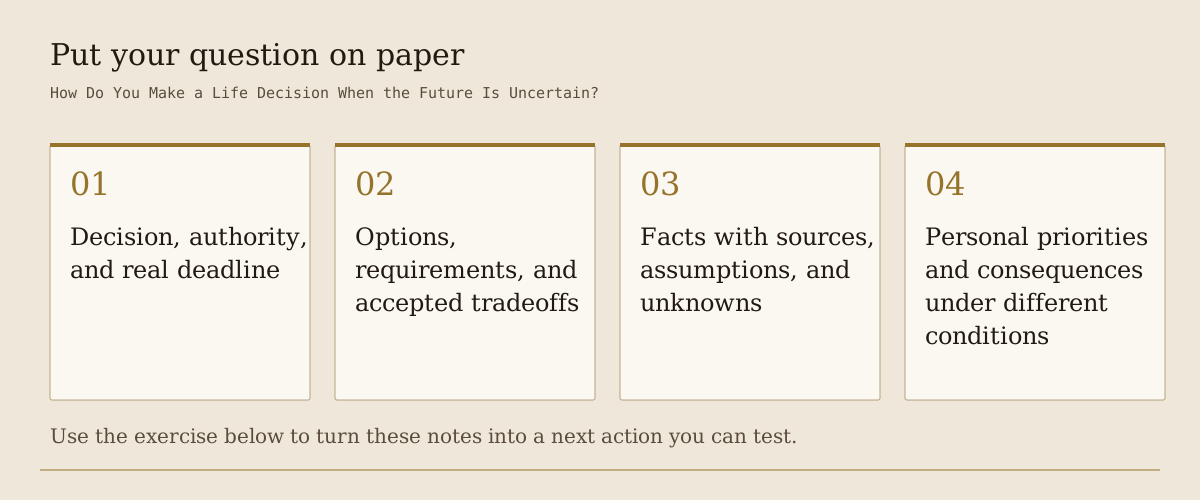
- Name the immediate decision in one sentence. Include the action you control, any real deadline, and the larger commitments this round does not yet authorize.
- Describe the plausible options, including the current course and a deliberate wait if either is relevant. Eliminate options that cannot meet a verified requirement, and explain the exclusion.
- Separate verified facts, assumptions, unknowns, and personal priorities. Record where important facts come from and what each assumption would change if it proved wrong.
- Compare the options under a few explicit conditions relevant to your life. Describe consequences in words, identify lasting effects, and avoid adding probabilities you cannot defend.
- Choose the missing answer or bounded test most likely to inform the next choice. State permitted resources, necessary approvals, what evidence you will collect, and concrete conditions that stop the action.
- Schedule the first task and enter an actual review date in your calendar. At review, record what changed and choose to continue, revise, stop, commit, or wait for a named trigger.
Completed hypothetical example: An experienced project leader is considering whether to pursue an internal role with more client problem-solving. This is an invented example of a completed worksheet, not a report of an actual person's results.
Decision, authority, and deadline: Ask the appropriate manager whether a defined internal opportunity exists and what it requires. The leader can decide to ask; the employer decides whether an opportunity is available. There is no verified offer deadline at this stage. This round doesn't authorize resignation, a public announcement, or accepting responsibilities that haven't been agreed.
Options, requirements, and tradeoffs: Continue the current role; continue while requesting a different assignment; or investigate an external alternative later. Any option must fit the leader's existing personal responsibilities and actual employment terms. The preferred internal option could offer more of the work the leader wants, but may involve additional availability or different performance expectations. Those costs require clarification.
Facts, assumptions, and unknowns: The leader can describe the tasks currently assigned and consult the available employment documents. The assumption is that more client problem-solving would be satisfying. The unknowns are whether the internal opportunity exists, what work it includes, and what availability it requires. AI commentary hasn't established any of those answers.
Priorities and conditions: The leader wants to use existing experience, do more direct problem-solving, and preserve an agreed household schedule. If the proposed role mainly adds presentations without meaningful responsibility, it may not address the preference. If it requires availability incompatible with the household arrangement, the leader would reconsider it. If relevant AI tools change how the work is produced, the question remains whether the responsibilities and actual tasks fit.
Next task, boundaries, and stopping conditions: Send a concise request for a conversation about the role's actual scope and requirements. Use no confidential client material in any outside tool. Don't promise acceptance during the conversation. Stop treating the option as available if the employer says it doesn't exist. If the answer is vague, ask for clarification of the specific condition that matters rather than assuming it is favorable.
Calendar and review: Reserve a real time to prepare and send the request. Enter an actual review date based on the expected response, and move it explicitly if the employer proposes a later conversation. At review, choose among pursuing the opportunity, requesting different terms, investigating another option, or remaining in the current role with a named future trigger. Completion means the request has been made and the next decision recorded, not that the leader feels certain about every possibility.
If the request remains unsent despite being clear and feasible, the leader has a second question to examine: what happens between intending to ask and actually asking? That could concern anticipated judgment, a practical constraint, or a tradeoff the leader hasn't acknowledged. The worksheet doesn't diagnose the answer. It helps identify the moment worth looking at.
If you've examined the options and still keep delaying a decision, look at what happens between the intention and the action. That is a question you can bring to AI and the Andes Retreat. During five days in Peru's Sacred Valley, you'll work on understanding the behavior, identifying what is driving it, and choosing an action you can test at home. The answer remains yours to examine and use. Support and accountability continue afterward.
Your working notes
Use this page while you think. Your notes stay in this browser tab; download them before you close it.
What does this question change for you?
A practical answer can change how you work. It can also leave a personal decision unresolved: what to learn, what to stop postponing, or which responsibility to take next. Name that decision before collecting another prediction.
Work through your next decision. Your notes stay in the browser tab, and the exercise gives you no predictive score.
If a recurring pattern keeps preventing action, AI and the Andes Retreat offers five days of practical inquiry in Peru's Sacred Valley, followed by support and accountability. Read about the seminar and assess whether that work fits your question.
Frequently asked questions
Search research, audience discussions, and the existing seminar FAQ library informed these questions. Some wording has been adapted to this guide.
What is an uncertain future?
An uncertain future is one whose relevant conditions and outcomes you cannot know fully in advance. For a life decision, identify which uncertainty matters: an employer's response, future demand, the work a role involves, or your own preference after trying it. Some unknowns have reachable answers; others remain conditional. You don't need a complete forecast to plan, but you do need to distinguish verified information from the assumptions your choice depends on.
How does planning reduce uncertainty?
Planning can clarify the decision, expose missing information, and identify what you will do under different conditions. It doesn't make external events predictable. A written request may settle whether an employer offers a particular arrangement; a scenario comparison can show how your option behaves if circumstances change. Treat planning as preparation for action and revision. The BLS 2025-2035 projections illustrate why even formal planning depends on stated assumptions rather than certainty.
How do you make decisions with uncertainty?
Name the choice, compare realistic options, and separate facts, assumptions, priorities, and unknowns. Examine the consequences if key assumptions are wrong. Where appropriate, choose a specific action that gathers relevant evidence before a larger commitment. Set stopping conditions and a review date. This is a practical reflection process, not a validated formula. If the decision depends on legal, financial, medical, or other specialist knowledge, obtain the relevant advice before taking the consequential step.
What are irreversible decisions?
They are decisions whose important consequences cannot be fully undone, or can be reversed only with substantial cost or difficulty. Examine specific effects rather than assigning one label to the whole choice. You might stop an activity while retaining obligations, losing time already spent, or being unable to restore a previous role. Information disclosures may also persist. Before acting, identify lasting consequences, necessary consent, and professional questions. A short trial isn't automatically reversible merely because you can end it.
What is the difference between a micro and a macro decision?
In Florian's teaching vocabulary, the distinction separates small everyday choices from decisions with substantial life consequences. It isn't a formal scientific classification. Use the distinction to match the process to the stakes: choosing the first task for an afternoon differs from resigning, relocating, or entering a binding agreement. Assess the actual consequences and return path. A decision that appears small may still need careful review if it affects confidential information, safety, or another person's obligations.
Should I wait until I feel certain before I decide?
Complete certainty may not be available, but that doesn't mean every decision should happen immediately. Distinguish a feeling of reassurance from the evidence and permissions the action requires. A bounded, low-consequence exploration may be reasonable while uncertainty remains. A consequential commitment may need a specific answer or specialist advice first. If you wait, name what you're waiting for, how it could change the choice, and when you'll review the situation. Waiting can be a deliberate decision.
When is deciding quickly useful, and when is waiting responsible?
Speed may fit a clear, modest choice with acceptable consequences and an available exit. Waiting may fit a commitment whose outcome depends on a material answer you can obtain. Neither speed nor delay is inherently wise. Check authority, obligations, affected people, and the cost of being wrong. Set a definite reason for waiting and a review point. Don't use a deadline to force an action that remains inappropriate, or use general uncertainty to postpone a feasible information task indefinitely.
When does gathering more information actually help?
It helps when the information could change an option, resolve a requirement, correct an assumption, or identify a consequence. Before searching, write what answer you need and what you would do differently depending on it. Research can also reveal that a proposed commitment needs to be narrowed or delayed. If the next source merely repeats familiar opinions without changing the decision, reconsider the research task. This is a practical stopping test, not a proven psychological intervention.
How much research is actually enough?
Enough depends on the consequences, the reliability of the evidence, and the questions still unresolved. There isn't a universal article count or information percentage. Define what you need before the next commitment, such as verified offer terms or an appropriate professional explanation. Stop that research task when its question is adequately answered, while recording what remains uncertain. For substantial commitments, don't let an arbitrary time limit substitute for necessary due diligence. For modest explorations, avoid demanding a complete forecast.
What are the signs of analysis paralysis?
In ordinary language, the term can describe repeated comparison that doesn't produce a decision or relevant next action. You might reopen the same shortlist, seek more opinions without changing your criteria, or research around a task you already know how to begin. These observations aren't a diagnosis. First check whether a real constraint, missing authority, or consequential unknown explains the delay. Then examine the sequence of actions and ask what the latest research actually changed.
Is there one root cause of analysis paralysis or overthinking?
No single cause is established by the research reviewed here, and a public article cannot determine yours. Delay might involve unclear options, missing information, conflicting priorities, real obligations, anticipated judgment, or another factor. Start with what you can observe: which action is postponed, what happens immediately beforehand, and what you do instead. Resolve practical barriers before assuming a personal explanation. If distress extends beyond an ordinary decision problem, a worksheet isn't a substitute for appropriate professional support.
How can I help someone who keeps postponing a decision?
Help them name the specific choice and the information it requires. Ask what matters to them, which constraints are real, and what a manageable next action would be. You can assist with an information task or discuss a tradeoff without taking ownership of their answer. Avoid labeling their hesitation or assuming you know its cause. If the decision affects you, state your own needs clearly. Support doesn't require accepting an indefinite delay where shared obligations need resolution.
Can you give me an example of analysis paralysis?
Hypothetically, a manager wants to investigate an internal transfer and already knows whom to ask. Each time the request is nearly ready, the manager starts another comparison of career trends. The reading produces no change in the request, and the conversation never happens. That sequence could illustrate stalled action, but it doesn't establish the cause. The manager should first check whether the request is clear, permitted, and practical, then examine what concern appears immediately before postponing it.
How can I move forward when two options both seem reasonable?
Identify the tradeoff rather than searching for proof that one reasonable option is universally correct. Compare requirements, ordinary tasks, accepted costs, and your priorities. If a bounded test can distinguish the options without unacceptable consequences, define it and schedule a review. If testing isn't appropriate, gather the evidence and advice the commitment requires, then make the choice explicitly. You may have to accept a real loss either way. A reasonable decision doesn't always feel free of regret.
How should I make a decision about a job offer?
Compare the actual offer with your present arrangement and requirements. Verify responsibilities, location, availability, and other terms that could change the choice. Separate what the employer has confirmed from what you expect. Ask questions that address material gaps before the real deadline, and obtain appropriate advice for consequential employment or contractual issues. AI forecasts provide context, not a verdict. For a fuller career comparison, use the career-change article rather than deciding from the title alone.
How should I evaluate a big decision about moving?
Separate wanting to live somewhere from being able to make the move work. Examine employment arrangements, household responsibilities, housing commitments, and any legal or financial questions requiring qualified advice. A visit may inform your preferences, but it won't verify every practical condition. Identify who is affected and what agreement is needed. Compare staying, investigating, and committing as different actions. Set a review point tied to relevant evidence rather than treating a pleasant experience as proof of feasibility.
Can I practice dealing with uncertainty through everyday decisions?
You can practice a clearer process: state a small choice, use relevant information, act within acceptable limits, and review what happened. That is a practical suggestion, not a claim that this exercise trains the brain in a clinically demonstrated way. Keep the stakes appropriate, and don't infer that comfort with everyday choices qualifies you for specialist decisions. The useful practice is making assumptions and consequences visible, then explaining what evidence would justify changing your mind.
What does leaving a decision open actually cost me?
Examine concrete costs rather than assuming every unresolved decision has the same effect. You may spend time repeating comparisons, leave a known problem unchanged, or allow an opportunity to expire. Waiting may also preserve resources while a necessary answer arrives. Record both possibilities. If the decision occupies your attention, note when that happens and what action it replaces. This observation doesn't prove a psychological mechanism; it helps you compare deliberate waiting with continuation that has no stated purpose.
How do I choose when both options have benefits but the downside worries me?
Describe the downside of each option in concrete terms. Ask what would make it manageable and what would make it unacceptable. Then compare the cost of waiting as a third option. You are looking for a choice whose consequences you understand well enough to accept, even if you cannot guarantee the outcome. If a small test would resolve the uncertainty, run it first. If the downside involves a binding legal or financial commitment, get the relevant expertise before deciding.
What if playing it safe leaves me wondering what might have happened?
Treat that possible regret as one factor, rather than a command to take the bigger risk. Write down what staying protects and what it postpones. You may be able to explore the other path through a bounded project, a conversation, or an agreed period of leave. Set a date to review what you learn. If staying remains your choice, name the reason clearly. An explicit decision can be easier to live with than waiting indefinitely while telling yourself you haven't decided yet.
Sources and evidence
These guides were drafted with AI assistance and checked against the linked sources. Examples labeled hypothetical illustrate a decision; they are not participant stories or measured results.
Studies answer specific questions about particular people, tasks, and tools. Their dates and limits matter. A result about task assistance is not a forecast for an entire profession.
- Generative AI and Jobs: A Refined Global Index of Occupational Exposure
- The Microstructure of AI Diffusion: Evidence from Firms, Business Functions, and Worker Tasks
- Employment Projections and Occupational Outlook Handbook: 2025-2035
- Time Horizon 1.1 and modeling-assumption audit
- Agentic AI in organisations: Early insights from practitioner interviews
- ABA Formal Opinion 512: Generative Artificial Intelligence Tools
- What I'd Learn Instead of Automation in 2026
- The most important video you'll ever watch in the age of AI
- Observed public comment asking about creative work and AI consulting
- Observed public comment asking about fear of judgment before practicing
- Canonical seminar FAQ: What is one thing I can do today to think more clearly?
- Canonical seminar FAQ: What is mental clarity?
- Canonical seminar FAQ: Why do I feel unclear even when I already know all the facts?
- Canonical seminar FAQ: Does mental clarity stay once you have it?
- Canonical seminar FAQ: When does gathering more information actually help?
- Canonical seminar FAQ: What is the difference between a micro and a macro decision?
- Canonical seminar FAQ: What about decisions I cannot reverse?
- Canonical seminar FAQ: What does leaving a decision open actually cost me?
- Canonical seminar FAQ: How do you make a decision you can actually live with?
- Canonical seminar FAQ: Should I wait until I feel certain before I decide?
- Canonical seminar FAQ: Why do I put off decisions that have no obviously right answer?
- Canonical seminar FAQ: Does making a fast decision fix this?
- Canonical seminar FAQ: What if I genuinely need the information?
- Canonical seminar FAQ: How much research is actually enough?
- Canonical seminar FAQ: How do I know if my research is still useful?
- Canonical seminar FAQ: Why does my research never converge on an answer?
- Canonical seminar FAQ: What is the difference between feeling lost and not knowing your purpose?
- Canonical seminar FAQ: How long does it usually take to find your purpose?
- Canonical seminar FAQ: Does being happy mean giving up my ambitions?
- Canonical seminar FAQ: Does changing this mean giving up my ambition or my career?
- Canonical seminar FAQ: Can inner work replace management skill or strategy?
- Canonical seminar FAQ: What if I need a co-founder or advisor, not a retreat?
- The SoulSearching Experience: confirmed offer facts supplied in the research packet
Where the audience questions came from
These linked discussions and comments supplied questions and wording. They do not establish the truth of the replies, verified professional identities, or how common a concern is.
