You have a document comparing your options. You've spoken with people whose judgment you respect. You can explain why staying in your current role makes sense, why moving might make sense, and what you would need to learn either way. Then someone asks what you're going to do, and you hear yourself say that you're still thinking.
That answer may be accurate. A consequential decision deserves attention. But perhaps the next step is already quite modest: ask about a different responsibility, arrange a conversation with a potential collaborator, or protect an afternoon to examine what you actually want. You intend to do it. Another ordinary week passes without it happening.
A retreat could be useful at that point, depending on what help you need. It offers a different arrangement of time and attention in which to examine an open question. The important question is whether the work addresses the gap between what you intend and what you repeatedly do, and whether you're willing to carry an action back into your life.
AI and the Andes Retreat is a five-day retreat and seminar for 8-15 participants in Peru's Sacred Valley, without plant medicine. Its confirmed method is to decode behavior, identify what is driving it, change an action, and test that change at home, with continuing support and accountability. That is a specific kind of work. It doesn't supply an AI forecast, professional strategy advice, clinical treatment, or a promise of complete clarity.
You don't need to abandon a successful career to examine one unresolved part of it. You also don't need to travel to make a useful decision. This article helps you distinguish those possibilities, compare forms of help, and prepare a question worth bringing. Start with the decision in front of you. The destination comes later.
What are the signs a retreat might fit your question?
A useful sign is a recurring mismatch you can describe without making a judgment about your whole character. You say you want to explore a new responsibility, yet you keep postponing the conversation. You want more room for meaningful work, yet you accept another commitment before checking your calendar. You want to delegate, yet you take the work back whenever someone approaches it differently.
None of those observations proves that you need a retreat. They give you something concrete to investigate. The relevant question is whether concentrated attention and guided inquiry would help you examine what happens at the moment your intention turns into a different action.
Look at what you've already tried. Perhaps information has changed your understanding, but your behavior remains the same. Perhaps a worksheet helped you name your options, but you haven't returned to it. Perhaps you can hold a useful conversation with a friend, then leave without naming what you will do. These are reasons to consider a different format, provided that format includes work you actually want to undertake.
Fit also involves willingness. You don't have to arrive knowing the explanation. You do need some readiness to examine your part in a situation while allowing for real external constraints. A missing budget, an unreasonable workload, or another person's refusal to cooperate doesn't become a personal failure because you're considering reflection.
Ask yourself what would make attendance worthwhile without requiring a dramatic revelation. A more accurate description of one recurring behavior, a next action you can explain, and a way to review it at home are reasonable aims. If only a guaranteed career answer would justify the trip, the offer doesn't fit that expectation.
You can be capable, ambitious, and functioning well while wanting help with this. The decision to attend doesn't need a story of collapse behind it. Equally, declining can be a considered choice when you have a workable way to address the question where you are.
Which question are you actually bringing?
Before comparing retreats, separate a question about the world from a question about your own next action. Whether an employer will reorganize a department requires workplace information. Whether a qualification is required for a role requires checking actual requirements. Why you keep delaying a conversation despite wanting to have it is a different inquiry.
Your situation may contain all three. Write them separately so that reflection doesn't get assigned a job it cannot do. You might need an answer from your manager, evidence about a possible role, and attention to the way you respond when a decision becomes yours to make.
If AI is part of your concern, keep its uncertainty in proportion to what the evidence establishes. The ILO's 2025 occupational exposure index describes potential task change; it doesn't predict an individual's job loss. The BLS 2025-2035 projections are conditional scenarios under stated assumptions, rather than precise accounts of what will happen to your career. A retreat cannot turn those limits into certainty.
A question you can work with might be: why do I keep seeking another prediction before testing a direction that already interests me? That preserves the legitimate need for evidence while examining a behavior you can observe. It also gives you a possible next action that doesn't depend on knowing the whole future.
Try finishing this sentence: answering my question would let me do something differently in an ordinary workweek. Name the difference. If you can't yet, narrow the inquiry. Bring the meeting you postpone, the offer you haven't examined, or the boundary you keep reconsidering.
For the broader assessment of changing work, use the career-change article. For planning across uncertainty, use the decision article. This page owns a narrower choice: whether a retreat is an appropriate setting for the personal work your question requires.
What could concentrated time make possible?
Concentrated time gives you an opportunity to stay with a question long enough to examine its details. Whether that opportunity becomes useful depends on what you do with it. Time away is an arrangement you can evaluate, rather than evidence that an outcome will follow.
Consider the difference between thinking about a decision while answering messages and sitting down with a particular incident. In the first setting, you might revisit the broad question repeatedly. In the second, you can examine the sequence: what you intended, what happened immediately before you changed course, what you did instead, and what consequence followed.
That sequence can make a conversation more specific. Instead of saying you always avoid responsibility, you can describe declining a project after asking for more responsibility the week before. You can then examine competing explanations. Was the project poorly defined? Did the resources make delivery unrealistic? Did you dislike the work? Did accepting it expose a concern you hadn't stated?
Guided inquiry may help you hold those possibilities open without rushing toward an impressive explanation. Someone can ask what evidence supports your account, what contradicts it, and what action would help you learn more. This describes a possible use of facilitation, not a demonstrated retreat effect.
The setting still matters to your choice. Ask whether you can attend with enough attention available, whether the group format suits you, and whether travel would create more pressure than the time away would address. A beautiful place cannot answer those questions for you.
There is also a useful limit to concentrated attention. Once you've identified information that only a person at home can provide, further reflection may stop helping that part of the question. Write down what needs checking and who can answer it. You can leave with an honest next inquiry rather than force a final decision from incomplete information.
What does AI and the Andes Retreat actually offer?
AI and the Andes Retreat is a five-day retreat and seminar in Peru's Sacred Valley, with 8-15 participants and no plant medicine. Its core method is to decode behavior, identify what is driving it, change an action, and integrate that change into real life. Support and accountability continue after participants return home.
In practical terms, the work begins with something you do or repeatedly don't do. That could be postponing a decision, accepting commitments you intended to decline, or avoiding a conversation you've already decided matters. The inquiry aims to articulate what is happening and identify the driver behind it, then determine the first actions required.
Identifying a driver shouldn't become an instruction to accept an explanation because it sounds deep. You can ask whether it fits the incidents you brought, whether alternatives were considered, and whether the proposed change addresses the behavior. Testing at home matters because the explanation has to remain useful when you're back among the actual people and responsibilities involved.
The offer doesn't require a belief system, and the participant owns the change. You can examine a recurring pattern while continuing to lead a business or pursue a demanding career. The scope is the behavior you want to understand and change, rather than an obligation to reinvent your entire life.
There are clear limits. The seminar isn't therapy, trauma treatment, relationship counseling, or a service that predicts AI's future. It cannot guarantee discovery of life purpose, complete clarity in five days, or business and income outcomes. Nor does this article establish that an AI-focused agenda is part of the program.
The confirmed facts also leave practical details to verify. Dates, price, venue, accommodations, inclusions, application procedures, terms, and the exact arrangement for continuing support need confirmation. Knowing the method helps you assess relevance; it doesn't replace the information you need before making a booking decision.

How do you examine a behavior without diagnosing yourself?
Start with observation. Describe an incident in language another person could recognize: you drafted the message, reread it, and closed the document without sending it. That is more useful than deciding you're incapable of difficult conversations. It leaves room to investigate what actually happened.
Then separate your explanation from the observation. You may suspect that you wanted to avoid disappointing someone. You may also have lacked a clear request, been unsure about your authority, or needed information you didn't have. Several explanations can fit the same outward action. Treat them as possibilities until you've examined the circumstances.
Check ordinary work conditions first. Was there a clear standard? Did the person involved have the competence and resources to meet it? Were you being asked to approve something outside your authority? A cautious response can be appropriate. The purpose of reflection is to improve the accuracy of your judgment, not to make every hesitation evidence of an internal problem.
If a concern about approval does seem relevant, you can name it plainly. Perhaps you find yourself making the request smaller whenever you imagine someone objecting. Ask what you're trying to preserve and what the smaller request costs. You don't need to assign a childhood cause to explore that question.
Choose a change that matches what you've observed. If the request was unclear, write it more clearly. If you were waiting for agreement before stating your position, practice stating the position respectfully while allowing disagreement. These are different actions addressing different possibilities.
Afterward, review both the result and the explanation. Did you do what you intended? Did a real constraint appear? Did the action help you understand the situation? A disappointing response doesn't automatically disprove the action, and a pleasant response doesn't establish that you've found a universal cause. Keep the inquiry attached to the behavior.
Would a retreat, a course, an advisor, or time alone fit better?
Choose the form of help by the work that needs doing. If you can't evaluate an option because you lack knowledge, a course, specialist consultation, or direct conversation may address the gap. If you understand the option but keep avoiding a particular action, behavioral inquiry may be relevant. If you need rest, you can choose rest without assigning it a developmental purpose.
A course is useful to consider when you can name what you want to learn and how you'll use it. Courses can include live teaching, feedback, and accountability; retreats don't have exclusive ownership of those features. Ask what the actual format provides rather than deciding from the label.
An advisor may be more appropriate when your problem needs professional judgment about a business, role, or technical system. You might need someone to examine a strategy, challenge assumptions, or help with a decision that requires expertise you don't yet have. Personal insight doesn't supply that expertise.
Working alone remains a real option. You can protect time, use the fit worksheet below, examine a recent incident, and arrange a conversation afterward. That approach may suit you if you can sustain attention and take the resulting action without a facilitated setting. It can also help you discover what support would be useful later.
A group retreat asks something different of your time and participation. Before choosing it, consider whether you want to examine your question in that format and whether the method is clear enough for you to judge. You don't have to regard the most intensive or expensive option as the most serious.
The comparison table offers practical distinctions, not a ranking of effectiveness. More than one form of help may fit at different stages. A professional advisor could clarify the external choice, while a separate reflective process helps you understand why you haven't acted on what you learned.
Hypothetical example: a senior professional keeps postponing an exploratory conversation
This is a hypothetical example, not a participant account. A senior operations professional is considering a role with more responsibility for changing how the organization works. Their current job is going well. They don't want to resign, and they haven't concluded that the new role is right. They want to speak with someone already doing it.
They've gathered role descriptions, compared requirements, and written questions. Each time they plan to request the conversation, they decide to read one more account of how AI could change the role. The research changes some details but doesn't change the next step. That step remains asking for a conversation.
They begin by checking whether a real obstacle explains the delay. Perhaps contacting the person would create a workplace conflict, or perhaps they need to use an appropriate internal channel. Those constraints deserve attention. In this example, they establish that an exploratory conversation is possible without making a commitment or misrepresenting their intentions.
The personal inquiry becomes narrower: what happens when exploring the possibility makes it visible to another person? They notice that privately comparing roles lets them preserve every option. Requesting a conversation means admitting they want something they may not receive. That is a proposed explanation of this fictional situation, not a diagnosis of people who postpone career conversations.
If they consider a retreat, they can bring the sequence of incidents and ask whether the method addresses it. Their aim would be to understand the delay and define an appropriate action. It wouldn't be to have someone choose a role or guarantee its future.
A possible action is to write an honest request for an exploratory conversation and decide when to send it. The stopping conditions are equally important: they won't make an employment commitment during the exploratory stage, disclose confidential information, or treat a friendly conversation as evidence of an offer.
They put a review date on their calendar before beginning. At that review, they will examine whether they made the request, what they learned, and which question remains. They may decide the new role doesn't fit. That can still be useful information if it came from a considered inquiry.
The professional could do this work independently, with a suitable advisor, or in a retreat setting. The example illustrates how to assess the need for help. It doesn't establish that attending would produce a better outcome.

Hypothetical example: a founder wants to delegate but keeps taking the work back
This is a hypothetical example, not an account of an actual business or retreat participant. A founder wants to spend less time revising routine project updates. They assign the updates to a capable colleague, then rewrite each draft before it goes out. They describe delegation as a priority, but the work continues to pass through them.
It would be premature to explain this as a personal need for control. First they examine the task. Have they written down what the update must include? Does the colleague have the information required? Are some changes necessary to correct a factual error or protect a client commitment? A real quality issue requires a work solution.
In this fictional case, the founder discovers a mixture. Some revisions correct missing information because the instructions were incomplete. Others replace acceptable wording with the founder's preferred phrasing. Separating those categories gives them two different things to address.
The immediate work action is to clarify the required content and the conditions under which an update needs review. The personal inquiry concerns the remaining revisions: why do they still feel compelled to rewrite an acceptable draft? They wonder whether allowing a different voice makes them feel less involved or less visibly useful. They keep that explanation tentative.
A retreat could be relevant to examining the second question. It cannot define the company's obligations, determine whether the colleague is competent, or replace the management work required to delegate well. The founder would need to bring a discreet description of the sequence, without turning other people's private work into group material.
For a test at home, they choose one appropriate update and agree on the required standard with the colleague. They record necessary corrections separately from preferences. The test stops if the content is inaccurate, exceeds the colleague's authority, or creates a material commitment that hasn't been approved.
At a review date chosen in advance, the founder examines what happened. Perhaps they allowed an acceptable draft to stand. Perhaps they discovered that the information flow needs improvement. Perhaps they still rewrote it and can describe the moment they chose to do so. Each result suggests a different next inquiry.
They don't need to become indifferent to quality. Their aim is to make intervention proportionate to the actual work. For the separate question of using agents in a business process, see the guide to AI agents and business responsibility.
When would the attractive recommendation be wrong?
Hypothetical counterexample: a business owner is drawn to a retreat because a major agreement feels unresolved. They have read the documents but don't understand a consequential obligation. They hope that time away will help them feel certain enough to sign.
Recommending deeper personal reflection as the next step would be wrong if the immediate uncertainty concerns what the agreement means. The owner needs appropriate professional advice and a clear explanation of the relevant terms. A calm feeling cannot establish that an obligation is acceptable. The retreat could be considered separately if there is also a recurring behavior they want to examine.
Another wrong recommendation would be to treat an unresolved workplace complaint as a problem the reader should reflect through before using the appropriate organizational process. Reflection can concern how you respond. It doesn't replace a process for addressing conduct, responsibility, or harm. This is a distinction about the kind of work required, rather than advice about a particular legal case.
There is a health boundary too. AI and the Andes Retreat isn't mental health treatment. The National Institute of Mental Health's guidance recommends professional help for severe, persistent symptoms and speaking with a health care provider if symptoms worsen. This page cannot assess your condition or establish what caused it.
A retreat can also be the wrong practical choice when arranging it would undermine responsibilities you haven't covered. You may need a feasible handoff, agreement about leave, or clarity about the total cost before deciding. Choosing to wait for those answers is different from indefinitely postponing a small action you can already take.
Use a concrete stopping condition: don't proceed on the assumption that the retreat will solve a missing professional answer, replace needed care, or make unconfirmed arrangements acceptable. Identify the appropriate person or service, obtain the answer, and then reassess whether there is still a personal question you want to bring.
What should you verify before booking?
Separate interest in the method from agreement to attend a particular event. The first can begin with your question and the confirmed offer facts. The second requires practical answers in writing. You should be able to understand what you're committing to without filling gaps from photographs or older descriptions.
Confirm the dates and how attendance is defined. Ask about the exact venue, accommodation arrangements, rooms, meals, transfers, and any other inclusions relevant to your plans. Ask what is excluded. None of those details is established here, and a general Sacred Valley location doesn't identify a property.
Ask for the full price, deposit, payment schedule, cancellation and refund terms, and what happens if event arrangements change. Include travel and any work or family arrangements when assessing the total commitment. The price and terms have not been confirmed here.
Then ask about the work itself. Request a description of the daily structure and how the method is applied. Ask what preparation is expected, what participation involves, how suitability is considered, and what options exist if an exercise doesn't fit your boundaries. These are questions to confirm, not claims that a particular process is already in place.
Ask how support and accountability continue after you return home. The offer confirms that they continue, while the channel, frequency, duration, and terms still need clarification. Consider how you would use that support when an action is delayed or an earlier explanation no longer fits.
You may also want to ask about facilitator background and the limits of facilitation. Understand what expertise is being offered and what must be handled elsewhere. A confident answer should still allow you to assess relevance for yourself.
Set a decision date after the necessary information is available. If a material detail remains unanswered, pause the booking decision. That isn't a test of courage. It's an ordinary way to make a considered commitment. If the answers establish a workable fit, you can decide without requiring a guarantee about the personal result.

How can you prepare while protecting your boundaries?
Prepare a few incidents rather than a complete account of your life. Choose examples that show the behavior you want to understand: what you intended, what occurred, what you did, and what followed. You can keep the description useful without including names, client records, sensitive documents, or another person's private history.
Write down what you've tried and what changed. This helps distinguish a question that needs more information from one that needs a different kind of attention. It also prevents the work from beginning with an assumption that every previous effort was inadequate.
Decide what you're comfortable discussing in a group and what you would want to ask about privately before attending. Ask about confidentiality expectations, recording, photography, and the handling of personal information. Don't assume that a small group automatically establishes the conditions you need.
For professional material, prepare an account of your own behavior that doesn't depend on revealing protected information. You might describe repeatedly postponing a difficult meeting without naming the organization or the people involved. If the question can't be discussed appropriately without sensitive details, ask what alternatives are available before you commit.
Preparation also includes an honest statement of expectations. Perhaps you want to articulate the question more accurately and choose a first action. Perhaps you want to understand why an intention repeatedly disappears when someone disagrees. State that aim without making your attendance conditional on a particular revelation.
You can remain discerning during the work. Ask for clarification when an interpretation doesn't fit, name a boundary, and distinguish a suggestion from a decision you own. Willingness to examine yourself doesn't require agreeing with every explanation. The home test gives you a way to evaluate what proves useful in your actual circumstances.
What happens when you return to an ordinary workweek?
The action has to meet the circumstances you left. Your calendar, relationships, responsibilities, and unfinished tasks are still part of the question. Plan for that encounter before you go, rather than expecting the usefulness of an insight to make the necessary time appear.
Choose a first action that is specific enough to recognize. Asking for a conversation is clearer than becoming more confident. Agreeing on a review standard is clearer than learning to trust. The action should also remain within your authority and be proportionate to the stakes.
Make room for it in your return plans. Decide what needs to be handed back, which commitments resume immediately, and where the first action belongs. If another person must participate, distinguish sending a request from securing their cooperation. You control the request; you don't control the response.
At the review date, look at what happened without editing it into a success story. Did you take the action? If you didn't, what occurred at the point of delay? If you did, what did you learn about your explanation and the external situation? What requires further information or a different form of help?
Continuing support and accountability are part of the confirmed offer. They can provide a context for discussing those questions, but the actual arrangements need confirmation. This article doesn't promise weekly calls, a particular communication channel, unlimited access, or a set duration.
A changed circumstance may justify changing the plan. A new deadline, a revised role, or information from another person can alter what is appropriate. Record the reason rather than treating every revision as failure or every uncomfortable moment as a reason to abandon the action.
The practical standard is whether you can connect what you understood to something you did and then examine it honestly. That is a review process you can use with support or independently. It doesn't establish that the retreat caused a later business or career outcome.
Can you continue working on the question without attending?
Yes. You can begin with the exercise below and decide what it reveals about the help you need. An independent attempt gives you something more useful than a vague comparison between doing nothing and booking a retreat.
Protect a period of time you can realistically use. Choose one question and one recent incident. Put unrelated research aside during that period, while preserving a separate list of facts you genuinely need to check. The aim is to examine your behavior without pretending the external world has stopped mattering.
Write down a possible explanation and an alternative. If you think you avoided a conversation because you wanted approval, also consider whether you lacked a clear request or an appropriate setting. Choose an action that lets you investigate without creating unnecessary consequences.
Arrange a review date and, if useful, a conversation with someone who can ask careful questions without taking over the decision. Tell them what kind of help you're requesting. You may want them to examine your reasoning, check whether you've described the action clearly, or listen while you work out what matters.
If the inquiry is mostly about what you want your work to express, continue with the article on meaning and work. If you keep collecting information without changing your plan, use the guide to research and AI news. If you're asking an AI system to help, the decision-support article addresses what to verify and what remains your responsibility.
At your review, assess the process as well as the action. Were you able to stay with the question? Did you need professional information? Would facilitation address a difficulty you can now name? Attending remains an option if the fit becomes clearer. Continuing independently is equally legitimate when the work is moving and the arrangement suits you.
Compare your options
| Option | Consider it when | What to examine before choosing | Where its limits matter | A useful next step |
|---|---|---|---|---|
| Independent reflection | You have a bounded question and can protect time to examine it. | Whether you can move from notes to a specific action and return for an honest review. | Time alone doesn't supply missing expertise or another person's participation. | Complete the fit worksheet and put an action review on your calendar. |
| A relevant course | You need knowledge or a skill before you can assess an option. | The content, practice, feedback, time commitment, and relationship to your actual task. | More instruction may leave a particular avoided action untouched. | Name what you need to demonstrate after learning, then compare actual course formats. |
| A professional advisor | Your question needs informed judgment about a role, business, agreement, or technical problem. | Relevant expertise, scope, independence, fees, and what information the advisor needs. | Advice doesn't automatically explain why you repeatedly avoid implementing a considered choice. | Write the professional question and request an appropriate consultation. |
| A company offsite | The decision belongs to a team and requires shared priorities or agreement. | Who needs to participate, who owns decisions, and how the work continues afterward. | Personal reflection cannot create an organizational agreement on behalf of absent colleagues. | Define the team decision and the people authorized to make it. |
| A personal retreat or seminar | You want concentrated behavioral inquiry and are willing to test an action at home. | The method, participation expectations, boundaries, practical arrangements, and follow-through. | It cannot guarantee career certainty, purpose, income, or professional solutions. | Bring a specific incident and obtain written answers to material booking questions. |
| Time for rest | Your immediate aim is time away from ordinary demands. | Whether the arrangement actually allows the rest you want and fits your responsibilities. | Rest doesn't have to resolve a decision to be your chosen purpose for time away. | Plan the break honestly without requiring it to produce a personal revelation. |
| Appropriate health care | You need assessment or treatment rather than an ordinary decision exercise. | The help suited to your situation with a qualified provider. | AI and the Andes Retreat isn't mental health treatment. | Use appropriate professional care; NIMH recommends help for severe, persistent symptoms. |
These options can serve different parts of the same situation. Begin with the immediate need, then reconsider what remains. For the health guidance cited here, see NIMH's guide to seeking help.
A fit worksheet for the question you would bring
Use this worksheet before choosing a retreat. It is a reflection tool, not a validated score or an application assessment. You don't need a polished explanation. Write enough to distinguish your open question, the behavior you can observe, and the kind of help that would actually fit.
Work with one recent incident. Leave space for uncertainty and external constraints. The exercise is complete when you have a considered next action or a specific missing answer to obtain, together with a review date and stopping conditions.
A reflection tool for planning your next step, rather than a predictive score.
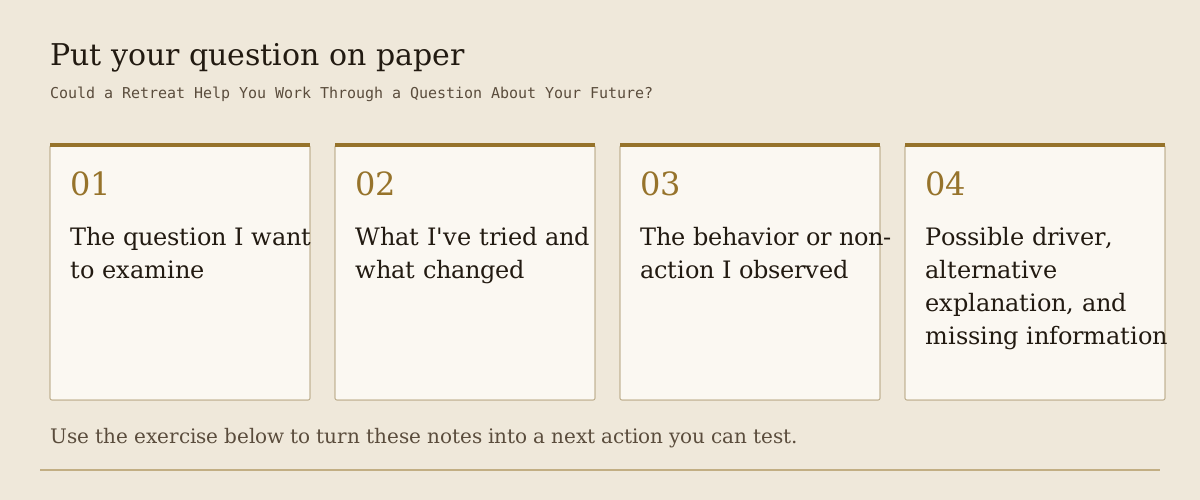
- Write the question in one sentence. Name what answering it would let you do differently in an ordinary week. Narrow broad requests such as knowing your whole future to a decision or recurring behavior.
- List what you've tried. Include relevant reading, conversations, worksheets, or actual experiments. Beside each, write what changed in your understanding or action, and what remained unresolved.
- Describe one incident without labeling yourself. Record your intention, what happened immediately before you changed course, what you did instead, and the consequence you can actually observe.
- Write a possible driver and at least one alternative explanation. Check missing information, unclear responsibilities, resources, and real risk before assigning a personal cause.
- Choose one proportionate next action. Specify what you will do, whom it involves, what remains outside your control, and the conditions under which you will stop or seek different help.
- Choose the support that fits this action and put a review date on your calendar. If you're considering attendance, obtain the material program and booking details before committing; at review, examine what happened and revise your explanation if needed.
Completed hypothetical example: a department leader wants to explore a broader role but keeps postponing an introductory conversation. This is an illustration of the worksheet, not a participant outcome.
The question: why do I postpone asking about the role when I already want to understand it? A useful answer would let me make an honest exploratory request without treating it as a commitment to move.
What I've tried: I've compared requirements and prepared questions. That work helped me identify what I need to ask, but I haven't contacted anyone. More general predictions about work haven't changed the next step.
The observed behavior: after drafting a request, I return to role comparisons and leave the message unsent. My possible explanation is reluctance to make my interest visible. An alternative is uncertainty about the appropriate internal channel, which I need to check.
The action: confirm the appropriate channel, then send an exploratory request if that route is suitable. I won't resign, imply that I've decided to move, or disclose confidential information. I'll stop if the proposed contact creates a conflict I haven't resolved. I'll choose a calendar date now to review whether I sent the request and what I learned.
The help that fits: first obtain the workplace information. If the repeated delay remains after that answer, consider independent reflection or facilitation focused on the behavior. Before any retreat commitment, verify logistics and the actual continuing-support arrangement.
AI and the Andes Retreat is for a question you are willing to examine through your own behavior. The five-day seminar in Peru's Sacred Valley brings together 8-15 participants, with no plant medicine. You'll work on understanding what is driving a pattern and choosing an action you can test at home. You may need an answer from a conversation, or space to find your own answer. Either way, the work continues in ordinary life, with support and accountability after the seminar.
Your working notes
Use this page while you think. Your notes stay in this browser tab; download them before you close it.
What does this question change for you?
A practical answer can change how you work. It can also leave a personal decision unresolved: what to learn, what to stop postponing, or which responsibility to take next. Name that decision before collecting another prediction.
Work through your next decision. Your notes stay in the browser tab, and the exercise gives you no predictive score.
If a recurring pattern keeps preventing action, AI and the Andes Retreat offers five days of practical inquiry in Peru's Sacred Valley, followed by support and accountability. Read about the seminar and assess whether that work fits your question.
Frequently asked questions
Search research, audience discussions, and the existing seminar FAQ library informed these questions. Some wording has been adapted to this guide.
What are the benefits of going on a retreat?
A retreat offers an opportunity to give a question concentrated attention in a different setting. For this decision, look for a clear method, appropriate participation, and practical follow-through. Those features describe what you can assess before attending; they don't prove a particular benefit will follow. A reasonable aim is to understand one recurring behavior more accurately and define an action to test at home. You can also pursue that aim independently.
What are the signs you need a retreat?
No sign establishes that you need one. Consider fit when you've understood your options but repeatedly postpone an action, when you want concentrated inquiry, and when you're willing to test a change afterward. Check external constraints before interpreting delay as a personal pattern. Missing information, unclear authority, or a difficult workload may require a different response. A retreat is one possible format for the work, rather than a necessary step toward making a decision.
How could a retreat help me examine career clarity?
It may give you a setting to examine what you want and why a particular next action keeps being delayed. Bring a specific question, such as your reluctance to request an exploratory conversation, rather than asking for a guaranteed career answer. Role requirements, opportunities, and professional information still need checking outside the retreat. For the larger career assessment, use the career-change guide. The retreat decision concerns whether its method fits the personal work that remains.
What is a personal development retreat?
The term describes a program organized around personal inquiry and practice, but the label alone doesn't establish its method or practical arrangements. AI and the Andes Retreat is a five-day retreat and seminar for 8-15 participants in Peru's Sacred Valley, without plant medicine. Its focus is understanding a recurring behavior, identifying its driver, and determining actions to test at home. Ask about the actual program structure and logistics before assuming what any retreat includes.
Is a corporate retreat the same thing as a personal development retreat?
They can have different purposes, so check who the work is for and who owns the decisions. A company offsite may concern shared strategy, responsibilities, or team agreement. This personal seminar concerns behavior the participant wants to understand and change. It cannot make an organizational decision on behalf of absent colleagues. If your question requires a team agreement, arrange that work with the relevant people rather than expecting individual reflection to resolve it.
What is the difference between a retreat, a seminar, and a workshop?
These labels aren't enough to tell you the duration, accommodation, teaching style, or depth of a particular program. Ask what happens, how participation works, and what continues afterward. AI and the Andes Retreat uses both retreat and seminar as format terms and has a confirmed five-day duration. Don't infer residential arrangements or a daily schedule from those words. A shorter workshop could fit a bounded need, while a longer format requires its own practical justification.
How does a personal development retreat differ from taking another course?
Compare the actual work each offers. A course may address knowledge you need, and it can include live practice, feedback, or accountability. A retreat may offer concentrated inquiry into a recurring behavior. Neither label guarantees usefulness. If you don't understand an option, learning may be the immediate need. If you understand it but keep postponing an appropriate action, examine whether behavioral facilitation fits. Choose by the unresolved task rather than assuming one format is inherently deeper.
What happens during the seminar, and which details need confirmation?
AI and the Andes Retreat is a five-day seminar that examines a behavior, what drives it, and a changed action to test in daily life. Support and accountability continue after participants return home. The daily schedule, specific exercises, and any AI-focused agenda are unconfirmed, so ask about the structure, preparation, participation boundaries, and practical arrangements before committing.
What is a useful question to bring to a retreat?
Bring a question connected to something you can observe and act on. You might want to understand why you postpone a conversation, take delegated work back, or accept commitments you intended to decline. Describe a recent incident and what you've tried. A broad question about your entire future can be narrowed to the next choice it contains. Keep missing professional information on a separate list so that reflection isn't asked to supply an answer requiring expertise.
Could this work be relevant even if my career is going well?
Yes. The confirmed audience includes capable people with a persistent gap between their intentions and actions. You may want to examine one behavior while continuing a successful career or running a company. You don't need to present your life as a crisis to justify that interest. Consider whether the question is specific, whether the method fits, and whether you want to participate. Professional success alone neither establishes nor rules out the usefulness of personal reflection.
Does examining a recurring pattern require giving up my ambition or career?
No. You can retain a demanding goal while reconsidering how you act toward it. For example, you might continue holding a clear standard while changing the way you communicate a request, or pursue a new responsibility while examining repeated delay. The work doesn't require renouncing success. It also doesn't promise improved performance. Define the behavior you want to change and judge the proposed action against your responsibilities, priorities, and actual circumstances.
What if I need an advisor rather than a retreat?
Choose appropriate expertise when the immediate question concerns a strategy, agreement, technical system, or role you can't adequately assess. Personal reflection doesn't supply missing professional knowledge or another decision-maker's participation. You can ask an advisor a clearly scoped question, then reconsider whether a behavioral inquiry remains. Both forms of help may be relevant to different parts of the situation. You don't need to book a retreat to demonstrate that you're taking your decision seriously.
What can't a retreat do for a founder?
It cannot restructure your business, recruit a missing colleague, negotiate an agreement, or provide a guarantee about revenue. Those tasks require the relevant people, information, and work outside the seminar. It may offer a setting to examine a recurring behavior that affects how you approach them. Keep the distinction practical: identify what needs a business solution and what concerns your own action. AI and the Andes Retreat also doesn't replace health care or provide mental health treatment.
When would another form of help fit my situation better?
Another option may fit when you primarily need professional information, a team agreement, rest, or assessment and treatment. A retreat focused on behavioral inquiry shouldn't be expected to supply those services. For severe, persistent symptoms, NIMH recommends professional help; it also advises speaking with a provider if symptoms worsen. This page doesn't assess your condition. Begin with the immediate need, then consider whether a separate personal question remains worth exploring.
How can I assess the work instead of choosing by the setting alone?
Ask how the method connects your question to an action and how that action is reviewed after return. Examine participation expectations, facilitator background, boundaries, and practical arrangements. Photographs can show a setting, but they don't establish those answers. A vacation may be exactly what you want; be clear about that purpose. If you're seeking behavioral inquiry, assess the proposed work on its own terms without treating a beautiful location as evidence of an outcome.
How much does it cost to go to a retreat?
This manuscript doesn't establish a price for AI and the Andes Retreat. Request the full price, deposit and payment structure, inclusions, exclusions, and cancellation terms in writing. Consider travel and the arrangements you need for work or home alongside the program charge. Don't infer a total from older pages or assume accommodation and transfers are included. Pause the booking decision if a material cost remains unclear, then assess the commitment against the work you actually want to undertake.
What should I verify before booking a personal development retreat?
Confirm dates, venue, accommodation arrangements, price, inclusions, terms, and the actual program structure. Ask how suitability is considered, what participation involves, and how personal information is handled. For continuing support, request the channel, frequency, duration, and terms rather than assuming a schedule. AI and the Andes Retreat confirms support after return, but those details remain to be established. You should have enough written information to make a considered commitment without filling gaps yourself.
Which workplace issues require a formal process rather than personal reflection?
Concerns involving harassment, discrimination, safety, or a complaint about conduct call for the appropriate organizational or professional channel. Don't postpone that work until you've reached a personal explanation at a retreat. Reflection may concern your response and can remain separate from the process addressing the issue. This is a practical distinction, not an assessment of a particular case or jurisdiction. If you're unsure about responsibilities or procedure, obtain appropriate guidance rather than relying on this article to settle them.
How is a working retreat different from a temporary reset or vacation?
Rest may be valuable on its own. For a working retreat, examine what you are expected to do and what you will carry home. AI and the Andes Retreat centers on examining behavior, understanding what is driving it, and choosing an action to test in ordinary life. That is a basis for assessing fit; it isn't proof of a lasting result for every participant. Ask about the work and continuing support before booking, alongside the practical details that still need confirmation.
How can I judge a retreat's value after returning home?
Choose a behavior to observe and an action you intend to test before you return. Review what you actually did, what happened, and what you need to adjust. A moving experience during the retreat can matter, but it isn't the same as a change in an ordinary week. AI and the Andes Retreat includes continuing support and accountability; confirm how that applies before attending. Judge the work against the question you brought and the actions you took, rather than a promise that every part of life will improve.
Sources and evidence
These guides were drafted with AI assistance and checked against the linked sources. Examples labeled hypothetical illustrate a decision; they are not participant stories or measured results.
Studies answer specific questions about particular people, tasks, and tools. Their dates and limits matter. A result about task assistance is not a forecast for an entire profession.
- The SoulSearching Experience: confirmed offer packet, last confirmed September 26, 2026; public destination supplied for review
- Generative AI and Jobs: A Refined Global Index of Occupational Exposure, ILO and NASK, May 20, 2025
- Employment Projections and Occupational Outlook Handbook: 2025-2035, BLS release dated August 27, 2026
- My Mental Health: Do I Need Help? National Institute of Mental Health, revised 2025
- Canonical seminar FAQ: What is a personal development retreat?
- Canonical seminar FAQ: What should you ask a center before booking a personal development retreat?
- Canonical seminar FAQ: What actually happens on a personal development retreat, day to day?
- Canonical seminar FAQ: Who is a personal development retreat actually for?
- Canonical seminar FAQ: Who should think twice about a personal development retreat, or skip it?
- Canonical seminar FAQ: How do you tell a serious personal development retreat from a repackaged vacation?
- Canonical seminar FAQ: Does a personal development retreat actually work, or does the change fade afterward?
- Canonical seminar FAQ: What is the difference between a personal development retreat and a personal development course?
- Canonical seminar FAQ: What is the difference between a personal development retreat, a seminar, and a workshop?
- Canonical seminar FAQ: Is a corporate retreat the same thing as a personal development retreat?
- Canonical seminar FAQ: What if I need a co-founder or advisor, not a retreat?
- Canonical seminar FAQ: What can't a retreat do for a founder?
- Canonical seminar FAQ: Does changing this mean giving up my ambition or my career?
- Canonical seminar FAQ: Is there research proving inner work increases business performance?
- Canonical seminar FAQ: Can inner work replace management skill or strategy?
- Canonical seminar FAQ: Why do I keep controlling details I have already delegated?
- Canonical seminar FAQ: Why do I avoid hard conversations even when I know I should have them?
- Canonical seminar FAQ: Does inner work make you soft, or worse at holding a standard?
- Canonical seminar FAQ: When should a workplace pattern go to HR instead of self-work?
- Canonical seminar FAQ: Why do I feel unclear even when I already know all the facts?
- Canonical seminar FAQ: Does mental clarity stay once you have it?
- Canonical seminar FAQ: What is one thing I can do today to think more clearly?
- Canonical seminar FAQ: When does gathering more information actually help?
- Canonical seminar FAQ: What about decisions I cannot reverse?
- Canonical seminar FAQ: Why do I put off decisions that have no obviously right answer?
- Canonical seminar FAQ: Am I researching the wrong question?
- Canonical seminar FAQ: What if I genuinely need the information?
- Canonical seminar FAQ: How do I start over in my career?
- Canonical seminar FAQ: Why is going back to work harder than leaving?
- Observed public comment question about fear of judgment and not attempting practice; question provenance only
Where the audience questions came from
These linked discussions and comments supplied questions and wording. They do not establish the truth of the replies, verified professional identities, or how common a concern is.