You can be good at your work and still wonder whether continuing to get better at it makes sense. Perhaps your team now uses AI to draft material you once prepared yourself. A client asks why a project still takes so long. A colleague starts talking about consulting, while another insists that experience will always be valuable. You finish the day with several plausible opinions and no clearer decision about your own career.
The useful starting question is smaller than whether your profession has a future. What is changing in the work you actually do, and what would you want to change in response?
That distinction matters. The ILO's 2025 occupational exposure index assesses potential changes to tasks. It doesn't count your future job loss or establish when an employer will adopt a tool. Your decision needs evidence about your situation as well as a wider view of technological change.
You might need a different employer rather than a different profession. You might want to keep your domain knowledge and take responsibility for a new part of the work. You might also have a sound reason to move into another field. None of those choices becomes more responsible simply because it sounds more dramatic.
This article helps you compare those possibilities without choosing for you. You'll examine the work, identify what carries forward, investigate an actual destination, and design a limited test before making a larger commitment. You'll also look at the gap between knowing what to investigate and repeatedly postponing the conversation or experiment that would help.
You don't have to dismiss AI to preserve your ambition. You don't have to abandon an established career to prove you're paying attention. What you need is a decision you can explain, an action you can take, and a review point that lets new evidence change your plan.
What exactly would you be changing?
Before comparing careers, describe the change you're considering in ordinary language. Changing how you prepare a report is different from changing your responsibilities. Moving to another employer is different from entering another profession. Leaving employment to sell your expertise is different again. These choices have different requirements, costs, and consequences, even when you put them all under the phrase career change.
Start with the tasks. What do you spend time doing? What are you expected to deliver? What decisions are yours? A job title can hide a mixture of preparation, analysis, coordination, relationship work, checking, and responsibility for what happens afterward. The ILO's task-based approach is useful here because potential exposure belongs to parts of an occupation, rather than automatically describing the fate of every person with that title.
Next, separate the role from the employer. You might enjoy solving customer problems but dislike an organization that measures only the number of tickets closed. You might like engineering but want a team that gives careful review enough time. You might value management while finding your current authority too limited to meet the expectations placed on you. A new field could leave those organizational problems untouched.
Then consider the field itself. Are you drawn to different subject matter, different customers, or a different kind of responsibility? If the attraction is mainly that another profession appears protected from AI, investigate that premise before treating the move as an escape. The evidence reviewed here doesn't establish a permanently protected occupation. A destination deserves scrutiny even when the departure feels urgent.
Finally, identify the life pattern around the work. Do you want less travel, more predictable hours, a different relationship with achievement, or room for something outside your profession? Those are legitimate aims. They need to appear in the comparison, because a role that sounds intellectually attractive could reproduce the schedule you're trying to leave.
Write a sentence that names both the change and its purpose: I want to move from producing recurring reports to helping teams make decisions from them, while keeping a predictable working week. That gives you something concrete to investigate. I need a future-proof career gives you no clear stopping point.
You can revise the sentence later. Its first job is to keep several different problems from collapsing into one frightening question. Once you know what would actually change, you can ask whether the smallest available change would solve the problem, or whether a larger move deserves serious preparation.
What evidence says your current work is changing?
A credible concern starts with something you can describe. Perhaps a recurring task now takes a different route through the team. Perhaps new vacancies ask for responsibilities that your current role doesn't include. Perhaps your employer has announced a specific restructuring. These observations deserve different responses from a prediction encountered while scrolling after dinner.
Make a short inventory of representative work rather than trying to document every minute. Include a routine deliverable, an ambiguous problem, a conversation, and a task where a mistake has consequences. For each, describe the input, the expected result, the checking required, and who decides the work is acceptable. If you need a fuller assessment, use the task inventory in the article about whether AI could change your job, then bring its findings back to this career comparison.
Look for evidence at several levels. A tool demonstration shows a capability under particular conditions. An approved workplace pilot shows that your organization is investigating a use. A changed process shows that adoption has reached actual work. A staffing decision shows something about employment at that employer. Don't jump from the first observation to the last without identifying the missing steps.
The OECD's July 2026 skills synthesis explicitly distinguishes high exposure from imminent automation. That doesn't mean you should ignore exposed tasks. It means you should ask what happens between technical possibility and a functioning process: access to appropriate information, acceptable output, review, integration, and a business decision to use the system.
When possible, examine work products. Compare an AI-assisted draft with the final version that somebody actually accepted. What was corrected? Which context wasn't supplied? Did a faster first draft reduce the total work, or move effort into checking? These questions are practical observations you can make without claiming to forecast your occupation.
Keep your evidence separate from your interpretation. My team now uses an approved tool for first drafts is an observation. My employer will need fewer people in my role is an inference unless an actual plan supports it. The inference may be worth investigating, but giving it the status of a fact can push you toward an unnecessary commitment.
Choose the next evidence question according to what would change your decision. If your main uncertainty is whether your responsibilities will expand, ask about the proposed role. If it's whether another employer still needs your experience, investigate real openings and speak with people who hire. More general AI reading may add little once the question has become specific.
Compare an adjacent move with a complete career change
CareerNextPivot connects a current role, existing skills, a possible destination and available time. Those inputs are useful planning prompts. The comparison below is our own exercise.
Put three options on the page: reshape work inside your current role, move into an adjacent responsibility, or retrain for a substantially different field. For each, name the work you would actually do. A more appealing title is not enough to compare the options.
Make prior experience visible
As a constructed planning example, suppose an experienced consultant considers evaluating an AI-assisted workflow for a familiar kind of client. Discovery, process mapping, stakeholder conversations and defining an acceptable deliverable may already be part of the consultant's work. Technical integration, security testing or production support may require a qualified collaborator. That division needs to appear in the offer and the handoff.
The consultant would still need to test whether a buyer has the problem, whether the proposed output helps, and whether delivery can be supported. Familiarity with an industry is useful context; it does not establish readiness for every technical or regulated task inside it.
Compare the cost of learning the work
For each option, list a responsibility you can already demonstrate and a gap you cannot yet demonstrate. Then ask what a small test would reveal. A conversation with a hiring manager may clarify the actual responsibility. A synthetic work sample may reveal whether you understand the task. A review by a qualified practitioner may identify a missing capability. These observations answer different questions.
Include the constraints that affect the test: permitted time outside work, obligations to clients or an employer, access to a reviewer, and commitments that a change would affect. Use your actual circumstances. There is no universal transition deadline or income assumption in this worksheet.
Make the next decision smaller
At the review point, decide whether to investigate further, change the proposed task, or stop. You do not have to turn a useful experiment into a commitment to leave. If the evidence is adequate and you keep postponing even a manageable step, examine that pattern as a separate question. The personal decision exercise helps you make the question explicit.
Use the planner to compare your options. Download the instructions and limits before replacing its constructed examples with your own notes.
What can labor-market research tell a midcareer professional?
Research can sharpen your questions without answering your personal career decision. The important move is to identify what a study measured. Task exposure, hiring, employment, earnings, and working hours are different outcomes. Treating them as interchangeable creates a certainty the evidence doesn't supply.
The Stanford analysis revised on August 12, 2026 reported no widespread economy-level displacement in its evidence, while finding a relative employment divergence among younger workers in exposed occupations. The divergence primarily involved reduced hiring. Experienced workers didn't show a comparable gap. The authors describe these results as indicators rather than causal estimates of jobs lost to AI.
For an established professional, that raises a useful question about starting over. If your proposed move requires competing for an entry-level position, investigate the entry route directly. Your experience in one field doesn't automatically determine how another employer will classify you. Equally, the study doesn't establish that experienced people are protected indefinitely. It can't be used to dismiss changes in your own organization.
A different picture appears in Humlum and Vestergaard's March 13, 2026 version of their Denmark study. In the exposed occupations they studied, work was substantially reorganized without measurable average earnings or recorded-hours changes over the observed horizon. The paper also documented work involving AI oversight and integration. Its administrative outcomes ran through December 2024, so it isn't a measurement of every workplace in October 2026.
These findings don't cancel each other out. They concern different settings, measures, and observation periods. For your purposes, they suggest checking whether the change you face concerns the task mix, the route into employment, the terms of your role, or an actual loss of opportunity. Each requires different evidence.
Official projections also need careful handling. The BLS 2025–2035 projections released in August 2026 are conditional scenarios under stated assumptions. Their methods don't promise an individual's security, and exceptionally rapid technological change could weaken the historical relationships used in projection. A projected growing occupation can still contain employers, locations, and entry routes that don't suit you.
Use this research to resist two shortcuts: assuming everything is already collapsing, and assuming your seniority settles the matter. Then return to the decision you can investigate. What is happening where you work? What does the proposed destination require? How much of your experience will be recognized there? Those questions connect broad evidence to an actual choice.

Which parts of your experience would carry forward?
Transferable experience is more useful when you can show it than when you can name it. Communication, problem solving, and leadership are broad labels. A future colleague needs to understand what you can do with those abilities in their setting, and where you would still need support.
The OECD's skills framework distinguishes foundational skills, information and communication technology skills, and complementary abilities such as collaboration and problem solving. It also separates AI literacy from advanced AI engineering. That supports a broader view of preparation than either learning one tool or assuming all useful experience must become technical specialization.
Take a piece of work you're proud of and reconstruct your contribution. What was unclear at the beginning? What did you notice that changed the plan? Which tradeoff did you explain? What did you verify? What happened because you followed through? You don't need to turn this into a heroic account. A precise description of an ordinary difficult task often gives a clearer picture than a list of strengths.
Now translate the contribution into the destination's language. Coordinating a difficult implementation might provide relevant evidence for a role involving several teams. Understanding how customers make decisions might matter in a different industry serving similar buyers. Knowing a particular regulation, product, or internal system may transfer less directly. You should distinguish the underlying capability from the context in which you developed it.
There are limits worth naming. Being an experienced manager doesn't automatically make you competent to supervise a specialized technical process. Being persuasive doesn't establish that your recommendation is correct. Being comfortable with AI doesn't mean you're qualified to advise on security or another profession's obligations. A credible transition includes the gaps alongside the strengths.
Ask a practitioner in the target role to respond to a concrete work sample or account. Which parts would be relevant here? What would I have to learn before taking responsibility? What would make you hesitant to hire someone with my background? Those questions invite useful correction instead of encouragement that leaves the details unresolved.
Keep the assessment free of permanence claims. This evidence doesn't prove that any skill is immune to technological change. It helps you identify what you can contribute now, what another setting recognizes, and what you need to practice next. For a broader learning plan, see what to learn when AI keeps changing. Here, the purpose is narrower: find the shortest credible bridge between your present experience and the work you're considering.
Hypothetical example: staying while changing the shape of the role
Hypothetical example, not a participant story or reported workplace result. Consider an experienced operations analyst whose employer is testing AI-assisted preparation of recurring internal reports. She likes understanding why a process fails and helping colleagues decide what to change. She doesn't particularly value the hours spent assembling the first draft. Her concern is whether easier preparation will make her role smaller.
A full career change is one possible response, but it isn't the only proposal she can investigate. She writes an alternative: keep the operations domain, reduce routine preparation where an approved process works, and take clearer responsibility for checking assumptions, explaining exceptions, and helping the team act on the findings.
That proposal needs an employer conversation. She asks which reports remain useful, who will verify the inputs, and how the team will handle discrepancies. She also asks whether the organization actually wants someone to own the decision process after the report is produced. These are questions about the employer's needs, rather than an attempt to invent a new title around her preferences.
She proposes a limited trial using an approved internal workflow. Before starting, she and her manager would identify the output, the review standard, the work that can be deprioritized, and the person who can approve expansion. Her suggested review point is four weeks after the trial begins. That interval is a planning choice for this hypothetical case, not a research-backed rule about adaptation.
The trial would examine the whole task. Preparation time matters, but so do checking, correction, handoffs, and whether colleagues can use the result. She would record where her operational knowledge changes the interpretation. She would also note whether she enjoys the proposed responsibility when it becomes actual work, rather than imagining it from a distance.
Several outcomes could change her decision. If the employer wants the responsibility and makes room for it, reshaping the role becomes a more concrete option. If it wants her to absorb additional accountability while retaining every existing task, the proposal needs renegotiation. If the work is useful but the employer won't support it, another organization might deserve investigation.
The scenario is consistent with the possibility of task reorganization described in the Denmark research, but that study doesn't predict this analyst's outcome. The value of the example is the decision structure. She can learn whether staying has a viable form before comparing it with a costly restart. Staying would be an active choice with conditions, rather than a promise to wait and hope.
Could a different employer solve the problem?
If your profession still interests you, examine the employer option before assuming the field itself has become unsuitable. This doesn't mean another organization will solve everything. It means you should compare the problem you're leaving with the conditions you're entering.
Write down what your current environment makes difficult. Perhaps you can't get time for careful review. Perhaps expectations change without clear authority. Perhaps you see useful applications for AI but have no approved way to test them. Perhaps the real issue is a travel schedule, an unstable reporting line, or work that no longer matches what you want to contribute.
Turn each concern into a question for another employer. How is work reviewed? Who decides whether an AI-assisted process is acceptable? How are responsibilities changing? What training and support are available? What would someone in this role be expected to own after joining? These questions make the comparison more informative than asking whether the company is innovative.
The OECD's September 2026 practitioner interviews describe varied deployment maturity and responses including human checkpoints and domain-expert involvement. The sample is illustrative rather than representative. Still, it gives you reasons to ask about the actual process instead of treating a company's enthusiasm for agents as evidence that the working arrangements are sound.
During an interview, request an ordinary example. What happens when a generated recommendation conflicts with the source material? Who can stop an automated action? How does a team distinguish a successful demonstration from a process ready for routine use? You aren't trying to perform a complete technical audit. You're learning how the organization handles uncertainty and responsibility in the work you might join.
Be equally specific about the human conditions. A role can have attractive technology and an unsuitable schedule. It can give you a senior title without enough decision authority. It can describe collaboration while expecting one person to absorb every difficult handoff. Compare the practical arrangement with your written reason for moving.
A different employer might also reveal that your existing knowledge remains relevant in ways you hadn't considered. Treat that as a possibility to investigate, rather than a reassurance to assume. Speak with people doing the work and people responsible for hiring it. If the employer option doesn't address the problem, you've learned something useful. If it does, you may be able to make a substantial improvement while keeping more of the experience you've already built.
What must be true before retraining is a sensible commitment?
Retraining is easier to evaluate when it leads toward a particular kind of work. A course advertised as preparation for the future can sound attractive while leaving the destination vague. Before committing significant time or money, describe what you'd expect to be able to do afterward and who would recognize that ability.
Choose a real target role or a clearly defined responsibility. Investigate its entry requirements, ordinary tasks, required credentials where applicable, and the evidence employers request. Ask whether your proposed training addresses those requirements. Completing a course, understanding a subject, and being ready to take responsibility are separate milestones.
Keep AI literacy distinct from specialization. The OECD's July 2026 synthesis describes literacy as including the ability to use and critically evaluate AI. Advanced engineering is a different undertaking. If your aim is to improve decisions in your existing domain, you may need a different learning path from someone preparing to build AI systems professionally.
Assess the course through the work it asks you to perform. Can you attempt a relevant task, receive meaningful feedback, and explain your result? Does it teach the limitations and checking required? Can an informed practitioner tell whether your work meets a reasonable standard? These are editorial questions for evaluating a purchase, not a guarantee that any particular course will lead to employment.
Be careful about confusing assisted completion with understanding. Anthropic's small coding-learning experiment, revised in February 2026, studied mostly junior developers learning an unfamiliar library and found weaker immediate comprehension in the AI-assisted group. Its narrow setting doesn't establish universal learning damage. It does provide a reason to include an independent self-check in your own preparation.
For example, after using help on a practice task, explain the important choices without the assistant. Try a modest variation. Identify a plausible mistake and show how you'd detect it. If you can't yet do those things, that tells you what to practice next. It doesn't mean the subject is beyond you.
Before a larger commitment, investigate the cost of being wrong. Could you sample the work first? Could the learning also serve your current role? Would a credential be required regardless of your experience? Set a decision point after the sample, with specific questions to resolve. Retraining becomes more defensible when you can connect the learning, the demonstrated competence, and the actual entry route. It becomes less defensible when its main purpose is to make an unsettling headline feel temporarily manageable.

Hypothetical example: testing another role before leaving
Hypothetical example, not observed career data. Consider a midcareer business analyst considering a move into advising organizations about AI-enabled processes. He already knows how to gather requirements and coordinate between business and technical colleagues. He finds the advisory role appealing, but he hasn't established whether he enjoys selling work, handling an unclear client request, or defining the limits of his own expertise.
His first test shouldn't be to resign and call himself a consultant. He identifies a narrower assumption: I would enjoy helping a team decide whether a proposed AI process solves a worthwhile problem. He then looks for a permitted way to test that responsibility without taking on obligations he can't meet.
One possible trial is an approved internal project using information the organization allows him to handle. Another is a practice case built entirely from public material and clearly presented as practice. Before starting outside work, he would need to check his actual employment terms and any relevant obligations. A reversible experiment isn't reversible if it creates an undisclosed conflict or exposes confidential information.
He defines an output: a short recommendation describing the problem, the proposed process, the evidence needed, the review responsibility, and reasons to decline the proposal. He asks an experienced practitioner to review the work. The feedback should concern his reasoning and omissions, rather than whether the document looks polished.
The test also includes the less glamorous parts of the proposed career. He conducts a conversation to clarify an ambiguous request. He practices explaining what he can and can't provide. He estimates the time required for checking and revisions. He notices whether the work remains interesting when somebody challenges the recommendation.
This caution has a professional basis. In the consulting experiment published in March 2026, AI improved selected tasks within the tested capability boundary but reduced correctness on the selected task outside it. The experiment involved BCG individual contributors using GPT-4 in June 2023. It doesn't predict this analyst's prospects, but it shows why producing an impressive recommendation is an inadequate test of advisory competence.
His review is scheduled for six weeks after starting, a chosen boundary for this hypothetical trial. He would assess the work sample, practitioner feedback, his interest in the actual responsibilities, and the unresolved commercial questions. He could then investigate an employed advisory position, continue developing relevant skills, or decide that another direction fits better. The trial's success is useful information. It doesn't have to end in a career change to justify the effort.
Which constraints should shape the decision?
A career comparison should include the life that has to function while the change happens. This is especially important when you have responsibilities that won't pause for retraining, a job search, or a new business. Naming those constraints is part of taking the decision seriously.
Start with the commitments you need to maintain. Consider household expenses, dependents, benefits, location, working hours, and any contractual or immigration questions that apply to you. Write down what you know and what needs qualified review. This article can't determine an appropriate financial reserve, interpret your employment agreement, or resolve a jurisdiction-specific issue.
Then examine time. A plan that assumes unlimited evening study may conflict with family responsibilities or with your ability to do your current work well. Describe an ordinary week during the transition. Where would the practice happen? What would you stop doing to make room? Who else would be affected? A credible schedule is more informative than an ambitious statement about commitment.
Distinguish constraints from preferences without dismissing either. A required credential is different from wanting to preserve your senior title. A fixed caregiving responsibility is different from disliking beginner status. Both can influence the decision, but they need different responses. One may require a different route; the other may need an honest choice about what you're willing to experience.
Compare transition routes. An internal move, a different employer, part-time study, an agreed leave arrangement, and a full departure distribute the costs differently. Don't assume that a sabbatical guarantees a return position. The actual agreement matters, including the return conditions and what could change during the absence.
Include a scenario in which the move takes longer than hoped. Without inventing probabilities, ask what you would do if the training didn't lead directly to work, the new role differed from its description, or your preferred employer didn't hire you. Identify an acceptable fallback and the point at which you would revise the plan. If you can't describe a tolerable response, the commitment may be too large for the evidence currently available.
There is also a cost to staying. You may continue in unsuitable conditions, delay relevant learning, or miss an opportunity you actually want. Put those costs beside the costs of moving rather than letting one side dominate the page. The aim isn't to remove every risk. It's to choose a form of risk you understand, can reasonably carry, and have a plan to review. Where the consequences are substantial, bring the actual facts to the appropriate professional before committing.
Counterexample: when moving into consulting would be the wrong recommendation
Hypothetical counterexample. Consider an experienced technical specialist who enjoys difficult implementation, maintaining systems, and improving reliability. She wants a steadier working week. After watching commentary about the declining value of routine automation, she considers leaving employment to become an independent management consultant.
The suggestion sounds attractive because it appears to preserve her experience while moving her toward work described as strategic. But her actual preferences and constraints don't support it yet. She doesn't want to spend a large part of her week finding clients. She has no defined advisory offering, no evidence that prospective buyers need it, and little interest in the commercial responsibilities of independent work.
Nick Saraev recommends business problem definition, team training, and strategic guidance in his video titled Here's What I'd Learn Instead of AI Automation in 2027. In his earlier commentary titled What I'd Learn Instead of Automation in 2026, he also emphasizes understanding how a business creates value. These are his practical suggestions, available in the research reviewed in October 2026, rather than independent evidence that consulting is the right next career. He sells education and implementation services, which is relevant context for his framing.
For this hypothetical specialist, the recommendation would change several things she wants to preserve. It would replace a technical focus with commercial and advisory work, introduce a different kind of uncertainty, and require an entry route she hasn't tested. Calling the move adaptation doesn't make those tradeoffs disappear.
The published consulting experiment also doesn't establish consulting as a protected destination. Its task-specific gains and correctness problem concern particular work under particular conditions. They provide no guarantee about client demand, independent practice, or her suitability for the role.
A better next comparison would include employed technical roles, an internal responsibility change, and a bounded advisory trial. She might still choose consulting after learning more. But advising her to leave because strategy sounds safer would substitute a fashionable answer for an investigation of her actual needs.
The broader lesson is practical. A recommendation can be reasonable for one reader and wrong for another without either person being resistant to change. Ask what the recommendation requires you to do every week. If the ordinary work conflicts with your preferences, responsibilities, or demonstrated competence, investigate another option. Your career should respond to credible change while remaining recognizable as a choice you would want to live.

Are you waiting, rushing, or asking someone else to decide?
Sometimes the next useful action is already clear. You know you need to ask your manager about responsibilities, speak with someone in another role, or try a small project. Yet you keep reading about the future instead. In another situation, you may feel pressure to announce a major move before you've investigated it. Neither observation is a diagnosis. Both can be examined as behavior.
Describe the sequence around the decision. What happens just before you postpone the conversation? What do you do instead? What practical relief does that give you? What remains unresolved afterward? You might discover an information gap, a concern about consequences, an unsuitable plan, or reluctance to be seen exploring. Don't decide the cause before checking the situation.
The same care applies to rushing. If a new career feels attractive mainly because it would end an uncomfortable period of uncertainty, ask whether it also fits the ordinary work you would be doing. Relief is a real consideration, but it doesn't establish that the destination is suitable. A smaller action may provide useful movement without requiring an unsupported leap.
Outsourcing can look like asking every informed person the same question until somebody gives a confident answer. Advice is useful when it corrects a fact, reveals a constraint, or helps you evaluate an option. It becomes less useful when you're asking another person to own a tradeoff that depends on your priorities and responsibilities.
AI can participate in this pattern too. You can ask it to organize options or suggest objections, but a polished answer isn't personal authority. The article about trusting AI with life decisions examines that question in more depth. Here, use any assistant to prepare the investigation, then verify consequential facts and write the decision in your own words.
Try changing one observable action. Instead of deciding to become confident, send the appropriate request for a conversation. Instead of resolving your entire future, prepare a permitted work sample. Instead of repeatedly reopening every option, schedule a review and identify the evidence you intend to bring. These are reflection practices, not validated treatments or guarantees.
You may also find that the hesitation is responsible. Employment terms may be unclear. Household constraints may need agreement. A proposed task may exceed your competence. Address those conditions directly. The intention-action gap is useful to investigate only after you make room for real obstacles. The question is what is preventing this particular action, and whether changing the action would produce information you can use.
Which conversations and professional advice do you need?
Choose a conversation according to the uncertainty it can resolve. Your manager may be able to explain planned responsibilities. A practitioner can describe the work behind a title. A hiring decision-maker can assess your entry route. A qualified professional may be needed for a consequential legal, financial, or clinical question. These people serve different purposes.
With your employer, focus on the proposed work. What changes are actually planned? Which tasks will be handled differently? What would you be accountable for? What support would be available? If you propose a trial, clarify the scope and what existing work would make room for it. Enthusiasm without an agreed arrangement can leave you carrying two roles at once.
With a practitioner in another field, ask about a normal difficult day. What causes rework? What does a beginner misunderstand? Which responsibilities aren't visible in a job advertisement? What must someone know before working independently? An account of ordinary constraints is especially useful when you have mostly encountered promotional descriptions of the destination.
With someone who hires, bring evidence of your experience. Ask which parts would count, which gaps matter, and what would demonstrate readiness. Don't request a promise of employment. You need an informed assessment of the route, including whether an intermediate position or additional qualification would be necessary.
If the question concerns your employment agreement, outside work, confidentiality, benefits, or departure terms, seek advice appropriate to the actual documents and jurisdiction. General career reflection cannot settle those issues. If the transition has significant household or business financial consequences, obtain advice suited to those facts rather than relying on a generic reserve rule.
Professional obligations also remain relevant if you practice in a regulated field. For example, ABA Formal Opinion 512 applies competence, confidentiality, communication, supervision, candor, and fee considerations to lawyers' use of generative AI. It is an interpretation of ABA Model Rules, not binding law everywhere. The point for this career discussion is limited: changing the tools doesn't automatically remove professional responsibility, and the governing requirements need their own review.
Finally, personal reflection has a different role from clinical support. If distress is significantly affecting your ability to function, a qualified clinician can assess what help fits. You don't need to interpret every difficulty as a career decision or a personal pattern. Choose the support according to the question. A useful conversation gives you a clearer fact, a more realistic option, or a specific next action, rather than a confident story that bypasses the work.
How will you know whether to continue, change direction, or stop?
Set the review before starting the trial. Otherwise, you may keep collecting experiences without deciding what they mean. A review point gives the experiment a purpose: bring back the evidence needed to choose the next commitment.
Use an actual date in your calendar. Its timing should fit the work and the decision. A conversation may be reviewed as soon as the answer arrives. A work sample needs enough time for informed feedback. A substantial training decision may require several different checks. There is no universal interval that makes a career choice responsible.
Write what would support each option. Staying might require an agreed role, suitable conditions, and work you still want to do. Adapting might require a feasible responsibility change and enough support to perform it well. Moving employers might require a credible opportunity that addresses the problem you're leaving. Changing fields might require a tested interest, a realistic entry route, and acceptable transition constraints.
Also define what would weaken your preferred plan. Perhaps the target role requires work you don't want to do. Perhaps the training doesn't establish a required qualification. Perhaps the employer won't make room for the proposed responsibilities. These findings should count even if you've already told people you're excited about the idea.
For a trial, stopping conditions should be concrete. Stop if the activity would require unauthorized information, exceeds the agreed cost or time boundary, conflicts with your obligations, or asks you to make judgments beyond your competence without appropriate support. Pause if the task changes enough that the original agreement no longer applies. Stopping a poorly limited trial is different from abandoning a worthwhile direction.
At the review, distinguish what you learned from what you still don't know. A good work sample doesn't establish demand for a business. Enjoying a practice task doesn't establish that you'll enjoy the full role. An encouraging conversation doesn't establish an offer. Decide which remaining uncertainty matters enough to investigate next.
You can finish the review with a limited decision: continue the current role while testing a specific responsibility, begin a targeted job search, investigate a credential, or stop pursuing this destination. If broad uncertainty is still dominating the discussion, the separate guide to life decisions under uncertainty can help you examine the stakes. For this career decision, leave with an owner, a next action, and the conditions under which you'll reconsider. That is a usable plan even when nobody can promise what AI will do next.
Compare your options
Use this comparison to make each option concrete. It is an editorial reflection tool, not a validated assessment or a forecast. An option becomes worth considering when you can describe the work, the evidence supporting it, and the consequences you would accept.
| Decision question | Stay and deepen your current role | Reshape responsibilities | Move to another employer | Change field or work independently |
|---|---|---|---|---|
| What would change? | Your capability and contribution within the existing arrangement. | The tasks, decisions, or outcomes you are responsible for. | The organization and working conditions around related work. | The domain, entry route, customers, or employment arrangement. |
| What evidence matters? | Actual demand for your work and a credible development opportunity. | An agreed need for the proposed responsibility and room to perform it. | Real openings, practitioner accounts, and verified role expectations. | Demonstrated readiness, a feasible entry route, and evidence about the full work. |
| What experience might carry forward? | Existing domain knowledge, relationships, and understanding of the process. | Experience that supports the new responsibility, with gaps made explicit. | Relevant work samples and capabilities another organization recognizes. | Only the knowledge and abilities that fit the destination's actual requirements. |
| What assumption should you test? | That continued development leads to work you want and the employer needs. | That the new responsibility improves the role rather than adding unsupported work. | That a different environment addresses the problem you are leaving. | That you want the ordinary responsibilities, including the less attractive ones. |
| What could a small trial look like? | A relevant learning task and a discussion of how it could be used. | An approved, bounded project with a defined output and reviewer. | A work-focused conversation and assessment of your fit for a real opening. | A permitted work sample reviewed by a practitioner, plus entry-route investigation. |
| What hidden cost deserves attention? | Remaining in conditions that no longer fit while calling it stability. | Carrying additional accountability without time, authority, or support. | Recreating the same schedule or organizational problem elsewhere. | Retraining, beginner status, selling, administration, and uncertain transition time. |
| What would weaken the option? | No supported path toward useful development or acceptable conditions. | No organizational demand or no feasible way to perform the responsibility. | A mismatch between the advertised role and the practical arrangement. | An unsuitable task mix, missing required qualifications, or intolerable transition constraints. |
| What should be settled before a larger commitment? | The next development action and when its usefulness will be reviewed. | Scope, priorities, authority, checking, and conditions for expansion. | Actual terms, outstanding conditions, and consequences of leaving. | Professional requirements, household implications, tested assumptions, and a fallback. |
You don't need to make every column equally attractive. You need to give the credible options enough detail that they can be compared fairly. If one remains vague, name the missing information instead of assigning it a reassuring score.
Build your stay, adapt, or change decision sheet
Set aside a short writing session to choose the next investigation. The purpose is to produce one action you can take, rather than resolve your whole career in one sitting. This sheet is a reflection tool. It doesn't calculate your replacement risk or determine the right choice for you.
Use your own observations and circumstances. Where you don't know something, write the question and who could answer it. Keep imagined outcomes separate from confirmed information.
A reflection tool for planning your next step, rather than a predictive score.
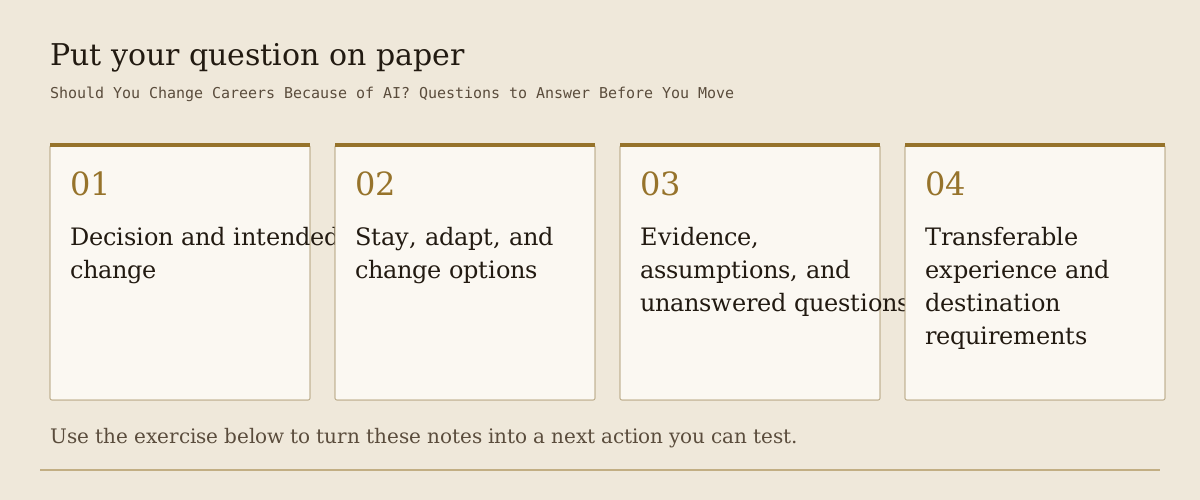
- Name the decision in one sentence. Specify whether you are considering different tasks, responsibilities, an employer, a field, or an employment arrangement, and what you want that change to accomplish.
- Write three concrete options: staying with a defined development action, adapting a responsibility, and making the relevant larger move. Describe an ordinary working week under each option.
- List the evidence you already have and the assumption that matters most for each option. Identify which missing answer could change your preference, then name the person, document, or work sample that could address it.
- Identify transferable experience through one real piece of work. Explain your contribution, how it was checked, and what you would still need to learn in the proposed destination. Keep confidential material out of external discussions.
- Choose one bounded trial or conversation. Define the output, permission needed, reviewer, maximum time and cost, and the conditions that would make you stop or pause.
- Put a review date in your calendar before starting. At that review, choose whether to continue, revise, stop, or investigate a specific remaining question. Write the reason and the next action in your own words.
Completed hypothetical example. An experienced customer operations manager wants more responsibility for improving processes and less time preparing recurring summaries. This example illustrates a completed plan, not a reported outcome.
Decision and intended change: Compare reshaping my current role with moving to an employed process-improvement role. I want to remain close to operational problems while changing the balance between preparation and decisions.
Options: Stay and develop a clearer method for evaluating process changes; propose an internal responsibility for reviewing an approved AI-assisted summary process; or investigate related roles at another employer. Independent consulting is outside this first comparison because I haven't established that I want its commercial responsibilities.
Evidence and open question: My current work includes interpreting recurring problems and coordinating responses. I don't yet know whether my employer wants a defined owner for the proposed process. The first useful evidence is a manager conversation, followed by an assessment of a bounded work sample.
Transferable experience: I can explain a real operational problem, the competing interpretations, and how I checked a proposed response. I need a practitioner to assess which parts would be recognized in the target role and what gaps remain.
Trial and review: Request permission for a limited internal comparison using approved information. Define the final output and reviewer before starting. Stop if the work requires unauthorized data or expands beyond the agreed responsibility. Review four weeks after the approved trial begins, with the actual calendar date set at approval. Continue only if the work is useful, the arrangement is feasible, and I want the responsibility.
Before making a career change, it can be useful to examine why the current pattern keeps repeating. Are you avoiding a test, postponing a conversation, or waiting for certainty that the decision cannot provide? Bring the question that fits your situation to AI and the Andes Retreat. Over five days in Peru's Sacred Valley, the work is to understand your behavior and choose an action you can test at home, with continuing support and accountability.
Your working notes
Use this page while you think. Your notes stay in this browser tab; download them before you close it.
What does this question change for you?
A practical answer can change how you work. It can also leave a personal decision unresolved: what to learn, what to stop postponing, or which responsibility to take next. Name that decision before collecting another prediction.
Work through your next decision. Your notes stay in the browser tab, and the exercise gives you no predictive score.
If a recurring pattern keeps preventing action, AI and the Andes Retreat offers five days of practical inquiry in Peru's Sacred Valley, followed by support and accountability. Read about the seminar and assess whether that work fits your question.
Frequently asked questions
Search research, audience discussions, and the existing seminar FAQ library informed these questions. Some wording has been adapted to this guide.
How can I future-proof my career?
There is no guarantee of permanent protection. A practical approach is to understand your task mix, investigate how your employer is changing it, and develop capabilities connected to work people actually need. The OECD's skills synthesis includes AI literacy alongside problem solving, communication, and collaboration. Choose a relevant task, demonstrate that you can perform and check it, then review whether your preparation is improving your actual options.
What are the most future-proof careers?
The research reviewed here doesn't establish a permanently safe list. Occupational exposure describes potential task change, and BLS projections are conditional scenarios rather than personal guarantees. Instead of choosing a field by a safety label, investigate its actual work, entry requirements, demand in your intended setting, and suitability for your circumstances. A career that appears attractive in a broad projection could still have an entry route or working conditions that don't fit you.
What signs deserve investigation before I change jobs?
Investigate a persistent mismatch between your responsibilities and authority, a task mix you no longer want, specific changes to the employer's plans, or conditions that prevent acceptable work. These observations don't automatically mean you should leave. Ask whether a responsibility change, better support, or another employer would address the problem. Keep actual workplace evidence separate from predictions about AI. Your decision becomes clearer when you can describe what is wrong, what would improve it, and what you've already tried.
How do I know which career I should choose?
Begin with the work and conditions you want, then compare them with an actual destination. Investigate ordinary tasks, required qualifications, entry opportunities, and the parts of your experience that would count. Speak with a practitioner and, where possible, someone who hires for the role. A permitted work sample can test your interest and reveal gaps. You don't need a universal answer about your identity before choosing the next investigation, but you do need more than an appealing title.
Can a career-change quiz tell me whether I should move?
A quiz can give you prompts for reflection, but it shouldn't carry authority beyond the evidence behind it. Use the result to ask better questions about your preferences and current conditions. Then check the proposed career against actual requirements, work samples, and practitioner accounts. If a quiz recommends a field without considering your constraints or entry route, those questions remain unresolved. Don't treat a score as permission to resign or as proof that another profession will suit you.
How can I investigate a career change at 40 without direct experience?
Separate lacking experience in the destination from having no relevant experience at all. Identify work you've already done that might transfer, then ask a practitioner which gaps matter. Investigate whether the route requires a credential, an intermediate role, or a demonstrated work sample. Build a trial around one ordinary task before committing to extensive retraining. Your age alone doesn't answer these questions; your responsibilities, available preparation time, and the actual entry requirements need to shape the plan.
Is 40 too old to start a cybersecurity career?
The research reviewed here doesn't provide evidence for an age cutoff or a guaranteed cybersecurity route. Investigate a specific role rather than treating the field as a protected destination. Ask about its daily responsibilities, entry requirements, supervised practice, and how your existing experience would be assessed. Check whether you actually want the work and can prepare for it within your constraints. If the attraction is mainly avoiding AI, examine that premise before making a large training commitment.
How do I determine my transferable skills?
Reconstruct a real piece of work: the problem, your contribution, the choices you made, and how the result was checked. Then compare that account with the destination's requirements. Ask which underlying abilities transfer and which depend on knowledge specific to your current field. A practitioner can help distinguish relevant experience from a broad label such as leadership. Include your gaps. A useful assessment gives you evidence to show and a focused preparation task, rather than a flattering inventory.
What are useful examples of transferable skills?
Examples include clarifying an ambiguous request, comparing alternatives, explaining a tradeoff, coordinating a handoff, and checking whether evidence supports a recommendation. These are examples to investigate, not a universal list of protected abilities. The OECD discusses complementary skills alongside technical and foundational skills. Their relevance depends on the target work. Describe a situation where you used the capability and ask whether the new setting requires a similar contribution.
What should I check before moving from employment into consulting?
Check the problem you can competently help solve, the people who need that help, and the full responsibilities of finding and delivering work. Investigate your employment terms before any outside trial. Test a bounded recommendation with informed feedback, including objections and checking costs. Consulting involves more than applying your existing knowledge under another title. The consulting task experiment doesn't establish independent practice as a protected career or guarantee demand for your offering.
How do I know if I should quit my new job?
Identify whether the problem concerns adjustment, a mismatch in the agreed role, unsuitable conditions, or something requiring prompt professional attention. Compare what was represented with what you're being asked to do. Where appropriate, clarify expectations and investigate whether a specific change is possible. A new-job label doesn't create an obligation to ignore serious issues, and discomfort alone doesn't settle the decision. Review the actual facts, departure consequences, and available alternatives before making a larger commitment.
How long should I give a new job a chance before deciding?
No fixed period fits every situation. Set a review point based on what you need to learn and how quickly the relevant facts can emerge. Clarify responsibilities, support, and the conditions causing concern. Decide what improvement would look like and what would require an earlier response. If safety, serious misconduct, or a consequential contractual question is involved, seek appropriate help rather than waiting for an arbitrary milestone. Time is useful when it produces information or a meaningful change.
When should I resign after receiving another job offer?
Review the actual offer, outstanding conditions, start arrangements, and your current departure obligations before choosing the sequence. A verbal expression of interest and a completed employment arrangement aren't interchangeable. If terms, benefits, restrictions, or other consequences are unclear, get advice suited to your documents and jurisdiction. This article can't specify a universal resignation point. The practical aim is to avoid treating an unresolved opportunity as settled and to make the handoff consistent with your real obligations.
Should I leave my job without another one arranged?
Compare the reasons for leaving with the consequences of an uncertain transition. Consider household commitments, benefits, the intended use of the time, and what you would do if the next role took longer to secure. Investigate alternatives such as an internal change or an agreed leave arrangement where available. Specific legal, financial, or health concerns need appropriate advice. Neither staying indefinitely nor leaving immediately is a responsible universal rule; the actual conditions and acceptable fallback matter.
What should a programmer investigate before moving toward solution design?
Investigate how the proposed role defines problems, evaluates alternatives, and handles implementation constraints. Use a permitted case to explain the need, propose a response, and identify why it might fail. Ask an experienced practitioner to review the reasoning. Keep technical understanding available for checking what you recommend. Saraev's business-understanding advice is commentary, not proof that implementation knowledge has expired. The transition should add demonstrated responsibility rather than replace technical competence with an attractive title.
How does an agreed sabbatical differ from a career break?
The practical distinction is whether there is an employer arrangement governing your absence and return, or whether you're leaving without an agreed position to resume. Don't rely on the label alone. Check pay, benefits, return conditions, permitted activities, and what could change during the absence. A sabbatical should not be treated as an unconditional guarantee. A career break needs its own transition and return plan. The actual terms determine what you can reasonably assume.
What problem would a career break solve?
Name the purpose before choosing the departure. You might need time for a life responsibility, structured preparation, or investigation of another direction. Ask what the break would make possible and what would remain unresolved afterward. Time away doesn't establish a new career or settle employment and financial questions by itself. Define the activities, constraints, and return plan. If the main problem requires professional support or a workplace process, arrange that work rather than expecting absence alone to handle it.
What should I plan before returning to work after a break?
Plan the practical arrangement as well as the first day. Confirm the role, expectations, working rhythm, and any agreed return conditions. Identify what you learned during the break that you want to test at work, then choose a manageable first action. Don't assume the organization has changed in the same way you have. Set a review after returning and clarify concerns early. The purpose is to connect your intentions with ordinary work rather than preserve an idealized version of the time away.
Why am I reluctant to take a leadership role even when I'm qualified?
Several explanations are possible, and the question alone doesn't identify one. Check the actual authority, workload, support, and responsibilities of the proposed role. You may have sound reasons to decline it. If those conditions fit but you repeatedly postpone exploring it, examine the specific action you're avoiding and the consequence you anticipate. A conversation or bounded responsibility can provide information. You don't need to label yourself or assume a hidden personal cause before investigating the situation.
Should I stay in my role, accept a new offer, or wait?
Compare three actual choices. For each, write down the work you would do, the conditions you can verify, and the cost of changing your mind. Ask the prospective employer about responsibilities and how AI is changing the team. Check the written offer and any obligations in your current role before acting. Waiting can be sensible when a specific missing fact is obtainable; it becomes costly when no new information is expected. Set a review date and decide what evidence would move you toward each option.
Sources and evidence
These guides were drafted with AI assistance and checked against the linked sources. Examples labeled hypothetical illustrate a decision; they are not participant stories or measured results.
Studies answer specific questions about particular people, tasks, and tools. Their dates and limits matter. A result about task assistance is not a forecast for an entire profession.
- Generative AI and Jobs: A Refined Global Index of Occupational Exposure, May 20, 2025
- Skills in the AI age, July 8, 2026
- Employment Projections and Occupational Outlook Handbook: 2025–2035, August 27, 2026 release
- Canaries in the Coal Mine? Six Facts about the Recent Employment Effects of Artificial Intelligence, August 12, 2026 revision
- Still Waters, Rapid Currents: Early Labor Market Transformation under Generative AI, verified March 13, 2026 author-provided version
- Agentic AI in organisations: Early insights from practitioner interviews, September 16, 2026
- How AI Impacts Skill Formation, Anthropic research, February 1, 2026 revision, arXiv v2
- Navigating the Jagged Technological Frontier: Field Experimental Evidence of the Effects of Artificial Intelligence on Knowledge Worker Productivity and Quality, published March 11, 2026
- ABA Formal Opinion 512: Generative Artificial Intelligence Tools, July 29, 2024
- Nick Saraev: Here's What I'd Learn Instead of AI Automation in 2027
- Nick Saraev: What I'd Learn Instead of Automation in 2026
- The SoulSearching Experience, offer facts confirmed September 26, 2026
- Observed comment question about adapting a business analyst role
- Observed comment question about moving into management consulting
- What Is a Sabbatical, Really? The Honest Guide to Taking One and Coming Back
- Canonical seminar question: What about decisions I cannot reverse?
- Canonical seminar FAQ: Why do I feel unclear even when I already know all the facts?
- Canonical seminar question: Does making a fast decision fix this?
- Canonical seminar FAQ: Why do I put off decisions that have no obviously right answer?
- Canonical seminar question: What if I need a co-founder or advisor, not a retreat?
- Canonical seminar FAQ: When should a workplace pattern go to HR instead of self-work?
- Canonical seminar FAQ: Does mental clarity stay once you have it?
- Canonical seminar question: How do you make a decision you can actually live with?
- CareerNextPivot by ExperienceBypass: published career-planning perspective, reviewed October 7, 2026
Where the audience questions came from
These linked discussions and comments supplied questions and wording. They do not establish the truth of the replies, verified professional identities, or how common a concern is.