You’ve saved the tutorial. You may have bought the course. There’s a folder of useful links somewhere, and another video is explaining why the skill you were about to learn might soon become less valuable.
Meanwhile, your actual work is waiting. A colleague needs a recommendation. A client needs an explanation. A process keeps producing exceptions that nobody has documented properly. You want to become more capable, but choosing a curriculum has started to feel like choosing a future.
That’s a lot to ask of a Tuesday evening.
A more manageable question is: what do you need to understand well enough to do, explain, or take responsibility for next? Your answer might involve an AI tool. It might involve programming. It might involve learning your own business more thoroughly, asking better questions, or checking work you previously accepted because it looked convincing.
The OECD’s July 2026 skills synthesis makes a useful distinction here. AI literacy includes using and critically evaluating AI. Advanced AI engineering is a separate specialization. You don’t need to become a specialist engineer to begin using AI thoughtfully, and using a conversational tool doesn’t make you qualified to design or approve every system it helps produce.
This article offers a way to choose a learning commitment without pretending anyone can identify a permanently protected skill. It connects learning to responsibility, separates tool familiarity from understanding, and gives you a practice plan that includes checking your own ability.
You’ll also find reasons to keep technical knowledge, reasons to postpone a course purchase, and examples where the attractive advice to become more strategic would be premature. The aim is a decision you can test in your real week, with a clear point at which to continue, change direction, or stop.
What are AI skills, and what does AI literacy actually mean?
AI skills are abilities involved in working with AI systems. That description covers very different responsibilities: using an existing assistant, deciding whether its output is suitable, connecting it to another application, developing a model, or supervising a process that can take actions. Calling all of these simply learning AI hides the choice you need to make.
The OECD’s July 2026 synthesis separates foundational skills, information and communication technology skills, and complementary abilities such as problem solving, communication, creativity, and collaboration. It also distinguishes AI literacy from advanced AI engineering. This is a policy research synthesis, not evidence that completing a particular curriculum guarantees employment.
For an adult professional, a practical definition of AI literacy is being able to choose an appropriate use, understand the important limitations, provide relevant information, evaluate the result, and explain your decision to use or reject it. That definition is an editorial application of the OECD distinction. It gives you something observable to practice rather than another label to collect.
Suppose you ask an assistant to summarize a proposal. Tool familiarity means you know where to upload the document and how to request a shorter answer. Literacy means you also ask whether you’re permitted to provide that document, whether the summary preserves the proposal’s conditions, and whether an omitted qualification would change the decision. You can describe what you checked before someone relies on your summary.
Technical specialization asks different questions. How is the information retrieved? What happens when a connection fails? Which permissions can the system use? How are changes tested? You may need some of this knowledge without needing all of it. The boundary follows your responsibility, not your enthusiasm for a demonstration.
There’s also domain knowledge: understanding the subject of the output. A fluent summary of an unfamiliar contract, production incident, or accounting issue can leave you unable to recognize what matters. Knowing the interface won’t fill every gap in the underlying work. Part of literacy is recognizing when somebody with the relevant knowledge needs to review the result.
A useful starting test is to describe one AI-assisted task in ordinary language. State what the tool receives, what you expect back, what could be wrong, and who decides whether it’s acceptable. If you can do that clearly, you have the beginnings of a learning plan. If you can’t, the next lesson may be about the task itself rather than the newest feature.
Which skill should you learn for the responsibility you already have?
Start with a responsibility you would still need to answer for if the tool were unavailable. You might be responsible for a recommendation, an accurate report, a working application, a client conversation, or a team’s ability to follow a process. These are better starting points than a list of fashionable courses because they tell you what acceptable work means.
Write the responsibility as a sentence with a real recipient. I need to explain this project’s status to the leadership team. I need to check whether these requirements describe what the client actually wants. I need to approve a small change without introducing an avoidable failure. The recipient helps you see what knowledge and communication the work requires.
Then identify the present difficulty. Perhaps the work takes too long because your information is scattered. Perhaps you can generate a draft quickly but can’t verify it. Perhaps you understand the subject but struggle to explain the tradeoff. Each difficulty suggests a different learning priority. More advanced prompting is only one possible answer.
This responsibility-based approach draws on the OECD’s distinction between technical and complementary abilities, and the decision table below helps you apply that distinction to your work. It isn’t a validated assessment or a prediction of which occupations will remain valuable. Its purpose is to help you choose a practice task that exposes the gap you actually have.
If you use AI to prepare a management brief, learn to preserve evidence, separate facts from assumptions, and explain unresolved questions. If you connect systems, learn how information moves between them, how permissions work, and what happens when something fails. If you approve technical work, you need enough understanding to question the implementation and enough support to check what exceeds your competence.
Consider the person who has become excellent at generating polished slides but keeps presenting recommendations that colleagues can’t implement. Another design course may improve the slides while leaving the real difficulty untouched. Interviews, process observation, and clearer requirements could be the more useful learning commitment. That’s a judgment about this particular task, not a claim that presentation skills have no value.
Choose one primary gap for the next month. You can keep other interests without giving them equal time. At the review, ask whether you can now perform the responsibility more clearly, with better checking or less avoidable rework. If the answer is no, examine the task and the practice before concluding you need a different tool. A curriculum should serve a responsibility you can name.
Choose a learning task that produces reviewable evidence
CareerNextPivot asks about skills someone already has and the time available to build toward a destination. Use those questions before choosing another course. The work-sample method here is our own application.
Start with a responsibility you want to perform. Write down what an acceptable output would look like, what input you may use, and who could review the result. Then choose the smallest learning task that would let you produce and explain that output. This gives a course or tutorial a specific purpose.
Four constructed examples
- A finance leader could practice checking a narrative against a fictional source table. The evidence is a reconciled claim ledger, including the claims the supplied numbers do not support.
- A consultant could practice defining an automation's boundaries. The evidence is a scope document that names the input, output, dependencies, review owner and unresolved implementation work.
- An attorney could practice mapping fictional document clauses to an exception log. The evidence preserves exact wording and open questions for counsel. It is not an approved contract or proof of legal competence.
- An engineer could practice building a small application against synthetic cases. The evidence includes tests, failures, review work and an explanation of what happens when a required input is absent.
These exercises do not establish that you qualify for a new role. They help you identify what you can explain and what you still need to learn. Use the existing finance, consulting, legal or engineering tools where the example fits.
Review understanding as well as output
After a practice task, explain the result without asking the assistant to explain it for you. Identify an assumption, a failure condition and a correction you made. Ask the reviewer where the work is incomplete. If you can only repeat the model's explanation, that is a useful gap to record rather than evidence that the responsibility is mastered.
Keep the time commitment realistic enough to repeat in your own schedule. A review date marks a chance to assess the work; it is not a promise that learning will finish by then. Change the task when the result shows you are practicing the wrong capability.
Record the capability, evidence and next test in the planner. Keep client data, proprietary documents and personal details out of a practice exercise unless the actual use is permitted.
Can you learn AI without programming?
Yes, if your immediate aim is to use existing tools thoughtfully. You can practice giving clear instructions, comparing an output with its source, recognizing an unsupported assertion, and explaining a decision without writing software. The OECD’s separation of AI literacy and advanced engineering supports keeping these learning paths distinct.
The more useful follow-up is what you intend to do without programming. Preparing a first draft and checking it is different from building a system that reads company records, updates an application, and sends messages. Both may begin in a visual interface. Their responsibilities differ because one produces material for review while the other can change something outside the conversation.
You don’t need to master every technical subject before experimenting. You do need to recognize when your task crosses a boundary you can’t currently evaluate. If a workflow can modify records, disclose information, or affect other people, learn how those actions are authorized and checked before treating the setup as ready. An interface that avoids code doesn’t remove the underlying process.
Programming becomes useful when reading or changing code is part of what you need to understand. That might mean maintaining a small script, examining an integration, reproducing an error, or communicating precisely with a developer. The appropriate depth can be modest and specific. You may need to understand a short transformation and its tests rather than train an AI model from the beginning.
A nonprogramming learner can still build a substantial practice routine. Use a public or otherwise approved document. Draft your own summary, ask an assistant for another version, compare both with the original, and explain the differences. Next, give a colleague a clear description of where the assistant helped and where you had to correct it. That exercise develops observable abilities rather than an impression of technical confidence.
If your goal is an AI-related career, do not let the phrase without coding substitute for researching the work. Training, business analysis, product decisions, and evaluation can involve different technical requirements. Read current role descriptions and ask employers what work you would need to demonstrate before deciding which education to pursue.
After several practice tasks, you may discover that your obstacle is technical, domain-specific, or interpersonal. Let that evidence guide the next step. You don’t need to choose between becoming an engineer immediately and remaining a passive user forever. There are useful intermediate levels of understanding.

Does technical knowledge still matter when AI can generate the work?
Technical knowledge matters when it helps you understand, verify, maintain, or change something you’re responsible for. The useful question is which knowledge serves those responsibilities now. Memorizing an interface and understanding a system aren’t equivalent, even when both appear inside the same technical course.
In his video about what he would learn instead of automation in 2027, Nick Saraev argues for more attention to diagnosing business problems, training teams, and deciding what to build. In his earlier video framed around 2026, he emphasizes understanding how a business creates and delivers value. These are his views about where to focus learning, rather than a measured forecast.
There’s a useful challenge in that advice. If you can operate a tool but can’t explain why the process exists, what would make its output useful, or who bears the consequences of an error, you have a narrow form of competence. Learning to frame a problem and communicate a result can broaden it. Saraev also sells education and implementation services, which is relevant context when considering his recommendations.
The substantive objection is that good specification and evaluation often require technical understanding. A viewer asks whether precise requirements and evaluations will still be needed for generated code. Another asks whether studying AI engineering has become pointless. These are different concerns: one asks how to judge work, and the other asks whether to abandon a substantial educational commitment. Neither can be answered by a speculative timetable.
The O*NET software developer profile describes work that includes requirements, design constraints, testing, integration, maintenance, and coordination. It’s a descriptive occupational profile, with task data updated in 2025, not a replacement forecast. It does help explain why generating code is only one part of the responsibility bundle.
A developer who can read an unfamiliar change, identify the assumptions, and design a meaningful check has knowledge that serves a present task. A manager who can recognize an architecture question but needs a specialist to answer it has a different, equally useful boundary. More strategic work doesn’t require pretending those boundaries have disappeared.
Keep technical learning connected to what you need to inspect and own. You might reduce time spent memorizing a feature while increasing time spent understanding data flow or failure recovery. That’s a change in emphasis, not evidence that an engineering education is worthless. Don’t drop out, quit a profession, or buy a new identity because a video has described an appealing future.
What should you understand about your domain before asking AI for help?
Your domain is the actual subject of your work: the customer’s situation, the operating process, the technical system, or the professional context. Domain knowledge gives you ways to judge whether an answer belongs in the situation. Without it, a well-written output may leave you with fewer questions than the task deserves.
Begin by naming the distinctions that experienced people use. In a project discussion, a requested feature may be different from the underlying need. In a report, a change in a measure may be different from an explanation for that change. In a technical process, a successful demonstration may be different from a change that can be maintained. You don’t need to know everything. You do need to know which distinctions your task depends on.
The OECD synthesis includes problem solving, communication, and collaboration among complementary abilities. The practical interpretation here is that your learning should include the work around an AI interaction: asking the right person, understanding a source, resolving ambiguity, and making the result usable. These aren’t employment guarantees. They’re abilities you can examine in a current responsibility.
A useful domain notebook is small. Record the terms you need, the authoritative materials you consult, the common exceptions, and the people who can clarify a question. Add examples of outputs you rejected and why. You’re building a reference for your own decisions, rather than trying to create a complete encyclopedia before beginning.
Choose trusted material independently of the assistant when possible. If you ask AI to explain a policy, compare the explanation with the actual policy. If you ask about a process, check the description with somebody who performs it. If nobody can identify the current source, that missing source may be the learning problem. Requesting a more confident explanation won’t establish what the organization has decided.
There’s a limit to this recommendation. Reading more about your domain can become another way to postpone practice. You don’t need complete mastery to draft a question, attempt a low-stakes analysis, or explain what you currently understand. Keep the notebook tied to a task, and add knowledge when a real uncertainty appears. Otherwise, the collection can grow while your ability remains untested.
You may also discover that the domain has changed enough to require formal study or specialist help. That’s a legitimate result. The aim isn’t to prove that everything you already know is sufficient. It’s to identify what remains useful, what needs updating, and what you shouldn’t approve alone. AI literacy includes being candid about all three.
How do you learn to check an AI output?
Checking begins before generation. Describe what would make the result acceptable: the facts it must preserve, the decisions it must not make, the audience it must serve, and the uncertainties it must acknowledge. If you define quality only after seeing a polished answer, it’s harder to notice that the answer has changed the task.
For a document summary, keep the original open. Look for omitted conditions, unsupported additions, and statements presented with more certainty than the source allows. For a calculation, reproduce the important reasoning through an appropriate independent method. For code, examine what changed and use checks that address the intended behavior. The right method depends on the work; one universal checklist won’t settle every question.
Don’t confuse asking the assistant whether it is correct with independent verification. You can ask it to explain its reasoning or identify weaknesses, but those responses remain material to examine. A second response may give you a useful lead without establishing the underlying fact. Your source, test, or qualified reviewer needs to do the work that the consequence requires.
The OECD’s September 2026 practitioner interview study describes concerns involving unpredictable behavior, incorrect actions, traceability, and accountability. Interviewees commonly described gradual increases in autonomy, human checkpoints, and domain-expert involvement. The sample comprised 25 organizations already involved with agents; it’s illustrative qualitative evidence, not a representative measure of failure or success.
Your learning task can be deliberately narrow. Take one approved output and separate its claims into facts, interpretations, and proposals. Identify the original support for each important fact. Write down which interpretations are reasonable but uncertain. Then decide whether the proposal follows from those facts and fits the situation. You’re practicing the ability to evaluate a result, rather than merely asking for a better-looking version.
Checking also includes recognizing when to stop. Pause if the source is missing, the relevant permission is unclear, an important calculation can’t be reproduced, or the proposed action exceeds your authority. Stop repeatedly rewriting the prompt when the real obstacle is unavailable evidence or knowledge you don’t have. The next step may be a question to a colleague.
Keep an example of a useful rejection. Explain why the output wasn’t ready and what would be needed to make it acceptable. That explanation is evidence of learning even if you produced no publishable deliverable. For deeper treatment of an entire business process, see what people still need to decide when using AI agents. Here, the commitment is to learn one checking method you can actually perform.
What does the research say about finishing a task versus learning it?
A completed task and a learned skill are different outcomes. You can submit an acceptable result while remaining unable to explain the method, recognize an error, or handle a slightly different case. You can also spend time understanding a task without producing the fastest result. A useful learning plan names which outcome you’re trying to improve.
A small randomized experiment by Anthropic researchers, published in January 2026 and revised on February 1, examined developers learning an unfamiliar Python library. The official report describes 52 recruited participants, mostly junior developers. On an immediate comprehension quiz, the AI group averaged 50%, compared with 67% for the group without AI assistance.
That is a 17 percentage-point difference in this quiz, not a universal loss of intelligence, a long-term measure of skill decline, or a result covering every profession. The task-time improvement wasn’t statistically significant. The researchers also observed associations between explanation-seeking or conceptual questions and stronger learning. Those interaction patterns weren’t randomly assigned, so the associations don’t establish that a particular conversational technique caused the better result.
The vendor affiliation matters. This is Anthropic research, and the study is a preprint with a small sample and a specific coding context. Those limits don’t make it irrelevant. They tell you how carefully to use it: as a reason to distinguish delivery from comprehension, and as a prompt to test your own learning rather than declare AI harmful in every educational setting.
Other evidence shows that AI assistance and learning can coexist in a particular workplace. The published customer-support study in The Quarterly Journal of Economics found evidence of learning and improved customer interactions in its setting. It involved one tool, firm, and occupation, and its technology predates today’s frontier systems. It doesn’t cancel the coding-learning result or guarantee that your own usage will develop your skills.
The practical distinction is how you’ll demonstrate understanding. If you’re learning to analyze a document, can you explain its main qualification without reopening the chat? If you’re learning a library, can you make a small change and predict what should happen? If you’re learning to frame requirements, can you spot an ambiguity in a new case?
These are suggested self-checks, not validated measures of intelligence or professional competence. They help you notice when an assistant has supplied the result you wanted while bypassing the ability you intended to build. That observation lets you change the next practice session without turning one difficult attempt into a verdict on your capacity.

How can you practice with AI while keeping your own understanding?
Separate a learning session from a delivery session. During delivery, you may appropriately use approved assistance to complete work efficiently, with the checking the task requires. During learning, protect time for your own attempt and explanation. Otherwise, the pressure to finish can quietly replace the commitment to understand.
Try a small task on your own. Identify the point where you are stuck, ask for limited help, check that help, and attempt a related task independently. Keep your attempts so you can compare what you understood before and after.
Nick Saraev recommends active attempts, limited explanations, and repetition without assistance in his video about learning complex skills with AI. Treat it as a practice suggestion you can test, rather than a promise of extraordinary learning speed.
Make the first attempt small enough to finish. If you’re learning requirements writing, draft one paragraph explaining the desired behavior and one paragraph describing what should happen when it fails. If you’re learning a programming concept, work through one short example. If you’re learning analysis, explain one conclusion from an approved source. A manageable attempt reveals a gap you can name.
Ask for help at that gap. Instead of requesting the complete solution, ask why two approaches differ, what a term means, or what question would help you check your reasoning. You can request a hint before an answer. You remain responsible for comparing the explanation with trusted materials, because the tutor’s confidence doesn’t establish correctness.
Then close the conversation and explain the result in your own words. Include the reason, an important limitation, and a check you would perform. If you can only repeat the assistant’s phrases, return to the unclear part. You don’t need to perform confidence. A precise admission that you can’t explain one step is useful information for the next session.
Finally, change something small about the task. Use a different document, a different input, or a slightly different requirement. The goal is to see whether you can apply the idea when the surface details change. Keep the result as evidence, including mistakes. After several sessions, you should have a clearer picture of what you can do independently, what you can do with assistance, and what still requires another person’s judgment.
How do you choose an AI course without buying reassurance?
A course is worth considering when it addresses a specific gap and gives you a reasonable way to practice it. Start by writing what you want to be able to do after the course. If the answer is simply feel less behind, pause the purchase long enough to define a task. Reassurance is understandable, but it makes course comparisons difficult.
Read the curriculum for fit. Does it teach everyday literacy, workflow integration, programming, model development, or business communication? These are different educational purposes. A course can be well made and still be wrong for your present responsibility. Advanced material isn’t automatically more useful if you need to learn basic checking or a clearer way to describe a problem.
Look for exercises that require decisions. Following an instructor’s exact steps can introduce an interface, but you also want opportunities to choose inputs, explain an approach, inspect errors, and work through a variation. Ask what happens when your result differs from the demonstration. A learning resource should help you understand that difference rather than encourage you to keep copying until the screen matches.
Check how the material handles verification. Does the instructor identify original sources, discuss limits, and show what should be reviewed? Are examples kept separate from promises about future employment or income? A course that teaches you to generate convincing work while leaving you unable to evaluate it may not address the most important gap in your role.
Current material matters in different ways. An interface walkthrough may need updating when the interface changes. Concepts about data flow, requirements, or explaining a decision may remain useful across versions. Examine the update information and the actual lesson content. Don’t assume a recent marketing page means every demonstration is current, and don’t dismiss older conceptual material solely because it lacks the latest tool name.
Include the demands on your week. Prerequisites, exercise time, required accounts, feedback access, and additional costs all affect whether you can use the course. An ambitious curriculum that you won’t practice may serve you less than a smaller resource you can apply immediately. This is a practical purchase judgment, not evidence that one format works best for all learners.
Before paying, complete one small practice task using material you already have. Record the point where you need instruction. If the course addresses that point, the purchase has a concrete purpose. If you cannot identify the gap, use the next week to learn from practice. Before buying, check the current syllabus, prerequisites, accounts you will need, and feedback you will actually receive.
Hypothetical example: a business analyst choosing what to learn next
This is a hypothetical example, not a participant story or a measured outcome. Consider an experienced business analyst who already translates operational requests into requirements. She has saved courses on automation, prompting, and AI consulting. Her immediate responsibility, however, is helping a team agree on how a recurring customer exception should be handled.
Her first learning sentence is too broad: become good at AI. She replaces it with a task: prepare a requirements draft that makes the normal process, exceptions, approvals, and unresolved questions clear enough for the team to review. This doesn’t settle her entire career direction. It gives the next month a purpose.
She first documents the process using approved material and conversations with the people involved. She drafts the requirements independently and marks where she’s uncertain. The difficulty isn’t producing paragraphs. It’s separating a stated preference from a necessary condition and identifying who can approve an exception. She therefore chooses requirements and evaluation practice before enrolling in a broad automation curriculum.
In an approved environment, she asks an assistant to identify ambiguities in her draft. She treats its observations as questions to investigate. If it proposes a new approval step, she checks whether that step reflects an actual requirement or simply an imagined tidy process. She doesn’t adopt a suggestion merely because it sounds professional.
Her teach-back is a short explanation to a colleague: here’s what the process must do, here’s what remains undecided, and here’s what I changed after checking the AI response. The colleague’s questions become part of her practice record. If she can’t explain why an approval is necessary, that’s a domain question to resolve, not a prompt to beautify.
The review criteria are concrete. Can she distinguish confirmed requirements from proposals? Can another person understand the exception path? Can she identify who owns the next decision? She also notes time spent checking and revising, so generating a fast draft doesn’t become the only sign of progress. If the current source material is contradictory, she pauses the draft and seeks clarification.
The analyst is learning how to bridge a business problem and a possible AI use without abandoning the knowledge she already relies on. If she later needs to build the integration herself, technical learning becomes a separate, justified commitment. She has not rejected it; she has stopped using it as a substitute for defining the present work. public comment in the research reviewed here.
Hypothetical example: when technical depth is the right next step
This is a hypothetical example, including a counterexample to an attractive recommendation. Consider a technical leader who is encouraged to spend less time understanding implementation and more time advising the business. That recommendation is appealing. He likes conversations about priorities, and AI can produce drafts of changes that previously required more manual work.
His present responsibility is approving a small integration that moves information between two internal systems. He can describe the intended outcome, but he can’t yet explain which records will be changed, how a failed attempt is detected, or how the team will recover. In this situation, moving away from technical learning would be premature.
He chooses to understand the integration’s data flow and failure handling. An approved assistant helps explain a small portion of the implementation, but he compares that explanation with the actual code and asks a qualified colleague about the uncertain parts. He draws the sequence in ordinary language and identifies the permissions required at each step.
The practice includes a deliberately bounded test outside consequential live use. He needs to explain what should happen when an input is missing or the receiving system rejects an operation. If he can’t trace the result, he pauses expansion. The learning goal is neither write every line unaided nor become a full-time strategist. It’s understand enough to make the approval responsibly, with appropriate specialist review.
The O*NET developer profile includes integration, maintenance, testing, and design constraints among the occupation’s tasks. That description supports a broader inventory than code generation, though it doesn’t establish future staffing needs. In this example, those categories help identify why technical depth belongs in the learning plan.
He also resists using a dramatic productivity headline as a reason to skip measurement. In its February 24, 2026 experiment update, METR warns against treating its specific 2025 experienced-developer slowdown finding as today’s general effect. Its newer evidence suggested improvement, but selection issues and concurrent-agent time measurement made the estimates unreliable. That doesn’t tell this leader how much time his team will save.
At the review, he examines the whole task: explanation, implementation, checking, corrections, and handoff. If AI helps him produce more material than he can inspect, he reduces the scope. If he can now explain and check the integration, he can decide whether broader coordination skills deserve the next month. The counterexample is simple: business understanding doesn’t excuse technical ignorance when the decision in front of you depends on technical facts.

What would a useful month of practice look like?
A useful month has one learning objective, a small set of practice tasks, and a review date you put on the calendar before starting. The date is yours to choose. It doesn’t need to coincide with a release or a forecast. You’re testing whether a particular learning commitment fits your work and develops an ability you can demonstrate.
In the first week, choose an approved, low-stakes task and make an independent baseline attempt. Keep the output and briefly record how you approached it, what you found difficult, and how you checked it. A baseline is a reference point, not a performance judgment. Don’t manufacture precise measurements you didn’t collect.
For a person learning to prepare a sourced brief, an example weekly routine could be three appointments: a 30-minute independent draft, a 30-minute assisted comparison and source check, and a 20-minute explanation and independent variation. Those durations are suggested planning choices, not a research-backed dose. Shorten them if your real week won’t support them, while preserving an actual attempt and check.
In the second week, repeat the task with assistance limited to a defined purpose. Ask for ambiguity checks, alternative explanations, or help with a concept you couldn’t explain. Note the useful contribution and any correction you had to make. Don’t record only the impressive parts. The cost of finding and correcting a mistake belongs in the account of whether the tool helped.
In the third week, try a related case without the conversation open. Explain the method, an important limitation, and the way you would verify the result. Then compare your explanation with the original material. If you can complete the first case but can’t handle the variation, narrow the next lesson to the missing concept.
In the fourth week, compare the baseline, assisted work, and independent variation. Consider quality, checking effort, and retained understanding together. The METR update is a useful reminder that productivity measurement can be difficult and context-sensitive. Your small trial won’t establish a universal effect, but it can reveal whether your own practice is addressing the gap.
Choose one of three actions at the scheduled review: continue because the ability is developing, adjust because you found a more specific obstacle, or stop because this task or resource isn’t serving the responsibility. Stop earlier if permission is unclear or the practice starts affecting consequential work without suitable review. A month of learning is useful when it produces a more informed next decision, even if that decision is to change the plan.
What should you learn about communication, confidentiality, and your limits?
Communication is part of responsible AI use because other people need to understand what they’re receiving. Practice explaining what the task was, which material supported the result, what assistance you used when that disclosure is relevant, and what still needs a decision. A colleague shouldn’t have to reconstruct the conversation to discover that an important statement was only a proposal.
The OECD’s skills synthesis includes communication and collaboration among complementary abilities. That doesn’t mean every professional should become a salesperson. Your communication practice could involve giving a clearer handoff, asking a more precise question, or explaining why an attractive output shouldn’t be used yet. These are different from adopting a career that doesn’t fit your responsibilities or preferences.
Confidentiality creates another learning boundary. Before practicing on work information, establish what your organization permits, which environment is approved, and who can answer questions about data handling. If you don’t know, use public or purposefully fictional practice material while seeking clarification. Don’t treat a subscription, a product category, or a reassuring phrase as a complete answer about the particular use.
If you’re discussing a tool with a business and aren’t a security expert, say what you have checked and what needs specialist review. You can prepare questions about access, retention, permissions, external actions, and recovery. You shouldn’t offer a blanket assurance that you haven’t established. Learning to make a clear referral is more useful than learning language that sounds certain.
Professional obligations can also determine what you need to learn. For lawyers, ABA Formal Opinion 512, issued July 29, 2024, applies competence, confidentiality, communication, supervision, candor, and reasonable-fee obligations to generative AI use. It explains that assistance doesn’t remove responsibility to evaluate and verify work. The opinion interprets Model Rules and isn’t binding law in every jurisdiction; current governing rules still need checking.
This is professional workflow education, not advice about a particular legal matter. If legal practice is your responsibility, see the separate article for experienced attorneys. A general literacy plan shouldn’t absorb an entire profession’s requirements, and it shouldn’t imply that basic familiarity qualifies you to approve specialized work.
Make limits visible in your practice record. Write what you can explain, what you checked independently, and where someone else’s review is required. Those statements aren’t admissions that you’ve failed to keep up. They’re a usable description of your present competence. A learning plan becomes stronger when it identifies the next boundary clearly instead of hiding it behind fluent output.
When is another tutorial postponing the decision you already understand?
Another tutorial can be useful when it answers a question that appeared during practice. It can also postpone the moment when you have to try, show unfinished work, ask for feedback, or choose a direction. You don’t need to diagnose yourself to notice the difference. Compare what you intended to do with what you actually did.
Suppose you planned to write a requirements draft, then spent the appointment comparing courses. The comparison may have been necessary. Ask what information it produced and whether that information changed your next action. If the same action remains clear, the next learning resource may be serving a different purpose from the one you named.
You may be avoiding an uncomfortable but ordinary situation: a colleague seeing you as a beginner, discovering that your first attempt is weak, or choosing a commitment while another option remains attractive. Those are possibilities to examine, not explanations to impose. Sometimes the real issue is workload, a missing prerequisite, or permission you haven’t obtained. Give those practical constraints a fair hearing.
Reduce the next action until you can tell whether you did it. Open the approved source and draft one paragraph. Explain one concept aloud. Ask a colleague one question about a process. A small action doesn’t settle every uncertainty, but it produces information that watching another general video may not. Keep the action connected to the responsibility so it doesn’t become busywork.
Set a stopping condition for research. For example, finish looking when you can name the task, choose an appropriate environment, identify a checking method, and describe the first practice attempt. If a necessary answer is missing, seek that answer deliberately. If those conditions are met, use the reserved time to practice. This is a suggested boundary, not a scientific rule about how much preparation anyone needs.
The existing seminar article on researching instead of starting gives this behavior separate attention. Broader uncertainty about your future belongs in preparing for an AI future you can’t predict, and managing your information intake belongs in the article on AI news overload. You don’t have to resolve all three questions before choosing one practice session.
At your review date, inspect the record without turning it into a judgment of character. Did you attempt the work? What interrupted it? What change would make the next attempt more likely? Sometimes the next skill is already clear. The useful work is understanding why your behavior keeps taking you somewhere else, then changing an action you can test.
Compare your options
| Your responsibility | Learn first | Practice evidence | Boundary or stopping condition |
|---|---|---|---|
| Prepare a useful summary | AI literacy, source comparison, and clear writing. Learn to preserve qualifications and distinguish source facts from interpretation. | Produce a short summary and explain where each consequential statement comes from, including a condition the reader could otherwise miss. | Pause if you can’t access the original source or confirm permission to use the material. |
| Recommend an operational change | Domain knowledge, problem definition, and stakeholder questions. Understand the current process before proposing a tidier one. | Explain the problem, an alternative explanation, the proposed change, and the person who can approve it. | Stop treating a suggestion as a requirement when the relevant people haven’t confirmed it. |
| Connect applications | Data flow, permissions, failure handling, and the technical concepts needed to inspect the connection. | Trace what enters, what changes, what can fail, and how a bounded test will reveal a problem. | Keep the work out of consequential live use when recovery or authorization remains unclear. |
| Review generated code | Enough programming and system knowledge to read the change, understand its assumptions, and choose meaningful checks. | Explain a small change, test its intended behavior, and describe an important failure case. | Seek qualified review when the change exceeds your understanding or approval authority. |
| Approve AI-assisted work | Evaluation criteria, evidence tracing, and an honest understanding of your own review limits. | Give reasons for accepting or rejecting an output before another person relies on it. | Don’t expand the volume beyond what the available review process can inspect. |
| Help a team use a tool | Communication, approved use boundaries, demonstrations tied to real tasks, and clear handoffs. | Teach one task and ask a colleague to explain the checking step independently. | Pause the rollout when people can reproduce the clicks but can’t identify what needs checking. |
| Learn a difficult subject | The underlying concepts, trusted reference material, and a practice routine with independent attempts. | Explain a concept without the chat open and apply it to a slightly different case. | Return to the missing concept if you can finish only by copying the assistant’s solution. |
| Develop an AI specialization | The prerequisites required by the actual specialist task, including appropriate programming, mathematical, or engineering foundations. | Complete work that demonstrates the relevant ability and make its limitations explicit. | Don’t substitute general tool familiarity for specialist competence or abandon education based on a video prediction. |
Choose one skill, then prove what you understand
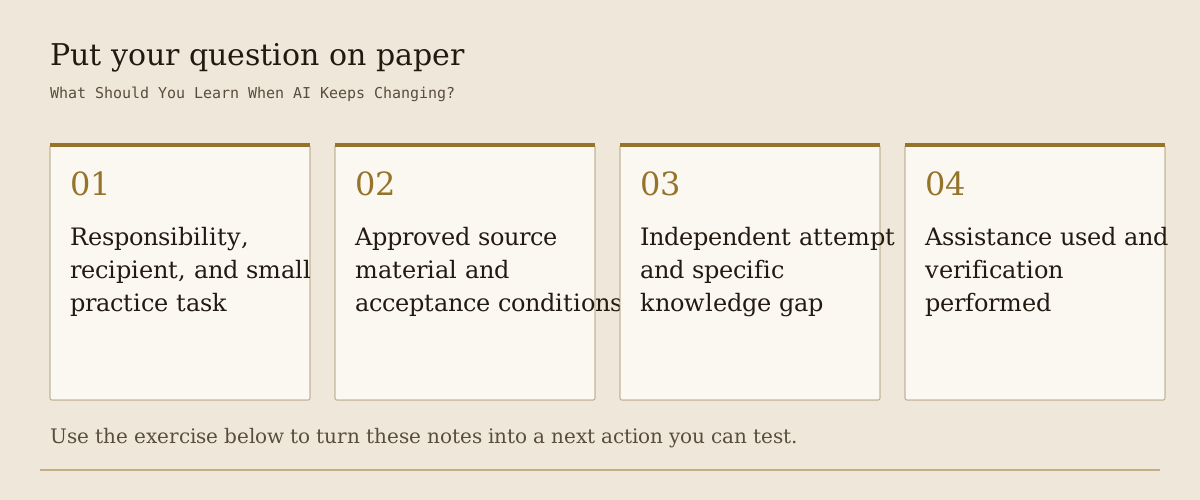
Use this exercise to turn a broad wish to learn AI into one reviewable commitment. Allow enough time to make a small attempt, rather than completing the worksheet while postponing the work. Choose material you’re permitted to use, and keep the task low-stakes. The worksheet is a reflection and practice tool, not a validated assessment of ability.
You’re looking for evidence of three things: a result you can inspect, an explanation you can give yourself, and a boundary you can recognize. A mistake can be useful evidence if you identify it and change the next attempt.
A reflection tool for planning your next step, rather than a predictive score.
- Name one responsibility and recipient. Write a sentence such as: I need to prepare a sourced project brief that my colleague can use to identify the unresolved decision. Avoid goals such as master AI.
- Choose a small approved task and define acceptance before starting. Identify the source material, the required result, and two or three important conditions it must preserve. State what the assistant is not authorized to decide.
- Make an independent attempt. Keep the draft and write a short note identifying what you could explain and the exact point where you became uncertain. Record actual time only if you measured it.
- Ask AI for limited help with that uncertainty. Request a clarification, critique, or hint rather than automatically asking for the whole solution. Compare consequential suggestions with the original source or an appropriate independent check.
- Close the conversation and teach the result back. Explain the purpose, the method, an important limitation, and the checking step in your own words. Mark any point you can’t explain clearly.
- Complete a related variation independently. Change a document, input, or requirement, then see whether you can apply the idea without copying the previous answer. Keep the variation alongside the original attempt.
- Schedule a review date before adding another course. At that review, decide to continue, narrow the learning goal, or stop. Pause earlier if permission, evidence, or qualified review is missing; identify the person or source needed to resolve it.
Completed hypothetical example. A project lead wants to learn to prepare a clearer brief from an approved project note. The responsibility is helping a colleague distinguish the confirmed scope from an unresolved approval. The practice task is a short summary, not a recommendation to change the project.
The acceptance conditions are to preserve the note’s scope limitation, identify the unanswered approval question, and avoid inventing a commitment. The project lead first drafts the summary independently. The draft is readable, but the lead can’t explain whether a sentence describes an agreed requirement or a proposal. That distinction becomes the knowledge gap.
The lead asks the assistant to flag statements that appear confirmed, conditional, or unresolved. Each suggestion is checked against the original note. Where the note remains ambiguous, the lead marks a question for the person who owns the decision rather than asking the assistant to settle it.
The teach-back is: this brief describes what has been agreed, preserves the condition on scope, and identifies an approval that still needs a person’s answer. The assistant helped identify possible ambiguity; it didn’t provide evidence of agreement. For the independent variation, the lead uses another approved note and repeats the distinction without opening the chat.
The worksheet’s stopping condition is missing or contradictory source evidence. The review date is set for four weeks after starting, with an appointment placed on the calendar. The next decision will be whether more requirements practice, domain clarification, or communication feedback would help. No improved outcome is assumed before that review.
Sometimes you know what to learn and still keep preparing to begin. Another course won't necessarily answer why. AI and the Andes Retreat offers five days in Peru's Sacred Valley to work on the question you bring, examine what is driving your behavior, and choose an action you can carry home. If the problem is the gap between your intention and your practice, that is a useful place to begin. Support and accountability continue afterward.
Your working notes
Use this page while you think. Your notes stay in this browser tab; download them before you close it.
What does this question change for you?
A practical answer can change how you work. It can also leave a personal decision unresolved: what to learn, what to stop postponing, or which responsibility to take next. Name that decision before collecting another prediction.
Work through your next decision. Your notes stay in the browser tab, and the exercise gives you no predictive score.
If a recurring pattern keeps preventing action, AI and the Andes Retreat offers five days of practical inquiry in Peru's Sacred Valley, followed by support and accountability. Read about the seminar and assess whether that work fits your question.
Frequently asked questions
Search research, audience discussions, and the existing seminar FAQ library informed these questions. Some wording has been adapted to this guide.
What are AI skills?
AI skills are abilities used to work with AI systems, from choosing an appropriate task and checking an output to integrating applications or developing models. These require different depths of knowledge. The OECD distinguishes AI literacy from advanced engineering and includes complementary abilities such as communication and problem solving. Choose a skill by what you need to do and take responsibility for, rather than treating every AI course as preparation for the same work.
What is an example of AI literacy?
An example is using an assistant to summarize an approved document, then comparing the summary with the original before sharing it. You check whether important conditions were omitted, distinguish source facts from suggested interpretations, and explain any unresolved question. This is an editorial example of the OECD’s emphasis on using and critically evaluating AI. Knowing how to request a summary is tool familiarity; knowing how to judge its suitability adds a responsibility you can practice.
What should an AI literacy framework help me do?
A useful framework should help you choose an appropriate use, provide relevant context, evaluate the result, recognize limits, and explain who owns the decision. Those categories are a practical organizing method, not a universally validated score. The supplied OECD synthesis distinguishes literacy from specialist engineering but doesn’t establish one mandatory checklist for every role. Judge a framework by whether it helps you perform and check an actual task, including knowing when to seek qualified review.
Can I learn AI without programming?
Yes. You can learn to use existing tools, give relevant instructions, compare outputs with sources, and recognize when help is inappropriate without writing code. The OECD distinguishes this literacy from advanced engineering. Building or maintaining an integration may require additional technical understanding, even when its interface is visual. Begin with your task, then add programming if reading, modifying, testing, or debugging software becomes part of the responsibility you need to perform.
Can I have an AI career without coding?
Not every AI-related responsibility is software development. Training, business analysis, product decisions, communication, and evaluation can involve different technical requirements. That distinction doesn’t establish which jobs are available or guarantee a career path. Examine actual role descriptions and the work you’d need to demonstrate. A role that avoids writing code may still require understanding data, permissions, or evaluation. Choose education around those responsibilities rather than relying on the phrase AI career to describe one uniform kind of work.
Can I learn AI at the age of 40?
Your age alone doesn’t determine which AI learning commitment is appropriate. The research reviewed here doesn’t establish an age cutoff or promise an equal learning pace for everyone. Start with your current knowledge, available time, and one responsibility you want to perform better. A small approved task can show whether the next gap concerns tool use, domain understanding, or technical foundations. Review the evidence from your attempts rather than treating a birthday as proof that you should avoid beginning.
What are the best AI skills to learn?
The best priority depends on the work you need to perform and check. Everyday users may need source verification and clearer instructions. People connecting systems may need data flow, permissions, and failure handling. Reviewers may need deeper domain or technical knowledge. The OECD describes several skill categories, not a universally winning curriculum. Identify the obstacle in one current task, practice the relevant ability, and review whether that practice improved your capacity to explain and assess the work.
What skills are needed to learn AI?
The prerequisites depend on your learning goal. For everyday literacy, begin with understanding your task, reading relevant material, and asking clear questions. For integration or engineering, examine the programming, mathematical, and system knowledge required by the specific curriculum. Don’t assume every beginner must start with model development. Equally, don’t assume conversational fluency replaces specialist foundations. Try a small task first, identify the point you can’t explain, and select prerequisite study that addresses that particular gap.
Is it worth learning programming when AI can generate code?
It can be worth learning when you need to read, modify, test, debug, or maintain software. Generated code doesn’t answer whether you can assess its suitability. The O*NET developer profile describes requirements, integration, testing, and maintenance alongside coding, although it isn’t a replacement forecast. Choose an appropriate depth for your responsibility. Don’t abandon programming solely because a prediction suggests that generating code will become easier, and don’t study it without a purpose you can name.
Does AI make an AI engineering education pointless?
The research reviewed here doesn’t support that conclusion. It distinguishes general literacy from specialist engineering and gives no reliable date when technical education becomes worthless. Examine the curriculum, your intended responsibilities, practical experience, and the knowledge needed to evaluate systems. Discuss a major education decision with people who understand the program and your circumstances. A video prediction can raise a question, but it isn’t a sufficient basis for dropping out or assuming that studying technical foundations no longer serves any useful work.
How can a business analyst adapt to AI, and how certain is that path?
One practical direction is to improve how you define problems, distinguish confirmed requirements from proposals, and evaluate assisted drafts. Practice with an approved case and explain the unresolved decisions to a colleague. Add technical knowledge when your responsibilities require understanding an integration or system constraint. This is a suggested learning path, not a guarantee of employment for a particular period. Your prospects depend on circumstances the research reviewed here doesn’t settle, so review actual responsibilities and opportunities before making a larger move.
Which skills besides sales are worth developing as AI changes work?
Consider problem definition, source evaluation, communication, collaboration, and the domain knowledge needed to recognize a suitable result. The OECD includes complementary abilities alongside technical skills, without showing that any is permanently protected from AI. Sales may be relevant to your role, but it isn’t a compulsory identity. Choose a skill that helps you fulfill a responsibility, such as explaining a tradeoff, asking a better stakeholder question, or giving a handoff someone can act on.
How can I practice sales and marketing skills instead of watching more advice?
Choose one bounded communication task relevant to your work. Explain an offer’s purpose in your own words, ask a willing colleague what remains unclear, and revise the explanation without inventing benefits. You can use AI to suggest questions or compare wording, while checking that the claims remain accurate. This is a practical exercise, not a promise of increased sales. If your obstacle is understanding the customer’s problem, spend the next session investigating that problem rather than generating more promotional copy.
Is learning an automation tool still useful as AI agents improve?
It can be useful when it helps you understand or maintain a real process. Learn the data flow, conditions, permissions, and failure handling along with the interface. That knowledge may serve a present responsibility even if some implementation becomes easier. The research reviewed here doesn’t guarantee future demand or income from a particular tool. Before investing substantially, test a small approved workflow and identify what you can now explain, check, or repair that you couldn’t handle before.
Is it worth taking an AI course?
A course can be worth taking when it addresses a specific knowledge gap and you can complete its practice. Define the ability you want to demonstrate, then check prerequisites, exercises, feedback, current material, verification methods, and additional costs. If you mainly want reassurance that you’re keeping up, try one small task before paying. That attempt can reveal what instruction you need. No course purchase is justified here by a video’s prediction of future employment or by an unverified income promise.
How do I learn AI for free as a beginner?
Begin with materials and access you already have permission to use. Choose a public document or fictional task, make an independent attempt, and compare any assisted result with the original material. Keep notes on the concept you could not explain, then look for instruction on that gap. Free access does not mean every resource is accurate or suitable. Check who produced it, what it teaches, and whether you can apply the lesson.
Can I learn AI by myself?
You can begin independently with a defined task, trusted reference material, and a practice record. Make an attempt, ask for limited help, check consequential points, and explain the result without the conversation open. Self-directed practice has limits when you lack the knowledge to judge an answer. Seek appropriate feedback or specialist instruction at that boundary. The aim is to identify what you can demonstrate and where review is needed, rather than assume studying alone means you must solve every uncertainty alone.
How can I learn AI while working full time?
Choose one responsibility and reserve a few appointments your real week can support. Separate an independent attempt, an assisted comparison, and a short teach-back instead of watching lessons whenever time appears. Keep the task small and set a review date. If the plan repeatedly fails, examine your workload and the point where you stop before adding another course. Adjust the commitment using what happened during your actual week.
Do you really learn when you use AI?
You may, but finishing an assisted task doesn’t demonstrate learning by itself. Try explaining the method, checking an error, or completing a related case independently. A small Anthropic coding-learning experiment found lower immediate quiz performance with AI assistance in its specific setting. A customer-support study found evidence of learning elsewhere. Neither establishes your result. Keep separate evidence of the output you completed and the ability you can now demonstrate without copying the assistant.
Should I prioritize technical practice or another formal qualification?
Start with the requirement you need to meet. A qualification can matter for an employer or regulated role; practical work can demonstrate that you can solve a particular problem. Ask people hiring for your intended role what they require, then examine a small sample of relevant openings. If you already hold the necessary credentials, a supervised project may reveal more about your skill gap than another general certificate. There is no evidence here establishing that technical practice always beats formal education.
Sources and evidence
These guides were drafted with AI assistance and checked against the linked sources. Examples labeled hypothetical illustrate a decision; they are not participant stories or measured results.
Studies answer specific questions about particular people, tasks, and tools. Their dates and limits matter. A result about task assistance is not a forecast for an entire profession.
- OECD: Skills in the AI age, July 8, 2026
- Generative AI at Work, published February 4, 2025
- METR: We are Changing our Developer Productivity Experiment Design, February 24, 2026
- OECD: Agentic AI in organisations: Early insights from practitioner interviews, September 16, 2026
- How AI Impacts Skill Formation, arXiv v2, February 1, 2026 revision
- ABA Formal Opinion 512: Generative Artificial Intelligence Tools, July 29, 2024
- O*NET: Software Developers, occupation 15-1252.00
- Nick Saraev: Here's What I'd Learn Instead of AI Automation in 2027
- Nick Saraev: What I'd Learn Instead of Automation in 2026
- Nick Saraev: How I Learn Complex Skills & Difficult Subjects So Fast with AI
- Observed public comment question about useful skills besides sales
- Observed public comment question about business analysis and AI
- Observed public comment question about continuing an AI engineering education
- Observed public comment question about choosing tools to learn
- Observed public comment question about judgment interrupting practice
- Observed public comment question about preserving agent context
- Observed public comment question about learning an automation tool
- Observed public comment question about subscription and API costs
- Observed public comment question about confidential company information
- Observed public comment question about specifications and evaluating generated code
- Observed public comment question about discussing AI security
- Observed public comment question about practicing sales and marketing
- CareerNextPivot by ExperienceBypass: published career-planning perspective, reviewed October 7, 2026
Where the audience questions came from
These linked discussions and comments supplied questions and wording. They do not establish the truth of the replies, verified professional identities, or how common a concern is.