You have a client call this afternoon, a draft waiting for review, and a colleague asking whether the firm should approve another AI subscription. Somewhere between those ordinary responsibilities, the larger question arrives: if software can produce a plausible research memo or contract draft, what happens to the work you've spent years learning to do?
The evidence supports a careful answer. AI can help with particular legal tasks. It can also produce incorrect information or cite an authority that doesn't support its conclusion. Neither finding tells you when an experienced attorney will become unnecessary. A published legal task experiment found improvements in quality and efficiency among upper-level law students using particular tools, but it did not study partner replacement, court outcomes, or the economics of a legal practice. A separate evaluation found that specialized legal research tools reduced certain errors without eliminating them. Those are useful findings, with different implications for your decisions.
Your next step doesn't need to settle the future of the profession. It needs to settle something closer: whether one defined use of AI belongs in your practice, what a competent reviewer must check, what information may enter the tool, and who owns the resulting advice.
This guide focuses on that decision. It draws on published legal task research, a legal research reliability study, and ABA Formal Opinion 512. The ethics discussion explains responsibilities and workflow choices; your governing jurisdiction and current local guidance still determine the rules that apply.
There is also a personal question worth keeping visible. You may understand the options and still postpone the policy conversation, the supervised trial, or the decision about where your practice should go. That gap deserves examination without assuming that your hesitation is irrational. Sometimes you need missing information. Sometimes you need to make a bounded choice and take responsibility for reviewing it.
What would replacing a lawyer actually mean?
Before deciding whether AI will replace lawyers, separate several claims that can sound identical in a headline. A system might produce a first draft faster. A firm might organize a matter differently. Clients might ask for a different service or fee arrangement. Hiring might change. An attorney might lose a position. Each claim concerns a different outcome, and evidence for one doesn't automatically establish the others.
The ILO's 2025 occupational exposure index assesses potential task exposure to generative AI. It does not count eliminated jobs or predict an individual's prospects. Its task-based approach is useful here because a profession contains many kinds of work. Producing language is one component of legal service. Deciding what information matters, understanding the client's objectives, checking authority, choosing a strategy, and accepting responsibility are additional components.
That distinction doesn't prove attorneys are protected. A practice can remain legally and professionally necessary while its staffing, workflow, or commercial position changes. A conditional possibility is that easier document production reduces the amount of labor required for certain services. Another is that it lets a firm serve work it previously couldn't handle. The supplied studies don't establish which possibility will dominate your market. Treat those possibilities as questions to investigate, rather than conclusions to announce.
Experienced readers may find reassurance in the Stanford analysis revised in August 2026, which did not find a comparable experienced-worker employment gap to the pattern it observed among younger workers in exposed occupations. That is a limited descriptive finding across the studied evidence, not a lawyer-specific guarantee. It cannot tell you that partnership, seniority, or a strong client book will preserve the same work indefinitely.
Likewise, the BLS 2025-2035 employment projections describe a conditional scenario under stated assumptions. They cannot provide an exact AI replacement date. Exceptionally rapid technological change could weaken historical relationships used in those projections. A forecast can inform your thinking while remaining insufficient to decide your next investment or career move.
A more useful version of the headline question is therefore specific: which part of my service could change, what would make that change feasible, and what would it mean for the work I remain accountable for? You can investigate that question through a task inventory, a controlled comparison, and actual conversations with colleagues and clients. You don't have to pretend that uncertainty has disappeared before beginning.
Which parts of your practice should you examine first?
Start with a recent matter you understand well. Walk through it from the first conversation to the final deliverable. Write down what you actually did, including the work that never appeared in a document: clarifying a client's priorities, reconciling inconsistent facts, deciding which issue deserved attention, supervising someone else's work, and explaining why an attractive option carried a cost.
The O*NET lawyer task profile includes interpreting law, examining facts, communicating with clients and witnesses, developing strategy, drafting, negotiating, representing clients, supervising, and managing a practice. It is a descriptive occupational profile covering different practices and seniority levels. Its underlying task data were updated in 2024. It supplies categories for an inventory, not a forecast about which responsibilities machines will assume.
Your own inventory should be narrower. Instead of writing research, write identifying potentially relevant authorities for a defined question in a specified jurisdiction. Instead of drafting, write preparing an initial issue list from an approved document set. Narrow descriptions let you see where assistance could begin and where a reviewer needs to intervene. They also reveal whether the proposed task has a stable answer or depends on information the tool doesn't possess.
Distinguish preparation from judgment and action. Preparation could include organizing approved material or generating alternative wording for internal review. Judgment includes deciding whether a proposition applies to the client's circumstances. Action includes sending advice, agreeing to a negotiation position, or submitting material externally. This is a practical reflection tool, not a validated classification of automation risk. Its value lies in making your boundaries discussable.
For each task, ask how you would detect a mistake. A summary that can be checked against a short source document offers a different review problem from a recommendation that depends on an incomplete factual record. If you cannot describe the review, you haven't yet described a workable pilot. Familiarity with the topic doesn't remove that requirement; it should help you define it more precisely.
Also notice tasks that feel repetitive but carry consequences. A familiar clause, a routine client update, or an administrative handoff may contain an important exception. Repetition describes frequency, not harmlessness. Your first experiment should have a limited scope, suitable inputs, an available reviewer, and a clear way to compare the result with your existing method.
Choose the task that gives you the most useful answer about your practice. That may be a modest internal drafting exercise. It may also be a decision to improve an existing checklist before introducing AI. You are examining the work, including whether the proposed technology addresses its actual difficulty.
What does the legal task research show?
There is evidence that AI can help with legal work, and you don't need to minimize it to remain careful. AI-Powered Lawyering, published in April 2026, studied 137 upper-level law students at Minnesota and Michigan on six realistic tasks designed with practicing lawyers. Participants worked without AI, with a mid-2024 version of Vincent AI, or with o1-preview under a balanced randomized design.
Both tools improved measured quality and efficiency overall, with effects varying by task and tool. That supports a meaningful claim: particular AI assistance improved particular written legal task performance in the studied setting. It does not establish that every task improved equally, that an experienced attorney would receive the same benefit, or that the products have the same characteristics today.
The population matters. A law student can be knowledgeable without possessing a partner's experience of a client's history, negotiation habits, organizational constraints, or changing objectives. Conversely, an experienced attorney may already perform some tested tasks efficiently and may spend more time reviewing an unfamiliar system's output. These are reasons to run your own bounded comparison, not reasons to assume either a large gain or no gain.
The measured outcome matters as well. Written task quality and efficiency are valuable, but they are different from court outcomes, professional liability, client retention, firm profit, or employment displacement. A firm cannot responsibly convert the experiment into a prediction that a certain share of its team is unnecessary. The study didn't measure that question.
When a vendor shows you a strong example, ask which parts resemble your intended use. Were the facts complete? Was the relevant material available? Who decided whether the answer was good? Did the comparison include review and correction? Those questions don't accuse the demonstration of being false. They identify what you still need to know before transferring the result into practice.
Suppose you want assistance preparing a research starting point. You could define an internal task using approved material, establish what a useful answer must contain, and compare AI-assisted work with the existing method. You would evaluate the whole result, including whether it makes the next stage easier. A fast answer that creates a longer verification problem may still be interesting, but it hasn't demonstrated the benefit you were looking for.
Keep your conclusion proportionate. A successful comparison supports continuing that use under the tested conditions. A poor result supports changing or stopping it. Neither result supplies a verdict on the profession. That restraint makes the evidence more useful because it connects the finding to a decision you can actually make.
Why isn't finding a real citation enough?
A fabricated case is an obvious warning sign once someone discovers it. A real case attached to the wrong proposition can be harder to notice because the citation creates an impression of support. You open the authority, confirm that it exists, and feel you have completed verification. The important question remains: does the authority support the specific claim being made?
The published legal research tool evaluation examined more than 200 legal queries using historical versions of specialized tools and a general-purpose comparator. Retrieval-based legal tools reduced errors relative to the comparator without eliminating them. The study's definition of hallucination included incorrect information and false claims that an authority supported a proposition. That second category deserves a place in your review process.
Retrieval augmented generation means that a system uses retrieved material while generating an answer. The presence of source material can make review easier, but it doesn't itself establish that the answer interpreted the source correctly. The study demonstrates why you should inspect the relationship between the proposition and its cited support, rather than treating a linked document as a certificate of accuracy.
A practical review begins with the sentence you intend to rely on. Identify its factual and legal components. Read the relevant original authority. Examine the jurisdiction and factual setting. Ask whether the answer has broadened a narrow point, omitted a condition, or treated an unresolved question as settled. These are editorial workflow recommendations grounded in the reliability problem; they aren't an exhaustive legal research protocol for every practice.
Omissions deserve attention too. An answer may look coherent because it leaves out a complication. A review organized solely around visible citations can miss the issue that wasn't mentioned. Before reading the AI output, write down the material questions you expect a competent analysis to address. That independent starting point gives you something to compare against the system's structure.
Don't use historical error rates as a probability for your next answer. The evaluation used particular versions, a particular query mix, and a defined approach to errors and refusals. It does not provide October 2026 product error rates. Its practical contribution is the demonstrated need to evaluate claims and support together.
Your stopping condition can be simple and concrete: if a material proposition cannot be verified, the output doesn't advance to advice or external use. The next step might be conventional research, a narrower question, or escalation to a colleague. That boundary protects the quality of the decision without pretending that a checklist can remove every possible error.

Can AI draft a contract without deciding the deal?
A contract draft can look complete while leaving the commercial decision unresolved. Consider an initial agreement that reads smoothly but assumes the client can accept an obligation it hasn't discussed internally. The immediate problem is not sentence quality. It is that the language has moved ahead of the facts, objectives, and negotiation authority.
The O*NET lawyer profile places drafting alongside fact examination, advice, strategy, negotiation, and client communication. That description helps explain why evaluating drafting assistance requires a broader view of the task. A document belongs to a process in which someone determines what the agreement should accomplish and which compromises the client is prepared to make.
As a proposed use, AI could prepare alternative language from instructions and approved materials for attorney review. That is an editorial application, not a finding that a particular current product can draft every agreement correctly. The relevant test is whether the language accurately reflects the instructions, fits with the rest of the document, and helps the attorney complete the work.
Write the instructions before generating text. State the purpose of the provision, the known constraints, the issues still open, and the assumptions the system must not silently fill in. If the client has not chosen a position, label that uncertainty. A useful draft can show alternatives or identify a missing decision instead of producing one apparently final answer.
Then review the agreement as an agreement. Check how the proposed provision interacts with definitions, related obligations, exceptions, and other sections. Read for changes in meaning, not merely for awkward language. A locally attractive sentence can create a wider inconsistency. The review method should reflect the document and the governing requirements, rather than the tool's confidence.
Sometimes the best assistance is an issue list. Asking for possible tensions in a prepared draft may help you organize your own review, provided you independently check the suggestions and retain your existing process. It may also produce irrelevant objections. You would measure whether the exercise improves the review, including the time spent dismissing weak suggestions.
The wrong recommendation would be to automate drafting simply because the agreement is called standard. If the supposedly standard form is frequently negotiated around a few consequential points, those points may be exactly where assistance needs the closest supervision. A familiar label should not decide the boundary.
Keep negotiation decisions explicit. Who can accept a departure? What needs client instructions? Which open issue requires a conversation before more drafting? If those questions remain unanswered, another draft may create activity without progress. Your experience is useful because it lets you recognize the decision that the document is waiting for.
What must you resolve before sharing client information?
Confidentiality is an input decision. Once information has been entered into a system, an excellent final review doesn't reverse that act. Before testing a tool with client material, identify what may be shared, under which conditions, through which approved environment, and with whose authorization.
ABA Formal Opinion 512 applies confidentiality obligations to generative AI use alongside competence, communication, supervision, candor, and reasonable fees. It is an ABA Model Rule interpretation, not binding law in every jurisdiction. Your governing rules, current local guidance, client obligations, and the proposed system's actual terms need to be examined together.
Separate a product name from the configuration you intend to use. A demonstration cannot answer your data questions. Request the relevant terms and document the account, settings, access arrangements, retention practices, and permitted data categories that your approval depends on. This is a practical procurement recommendation; it doesn't establish that any particular provider offers acceptable protection.
Removing names is also a decision that deserves scrutiny. A matter can contain contextual details that identify a client or reveal sensitive information without naming the client directly. Treat de-identification as a process to evaluate, not a casual assurance that the material has become harmless. If your team cannot determine that an input is suitable, use different material for the experiment.
A constructed scenario can answer an initial workflow question without exposing a live matter. You might use a hypothetical contract problem or public material to learn how a system presents sources and handles explicit uncertainty. That first test won't establish suitability for confidential work, but it can prevent you from combining technical familiarization with an unresolved disclosure decision.
Agents introduce an additional question because they may interact with connected resources. The OECD's practitioner interviews describe concerns about incorrect actions, traceability, and accountability, with organizations using human checkpoints and gradual increases in autonomy. Those interviews are illustrative, not a security certification. For your pilot, identify which resources the system can access and which actions require an explicit human decision.
Keep the boundary operational. Staff should be able to answer whether this specific input is allowed today. A policy that says protect confidentiality but leaves everyone guessing about tools and data categories hasn't resolved the workflow question.
If confidentiality approval remains unresolved, pause use of that material. You can continue procurement review, training with suitable examples, and comparison of nonconfidential tasks. Waiting at this boundary is a concrete professional decision. It doesn't require abandoning the entire subject or pretending the tool has already been approved.
Which professional responsibilities remain with the attorney?
AI assistance doesn't create a separate category of legal work that sits outside professional responsibility. ABA Formal Opinion 512 addresses generative AI through competence, confidentiality, communication, supervision, candor, and reasonable-fee obligations. It also makes clear that assistance does not remove the lawyer's responsibility to evaluate and verify the work.
That is a starting point for workflow education. It isn't a universal answer about every jurisdiction, court, engagement, or proposed use. If you need a determination about a specific obligation, consult the governing rules and current applicable guidance. The practical point here is to make those questions visible before output moves into a consequential setting.
Competence should translate into understanding the proposed use well enough to recognize its limitations and review the result. You don't need to treat advanced AI engineering as the same skill as using a tool critically. The OECD's skills synthesis distinguishes AI literacy from advanced engineering. For an attorney, useful literacy includes knowing what was supplied, what the system produced, and how the work will be checked.
Supervision should identify people and actions. Who reviews an associate's AI-assisted draft? What evidence of verification travels with it? What happens if the reviewer finds an unsupported proposition? A partner's name at the end of a process is less useful than a clear account of what that partner must receive and inspect. This is a recommended design principle, not a claim that a named checklist satisfies every rule.
Communication requires examining the significance of the use in context. Avoid a universal statement that every interaction with AI must always be disclosed, or that disclosure is never necessary. Review the opinion's communication discussion alongside your applicable requirements and the engagement. Your policy should identify who resolves questions and how that resolution is recorded.
Candor and external submission deserve their own review boundary. Before court-facing material advances, determine the applicable requirements and verify the substance. A system's assurance that it checked its own work does not transfer responsibility. A disclaimer appended to an unchecked draft doesn't supply the missing analysis.
Fees belong in the same conversation because the method of producing work can change without eliminating the obligation to evaluate the fee properly. Address the actual arrangement and governing requirements instead of inventing a billing rule around AI.
You can turn these responsibilities into a matter-specific preparation sheet: approved inputs, assigned reviewer, verification requirements, communication decision, external-use boundary, and fee review. Its purpose is to organize responsible work. It doesn't promise immunity from error, liability, or professional scrutiny.
How do you preserve client trust when the production method changes?
A client asking about AI may be asking several different things. They may want to know whether their information is protected, whether the advice is dependable, whether the fee remains appropriate, or whether the firm understands their business. Answering with a general statement about innovation can leave every practical concern untouched.
Begin by identifying the question. If the client is concerned about confidentiality, discuss the actual approved arrangement and the unresolved limits. If the concern is quality, explain the attorney's review and verification. If the concern is the service relationship, describe who remains available to understand their objectives and discuss the recommendation. Don't let a technical explanation substitute for the issue they raised.
ABA Formal Opinion 512 addresses communication and confidentiality as professional obligations implicated by AI. Whether a particular disclosure or consent is required depends on the relevant rules and circumstances. This guide cannot settle that for your matter. It can help you prepare a conversation that avoids unsupported assurances.
For example, you could explain that a proposed tool would assist a defined internal task, that use depends on approved inputs, and that attorneys would evaluate the resulting work before relying on it. Only say that if it accurately describes your process. Don't promise that the system never makes mistakes, that data can never be exposed, or that assistance necessarily reduces the client's cost.
Client understanding still requires questions that a draft cannot answer on its own. What does the client want to protect? Which practical constraint changes the recommendation? What tradeoff are they willing to accept? The O*NET lawyer task profile includes communication, fact examination, advice, and strategy alongside drafting. That supports examining the full service relationship without proving those tasks permanently immune to AI.
A reasonable conditional concern is that faster production could make it easier to send advice before the underlying objectives are clear. Your response can be to preserve a decision checkpoint: confirm the relevant objectives before finalizing the recommendation. That is a workflow choice you can observe. It doesn't depend on claiming that clients will always prefer a human or that technology cannot contribute to communication.
Trust also requires consistency between what you say and what colleagues do. If the firm describes a carefully supervised process while staff use unapproved accounts, the conversation has exposed an operational problem. Resolve the practice rather than improving the wording.
Use client questions to refine the service. They may reveal that your approval process is unclear or that your explanation emphasizes production while the client values judgment. Those findings can guide change even before you know whether AI will materially affect the firm's economics.

Will faster work necessarily reduce legal fees or improve firm economics?
Generation speed, client cost, and firm economics are different questions. A system can produce a draft quickly while an attorney spends substantial time checking it. A workflow can improve internally without changing the agreed fee. A fee arrangement can change without increasing the firm's margin. The supplied legal research does not determine any of those commercial outcomes for your practice.
The legal task experiment measured quality and efficiency in controlled student tasks. It did not measure firm profit, legal fees, client demand, or staffing needs. Use the results as a reason to investigate a particular workflow. Don't convert them into a promised discount or a projected reduction in personnel.
Define the complete cost of the proposed process. Include tool access, preparation of suitable inputs, attorney review, correction, supervision, administration, and the work required when the output isn't usable. Some of those costs may already exist in your current method; the comparison should include them on both sides. The goal is an honest comparison, not a favorable result produced by counting only the convenient stages.
METR's February 2026 productivity update offers a methodological caution from a different profession. It says its earlier experienced-developer slowdown should not be treated as today's general effect, while its follow-up estimates faced selection and time-measurement problems. This isn't legal productivity evidence. It illustrates why task choice and measurement can complicate apparently simple claims about speed.
For your practice, record elapsed progress and human effort separately where that distinction matters. A draft arriving overnight may improve responsiveness even if total review effort remains similar. Alternatively, it may create work that blocks a reviewer the next morning. Decide in advance which outcome you are testing so a pleasing demonstration doesn't quietly redefine success.
Then examine fees through the actual engagement and applicable requirements. ABA Formal Opinion 512 applies reasonable-fee obligations to AI use. It does not support a universal rule that every saved minute becomes additional billable time or that every tool expense may be passed through in the same way.
Commercial conversations can begin without a forecast. Ask clients what they need from the service, how they assess responsiveness and clarity, and which outcomes justify the arrangement. Ask colleagues where review effort actually goes. Those conversations give you information about your offering.
If a pilot produces no useful improvement after review, stop or redesign it. If it improves a defined outcome, investigate the next commercial question separately. A technical success is evidence about a task. Pricing and staffing remain decisions that require their own facts and judgment.
What should associates learn when AI helps produce the draft?
A polished draft can conceal whether the person preparing it understands the issue. That is a supervision question even when the draft is accurate. If an associate cannot explain why a proposition belongs in the analysis, a partner may have difficulty judging whether the work can be trusted on the next matter.
The OECD's skills synthesis treats AI literacy as using and critically evaluating AI alongside broader abilities such as problem solving, communication, and collaboration. For a legal team, an editorial application is to teach tool use together with source reading, issue explanation, and the ability to identify uncertainty. Tool fluency alone doesn't demonstrate legal understanding.
Keep the explanation attached to the work. Ask the preparer to state the question, identify the material facts, distinguish what has been verified from what remains open, and explain the recommendation in their own words. The point is not to create a performance ritual. It is to give the reviewer access to the reasoning that the finished document might otherwise hide.
There is a relevant caution from Anthropic's small coding-learning experiment. Mostly junior developers learning an unfamiliar library showed different immediate comprehension results with and without AI assistance. The study doesn't establish effects in legal training or long-term skill decline. It supports taking the distinction between completed output and demonstrated understanding seriously, while leaving the legal question to your own observation.
A practice exercise could begin with a known question and approved sources. Have the associate attempt an initial analysis, use AI to explore a defined difficulty, and then explain the final position without relying on the generated wording. Independently assess the explanation and sources. This is a recommended self-check, not an intervention validated for attorneys by the research reviewed here.
Supervision also needs to fit the reviewer's capacity. Asking a partner to approve a growing volume of longer drafts may create a bottleneck. Specify what the associate must check before handoff and what the partner must examine afterward. If the reviewer cannot perform the required review within the proposed process, reduce the scope. Calling someone the human checkpoint doesn't supply the time or expertise.
The OECD practitioner interviews describe domain-expert involvement and human checkpoints as responses to unreliable actions. They don't prove a training method works in law firms, but they reinforce the importance of making expertise part of the process.
Preserve work that develops judgment deliberately. You can experiment with assistance while asking whether team members are becoming better at recognizing issues, supporting conclusions, and explaining decisions. If output improves while understanding remains unclear, revise the training and handoff rather than assuming the document has answered the learning question.
A hypothetical litigation research pilot with an explicit stopping point
Hypothetical example: An experienced litigation partner wants to know whether AI assistance can improve the preparation of an internal research starting point. This is a constructed planning example, not a report of a firm's results. The partner's initial temptation is to give the tool a live question and see whether the answer looks useful.
A more informative first step is to prepare a suitable test question whose relevant facts and answer can be independently checked. The team uses material approved for the experiment and resolves data-handling questions before entering it. The task is limited to identifying potentially relevant authorities and organizing questions for attorney review. It does not authorize filing, client communication, or a final litigation recommendation.
Before generation, the partner writes the expected review criteria. The output should address the stated question, distinguish assumptions from supplied facts, identify material uncertainty, and connect propositions to authorities that a reviewer can inspect. The partner also lists the issues the existing research method would require the team to examine. That independent list helps reveal omissions rather than merely checking the system's chosen structure.
An associate records the work needed to prepare the inputs, operate the tool, read authorities, and correct the answer. The conventional comparison includes its own preparation and review. No numerical result is assumed. The pilot is designed to find out whether assistance changes the complete task, including the quality and usability of the handoff.
Now consider a possible problem. The AI output cites a real opinion but assigns it a proposition the reviewer cannot confirm. The team does not treat the citation's existence as sufficient. The legal research reliability study specifically includes this kind of false support in its error definition. The associate reads the authority, records the mismatch, and prevents the proposition from advancing into advice.
The stopping rule is set before the trial: an unverified material proposition, an unresolved input-permission question, or inability to complete meaningful review stops that output from advancing. The team can investigate and correct the issue, but the pilot does not silently become a live production process.
The partner chooses an actual calendar review date fourteen days after the pilot begins. At that meeting, the question is whether to continue this narrow use, modify it, or end it. If the experiment involves too few suitable tasks to support a useful judgment, the decision can be to gather additional comparisons within the same limits. Expansion is not the default.
A favorable result would justify consideration of the tested use under the tested conditions. It would not justify autonomous research, reduced supervision, or a staffing conclusion. The partner has learned something concrete about a workflow while keeping the larger professional questions separate.

A hypothetical corporate drafting decision, and when a pilot would be wrong
Hypothetical example: A corporate partner is considering AI assistance for an initial contract issues list. The work involves a proposed agreement, the client's stated objectives, and departures from an approved form. This example describes choices the partner could make; it does not invent client results or claim a particular product can perform the task.
The partner begins by separating document comparison from the client's decision. An approved tool might be tested on whether it identifies differences and organizes questions for review. Deciding which differences are acceptable remains a separate stage requiring the relevant facts and instructions. The test should make that distinction explicit so an apparently complete list doesn't become an unauthorized negotiating position.
The team first resolves which material may enter the proposed environment. It then defines the output: identify differences, point to the relevant text, describe the possible issue in tentative language, and flag missing instructions. The attorney checks the source document directly. A suggestion that depends on an assumption about the client's priorities is recorded as a question to ask, not adopted as the client's position.
Imagine that the system proposes familiar language that seems commercially reasonable. On review, the attorney notices that it conflicts with the client's stated operational constraint. The useful response is to revise the instructions and assess whether the tool can help under clearer boundaries. The presence of polished wording is not itself evidence that the recommendation fits the deal.
This use draws on the distinction between drafting and the broader responsibilities described in the lawyer task profile. Professional evaluation and verification also remain part of the responsibilities addressed by ABA Formal Opinion 512. Neither source certifies this hypothetical workflow.
Counterexample: The same recommendation would be wrong if the partner tried the tool on an urgent live agreement while confidentiality approval remained unresolved, client instructions were incomplete, and no qualified reviewer had time to inspect the output. Calling it a small pilot would not make those conditions acceptable. The action could affect the matter before the firm had answered the questions needed to supervise it.
In that situation, the responsible choice is to complete the work through an appropriate existing process and schedule a separate test using suitable material. There may still be a strong case for learning about AI. The immediate deadline does not answer whether this particular environment, input, and review arrangement are suitable.
Another counterexample is a task so infrequent or unusual that preparing a controlled AI process consumes more effort than doing the work directly. A firm might still experiment for learning purposes, but it should name that purpose honestly. It shouldn't call the exercise an established efficiency improvement.
The partner's review date is the scheduled meeting after the trial period, with immediate review if inputs, terms, permissions, or material requirements change. That gives the experiment both an ordinary ending and conditions that bring the decision forward.
How should a partner decide what to change next?
A partner's next decision may concern a workflow, a service offering, team development, or a personal career direction. Keep those decisions distinct. You can approve a narrow drafting experiment without deciding the firm's staffing model. You can reconsider your own interests without concluding that the profession is disappearing.
Start with evidence closest to the decision. For a workflow, examine completed comparisons and review demands. For a service, examine what clients need and what the firm can deliver responsibly. For a role, examine actual requirements and your transferable experience. General AI forecasts provide context, but they cannot substitute for those facts.
Nick Saraev's commentary, available in the research reviewed as of October 2026, anticipates greater emphasis on advice, team training, and deciding which systems to build. His earlier 2026-titled video recommends understanding how a business creates and delivers value. These are attributed suggestions from a creator who sells education and implementation services. They are not independent evidence of legal demand or reliable timing.
For attorneys, the useful question is whether a proposed advisory direction addresses a client problem you are qualified to handle. Governance work may be relevant to your practice, but legal judgment, technical security, implementation, and organizational change require different forms of expertise. Don't rebrand yourself as the answer to all of them because a forecast makes consulting sound attractive.
Preserve a demanding counterquestion: what would make this change a poor fit? Perhaps the firm's actual difficulty is inconsistent supervision rather than insufficient drafting speed. Perhaps clients want clearer advice rather than more documents. Perhaps you enjoy specialist work and do not want to build a technology advisory offering. A sound decision can respect those facts.
The OECD skills synthesis supports considering critical AI use alongside domain knowledge, communication, collaboration, and problem solving. It does not establish that any one skill guarantees continued employment. A practical response is to strengthen a combination that serves the work you intend to do.
Choose a next action that tests the relevant assumption. That might mean interviewing a client about a service need, asking a qualified colleague to examine a governance offering, or completing a supervised task comparison. Set an actual calendar date to review what you learned. State the conditions that would stop the plan before then.
If your question deserves a broader career decision, use the guide to changing careers because of AI. For general employment assessment, see how to assess what could change in your job. This article's decision remains narrower: what legal work to change, under which responsibilities, with what evidence.
What if you understand the options and still keep postponing the decision?
You may have enough information to choose a next step and still reopen the same question each week. The subscription comparison continues. The policy conversation stays on the agenda. The trial never acquires an owner. This doesn't establish anything about your character. It gives you a recurring action, or non-action, that you can examine.
First check the practical conditions. Is a rule question genuinely unresolved? Is the reviewer unavailable? Are colleagues disagreeing about the task? Is someone asking you to accept a risk you cannot evaluate? Those are real constraints. Personal reflection cannot supply missing legal, technical, or management expertise, and a faster decision doesn't automatically improve the outcome.
Then identify what further information would change your choice. If confirmation of a data-handling term would determine whether the trial can proceed, obtain that answer. If another general prediction would leave the proposed pilot unchanged, more prediction reading may not resolve the decision. You can acknowledge that distinction without dismissing the importance of staying informed.
Ask what happens immediately before you postpone. Perhaps you imagine having to admit uncertainty to the team. Perhaps you are unwilling to commit review time while hoping the problem will disappear. Perhaps you want everyone to agree before taking responsibility for a limited choice. Those are possible explanations to test against your experience, not diagnoses or claims about an unseen psychological cause.
A useful next action could be a conversation: here is what we know, here is what remains unresolved, and here is the narrow decision we can make today. You don't have to announce certainty about AI. You can assign responsibility for one unanswered question and put a date on the next review.
The same approach applies if enthusiasm is carrying you too quickly. Ask whether you are trying to demonstrate that the firm is modern before you have defined a useful task. Slowing down to resolve a material boundary can be the action that closes the gap between your intention to lead responsibly and what you actually do.
Reflection tools are aids to observation. They are not scientific scores, legal approval mechanisms, or guarantees that a decision will work. Their purpose is to help you distinguish an information problem, an organizational problem, and a repeated behavior you want to change.
For deeper treatment of those separate questions, see decisions under uncertainty, choosing what to learn, and using AI while retaining your own decision-making. The legal workflow still needs its professional review. Your personal work is to choose the next appropriate action and follow through far enough to learn from it.
Compare your options
| Proposed use | Question to resolve | Review that makes the comparison useful | Stopping condition | Decision the test cannot settle |
|---|---|---|---|---|
| Internal research starting point | Does assistance help organize a defined legal question using suitable inputs? | Read original authorities, check support for each material proposition, and examine omitted issues. | A material proposition remains unverified, or the reviewer cannot complete the required check. | Whether the system can independently advise a client or replace a litigator. |
| Alternative contract language | Does proposed wording reflect confirmed instructions and fit the agreement? | Compare meaning, definitions, related provisions, open decisions, and client constraints. | The draft assumes a client position that has not been authorized or creates an unresolved inconsistency. | Whether the language is the right negotiation outcome for the client. |
| Contract issues list | Does the output identify differences that help attorney review? | Compare each observation with the source text and the attorney's independently prepared issue list. | Material omissions or misleading descriptions make the list unsuitable as a handoff. | Whether an entire contracting process can proceed without attorney involvement. |
| Client explanation draft | Does assistance improve clarity after the substantive position has been checked? | Inspect accuracy, tone, client objectives, uncertainty, and the applicable communication requirements. | The explanation overstates confidence, changes the advice, or obscures a material choice. | Whether a disclosure or consent requirement applies to the matter. |
| Associate learning exercise | Can the preparer explain and verify the analysis after receiving assistance? | Discuss the issue without generated wording and inspect source-based reasoning. | A polished deliverable cannot be explained well enough for meaningful supervision. | Whether AI improves long-term legal learning across the team. |
| Agent connected to firm resources | Which information and actions are actually permitted? | Review access boundaries, action approvals, traceability, and recovery with qualified people. | The system can reach unapproved material or act beyond its defined authority. | Whether a demonstration establishes security or legal compliance. |
| Firm-wide adoption proposal | What evidence supports expansion beyond a successful narrow trial? | Examine additional task conditions, reviewer capacity, costs, client obligations, and exceptions. | Expansion would exceed the evidence or the available supervision. | Future staffing, legal demand, or the firm's commercial outcome. |
The professional responsibility starting point is ABA Formal Opinion 512, read alongside your governing requirements. The distinction between an existing citation and actual support is grounded in the legal research reliability evaluation. The table translates those concerns into proposed workflow questions; it does not certify an answer.
Define one legal AI decision you can actually review
Use this exercise to produce a one-page decision, not a prediction about your profession. Choose a task you know well and a proposed use small enough to examine. The worksheet is a reflection and planning tool. It doesn't determine compliance, calculate replacement risk, or replace professional review.
Keep the first action modest. You might be deciding to obtain a missing approval, prepare a suitable test, or stop a use that lacks adequate supervision. Each can be a useful result. Allow about twenty minutes to write the initial page, then involve the people whose expertise or authority the decision requires.
A reflection tool for planning your next step, rather than a predictive score.
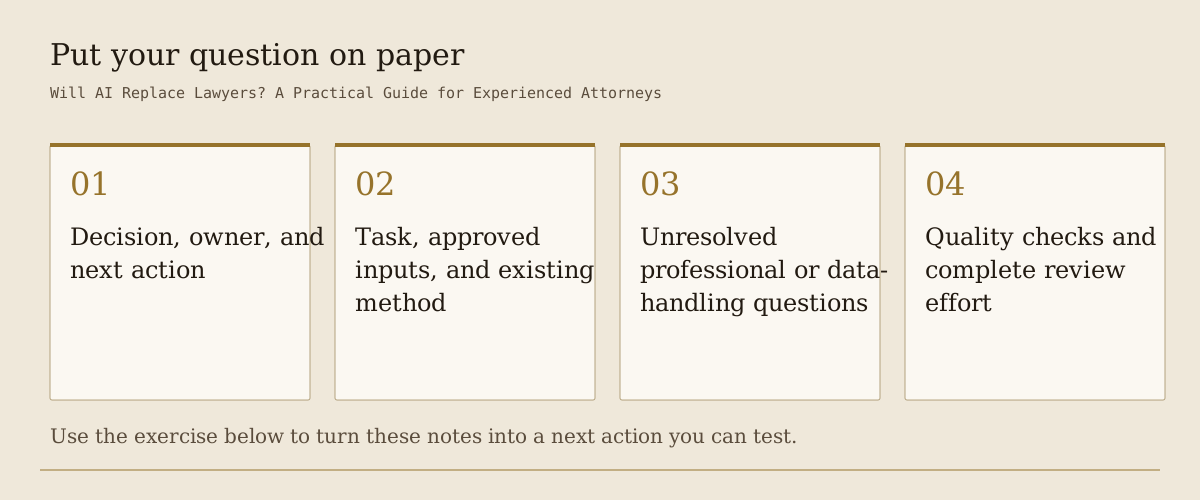
- Name the exact decision and its owner. Write one sentence such as: decide whether to test AI-assisted preparation of an internal research starting point. Identify who can authorize the test and who will review the work.
- Describe the task and the existing method. Record the inputs, intended output, normal review, and the difficulty you hope assistance will address. Keep final advice, external submissions, and negotiation authority outside the trial unless separately resolved.
- Resolve the material boundaries. List governing-rule questions, input permissions, account approval, confidentiality considerations, and any client communication or fee questions requiring review. Mark unanswered items explicitly. Do not enter restricted material while those questions remain open.
- Define the comparison before using the tool. Choose suitable material and an independently checked reference. Specify the important issues, source checks, omissions to watch for, and how you will record preparation, review, correction, and usable output.
- Write the stop and escalation conditions. Stop advancement when a material claim cannot be verified, an input is unapproved, the output exceeds its authorized task, or meaningful review cannot be completed. Identify who resolves each problem.
- Schedule the action and its review. Put the next action on your calendar, then choose an actual calendar review date fourteen days after the pilot starts. At review, decide to continue, modify, stop, or collect further bounded evidence. Record the reason in your own words.
Completed hypothetical example: A litigation partner writes: I will decide whether to test AI assistance for an internal research starting point. My first action is to ask the firm's designated approval owner whether the proposed account and constructed test material are suitable. I will not enter live client information during this initial exercise.
The task is to organize potentially relevant authorities and questions around a legal issue whose answer can be independently checked. The existing method is conventional research followed by attorney review. The hoped-for benefit is a clearer initial handoff, rather than an assumption of lower fees or less staffing.
The unresolved question is whether the proposed environment is approved for this material. The partner assigns that question to the appropriate firm reviewer. Once resolved, an associate prepares the comparison, and the partner reviews the substantive output. The reference is a separately checked analysis, not another AI-generated answer.
The quality criteria are accurate treatment of the supplied facts, attention to the material issues, inspectable sources, and verified support for every proposition the team might rely on. The associate records preparation, source reading, correction, and handoff effort for both methods. The worksheet contains no assumed savings.
The stopping conditions are unapproved inputs, an unverified material proposition, output that moves beyond the authorized research starting point, or insufficient reviewer capacity. The partner chooses the actual calendar date fourteen days after the approved pilot begins. The review will consider usefulness, omissions, correction demands, and whether the team can supervise the process consistently.
You may be skilled at examining someone else's problem and find your own next decision harder to approach. If that is the gap you're noticing, you can bring it to AI and the Andes Retreat. Over five days in Peru's Sacred Valley, the work is to examine behavior, understand what is driving it, and choose an action to test at home. There's space to work on the question behind your hesitation, with support and accountability continuing afterward.
Your working notes
Use this page while you think. Your notes stay in this browser tab; download them before you close it.
What does this question change for you?
A practical answer can change how you work. It can also leave a personal decision unresolved: what to learn, what to stop postponing, or which responsibility to take next. Name that decision before collecting another prediction.
Work through your next decision. Your notes stay in the browser tab, and the exercise gives you no predictive score.
If a recurring pattern keeps preventing action, AI and the Andes Retreat offers five days of practical inquiry in Peru's Sacred Valley, followed by support and accountability. Read about the seminar and assess whether that work fits your question.
Frequently asked questions
Search research, audience discussions, and the existing seminar FAQ library informed these questions. Some wording has been adapted to this guide.
Are lawyers likely to be replaced by AI?
The research reviewed here doesn't establish whole-profession replacement. A legal task experiment found useful assistance among law students, while a research reliability study found continuing errors. Neither measured partner replacement or future legal employment. For your practice, examine specific tasks, review demands, client needs, and professional obligations. A change in drafting or research can matter substantially without demonstrating that the entire role will disappear. Seniority also doesn't supply a guarantee.
Does AI still hallucinate in 2026?
The sources reviewed here don't establish current error rates for every October 2026 legal product. The published reliability study evaluated historical versions, so its results should not become a present product ranking. There is no basis here for assuming errors have disappeared. Check the specific proposed use with independently verified material and meaningful attorney review. An update or a retrieval feature doesn't, by itself, answer whether a particular legal proposition is accurate and supported.
Can you get in legal trouble for using AI?
A specific answer depends on the conduct, jurisdiction, and applicable requirements. ABA Formal Opinion 512 applies existing professional obligations to generative AI use, including competence, confidentiality, supervision, candor, communication, and reasonable fees. Assistance doesn't remove responsibility for evaluating and verifying the work. This guide doesn't determine exposure to sanctions or liability in a particular matter. Review your actual workflow and governing rules rather than treating either tool use or a tool disclaimer as decisive.
Are there AI tools specifically designed for lawyers?
Yes, the research reviewed here studied specialized legal products as well as general-purpose systems. The legal task experiment included Vincent AI, and the reliability evaluation examined several legal research tools. Those studies concern particular historical versions. They don't establish which subscriptions, features, or terms are available today. Treat legal branding as a starting point for investigation, then examine your intended task, sources, data permissions, review process, and applicable obligations.
Which is the best AI for lawyers?
The research reviewed here cannot support a current universal ranking. Results vary by task and tool, and the legal task study used specific older versions. Define the use before comparing products. Examine suitable inputs, source access, verifiability, complete review effort, costs, and the applicable professional requirements. A tool that helps organize one research question may be a poor choice for another workflow. Choose from evidence about your task rather than a claim that one system is best for the profession.
Will AI replace corporate lawyers in the United States?
No reliable replacement conclusion follows from the sources reviewed here. Corporate practice includes document work, factual inquiry, advice, negotiation, and client objectives, reflected in the broader lawyer task profile. That description doesn't prove immunity either. Examine a bounded use such as an internal contract issues list, with approved inputs and attorney verification. Assess changes in the complete service separately from claims about drafting speed. Applicable U.S. professional requirements also need jurisdiction-specific review.
Will AI replace law firm partners?
The supplied studies don't measure partner replacement. The legal task experiment studied upper-level students, while the occupational profile describes responsibilities across practices and seniority levels. Partners should examine supervision, client objectives, service design, and review capacity as production methods change. Those responsibilities are useful inventory categories, not proof of permanent protection. A successful narrow pilot cannot, on its own, settle the firm's leadership or staffing model.
Can ChatGPT act as a lawyer?
Generating legal-sounding text is different from establishing that a system can provide representation or assume an attorney's obligations. The research reviewed here doesn't demonstrate that ChatGPT can take over an entire legal practice. ABA Formal Opinion 512 addresses lawyers' responsibilities when using generative AI; it doesn't transfer those responsibilities to the tool. If the question concerns permitted legal services or representation in a particular jurisdiction, consult the governing requirements. Treat generated material as something requiring evaluation.
Can your ChatGPT be used in court?
That depends on what use you mean and the applicable court and professional requirements. The research reviewed here doesn't contain a universal court-use rule. Before any AI-assisted material advances into a submission, verify the substance and examine the governing requirements. ABA Formal Opinion 512 addresses competence, candor, and related responsibilities without removing the attorney's obligation to evaluate work. An existing citation or an AI self-check doesn't establish that the proposed submission is accurate or appropriate.
How is artificial intelligence being used in the legal profession?
The supplied studies examine assistance with realistic written legal tasks and legal research queries. They show that particular tools can help while still requiring verification. For a practice, possible bounded applications include a research starting point, alternative wording, or an internal issues list using suitable inputs. Those examples are workflow proposals, not a representative survey of adoption. Read the legal task research with its student population and historical tool versions in view before generalizing.
What are the ethical responsibilities for a lawyer using AI?
ABA Formal Opinion 512 addresses competence, confidentiality, communication, supervision, candor, and reasonable fees in generative AI use. Assistance doesn't remove responsibility for evaluating and verifying work. Translate those concerns into a specific process: permitted inputs, a qualified reviewer, source checks, escalation, communication decisions, and fee review. The opinion interprets ABA Model Rules and isn't binding everywhere. Check your governing rules and current local guidance rather than treating this summary as matter-specific legal advice.
Do lawyers have to disclose the use of AI?
A universal always-or-never answer would overstate the research reviewed here. ABA Formal Opinion 512 discusses communication obligations, but a specific determination requires the applicable rules, engagement, and circumstances. Identify who will resolve disclosure and consent questions before the proposed use. Record the answer and its basis in the appropriate firm process. Avoid assuming that disclosure cures an otherwise inadequate workflow or that an internal use is automatically irrelevant to client obligations.
Can AI draft a contract?
AI-generated wording can be considered as a proposed drafting aid, but the research reviewed here doesn't establish that any current tool can independently produce the right agreement for every matter. Begin with confirmed instructions, suitable material, and clear open issues. Review meaning and interaction across the document, then obtain the necessary client decisions. The lawyer task profile places drafting alongside advice, fact examination, strategy, and negotiation. A complete-looking document doesn't demonstrate that those stages are complete.
Will contracting be replaced by AI?
The sources reviewed here don't establish replacement of the entire contracting process. Producing text, reviewing departures, confirming objectives, negotiating, and approving a position are different tasks. A bounded comparison could examine whether assistance improves an internal issues list while preserving the appropriate decision authority. The lawyer task profile helps identify those responsibilities but doesn't forecast their automation. Evaluate the process stage you intend to change instead of treating a convincing draft as evidence about the whole process.
How can a law firm protect confidential information when using AI tools?
Resolve the actual input and environment before sharing material. Examine applicable confidentiality requirements, vendor terms, approved data categories, settings, access, and the proposed workflow with qualified reviewers. ABA Formal Opinion 512 supplies professional context, not a security guarantee. Removing names doesn't automatically resolve every concern. If approval remains unclear, use suitable constructed or public material for initial familiarization and pause client-data use. The answer depends on your arrangement rather than the product's branding.
How should I check AI-generated citations before filing a brief?
Open the authority and confirm that it exists, is applicable, and supports the proposition for which you cite it. Use your ordinary process for checking current validity and relevant jurisdiction. A real case name alone isn't enough. The legal reliability study distinguishes problems with generated answers under its historical test conditions. The ABA guidance also addresses professional duties when using these tools. The responsible lawyer must complete the required review under the rules governing the matter.
Does a legal AI tool connected to a case database remove the need for verification?
No. Distinguish a system that retrieves documents from one that generates an answer using retrieved documents. A database can contain reliable authority while a generated answer still misstates its relevance. The 2025 study reviewed here tested particular legal research systems; its error figures aren't current rates for every product. Evaluate the version and workflow your firm intends to use, then retain the professional review required for the actual matter. Source access is useful evidence about a system, not an exemption from checking its work.
Can AI help analyze the contents of a contract, rather than only draft one?
It can assist with a draft issue list or comparison if the inputs are permitted and a qualified lawyer checks the result. Ask it to identify the clause behind each point, then inspect the actual wording and the surrounding provisions. Interpretation depends on the transaction and governing law, as well as the client's objectives. A polished explanation can miss a cross-reference or assume a fact the contract doesn't establish. Keep responsibility for the advice with the lawyer; do not treat the generated issue list as a completed legal review.
How should I test a new legal AI research workflow?
Choose a bounded research question in an area where you can evaluate the answer. Use permitted material and compare the output with your established research process. Check both omitted authority and misleading support, and count the time spent correcting the result. Record the product version and the task so the comparison can be repeated. A successful example doesn't establish suitability for every matter. The professional guidance remains relevant to competence and supervision as you decide whether to extend use.
What should I check before sending an AI-assisted client email?
Check that the email answers the client's actual question and accurately reflects the advice you intend to give. Remove unsupported promises and any unnecessary sensitive detail. Read it as the recipient will: is the action clear, and does the wording sound like your firm? A formal tone doesn't compensate for a wrong instruction or a missed qualification. Under the professional duties discussed here, assistance with drafting leaves the lawyer responsible for an appropriate communication. Keep the review proportionate to the importance of the message.
Sources and evidence
These guides were drafted with AI assistance and checked against the linked sources. Examples labeled hypothetical illustrate a decision; they are not participant stories or measured results.
Studies answer specific questions about particular people, tasks, and tools. Their dates and limits matter. A result about task assistance is not a forecast for an entire profession.
- Generative AI and Jobs: A Refined Global Index of Occupational Exposure
- Skills in the AI age
- Employment Projections and Occupational Outlook Handbook: 2025-2035
- Canaries in the Coal Mine? Six Facts about the Recent Employment Effects of Artificial Intelligence, revised August 12, 2026
- We are Changing our Developer Productivity Experiment Design
- Agentic AI in organisations: Early insights from practitioner interviews
- How AI Impacts Skill Formation, arXiv v2
- AI-Powered Lawyering: AI Reasoning Models, Retrieval Augmented Generation, and the Future of Legal Practice
- Hallucination-Free? Assessing the Reliability of Leading AI Legal Research Tools
- ABA Formal Opinion 512: Generative Artificial Intelligence Tools
- O*NET 23-1011.00: Lawyers
- Here's What I'd Learn Instead of AI Automation in 2027
- What I'd Learn Instead of Automation in 2026
- The SoulSearching Experience
- Observed public comment question about protecting company information
- Observed public comment question about automation and confidential company information
- Observed public comment question about company AI governance
- Observed public comment question about subscription and API costs
- Observed public comment question about preserving context across AI interactions
- Observed public comment question about limited context and session recovery
- Observed public comment question about human quality control
- Observed public comment question about skills beyond sales
- Canonical seminar FAQ: When does gathering more information actually help?
- Canonical seminar FAQ: Why do I feel unclear even when I already know all the facts?
- Canonical seminar question: Does making a fast decision fix this?
- Canonical seminar FAQ: Can inner work replace management skill or strategy?
Where the audience questions came from
These linked discussions and comments supplied questions and wording. They do not establish the truth of the replies, verified professional identities, or how common a concern is.
- Audience question, r/Lawyertalk: Best use cases for Lexis/Westlaw AI (and learning resources)?
- Audience question, r/Lawyertalk: How Do Lawyers Not Check AI Brief Cites Before Filing?
- Audience question, r/Lawyertalk: Best use cases for Lexis/Westlaw AI (and learning resources)?
- Audience question, r/Lawyertalk: How Do Lawyers Not Check AI Brief Cites Before Filing?
- Audience question, r/Lawyertalk: AI - it ain't as great as you think and for some of us feels extremely off