You arrive at work with three ordinary things to finish: a proposal, a conversation with a colleague, and a decision you've carried over from last week. Before you begin, you check an AI update. A new system appears to do something that recently required a specialist. Someone says your profession will change completely. Someone else says the concern is exaggerated.
By lunch, you understand more about AI and still haven't decided what to do differently.
That gap matters. You may be capable, experienced, and accustomed to taking responsibility. Yet preparing for AI can remain strangely vague because the question keeps expanding. Should you learn a tool, change your business, reconsider your career, or rethink what work means to you? Those decisions require different evidence. Treating them as one enormous problem makes even a sensible first step difficult to see.
The useful starting point is your actual week. What do people rely on you to deliver? Which tasks take time? Where would an incorrect answer matter? What can you test without making a commitment you cannot easily reverse? Preparation becomes more practical when you connect one question to one decision, one action, and a review date.
The evidence doesn't justify pretending nothing is changing. It also doesn't justify converting every capability announcement into a personal replacement forecast. The ILO's 2025 occupational exposure research, for example, concerns potential task change, not a count of jobs already eliminated. That distinction gives you a better place to begin than either reassurance or alarm.
This guide helps you separate the kinds of change, choose a focused learning experiment, and recognize when more research is postponing the decision you already understand. The aim is a usable preparation plan. You can revise it when evidence changes, without asking today's plan to settle the rest of your life.
What does preparing for AI mean in your actual week?
Preparing for AI becomes useful when it changes something you can name. You might decide to test an approved assistant on a recurring report, ask your employer about its data policy, practice checking AI-generated analysis, or investigate whether customers still value a service you're considering. Each action addresses a particular uncertainty. None requires you to decide what every future workplace will look like.
Begin by finishing this sentence: I need to decide whether to change how I do this specific piece of work. The sentence may feel smaller than the concern that brought you here. That is its value. A broad concern can contain several decisions, but you cannot test all of them in the same way. Whether a tool improves your drafting is different from whether your employer will reduce hiring. Whether you enjoy learning to use it is different from whether you want a new career.
Look at the work people actually receive from you. A manager may describe the job as leadership, while a normal week includes preparing information, making tradeoffs, resolving misunderstandings, following up on decisions, and helping someone deliver a difficult assignment. A business owner may think first about strategy, while much of the week concerns proposals, scheduling, exceptions, and customer conversations. These descriptions are starting points for observation, not claims that every manager or owner works alike.
Choose one recurring task that has a recognizable beginning and end. A proposal begins with a request and ends with an approved document the customer can understand. A meeting summary begins with notes and ends with an accurate record of decisions and responsibilities. If the task cannot be bounded, narrow it further. Testing the first draft of a proposal is more manageable than testing the entire sales process.
Then identify the decision that a result would influence. If a draft becomes faster but requires more checking, would you keep using the tool? If it helps only with familiar requests, would you limit it to those? If your workplace has no approved environment, would the next action be a policy conversation rather than a trial? A preparation plan needs an answer to what happens after you learn something.
There is also room for a different starting point. You may have no immediate reason to automate anything. Your most useful action could be understanding the tools colleagues already use, documenting a process that depends on your memory, or deciding which professional responsibility you need to understand better. Activity is not automatically preparation. The relevant test is whether the action helps you make or carry out a decision that matters in your circumstances.
Write that decision in ordinary language. If you can explain it without using the phrase AI strategy, you are more likely to know what evidence belongs in the plan and what can wait.
What has changed, and what remains a prediction?
AI discussions often move between capability, use, and outcomes without marking the transition. Capability asks whether a system can perform a task under specified conditions. Adoption asks whether people or organizations are using it. Outcomes ask what happened to quality, time, hiring, earnings, or other results. Evidence about one category can inform another, but it cannot simply stand in for it.
The ILO and NASK's May 2025 exposure index estimates that about one quarter of workers globally hold occupations with some potential exposure to generative AI. Its assessments combine task information, expert judgment, and AI predictions. Exposure means that parts of the occupation could change. It does not establish that one quarter of workers have lost their jobs, that adoption will happen at a particular speed, or that your own position will disappear.
Business use is a separate observation. The Census Bureau's April 2026 working paper examines a reference period from November 2025 through January 2026. In that period, 18% of firms reported AI use in a business function, or 32% when weighted by employment. Adoption differed by firm size and sector, and many adopters used AI in only a few functions or tasks. Those figures describe that period. They are not an October 2026 adoption estimate.
The two sources answer different questions. The exposure index describes potential task change across occupations. The business study describes reported use in firms. A task can be technically exposed while the organization has not adopted a suitable system. A worker can also use an assistant informally without the firm having redesigned a process around it. When someone says businesses are already using AI, ask which measure they mean.
Your practical interpretation should remain proportionate. Potential exposure is a reason to examine your tasks. Reported adoption is a reason to learn how your organization and customers are using the technology. Neither is sufficient evidence for a particular staffing decision. To make that decision responsibly, you would need information about the actual process, its reliability, demand, costs, and the consequences of changing it.
Apply the same separation to a product demonstration. The demonstration may show a real capability. It may still omit the failed attempts, the work needed to prepare the input, the checking required afterward, or the circumstances in which the system should stop. Asking about these omissions is not refusing to recognize progress. It is identifying the difference between an impressive output and a dependable work process.
On your preparation map, give each piece of evidence a label: capability, adoption, or outcome. Add the setting and observation period. That small habit keeps a genuine finding from growing into a conclusion the source never established.
What do employment and productivity findings actually tell you?
Employment evidence deserves attention, especially when your decision concerns a career move or hiring. It also deserves careful reading. Reduced hiring, layoffs, changed hours, and changed earnings are different outcomes. An occupation can have reorganized work without an immediate change in recorded pay. A firm can gain useful assistance without eliminating the position that uses it.
The Stanford Digital Economy Lab analysis revised in August 2026 found no widespread economy-level displacement in its evidence. It did find a relative employment gap among workers aged 22 to 25 in exposed occupations, primarily involving reduced hiring. Experienced workers did not show a comparable gap in that analysis. The authors describe these as descriptive indicators, not causal estimates of jobs lost to AI.
That finding raises a practical question for an established professional: what happens if you change fields and become a beginner again? Your years of experience may help in some tasks, but they do not automatically transfer to every new market. If a proposed career change would put you into a new entry route, investigate that route directly. Talk with relevant employers, examine current requirements, and test the work before assuming that a new label creates a stronger position.
A different setting provides a different result. In the March 2026 version of Humlum and Vestergaard's Danish study, the researchers found substantial work reorganization in the studied exposed occupations but no measurable average changes in earnings or recorded hours over the observed horizon. Administrative outcomes ran through December 2024. That is meaningful evidence about that setting and period. It is not proof that AI cannot affect employment or pay elsewhere.
Productivity findings are narrower again. The published study Generative AI at Work found that AI access increased issues resolved per hour by 15% on average among 5,172 customer-support agents. Less experienced and lower-skilled agents benefited more. Experienced high performers had smaller speed gains and some quality tradeoffs. One firm's support setting cannot establish your own gain, a universal wage effect, or a guarantee of job security.
Do not force these findings into one story. A tool can improve a measured task while a labor-market study finds little average earnings change. A hiring pattern can be concerning without establishing that every exposed worker is being displaced. Different populations, time periods, technologies, and measures can produce different observations.
For your preparation decision, use employment studies to identify questions that deserve investigation, then look for evidence closer to your situation. Use productivity studies to justify a test, then measure the complete task. The evidence should help you decide what to examine. It should not become a substitute for examining your own work.
Can a benchmark or job forecast tell you when to act?
A forecast can be useful without being a reliable calendar for your life. Its value depends on the question it answers, the assumptions it makes, and what you would do differently if it were wrong. You can use a forecast to explore a possibility while refusing to treat its date as a deadline imposed on your career.
The Bureau of Labor Statistics' 2025 to 2035 employment projections, released in August 2026, are a conditional scenario under stated assumptions. The BLS methodology assumes technological progress broadly follows historical patterns and applies exceptional technology adjustments conservatively. BLS also acknowledges that exceptionally rapid change could undermine historical relationships used in projections. An official projection is therefore a structured planning input, not a guarantee of an individual's prospects.
Capability benchmarks have a different purpose. METR's January 2026 Time Horizon 1.1 release measures the human-estimated length of sampled software tasks a system can complete at a specified probability of success. That is not the same as the time the model runs. It is also not a measurement of an entire occupation, with its changing instructions, conversations, permissions, and responsibilities.
The success threshold is essential. A horizon measured at 50% success means something very different from a process you need to complete dependably for a customer. A task that sometimes succeeds can be useful for research or a supervised draft. The same reliability may be unacceptable when an incorrect action changes a live system or creates an obligation. Do not remove the threshold when repeating a benchmark headline.
METR's March 2026 modeling-assumption audit also reports substantial uncertainty and corrections. Task selection and modeling affect both point estimates and trends. The long-task baselines include estimates as well as measured human performance. These limits matter when someone extends a trend line into a claim about the date a whole profession becomes unnecessary.
Translate a forecast into a conditional statement you can use. If systems become more dependable on this task, I will test a wider scope. If employers begin requesting a particular capability in the roles I want, I will investigate that requirement. If my organization's approved tools change, I will revisit the trial. These statements connect an observable development to an action without pretending you know when it will arrive.
You can also act before a prediction resolves. Learning to define a task clearly, verify a claim, or document a decision may be worthwhile under several timelines. The relevant question is whether the action has present value and a manageable cost. A dramatic forecast should not be necessary to justify a sensible, reversible improvement.

Which parts of your work should you examine first?
A job title is too broad to serve as your first test. Start with the tasks inside it. Write down what you actually did during a recent ordinary week, including the work that rarely appears in a polished description of your role. Include finding missing information, checking another person's assumptions, handling exceptions, and explaining why a decision changed. These activities can determine whether an apparently simple automation works.
The ILO's task-based exposure approach supports the distinction between potential task change and whole-job disappearance. Your personal inventory is an editorial application of that distinction. It is not an occupational risk score, and it should not produce a percentage claiming how likely you are to be replaced.
Official occupational profiles can help you notice omissions. The O*NET software developer profile includes needs, requirements, design constraints, testing, integration, maintenance, and coordination. The management analyst profile includes fact gathering, interviews, analysis, recommendations, implementation, and training. These are descriptive task bundles, not forecasts. Their task data also have their own update dates, separate from the current page header.
For each task, ask what enters the process, what leaves it, and who determines whether the output is acceptable. Then ask what happens when it is wrong. A summary used as a private starting point has different consequences from a summary sent directly to a client. A draft calculation that you can reconcile has different stakes from an action that releases funds. Similar-looking outputs can belong to very different responsibilities.
Look for a first task where you understand the quality standard and can inspect the result. Familiarity helps you notice omissions. Repetition gives you another opportunity to test. Reversibility gives you a way to recover if the tool does not help. None of these qualities makes the task harmless, but together they can make a small experiment easier to evaluate.
Do not select a task only because it is unpleasant. You may dislike customer follow-up because it requires an awkward conversation, while the real value lies in understanding the customer's hesitation. Automating the message may remove the part you want to avoid without resolving the issue. Conversely, a tedious formatting task may be a reasonable candidate if you can check the result easily and no important relationship depends on doing it personally.
This article uses the inventory to choose your next preparation action. For a fuller examination of task exposure, organizational constraints, and personal job questions, see Will AI Take My Job? You don't need to complete an exhaustive assessment before taking one sensible step. You do need enough understanding to know what your first test is allowed to change.
What should you learn next?
Choose the next skill by its usefulness in a real task. If you cannot name where you will practice it, the choice may be premature. A course can be interesting and still have little relevance to the decision in front of you. Start with the work you want to improve, then identify the smallest capability that would let you test an improvement.
The OECD's July 2026 synthesis Skills in the AI Age distinguishes foundational skills, information and communication technology skills, and complementary abilities such as problem solving, communication, creativity, and collaboration. It also separates AI literacy, including using and critically evaluating AI, from advanced AI engineering. That distinction leaves room for meaningful preparation without assuming everyone needs the same technical specialization.
Your first learning target might be writing a clear task brief. It might be checking whether a generated statement is supported by its source. It might be understanding how an approved tool handles documents. For a different reader, programming or deeper system knowledge may be necessary because the intended work involves integration, maintenance, or technical review. The right depth follows from the responsibility you want to take.
Make the target observable. I want to understand AI is too broad to evaluate. I want to produce a draft from approved material, trace its important claims, and explain the revisions I made is specific enough to practice. You can keep the task small while still learning something that transfers beyond the current interface.
Separate finishing the task from learning to do it. Anthropic researchers' small coding-learning experiment, revised in February 2026, found lower immediate comprehension scores in the AI-assisted group in its particular setting. It does not establish a universal loss of skill or intelligence. It does show why a completed output is insufficient evidence that you understand the process behind it.
As a practical learning routine, attempt a manageable part yourself, ask for an explanation where you get stuck, verify against trusted material, and explain the result in your own words. These are suggestions for structuring practice, not a promise of a measured learning advantage. The useful check is whether you can perform or explain the relevant work afterward, including recognizing when an answer is wrong.
Keep the first learning commitment modest enough that you can revise it. If your task reveals a need for deeper technical knowledge, pursue that deliberately. If your main bottleneck is a vague request or an unresolved stakeholder disagreement, another tool tutorial may be the wrong response. The companion guide What Should You Learn When AI Keeps Changing? develops the learning choice in more depth.
Which decisions remain useful across several possible futures?
You can prepare without choosing a single prediction to believe. Consider a few conditional situations and ask which actions make sense across them. The purpose is to reveal dependence on assumptions. It is not to attach invented probabilities to the future or create a scientific score from your preferences.
In one situation, change is gradual. Your organization adopts assistance unevenly, familiar processes remain, and people still spend substantial time preparing and checking work. In that setting, useful preparation could include improving one recurring task, understanding the approved tools, and documenting how quality is judged. You would not need to reorganize your whole career to begin.
In another situation, selected tasks become much easier to automate. Producing a draft becomes less distinctive, while understanding the request, deciding what matters, and evaluating the result remain important responsibilities in your current process. Preparing could mean learning to supervise a larger amount of generated work while maintaining your ability to inspect it. That is a conditional workflow possibility, not a claim that every profession will turn into supervision.
A third situation concerns disrupted entry routes. Even if experienced roles continue, beginners or people changing fields may face different opportunities to acquire experience. The Stanford revised payroll analysis makes that question worth examining, while its descriptive limits prevent a universal conclusion. If this situation matters to you, preparation might include building evidence of relevant work and investigating how employers currently develop new staff.
Choose an action that helps with work you already have: document a recurring task, practice checking its output, or ask someone in your market what has changed. Before a larger commitment, ask which forecast would have to come true for it to pay off. If the answer is one precise timetable, look for a smaller step you can revise.
Also identify actions that depend heavily on a particular future. Leaving a stable role solely because a commentator predicts rapid disappearance has a different exposure to being wrong than taking a short approved training session. Buying a complex system before you understand the process it will support is different from testing a single task. The more difficult a commitment is to reverse, the stronger and more local your evidence should be.
Use scenarios to ask what would change your plan. If progress is slower, is the action still worthwhile? If it is faster, what capability would you wish you had practiced? If the tool helps but customer demand weakens, what information would you need next? The AI future scenarios guide owns the wider scenario discussion. Here, the aim is simply to choose an action that doesn't require the world to follow one precise script.
Hypothetical example: an experienced manager chooses a reporting experiment
Consider an experienced operations manager who reads AI news most mornings. The manager knows the company has approved an assistant but has not used it systematically. The concern sounds broad: I need to stay relevant. The actual recurring frustration is narrower: preparing the weekly operating update takes attention away from resolving the issues the update describes.
The manager lists the stages of that work. Information arrives from several teams. Some entries need clarification. The update distinguishes completed work, unresolved problems, and decisions required from leadership. After drafting, the manager checks the document and uses it to guide a meeting. The inventory makes an important distinction visible: arranging approved information into a draft is different from deciding which issue deserves escalation.
The first decision becomes whether the approved assistant can help draft the update without increasing the total checking burden or confusing facts with interpretation. The manager keeps the normal information-gathering process and the final decision responsibility. The trial uses approved material only. It does not authorize the tool to request information from colleagues or circulate the finished update.
Before the first assisted attempt, the manager records how the ordinary process works. The notes include time spent preparing, clarifying, drafting, checking, and correcting. They also describe the quality standard: every important statement should match the source, unresolved questions should remain visible, and the reader should know which decisions require attention. No invented productivity target is needed to make those expectations clear.
The trial then produces a draft that the manager compares with the source material. A polished paragraph is not accepted because it sounds plausible. A missing uncertainty matters even if every sentence is grammatically correct. The manager writes down where the assistant helped, where it added interpretation, and where checking required a return to the original notes. These observations remain about this workflow, not about management as a whole.
The possible decisions are conditional. If the tool reduces drafting work while preserving accuracy and clarity, the manager could continue within the tested scope. If it helps only with headings and organization, the use could be narrowed accordingly. If verification takes longer than drafting independently, the manager could pause. A finding that the source notes are inconsistent might lead to improving information collection before trying more automation.
The November 2025 version of Shifting Work Patterns with Generative AI is relevant background: individual tool provision saved time in some activities without detecting changed task quantity or composition. It does not predict this manager's result. The example shows how a broad concern can become a specific learning decision, with useful outcomes available even if the tool itself proves disappointing.

Hypothetical example: a business owner tests a service before changing the business
This is a hypothetical example, not an account of a real client or retreat participant. Consider an owner of an established professional service business. The owner has heard that AI agents can produce research and draft recommendations. One possible response is to rebuild the service around automation immediately. Another is to dismiss the tools because clients pay for experience. Both responses skip the question of where assistance would actually improve the service.
The owner chooses a familiar deliverable: a preliminary briefing prepared before a client conversation. The briefing organizes approved facts, identifies unresolved questions, and gives the human advisor a starting point. It does not decide the client's strategy or replace the conversation. The owner can inspect the result because the subject is familiar and the source material is available.
The decision is whether assistance improves preparation without creating unsupported confidence. Before testing, the owner writes the quality requirements. Important claims must trace to supplied evidence. Missing information must be stated. Alternative interpretations should remain visible. The briefing must distinguish what the client has said from what the advisor infers. These requirements matter because a neat document can otherwise hide a weak diagnosis.
The published consulting experiment on the jagged technological frontier provides a reason to examine both speed and correctness. AI improved selected tasks within the assessed capability frontier, while assistance reduced correctness on one selected task outside it. The study involved individual-contributor consultants using a 2023 tool. It does not establish the commercial future of this owner's service or the performance of a current product.
During the hypothetical trial, the owner compares the assisted briefing with the original evidence and an independently prepared account. Any useful structure is retained only after checking. An apparent recommendation that depends on missing information becomes a question for the client, rather than a conclusion quietly carried into the meeting. The owner tracks preparation, review, and correction as parts of the same job.
The commercial decision remains separate. Even if drafting becomes easier, the owner still needs to learn what clients value, whether the service solves a relevant problem, and what delivery requires. The OECD's September 2026 practitioner interviews describe varied agent maturity and concerns about unpredictable behavior, traceability, and accountability. They are useful context for a gradual trial, not quantitative evidence of revenue or savings.
At review, the owner could continue with briefing support, change the input process, or stop using the tool on this task. A broader business change would require additional customer and operational evidence. The small test does not answer everything, but it answers something consequential before the owner makes the entire business depend on an untested assumption.
When would an attractive AI recommendation be wrong?
A sensible recommendation for one task can be wrong for another. Start small is usually practical advice, but even a small trial may be inappropriate if you cannot protect the information, judge the result, or recover from an action. The size of the output does not determine the size of the responsibility.
Hypothetical counterexample: an advisor wants to save time by having an AI assistant handle an important client conversation. The task appears repetitive because clients often ask similar questions. The advisor already has a collection of approved documents and a tool that writes persuasive answers. It would be tempting to treat this as an easy first automation.
Now change the details. The client is deciding whether to proceed after a misunderstanding. The important work is recognizing what the client means, clarifying an unstated concern, and taking responsibility for what the business can deliver. A fast reply based on familiar wording may miss the actual issue. Here, automating the conversation could remove the contact through which the advisor would understand the problem.
The better first test might support preparation while leaving the conversation with the advisor. The tool could help organize approved background material or draft questions for review. Whether this is useful still requires observation. The point is that producing words similar to a successful interaction does not establish that the interaction's purpose has been fulfilled.
The consulting field experiment reinforces the need for task-specific judgment: assistance helped selected tasks and harmed correctness on a different tested task. It does not prove that relationship work is permanently beyond AI. It does give you a reason to reject the assumption that success on one nearby task guarantees success on another.
There are also professional boundaries. For lawyers, ABA Formal Opinion 512 applies competence, confidentiality, communication, supervision, candor, and reasonable-fee obligations to generative AI use. The opinion is not binding law in every jurisdiction, and governing rules need checking. A convenient tool does not remove the professional's obligation to evaluate the work.
Your counterexample may be less formal. You might be learning a skill that you still need to perform independently. Automating the central reasoning would then frustrate the purpose of the exercise. Or a task may happen so rarely that setup and maintenance are disproportionate. Preparation includes choosing where assistance belongs and recognizing when the current process is the more appropriate choice. Declining a particular use can be an informed action when you can explain the reason and the condition under which you would reconsider.
Who remains responsible when AI helps with the work?
Before you expand a trial, identify who is responsible for the result. An assistant may produce the draft, but someone still needs to decide whether it can be used, who receives it, and what action follows. If responsibility is unclear, the workflow is not ready merely because the output looks complete.
The OECD's September 2026 report on agentic AI draws on interviews with 25 organizations already involved with agents. Practitioners described unpredictable behavior, incorrect actions, and difficulties with traceability and accountability. Common responses included gradually increasing autonomy, keeping human checkpoints, and involving domain experts. The sample is illustrative rather than representative, and it does not independently validate performance.
For your first experiment, define an information boundary and an action boundary. The information boundary specifies what may enter the tool. The action boundary specifies what the tool may do with the result. Drafting from approved material does not imply permission to send messages, alter records, spend money, or change a live system. Keeping these boundaries explicit makes it easier to know what the trial actually tested.
Check the approved environment rather than assuming a familiar brand or paid plan settles confidentiality. Ask who can access the data, what your organization permits, and whether connected services change the handling of information. These are questions to resolve with the responsible people and current documentation. This article does not certify a product's security or establish that a deployment meets your contractual or legal obligations.
Professional work adds specific responsibilities. ABA Formal Opinion 512 explains that AI assistance does not remove lawyers' responsibility to evaluate and verify work, alongside other professional obligations. The governing jurisdiction matters. Confirming that a citation exists is also insufficient if the authority does not support the proposition being made, as the published legal-tool reliability evaluation helps illustrate with its historical tools and query set.
In finance, keep management controls visible. The O*NET treasurer and controller profile includes disbursement authority, financial statements, internal controls, supervision, and audits. This describes responsibilities; it is not a universal compliance rule or an AI forecast. A trial might support a draft explanation while retaining source reconciliation and the appropriate approval authority. No investment or tax decision follows from the task example.
These considerations need not turn every beginner exercise into a large procurement project. They help you select a scope you can responsibly test. If the boundaries cannot yet be established, preparation can begin with public material, a fictional practice document clearly identified as such, or a conversation with the person who owns the relevant policy.
How much AI news belongs in your preparation plan?
A useful information routine starts with a question that the information could answer. If you're testing a reporting task, relevant developments include changes to the approved tool, its document handling, and any policy that affects your use. A dramatic announcement about a distant application may be interesting without changing your current decision.
Nick Saraev recommends choosing what you need to learn before searching, rather than letting a feed choose the curriculum. He also distinguishes entertaining AI coverage from information that helps with a real workflow. Treat this as practical advice to test against your own work. Nick Saraev recommends choosing what to learn before searching discussion of AI news.
His incentives matter too: Saraev sells education and implementation services. That does not automatically invalidate a useful suggestion. It means you should evaluate the suggestion on its merits and separate it from claims about markets or timing. His preference for business understanding and communication can prompt a learning question without establishing that those skills are immune to AI or that technical learning has become pointless.
Create two places for information. One is your active decision record, containing evidence that could change the current plan. The other is a short parking list for interesting developments that do not yet affect it. You are allowed to remain curious. The boundary prevents every curiosity from becoming a new preparation obligation.
A complete disengagement from news would also be an overcorrection. A relevant change in access, pricing, safety guidance, or capabilities may require attention. Instead, choose a manageable review appointment and an exception rule. For example, you could review relevant updates at the end of your trial and check sooner if the approved tool changes or your organization issues new guidance. The schedule is a planning choice, not a scientifically established ideal.
Ask what you will do after reading. If the answer is compare a new feature on the task I'm testing, the information has a clear destination. If the answer is read more until I feel certain, you may be asking information to do something it cannot do. The next useful step may be making the test smaller, seeking permission for the right environment, or deciding what cost you are willing to accept.
For deeper work on this attention problem, see How Much AI News Do You Need Before It Stops Helping? The preparation plan here needs only a workable boundary: enough relevant information to act responsibly, followed by actual practice and a date to reconsider.

How will you know whether your experiment helped?
Define help before the first assisted attempt. Otherwise, a quick draft or an impressive interface can quietly become the measure of success. For most work, the useful measure is the complete process from receiving the task to delivering an acceptable result. Preparation, checking, correction, handoff, and recovery all belong in that process.
Record a baseline that matches the question. If you're investigating time, include the time spent reviewing. If you're investigating quality, define the important errors and omissions. If you're learning, include an independent explanation or performance check. You do not need an elaborate dashboard for a small trial. You need a record that lets you compare the result with the work you would otherwise have done.
The METR developer productivity update from February 2026 shows why measurement deserves care. Its earlier experiment found a slowdown in a specific experienced-developer setting, while the follow-up suggested improved productivity but had selection and time-measurement problems. METR cautioned against treating the newer estimates as reliable general effects. Neither result supplies a current universal percentage for your own work.
For your trial, note factors that could make a comparison misleading. Perhaps the assisted task was easier, the source material was cleaner, or you were still learning the interface. Perhaps the unassisted task benefited from knowledge gained during the assisted attempt. These details do not make every small experiment useless. They help you avoid presenting a tentative observation as a settled productivity claim.
Quality can also move differently from speed. The customer-support field study found different gains across worker experience levels, including smaller speed gains and some quality tradeoffs for experienced high performers. That is a reason to inspect both dimensions. A faster answer that omits an important exception may be worse work, even if it helps you clear the task from your screen.
Include retained understanding if the task develops a skill you need. The Anthropic coding-learning study distinguishes successful task completion from immediate comprehension in a small, specific experiment. Your practical check could be explaining the reasoning without the assistant, identifying a deliberately changed assumption, or completing a similar task independently. Use these checks to see whether you can explain and verify the work yourself.
Finally, write stopping conditions before you become invested. Stop the trial if it crosses the agreed information boundary, produces an error you cannot evaluate, requires unauthorized action, or consistently creates more review work than the benefit you are testing. Pause and investigate when the task or tool changes materially. A stopping condition turns disappointment into a decision you already know how to make.
What should happen at the review date?
A review date is useful because it turns learning into a decision. Without one, a trial can continue indefinitely while you keep accumulating impressions. Put the appointment on your calendar before beginning. Choose a date that allows the task to occur enough times to provide useful observations, while keeping the commitment small enough to change.
At the review, return to the original question. Did you learn whether assistance helps draft the report? Did you establish what the organization permits? Did you discover that the task is too variable for the first test? A trial can answer its question without producing the result you hoped for. That is different from failing to learn anything.
Choose among concrete outcomes. Continue within the tested scope if the result is useful and the boundaries remain appropriate. Narrow the scope if the tool helps only with one part. Revise the input or checking process if the problem is identifiable. Pause when the evidence is too weak or the environment has changed. Stop when the result doesn't justify its cost or creates a problem you cannot responsibly manage.
Expansion should be a new decision, not an automatic reward for an impressive attempt. Drafting support does not establish readiness to send the document without review. A successful public-information trial does not settle confidential-data use. A task that works under your close supervision may behave differently when delegated to a team. Name what changes with the wider scope and what evidence would be needed.
Write the next review trigger as well as the next review date. A trigger is an event that deserves attention sooner: a changed policy, a new tool version, an important error, a changed client requirement, or evidence that the process is no longer being checked as agreed. The date handles ordinary reconsideration. The trigger handles a material change.
For a career decision, the review may reveal the next question rather than settle the move. You might learn that you enjoy the work but lack evidence of market demand. The next action could be a conversation with a relevant employer or a small project that demonstrates capability. You might discover that the new field requires a commitment you currently cannot make. That is useful information about the decision, not a judgment about your ambition.
Keep a brief record of your reasoning: what you observed, what remains uncertain, what you decided, and what would change the decision. Use this as a working record for your decision. It cannot eliminate uncertainty, but it can help you avoid rebuilding the whole argument each time a headline appears. For a larger personal commitment, making life decisions under uncertainty deserves separate attention beyond this first preparation experiment.
What if you understand the options and still keep delaying?
Sometimes the evidence is incomplete. Sometimes the evidence is sufficient for a small next step, and you still don't take it. Those situations deserve different responses. More research is appropriate when a consequential requirement remains unknown. It is less useful when you already know what the first specific action would be and keep returning to the same material instead.
Look at the behavior without diagnosing yourself. You intend to practice with an approved tool, then spend the available time comparing courses. You intend to ask a colleague how the team is using AI, then wait until you can phrase the question perfectly. You intend to investigate a career option, then reopen a forecast about whether the field will exist. Describe the sequence as it happens. That gives you something more specific to work with than a label such as procrastination.
Ask what makes the action difficult. You may dislike being visibly inexperienced. You may be protecting a professional identity built over many years. You may disagree with the direction you've told yourself you should pursue. You may simply have chosen a task too large for the time available. These are possibilities to examine, not conclusions about the cause of your behavior.
Reduce the action until it tests the actual difficulty. A private attempt may help you see whether the obstacle is public exposure. A short conversation may show that you don't yet understand the role you're considering. Reserving a specific block of time may reveal that the obstacle was an overloaded week. If shrinking the action leaves the same pattern intact, that too is information. The established page on researching instead of starting explores this pattern more fully.
If a clear next action keeps turning into another research session, bring that specific pattern to the exercise below. The question is what happens between deciding and beginning.
You don't need to resolve every question about your future before beginning. You do need to distinguish an unanswered research question from an action you are avoiding. That distinction helps you choose the kind of support or information that fits the problem in front of you.
Compare your options
The comparison below is an editorial planning aid. It connects different questions to suitable evidence and specific actions. It is not a validated risk assessment, and the rows do not rank occupations or predict replacement.
| Your question | Evidence to examine | A useful first action | What would justify reconsidering? | What this cannot establish |
|---|---|---|---|---|
| Can AI help with this recurring task? | Your current process, approved tool capabilities, complete task time, and a clear quality standard. | Compare one bounded assisted attempt with an independently checked baseline. | Useful results across relevant task variations, or repeated review costs that outweigh the benefit. | The future of your whole occupation or a guaranteed productivity gain. |
| Which skill should I learn? | The requirements of a real task and the knowledge needed to evaluate its output. | Practice one capability and check whether you can explain or perform it independently. | A demonstrated gap that requires deeper study, or evidence that the skill doesn't serve your goal. | A permanent AI-proof skill or guaranteed employment. |
| Should my business expand an AI workflow? | Task results, review effort, customer needs, information permissions, and action boundaries. | Test preparation or drafting before delegating consequential actions. | Evidence that the wider scope is useful, inspectable, authorized, and recoverable. | Profitability, customer acceptance, or readiness for autonomous operation. |
| Should I change careers? | Actual work requirements, current entry routes, your constraints, and direct conversations with relevant employers. | Investigate a specific role and try a small representative piece of work. | Evidence of fit and a feasible entry route, together with a realistic account of the commitment. | The right life choice from an occupation forecast alone. |
| Does this headline change my plan? | The original source, observation period, task setting, success threshold, and limitations. | Write the precise decision the new information might change. | A relevant capability, policy, or demand change that affects your current task. | A replacement date derived from a demonstration or extrapolated trend. |
| Why do I keep postponing the next step? | Your actual sequence of intentions and actions, including what happens immediately before you delay. | Make a smaller attempt and examine what still stops it. | A recurring pattern that calls for a different action or support. | A diagnosis or a guarantee that reflection will resolve the issue. |
Use the row that matches your primary decision. If several rows apply, choose an order. Resolving the approved environment may come before testing a confidential task. Investigating the work may come before buying a course. A small result becomes useful when you know which later decision it is meant to inform.
Make a one-page map for your next AI decision
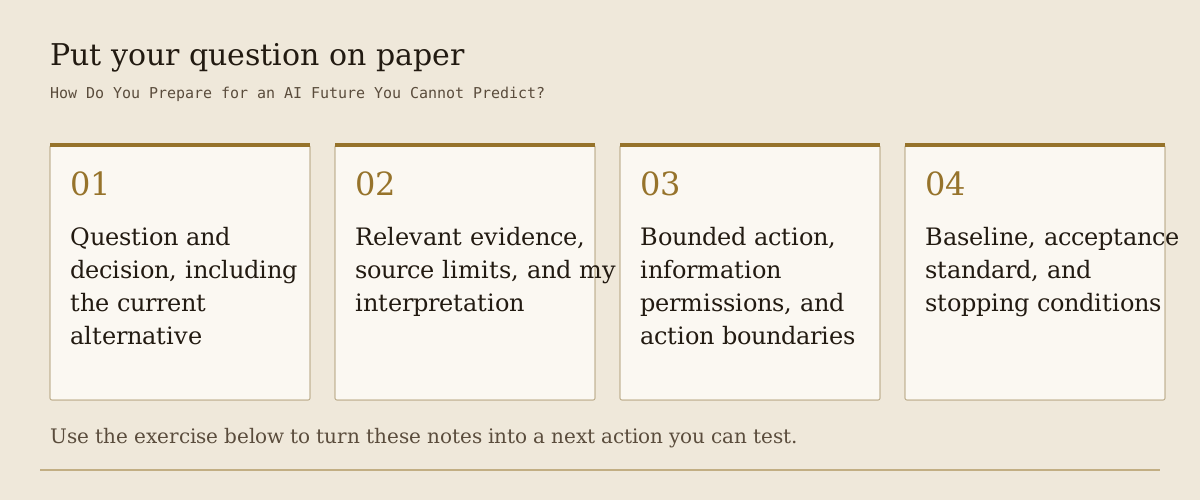
Use a single sheet of paper or a plain document. Choose one question you keep returning to, small enough to investigate in your current circumstances. Name the decision, an action you can take, and the evidence you will review before deciding what comes next.
You should be able to show the page to another person and explain what you will do next. If the page mostly contains forecasts about the whole economy, bring it back to the work or commitment you can actually change. If the decision involves confidential material or professional obligations, resolving the appropriate permissions may be the first action.
A reflection tool for planning your next step, rather than a predictive score.
- Write one decision sentence: I need to decide whether to change this specific task, learning commitment, or work arrangement. Name the present alternative so that keeping the current approach is a real option.
- Record the strongest relevant evidence and its limit. Identify whether it concerns capability, adoption, productivity, or employment. Keep your interpretation in a separate sentence.
- Choose one bounded action that can answer part of the question. Specify the approved information it may use, the output you will inspect, and any actions the tool is not authorized to take.
- Describe the baseline and acceptance standard. Include preparation, checking, correction, and retained understanding where relevant, rather than counting only generation time.
- Write stopping conditions before starting. Include unauthorized information use, an error you cannot evaluate, an action outside the agreed scope, or review work that makes the tested benefit unconvincing.
- Put the review appointment on your calendar. At that review, choose continue, narrow, revise, pause, or stop. Add the evidence or event that would require an earlier review.
Completed hypothetical example: An experienced team lead chooses the question: Can the approved assistant help prepare our weekly decision summary without making it harder to verify? The decision is whether to use it for a reviewed first draft. The current alternative is preparing the summary manually from the same approved notes.
Evidence and interpretation: The November 2025 randomized field experiment on work patterns found individual time savings in some activities but did not detect changed task quantity or composition from tool provision. That supports testing a bounded activity; it does not predict this team's result. The team lead's interpretation is that drafting may be worth examining while decision responsibility remains unchanged.
Action and boundaries: For the next four weekly summaries, the lead will use approved notes to request a draft separating decisions, open questions, and named responsibilities. The assistant will not send the summary, contact colleagues, or change task records. The lead will compare every substantive entry with the original notes before circulation.
Baseline and acceptance: The normal manual process will be recorded before the assisted trial, including drafting and checking. An acceptable summary must preserve uncertainty, assign no responsibility that wasn't agreed, and introduce no unsupported decision. The comparison includes total effort and whether colleagues can understand what requires action.
Stop and review: The lead will stop if the tool requires unapproved information, produces an entry the lead cannot verify, or repeatedly makes checking more burdensome than the drafting help is worth. The review is booked immediately after the fourth weekly summary, before the trial begins. A policy change or material error triggers an earlier review. Continuation will remain limited to reviewed drafts unless a separate decision supports a wider scope.
You can complete the same page with a learning or career question. The important connection is visible: this evidence supports this action, and this observation could change this decision.
If the plan makes sense but you still don't act on it, that gap deserves your attention. You can bring it to AI and the Andes Retreat: five days in Peru's Sacred Valley to examine the behavior, understand what is driving it, and choose an action to test at home. You may arrive with a question about AI and find that the decision you need to make is more personal. There's room to work on that question, with support and accountability continuing afterward.
Your working notes
Use this page while you think. Your notes stay in this browser tab; download them before you close it.
What does this question change for you?
A practical answer can change how you work. It can also leave a personal decision unresolved: what to learn, what to stop postponing, or which responsibility to take next. Name that decision before collecting another prediction.
Work through your next decision. Your notes stay in the browser tab, and the exercise gives you no predictive score.
If a recurring pattern keeps preventing action, AI and the Andes Retreat offers five days of practical inquiry in Peru's Sacred Valley, followed by support and accountability. Read about the seminar and assess whether that work fits your question.
Frequently asked questions
Search research, audience discussions, and the existing seminar FAQ library informed these questions. Some wording has been adapted to this guide.
What can I do to prepare for AI?
Choose a specific decision before choosing a tool. Inventory a recurring task, identify its quality standard, and check which information and tools your organization permits. Then run a small experiment and schedule a review. The ILO exposure index concerns potential task change, not a personal replacement forecast. Use it as a reason to examine your work. Your first useful result is knowing what to continue, change, or investigate next.
What could AI be like in ten years?
The research reviewed here cannot establish a dependable ten-year description. Capabilities, adoption, organizational choices, and economic outcomes can move differently. Even BLS employment projections are conditional on stated assumptions, while software benchmarks address selected tasks. Use possible futures to test your plan: would the action still help if change were slower, faster, or uneven? Avoid making a difficult commitment depend entirely on one forecast. Identify developments that would actually change your decision.
What jobs will be gone by 2030 due to AI?
No defensible list of jobs that will disappear by that date follows from this evidence. The ILO research measures potential task exposure, and BLS projections describe conditional employment scenarios. Neither provides a guaranteed replacement calendar. For a personal decision, examine your tasks, your organization's adoption, and actual demand for the work. A dated disappearance list can sound decisive while giving you less useful information than a careful task assessment.
What AI jobs are in high demand?
Demand depends on the role and the market where you want to work. Check current vacancies for responsibilities, prerequisites, and examples of work employers expect; a popular title or course advertisement is not enough. The OECD distinguishes general AI literacy from specialist engineering. Use that distinction to choose a learning path, then test it against actual opportunities before making a substantial commitment. OECD skills synthesis.
How can a beginner start working with AI?
Begin with a task you understand well enough to check, using public or approved material. Ask for a small output, compare it with the original information, and revise it yourself. Keep the tool's authority limited to drafting during the first trial. The OECD describes AI literacy as including use and critical evaluation. Being a beginner with the tool doesn't mean discarding your existing knowledge. That knowledge helps you identify what the output missed.
How can I use AI for work productivity?
Choose a recurring task and measure the full process, including preparation, checking, and correction. A faster first draft may still create more work later. The customer-support field study found productivity gains in a specific setting, with effects varying by experience. It doesn't supply your expected gain. Define acceptable quality before testing, compare against your ordinary process, and continue only where the result is useful. Keep income and staffing conclusions separate from task productivity.
Can I begin using AI without paying?
You can investigate whether an available free option meets a small practice need, but the research reviewed here does not verify current product plans or limits. Check the provider's current terms and your organization's policy before choosing. Price alone doesn't establish suitability for confidential work. Begin with public material if workplace approval is unresolved. Your initial goal is to learn how to define and inspect a task. You do not need to buy a large learning commitment before establishing what you want to practice.
Do I need a personal AI system to prepare?
You don't need a custom system to make a first preparation decision. An approved general-purpose assistant may be enough for a bounded draft, while some tasks require different tools or deeper setup. Start with the purpose rather than the label personal AI. The OECD practitioner interviews describe varied deployments and continuing accountability concerns. A more elaborate system should follow a demonstrated need, appropriate permissions, and an ability to inspect its work.
How should I choose which AI tools to learn next?
Choose tools against the requirements of a task: permitted information, needed output, inspection, cost, and fit with your existing process. Use one tool long enough to understand the relevant behavior before comparing every new release. A viewer question about future tool choices prompted this adaptation; it doesn't establish which product will matter later. Review the choice when capabilities, terms, or organizational needs change. Tool familiarity is useful when it serves work you can name.
Will human quality control still matter as AI systems improve?
In the deployments described by the OECD's practitioner interviews, human checkpoints and domain expertise were common responses to reliability concerns. That is current descriptive context, not proof of permanent human exclusivity. This adapts an observed quality-control question. For your work, define who checks the result and what acceptable quality means. Improved capability can change the checking process without making responsibility disappear from the decision you must make now.
How can a company protect confidential information when using AI tools?
Begin with approved tools, permitted data, access boundaries, and review by the people responsible for your organization's requirements. Check current documentation rather than relying on a general reassurance about a product. This adapts an observed confidentiality question. The OECD interviews illustrate governance concerns but do not certify any deployment. If permissions remain unresolved, use public material for practice and make clarification the first workplace action.
What costs should I check before adopting an AI agent workflow?
Check the current plan, usage charges, connected services, setup, review, maintenance, and recovery work. A subscription name alone doesn't establish what a particular workflow includes. This adapts an observed question about subscription and API access; current product pricing isn't verified here. Compare the whole process with the alternative you already use. A low generation cost can coexist with substantial checking or integration work, so test the intended scope before making a larger commitment.
How should a team preserve decisions and context when working with AI?
Keep an approved record of the task, source information, decisions, changes, and unresolved questions. Identify which record is authoritative and who maintains it. This is practical workflow advice, not a guarantee about a product's memory. The question adapts an observed context-persistence question. The OECD report identifies traceability as a practitioner concern. Check that a new run receives the relevant current information instead of assuming previous discussion is available.
Can you start a business with AI?
You can investigate whether AI supports a product or service, but assistance doesn't establish customer demand or a viable business. Start with a specific customer problem and test whether someone values the proposed result. Then examine delivery, checking, permissions, and costs. The OECD agent interviews describe varied maturity, not guaranteed business outcomes. If your immediate decision is preparation, a small customer or workflow test is more informative than assuming a new tool creates a business by itself.
How does planning reduce uncertainty?
Planning can identify what you need to learn and when you'll reconsider, but it doesn't make the future predictable. A useful plan distinguishes evidence, assumptions, actions, and review triggers. The BLS projection methodology illustrates why assumptions remain important even in formal forecasts. Your one-page map serves a narrower purpose: it connects an unanswered question to a test. Afterward, you may know more about the task while still not knowing what the whole economy will do.
Why does AI feel overwhelming?
You may be combining several unresolved questions: what the technology can do, what your employer will adopt, what you should learn, and what kind of work you want. This is a possible interpretation, not a diagnosis or a general psychological finding. Separate those questions and choose the one requiring an action now. Put unrelated developments aside for a later review. The AI news guide offers more depth on choosing information around a decision rather than around every new release.
How can I start practicing when fear of judgment stops me from trying?
Make the first attempt private, specific, and small enough to inspect. You might practice explaining one result or ask a trusted colleague one bounded question. Notice whether the smaller action changes the pattern; don't assume it must. This adapts an actual viewer question about not beginning despite knowing what to say. The aim is an ordinary practice step, not eliminating fear or treating a condition. If the same delay continues, examine what the action represents to you.
How can I choose between creative work and an AI-related career?
Separate the work you want to do from assumptions about what will be economically secure. Investigate the actual tasks, entry requirements, commitments, and opportunities in each option. If combining them appeals to you, test a small project before assuming the combination is viable. This adapts an observed question about artistic and AI-related work. Neither a forecast nor a tool can establish your values. A useful trial gives you experience to reflect on without demanding an immediate identity change.
Do I need to replace tools that already work with AI?
No. A reliable spreadsheet or established process gives you a baseline to compare against. Ask what the AI would improve, then test that part on permitted material. Count the time spent checking its work as well as generating it. If it adds complexity without improving the result, keep your existing method. Preparation can mean learning where AI helps and where it doesn't. You don't have to rebuild a functioning workflow to prove that you're paying attention.
How should I prepare if my current job uses very little AI?
Start with the work you actually do. Pick a recurring task and ask whether an approved AI tool could assist with part of it. Test a small example against your existing standard, without uploading confidential information. Also investigate how your customers or colleagues are using AI. A role with little current use isn't proof of permanent safety or imminent replacement. Keep a record of useful skills and changes in demand rather than making a career decision from the amount of AI in your current job.
Sources and evidence
These guides were drafted with AI assistance and checked against the linked sources. Examples labeled hypothetical illustrate a decision; they are not participant stories or measured results.
Studies answer specific questions about particular people, tasks, and tools. Their dates and limits matter. A result about task assistance is not a forecast for an entire profession.
- Generative AI and Jobs: A Refined Global Index of Occupational Exposure
- Skills in the AI age
- The Microstructure of AI Diffusion: Evidence from Firms, Business Functions, and Worker Tasks
- Employment Projections and Occupational Outlook Handbook: 2025-2035
- Canaries in the Coal Mine? Six Facts about the Recent Employment Effects of Artificial Intelligence
- Still Waters, Rapid Currents: Early Labor Market Transformation under Generative AI, March 2026 verified author-provided version
- Generative AI at Work
- Shifting Work Patterns with Generative AI, arXiv v4
- We are Changing our Developer Productivity Experiment Design
- Time Horizon 1.1 and modeling-assumption audit
- Agentic AI in organisations: Early insights from practitioner interviews
- How AI Impacts Skill Formation, arXiv v2
- Navigating the Jagged Technological Frontier: Field Experimental Evidence of the Effects of Artificial Intelligence on Knowledge Worker Productivity and Quality
- Hallucination-Free? Assessing the Reliability of Leading AI Legal Research Tools
- ABA Formal Opinion 512: Generative Artificial Intelligence Tools
- O*NET 15-1252.00: Software Developers
- O*NET 11-1011.00: Chief Executives
- O*NET 13-1111.00: Management Analysts
- O*NET 11-3031.01: Treasurers and Controllers
- Nick Saraev: Why You Should Stop Listening To AI News
- Nick Saraev: Here's What I'd Learn Instead of AI Automation in 2027
- Nick Saraev: What I'd Learn Instead of Automation in 2026
- Observed viewer question about valuable skills beyond sales
- Observed business analyst question about adapting to AI and uncertainty
- Observed student question about AI engineering education
- Observed viewer question about choosing tools to learn
- Observed viewer question about beginning despite fear of judgment
- Observed viewer question about preserving context in human-agent work
- Observed viewer question about learning an automation tool
- Observed viewer question about subscription versus API access
- Observed viewer question about organizational data confidentiality
- Observed viewer question about creative and AI-related career directions
- Observed viewer question about human quality control
Where the audience questions came from
These linked discussions and comments supplied questions and wording. They do not establish the truth of the replies, verified professional identities, or how common a concern is.