You open an AI prediction before a meeting. It says the work your team does today could soon be handled by a system. Another article says the employment effects are still limited. Both sound informed. Neither tells you whether to approve a training budget, change a hiring plan, or keep developing the expertise you've spent years building.
The useful answer is that AI may change a great deal by 2030, while the route from technical progress to your ordinary workday remains conditional. A system can perform a selected task without operating a dependable business process. A company can adopt a tool without changing staffing. Hiring can change before existing employees lose their roles. Those differences matter when you're making a decision with consequences.
This article uses an evidence basis dated October 5, 2026. It separates observed findings from interpretation and three possible futures. The scenarios aren't numerical predictions or a ranking of what must happen. They're ways to expose assumptions: what would have to become more reliable, what organizations would have to change, and what evidence would make a plan worth reconsidering.
You'll also find two extended hypothetical examples, an example where moving quickly would be the wrong recommendation, a comparison table, and a short exercise. The purpose is to help you decide what to investigate and do next without requiring certainty about the entire decade.
You may already understand your options. Perhaps you know that a small trial would tell you more than another evening of reading, yet the trial keeps moving to next week. That gap deserves attention too. It doesn't mean the future is simple or that your hesitation has one hidden cause. It means there are two questions worth keeping separate: what AI might change, and what is preventing you from taking the next responsible action available now.
What can anyone actually know about AI in 2030?
Start by distinguishing a fact, a forecast, and a scenario. A fact describes something observed under stated conditions: a survey response, a measured task result, or an employment pattern in particular records. A forecast estimates an outcome that hasn't occurred. A scenario describes how an outcome could develop if certain assumptions hold. These are different contributions to a decision, even when a headline presents them with the same confidence.
Suppose an experiment finds that a particular AI tool helps workers complete a selected task faster. That finding belongs to the experiment's population, tool, task, and period. Saying similar tools could assist related work is an interpretation. Saying the entire occupation will disappear by 2030 adds assumptions about reliability, economics, demand, organizational change, and responsibility. Each additional step needs its own support.
The Bureau of Labor Statistics' 2025–2035 employment projections, released August 27, 2026, make the conditional nature of projection explicit. Their methods broadly assume technological progress follows historical patterns, with exceptional adjustments applied conservatively. BLS also acknowledges that exceptionally rapid technological change could undermine the historical relationships used. Official status doesn't turn the projection into a promise.
A scenario is useful when you need to act before those uncertainties resolve. You can ask what happens to your plan if AI remains mainly an assistant, if routine work becomes easier to automate, or if capabilities advance faster than organizations can safely deploy them. The question is whether your decision survives those conditions, rather than whether you can announce the winning future.
There is a practical distinction between uncertainty about timing and uncertainty about direction. You might consider it worth learning to evaluate AI-assisted work while remaining uncertain about how much automation your employer will adopt. That decision doesn't require a replacement date. Conversely, leaving an established profession because you believe its entire market will vanish requires much stronger assumptions and a clearer account of the consequences if you're wrong.
Ask any confident prediction to finish three sentences: this outcome depends on these conditions; this evidence would challenge it; this decision would change if it were true. If the prediction can't do that, it may still be interesting commentary, but it isn't yet a sound basis for an expensive commitment.
The three scenarios below are editorial planning tools constructed from the research reviewed here. They aren't validated scientific scores, and they don't cover every possible future. Their value comes from making your reasoning inspectable. You can disagree with an assumption, revise it, and still use the structure to make a more deliberate decision.
Which present-day signals deserve your attention?
Four kinds of evidence deserve separate attention: task capability, actual adoption, labor outcomes, and organizational experience. Together they describe different parts of the route from a model's output to a changed workplace. None can stand in for all the others. A useful reading routine asks which part a source measures before asking whether its finding supports your preferred future.
For capability, METR's January 29, 2026 Time Horizon 1.1 release examines sampled software tasks at specified success thresholds. It helps frame questions about the length and complexity of work systems can complete under evaluation conditions. It doesn't measure dependable performance across an entire occupation. Its modeling uncertainty matters as much as an impressive result.
For adoption, the Census Bureau's 2026 study of AI diffusion uses a November 2025–January 2026 reference period. It describes sharp differences by firm size and sector, with many adopters using AI in only a few functions or tasks. That is evidence of uneven use during the period studied, rather than an October 2026 snapshot of every workplace.
For labor outcomes, the Stanford study revised August 12, 2026 identifies concerning employment patterns among younger workers in exposed occupations, primarily involving reduced hiring. The March 13, 2026 version of the Danish labor-market study finds substantial work reorganization without measurable average earnings or recorded-hours changes over its observed horizon. These findings address different settings and outcomes.
For organizational experience, the OECD's September 16, 2026 practitioner interview report describes agent deployments, pilots, varied maturity, and problems with incorrect actions, traceability, and accountability. It gives useful examples of deployment constraints. Its selected organizations aren't a representative sample from which to estimate a universal success rate.
Your own workplace observations can complement these sources, provided you keep their scope honest. If a team reports that drafting became faster, ask what happened to review, corrections, customer response, and final delivery. If vacancies changed, ask whether management attributes that change to automation, weaker demand, a reorganization, or several causes. A local observation can guide a local investigation without proving a national trend.
A productive signal is one that could change a decision. Evidence of fewer errors across comparable workflows might justify expanding a pilot. Evidence of deteriorating entry opportunities might justify changing how your team trains newcomers. A new model name, by itself, tells you little about either choice. This filter lets you remain attentive to real change while giving your attention a defined purpose.
Does a longer AI task horizon mean a whole job is ready to automate?
A task horizon sounds like a familiar unit of work, which makes it easy to misread. In METR's Time Horizon 1.1 evaluation, it refers to the human-estimated length of sampled software tasks a system can complete at a specified success probability. It isn't the elapsed time the model runs, the number of hours an employee can be removed, or a guarantee of successful delivery.
The distinction becomes concrete when you consider a working afternoon. You might clarify an ambiguous request, discover that a dependency changed, check with a colleague about an exception, produce a deliverable, and explain why a particular compromise was necessary. A benchmark task can assess important capabilities without representing that entire chain. The missing context isn't evidence that systems can never handle it. It is a reason to avoid assuming it was tested.
A success threshold also changes what a result means. A 50% success horizon describes a boundary at which success is far from dependable. That may be informative for research or for work where unsuccessful attempts are cheap and easy to detect. It is a different proposition from allowing a system to make consequential changes without review. The appropriate deployment standard depends on the action and the cost of an undetected mistake.
TH1.1 expanded to 228 tasks, including 31 estimated to take at least eight human hours. Only five of those longer tasks had measured human baselines. The remaining estimates require particular caution when a reader wants to translate the chart into familiar work durations. METR's March 20 modeling-assumption audit also describes substantial uncertainty and corrections. The audit is a less-polished researcher note, rather than a final answer to every methodological question.
For scenario planning, the useful question is whether capability improvements persist across comparable evaluations and then appear in ordinary workflows. Look for consistent task definitions, the same success criteria, disclosed tool access, and uncertainty around the estimates. If the task set or grading changes, an apparent trend may partly reflect a changed measurement. You can still learn from it, but you should record the change.
At work, test an outcome that someone can independently assess. Producing a draft is one outcome; producing an approved draft that accurately reflects the evidence is another. Generating a code change is one outcome; integrating a correct, maintainable change is another. These distinctions help you identify where a capability gain could matter without treating every output as completed work.
A benchmark can justify closer attention. It can suggest that an assumption about a system's limitations needs updating. The leap to whole-job automation remains a separate argument. Keep that argument visible, and you'll be better prepared to notice both genuine progress and claims that outrun their evidence.
Why might ordinary workplace adoption move differently from capability?
A company adopts a workflow, not a benchmark chart. It needs a task worth changing, usable information, access to the relevant systems, a way to assess results, and people who understand what to do when something goes wrong. Those requirements help explain why an impressive demonstration can coexist with a cautious operational decision. Capability opens possibilities; deployment decides which possibilities become routine.
The Census Bureau's AI diffusion study reported AI use in a business function by 18% of firms in its November 2025–January 2026 reference period, or 32% when weighted by employment. The distinction matters: a measure that gives larger employers more weight answers a different question from a count of firms. Neither figure establishes that all employees in an adopting organization use AI.
The study also found substantial differences across sectors and firm sizes, and limited use across functions among many adopters. Its question wording broadened in November 2025 from production use to any business function, so earlier percentages aren't directly comparable. A chart that ignores that change can create a misleading impression of acceleration. The correct practical response is to check what was counted before interpreting the movement.
Employee use is another separate measure. Someone may use a writing assistant privately or informally while the organization has no approved agent workflow. Conversely, a company may operate AI in one function while most employees have little direct interaction with it. When you hear that a workplace has adopted AI, ask which people, which tasks, which permissions, and which decisions the statement covers.
The OECD's practitioner interviews describe varied levels of deployment maturity and responses such as staged autonomy, human checkpoints, and domain-expert involvement. These are reported practices in organizations already involved with agents. They support the existence of real implementation work, without establishing how quickly the average organization will complete it.
Consider a team that can generate a service proposal quickly but doesn't have a consistent definition of which terms may be offered. Faster drafting doesn't settle the authority question. If the system has access to outdated guidance, it may generate a polished proposal that the team cannot approve. Updating the underlying information and clarifying authority could matter more than switching to a more capable model.
For your scenario register, watch the movement from individual assistance to repeated, approved delivery. Ask whether the workflow continues to work when the usual expert is away, when the input is incomplete, and when the request contains an exception. Those are proposed operational checks, rather than claims that every company has the same obstacles. Their purpose is to reveal what your organization actually needs before you infer its future from general adoption headlines.
What does the labor evidence establish, and where does it stop?
Employment, hiring, hours, earnings, and task content are distinct outcomes. A workplace can reorganize tasks while keeping the same employees and recorded hours. An employer can reduce new hiring without laying off its existing team. A productivity improvement can affect output without immediately changing anyone's pay. If you collapse these into one statement that AI is taking jobs, you lose information needed for a responsible decision.
The ILO and NASK's May 20, 2025 occupational exposure index estimates that about a quarter of workers globally hold occupations with some potential generative-AI exposure. That is a task-capability assessment, not a count of people who have lost work. Continued human input makes transformation an important possible outcome. The index doesn't establish deployment speed, wages, or an individual's prospects.
The Stanford analysis revised August 12, 2026 found employment among 22–25-year-olds in exposed occupations 19% below a benchmark based on less-exposed peers. The divergence primarily involved reduced hiring, and experienced workers didn't show a comparable gap. The authors describe these as indicators, rather than causal estimates of jobs lost to AI. The figure doesn't mean 19% of all young workers lost their jobs.
Important qualifications remain alongside that finding. Education controls attenuate the results, some divergent trends predate generative AI, and patterns in the payroll records are stronger than national survey benchmarks. The revised analysis didn't find widespread economy-level displacement in its evidence. You can take the entry-level concern seriously while declining to attribute every observed difference to AI.
The Danish study's March 13, 2026 version documents substantial work reorganization in studied exposed occupations, with no measurable average earnings or recorded-hours changes over the observed horizon. Its administrative outcomes run through December 2024. Its design depends on identification assumptions, and its country, occupations, technologies, and period limit transfer to other settings.
These studies don't cancel each other. They examine different populations, periods, measures, and relationships. Together they support a more careful position: work can change before broad averages move, and entry opportunities can merit attention even without evidence of general displacement. They don't establish a single 2030 unemployment outcome.
For an accomplished reader, the absence of a comparable experienced-worker gap in one study should neither reassure you indefinitely nor erase your expertise. Ask what your organization is changing now, how people enter and develop within it, and what evidence supports the next proposed staffing decision. If you need a personal task assessment, Will AI Take My Job? takes that question further. Here, the employment evidence informs conditions to monitor rather than a replacement calendar.

Scenario one: What if AI spreads unevenly and mainly assists with everyday work?
In the first conditional future, AI becomes more useful across many tasks while organizations adopt it unevenly. Some teams redesign important workflows; others use it mainly for drafting, preparation, searching within approved information, or selected technical assistance. Work changes substantially in particular places, but there is no single moment when every business operates in the same way.
This scenario assumes that differences in task fit, information quality, management choices, and deployment effort remain consequential. It also assumes that many organizations continue to find human review and coordination worthwhile. These are hypotheses about a possible future, not findings that these studies can extend automatically to 2030.
The present evidence gives the scenario a starting basis. The Census diffusion study found uneven adoption during its reference period. The Danish labor study documented work reorganization without measurable average earnings or recorded-hours changes in its observed setting. Neither study proves this pattern will persist, but both show why task change and broad labor outcomes should be monitored separately.
A workplace example helps make the assumptions visible. A project lead might use AI to prepare a draft status report, while colleagues still confirm commitments and discuss disputed priorities. The assistant could reduce preparation work without receiving authority to promise a delivery date. In another team, a similar reporting process might become largely automatic because inputs are standardized and exceptions are easier to detect. Both fit this scenario's unevenness.
If this future develops, a useful professional response would be to combine practical tool use with the ability to assess results and improve the underlying process. Knowing your field gives you a basis for noticing omissions and asking better questions. It doesn't establish permanent immunity. The work of defining, reviewing, and coordinating may itself become easier or change form as capabilities improve.
The strongest challenge to this scenario would be evidence that reliable automation is spreading broadly across comparable workflows with lower total review and recovery costs. Repeated operational results would matter more than demonstrations selected because they succeeded. Changes in hiring across a wider range of occupations would also require reassessing how much this future remains centered on assistance.
A sensible current decision is to improve one workflow you already understand and keep its result reversible. Document what the tool does, what you check, and whether the final work is better or merely quicker to generate. If adoption remains uneven, that knowledge helps you use assistance well. If automation advances faster, it gives you a grounded basis for deciding where to expand. The action remains useful without making uneven adoption a comforting promise.
Scenario two: What if faster automation changes how people enter and organize careers?
In the second conditional future, reliable automation expands across more routine digital work, and employers reorganize how they produce services. Some tasks that once provided an entry point become less available or are bundled differently. Teams may expect newcomers to demonstrate judgment earlier, or may need to deliberately create other ways for them to learn. This is a possible organizational response, rather than a settled forecast of disappearing professions.
The scenario depends on several assumptions. Capability gains would need to translate into dependable results on economically useful tasks. Total costs, including oversight and recovery, would need to compare favorably with existing processes. Employers would need to change hiring or work allocation rather than use all the gains to expand output. Customer demand, competitive choices, and institutional constraints would still influence the result.
The Stanford employment study's revised analysis makes entry opportunities worth watching. Its descriptive younger-worker gap, concentrated primarily in reduced hiring, is relevant to this scenario. It isn't proof that automation caused the gap, and it doesn't establish that all entry work will vanish. The study's qualifications should remain attached whenever you use it to inform a plan.
Consider a team where junior staff learn by preparing first drafts and receiving corrections. If AI begins producing more of those drafts, management has a choice. It could reduce entry hiring, assign newcomers different work, or redesign training so that they diagnose and check outputs before taking greater responsibility. The technology doesn't, by itself, specify which choice management will make.
For an experienced reader, this scenario has implications beyond personal job security. Who will acquire enough understanding to become the next reliable reviewer? What work gives people access to the exceptions, customer context, and difficult decisions that shape competence? If a team automates a learning task, it should examine what replaces that learning opportunity. These are proposed management questions, not established predictions about skill loss across the workforce.
Evidence challenging the scenario would include sustained entry hiring in relevant organizations, reliable creation of alternative learning paths, or automation that repeatedly fails to reduce total operational effort. Evidence of improved task capability without accompanying hiring change would also weaken a simple claim that automation necessarily contracts career entry.
The practical response is to investigate actual pathways rather than search for an occupation guaranteed to survive. A professional considering a move can speak with employers about real responsibilities and demonstrate work with independently checked results. A leader can test automation while explicitly planning how less-experienced colleagues develop. For deeper personal career choices, the career-change article addresses the move itself. This scenario supplies a condition to examine, not an instruction to resign or abandon education.
Scenario three: What if capability advances rapidly while deployment remains difficult?
The third conditional future combines rapid capability gains with persistent difficulties in putting them to work responsibly. Systems may complete increasingly demanding selected tasks while organizations struggle with inconsistent behavior, information boundaries, traceability, recovery, or unclear authority. Public demonstrations look far ahead of the average operational process. Technical progress and deployment friction exist at the same time.
This scenario differs from the first in the speed and breadth of the assumed capability improvement. It differs from the second because reliable operational automation doesn't keep pace across many consequential workflows. A company could have access to a system that performs remarkably well under some conditions and still limit its permissions because mistakes are difficult to detect or reverse.
METR's task-horizon work supplies a way to examine capability under specified conditions. The OECD's practitioner interviews describe incorrect actions, unpredictable behavior, traceability concerns, and accountability questions in actual deployments and pilots. The scenario is an editorial combination of these distinct kinds of evidence. Neither source predicts their future relationship.
Consider a business that can have an agent assemble a technically impressive customer solution. The remaining question is whether it can reliably use the correct customer information, respect approved terms, recognize an exception, and stop before making a commitment outside its authority. Even if those capabilities improve, the business needs evidence that the complete process works under its conditions. A polished output doesn't answer every operational question.
In this future, organizations might invest more effort in evaluation, permission design, reliable records, and recovery procedures. That is a conditional consequence of the assumed constraints. It isn't a promise of a permanently secure governance career. Tools could make parts of those activities easier too, and demand would depend on whether organizations find the services useful.
What would challenge the scenario? Consistent evidence that systems perform varied operational workflows with acceptable error handling and traceable decisions would weaken it. So would a marked reduction in the effort needed to supervise and recover work across repeated deployments. Another challenge would be slower capability improvement than the scenario assumes. A useful register records both possibilities rather than protecting the story from disconfirmation.
Your current response can be to become more precise about where a system may act and how you know an outcome is acceptable. Distinguish access to information from authority to change it. Define which exceptions require a person. Keep an understandable record of decisions and a way to return to the previous process. These actions don't require you to predict a crisis or claim that deployment problems are permanent. They help you assess whether progress has reached the part of the workflow for which you are responsible.
Who is accountable when an AI system does more of the work?
For a practical decision, accountability starts with naming the person or organizational role that can explain and respond to the outcome. An AI system may produce an answer or carry out an action, but your operating plan still needs to say who reviews consequential work, who can stop the process, and who handles an error. Leaving those questions vague makes it difficult to judge whether a deployment is ready.
The OECD's September 2026 practitioner report describes traceability and accountability concerns alongside gradual autonomy, human checkpoints, and domain-expert involvement. These observations support the relevance of responsibility in deployment. They don't establish a single mandatory design for every organization or certify that a human checkpoint will catch every problem.
A meaningful checkpoint needs someone capable of evaluating the relevant result and enough time and information to do so. If a reviewer can only check formatting, their approval doesn't establish substantive correctness. If an agent uses information the reviewer cannot inspect, a confident explanation may be difficult to verify. These are questions to investigate in your workflow, rather than reasons to reject assistance altogether.
You can separate several decisions that often get bundled into a single approval. May the system read this information? May it prepare a draft? May it alter an internal record? May it send something outside the company? May it commit resources? Each permission changes the consequences of an incorrect action. Start with the permissions your proposed task actually needs.
Professional settings add specific obligations. For example, ABA Formal Opinion 512, dated July 29, 2024, applies competence, confidentiality, communication, supervision, candor, and reasonable-fee obligations to lawyers' generative-AI use. It says assistance doesn't remove responsibility to evaluate and verify work. This is an interpretation of ABA Model Rules, not binding law everywhere; legal professionals need their governing rules and current local guidance.
In an ordinary business trial, stopping conditions can be specific without becoming elaborate. Stop if the system uses an unapproved information source, acts beyond its permitted scope, produces an important claim that cannot be checked, or repeatedly requires more correction than the existing process. Resume only after the cause is understood and the proposed change has been assessed. A stop is an operational decision, not a verdict on the future of AI.
This matters across all three scenarios. Assistance still needs clear responsibility. Faster automation makes authority boundaries more consequential. Rapid capability with deployment constraints makes them central to judging readiness. The question you can answer now is who owns each part of the process and what evidence that person needs. You don't have to settle the future of human responsibility in every possible technological world.

Where does Nick Saraev's view fit, and what should you challenge?
Nick Saraev's commentary belongs in the discussion as an attributed view about changing business work. In Here's What I'd Learn Instead of AI Automation in 2027, he argues that easier implementation could reduce the premium for routine tool operation. He recommends greater attention to business problems, communication, training, and deciding what systems to build. This is his interpretation, rather than independently established timing.
In the same video's discussion of business guidance, he forecasts demand shifting toward human strategic help in the first half of 2027 and acknowledges uncertainty beyond that period. A forecast can raise a worthwhile question without proving the answer. His internal market analysis isn't supplied here, and his education and implementation businesses give him commercial interests relevant to his framing.
In What I'd Learn Instead of Automation in 2026, Saraev also argues that narrow implementation may become less valuable even while it remains useful today. The exact publication dates of these videos are unverified, so their titles cannot establish when his forecast begins or ends.
The strongest practical question is whether your value depends entirely on operating a particular tool, or whether you also understand the problem, constraints, and acceptable outcome. That question is compatible with the OECD's July 2026 skills synthesis, which distinguishes foundational and ICT skills from complementary abilities such as problem solving, communication, creativity, and collaboration. The synthesis doesn't promise that any category is immune to automation.
Substantive audience objections deserve equal attention. One observed comment asks about requirements and evaluation: easier code generation may still leave the challenge of defining and checking what good work means. Another questions the business strategy, asking whether automation knowledge should support a broader business rather than remain the product being sold. These are observed questions, not representative audience findings.
The independent evidence also pushes against simple conclusions. METR's February 2026 productivity update explains why both an older slowdown result and newer, biased estimates should be handled carefully. The OECD agent interviews describe work around deployment and accountability. Neither establishes that everyone should move into consulting or stop acquiring technical understanding.
In his benefits-and-harms commentary, Saraev argues that positive uses and serious risks can coexist. That perspective doesn't establish the magnitude or timing of either. The useful response is to inspect a particular deployment and its consequences. Take his questions seriously, compare them with primary evidence, and retain the freedom to choose a path that fits your actual work.
Hypothetical example: A business owner considers changing a client-service workflow
Hypothetical example, not a reported business or participant outcome. An owner runs an established service business. The team spends substantial attention preparing proposals from discovery notes, checking scope, and discussing exceptions with clients. The owner sees an agent demonstration and considers replacing most of the preparation process. The decision is specific: whether to test AI-assisted proposal drafting within approved information and existing review.
The first assumption is that drafting is the main obstacle. Before acting, the owner examines the current process. Perhaps a proposal takes time because the client's request is ambiguous, the team hasn't agreed what can be offered, or the reviewer must resolve a scope conflict. If those conditions are present, faster text generation wouldn't necessarily resolve the delay. This is something the owner would investigate, rather than a finding about service businesses generally.
Under scenario one, the owner expects assistance to be useful but uneven. The trial would preserve discovery conversations and final approval while testing whether a draft helps the team prepare. Under scenario two, more of the workflow might eventually become reliable enough to automate. The same trial would need to reveal which information and decisions are sufficiently clear for greater autonomy. Under scenario three, the agent might write excellent proposals while still requiring narrow permissions because exceptions remain difficult.
The owner defines an acceptable result before running the trial. The proposal must accurately reflect the approved scope, identify unresolved questions, avoid unauthorized commitments, and give the reviewer access to the information supporting its terms. The trial compares the complete preparation and review process with the existing method. Agree on these checks before comparing the approaches.
A stop condition is equally concrete. If the system invents a service commitment, uses unapproved client information, or obscures a material uncertainty, its output isn't sent. The owner checks why that happened before considering another run. If the permitted input is too limited to support the task, the decision may be to narrow the task further rather than quietly broaden access.
The owner also examines what happens to team development. If less-experienced staff no longer write first drafts, how will they learn to recognize a scope problem? The trial could include having them explain the draft's reasoning and identify questions for the reviewer. Whether that helps is something to assess locally, not an outcome to assume.
The OECD practitioner report supports the relevance of checkpoints and domain-expert involvement, while its evidence limits remain intact. The owner's decision can be useful across all three futures: run a bounded test, examine total effort and quality, and expand only when the actual workflow supports it. The fuller operating questions belong in Can AI Agents Run Your Business?, rather than in a prediction about what every service business will do by 2030.
Hypothetical example: An experienced professional considers a career pivot
Hypothetical example, not an account of a real reader. An experienced operations professional is considering a move into AI-related advisory work. They understand complicated processes and can translate between technical colleagues and business leaders. They also see predictions that implementation work will become less valuable. The question is whether to explore the advisory path while retaining their current role, rather than whether a prediction has made resignation necessary.
The first assumption is that employers or clients would value the professional's ability to diagnose and improve a particular process. That can be investigated through actual conversations and work samples. The second assumption is that the professional would enjoy the daily work, including presenting recommendations, addressing objections, and remaining involved when implementation becomes difficult. Interest in AI news doesn't settle that preference.
Under scenario one, their existing domain knowledge could help them assess useful assistance and explain where it belongs. Under scenario two, they might help organizations redesign work as more tasks become easier to automate. Under scenario three, they might contribute to evaluation and controlled deployment. These are possible applications of experience, rather than guarantees that the market will pay for them.
The professional chooses a bounded exploration. Using a permitted process they already understand, they prepare a clear problem description, assess where AI assistance might fit, and explain what evidence would be needed before changing the workflow. They ask knowledgeable people to challenge the proposal. The goal is to discover requirements and gaps, rather than produce a polished claim of expertise.
The OECD's skills synthesis supports considering AI literacy alongside problem solving, communication, collaboration, and technical skills. It does not establish that a bridge between business and technology is a permanently protected role. The professional may find that security, system design, or sector knowledge requires deeper study before they can responsibly offer particular services.
An attractive shortcut would be to relabel existing experience as AI consulting without checking those requirements. A better decision could be narrower: pursue a role that uses operational knowledge while learning the relevant technical and evaluation work. The exploration could also reveal that advisory work isn't appealing. That finding would be useful even if AI capabilities advance rapidly.
The professional sets a review after completing the chosen work sample and conversations. At that point, they compare actual responsibilities, their interest, available opportunities, and the consequences of a larger commitment. They don't need a final answer about 2030 to decide whether the next learning step is worthwhile. For the larger move, Should You Change Careers Because of AI? considers the personal decision in greater depth. Here, the scenarios help test assumptions without allowing a broad technological prediction to become a command about someone's life.
When would the appealing advice to move quickly be wrong?
Moving quickly is attractive when the alternative looks like endless hesitation. But a responsible decision can be to wait for specific information, narrow the proposed action, or reject it. Reversibility and consequences matter more than the appearance of decisiveness. An action isn't useful merely because it proves you aren't afraid of change.
Hypothetical counterexample. A senior manager proposes letting an agent prepare and send responses to clients using confidential internal records. The demonstration looks accurate, and the manager wants to show that the company is keeping up. Nobody has yet checked whether the proposed environment is approved for those records, which commitments the system may make, or who will review an exceptional case.
Here, the recommendation to run a live trial immediately would be wrong. The missing information affects whether the proposed trial is appropriate at all. A bounded next action could be to obtain the relevant vendor terms, identify permitted data categories, and clarify authority. Another could be a separate demonstration using nonconfidential material and no external sending. Calling something a pilot doesn't make its consequences small.
The OECD's practitioner interviews describe traceability, accountability, and incorrect-action concerns. They don't certify a vendor or supply the applicable professional requirements for this company. General evidence can help identify questions; it can't substitute for checking the actual deployment conditions.
There is also a measurement reason to resist a rush. METR's February 24, 2026 update explains difficulties in obtaining reliable developer productivity estimates, including task and participant selection and measuring time when agents work concurrently. If skilled researchers face those problems, an informal impression of speed should be treated as a starting observation rather than sufficient proof of value.
A different counterexample concerns personal direction. Someone may be considering an expensive course because they believe a forecast establishes that their current skills will soon expire. If they haven't checked the course's actual content or the requirements of a role they want, buying quickly could commit resources without answering the important question. A conversation with a prospective employer might provide more decision-relevant information than the purchase.
Waiting becomes responsible when you can name what you're waiting for and how it would change the decision. It becomes less useful when the same vague request for more certainty survives every new piece of information. The difference can be written plainly: access approval would let this trial proceed; another general prediction would not. That distinction respects both ambition and care. It doesn't ask you to be fast everywhere, and it doesn't let uncertainty become an unlimited postponement.

Which decisions remain useful across more than one scenario?
Several decisions can be justified without choosing a single future. Learn enough to use and critically evaluate a tool in a task you understand. Make important work requirements clearer. Preserve evidence supporting consequential outputs. Investigate real career requirements. Decide how you'll review a trial. These actions can help whether assistance spreads unevenly, automation expands faster, or capability outpaces dependable deployment.
The OECD's July 2026 skills synthesis distinguishes AI literacy from advanced AI engineering and places it alongside other skill categories. That supports a practical separation: you can begin understanding use and evaluation without deciding that everyone must become an engineer. Some roles will still require substantial technical education, and a general literacy exercise doesn't supply it.
Choose a learning task by naming the result you need. A manager might want to assess whether an AI summary faithfully represents an approved report. An operations professional might want to identify exceptions in a proposed process. A developer might compare an assisted change with a known requirement. The learning goal should include explaining how the result was checked, rather than simply demonstrating that the tool produced something.
Protecting understanding is a useful consideration, with evidence limits attached. Anthropic researchers' small coding-learning experiment, version two, studied mostly junior developers learning an unfamiliar library and found lower immediate comprehension scores in the AI group. It doesn't establish universal cognitive decline or long-term outcomes. It does give a reason to distinguish finishing a task from being able to explain it.
Another useful decision is to measure work through final acceptance. Shifting Work Patterns with Generative AI, version four, found individual time savings without detecting changed task quantity or composition from individual-level tool provision. The study doesn't measure every redesigned workflow. Its practical implication here is modest: access to a helpful tool doesn't automatically tell you how the whole organization should change.
You can also create options without committing to a career identity. Complete one relevant work sample, speak with people who know the role, and identify the next gap in your knowledge. A useful skill is one that serves an actual task or opportunity, even if the tool interface changes. That reasoning doesn't make any skill permanently protected or guarantee a market for your services.
Across scenarios, be selective about commitments that require a narrow forecast to succeed. A small learning test may remain worthwhile under several futures; a major irreversible change could depend on assumptions you haven't examined. How Do You Prepare for an AI Future You Cannot Predict? expands the preparation question, and What Should You Learn When AI Keeps Changing? develops the learning choice. This article's contribution is to show which future conditions those decisions do, and don't, require.
What if another prediction won't resolve the decision you're delaying?
You can understand a forecast and still postpone a decision. Perhaps you have enough information to try a tool, but you keep comparing courses. Perhaps the question is whether you want a different kind of work, while your reading remains focused on what AI might do. The gap between understanding and action is worth examining without assuming it has one psychological cause.
Start with the behavior you can observe. You intended to schedule a conversation and didn't. You set aside time for a work sample and used it to watch another prediction. You reopened an option after receiving the answer you said you needed. Describe the action or nonaction accurately before explaining it. Constraints, unclear authority, competing priorities, and a reasonable concern about consequences should be checked too.
Then separate an evidence question from a preference question. Whether a tool is approved for particular information is an evidence question. Whether you want to spend more of your working week advising clients is partly a preference question. Better evidence can inform that choice, but it cannot decide what daily work you want to inhabit. A forecast about demand doesn't establish that a role fits you.
The seminar question library invites you to ask which missing information would actually change a choice and how a small trial differs from a major commitment. They give you a way to examine the decision you are facing. You can use them by writing one sentence about the information you need and another about the decision that remains yours.
Saraev's clear-thinking commentary recommends seeking strong objections and expressing a final decision in your own words. That can be a useful prompt. It doesn't verify facts generated by AI, establish probabilities, or tell you what to value. If an AI system offers a convincing objection, check the factual parts independently before allowing it to redirect your plan.
For a reversible step, choose a scope you can responsibly test and a point at which you'll review it. For a decision with lasting consequences, allow time for relevant evidence and appropriately qualified advice. There is no virtue in pretending those decisions are interchangeable. You can act on a small question while leaving the larger one open for a defined reason.
How Do You Make a Life Decision When the Future Is Uncertain? owns the deeper personal framework. Here, the essential distinction is that predicting the world and owning your next action are separate tasks. A useful next action might be modest: send the invitation, complete the first checked example, or write down the condition that would make waiting sensible. That is something you can assess in ordinary life while uncertainty about 2030 remains.
What evidence would change these scenarios, and when should you review them?
A scenario becomes more useful when it has a visible revision rule. You don't need to change your view after every release, but you should be able to identify the evidence that would challenge it. Otherwise, the scenario can become a story that absorbs every development without ever being tested. The same discipline applies to your own plan.
For scenario one, watch whether dependable automation moves beyond selected tasks into repeated workflows across varied organizations. Broadly consistent operational results, with total review and recovery costs disclosed, would challenge an assumption that assistance remains the main pattern. For scenario two, watch entry hiring and training practices alongside task automation. If organizations maintain entry routes or redesign them successfully, that would challenge a simple expectation of narrowing access.
For scenario three, watch whether reliability, traceability, permission design, and recovery improve enough to support greater autonomy in consequential work. A capability milestone alone wouldn't settle those questions. Conversely, slower progress on comparable capability evaluations would challenge the scenario's rapid-progress assumption. Record both routes by which it could become less useful.
METR's March 2026 modeling audit is a reminder that revisions can concern the measurement itself. A corrected baseline, changed task set, or revised model can alter the meaning of an earlier chart. The Census study's question-wording change similarly shows why trend comparisons need care. A revision should say what changed in the evidence, rather than merely announce a new opinion.
The evidence for these scenarios was reviewed on October 6, 2026. Revisit the scenarios within three months, or sooner if a cited source is corrected or a relevant operating condition changes. New evidence may alter the range of plausible outcomes; the studies discussed here do not establish a date for widespread job displacement.
A public revision note should record the date of the actual review, the source and version checked, the changed assumption, and any resulting change to practical guidance. If the conclusion remains the same, explain briefly why the new evidence didn't change it. Keep old entries available so readers can see whether the article is learning from its own assumptions.
For your personal decision, use a nearer review tied to the action you choose: after the work sample, after an approval answer, or after the pilot's agreed period. At that point, inspect actual results and decide to continue, change scope, or stop. You can revise a plan without treating the earlier decision as a failure. The purpose of keeping assumptions visible is to make correction possible while the future is still unfolding.
Compare your options
The register below uses the October 5, 2026 evidence basis. Each column describes a conditional future. The assumptions, signals, and decisions are editorial planning suggestions, not measured probabilities or promises about 2030.
| Decision dimension | Uneven adoption and task assistance | Faster automation and changing career entry | Rapid capability with deployment constraints |
|---|---|---|---|
| Capability assumption | Systems improve on useful tasks, with substantial differences in task fit. Assistance remains valuable even when complete automation isn't appropriate. | Systems become reliable enough to automate more economically important digital tasks. Improvements extend beyond successful demonstrations into ordinary delivery. | Systems advance rapidly on selected capability measures. Their operational consistency and permissions remain harder to establish across consequential workflows. |
| Deployment assumption | Information quality, organizational choices, and implementation effort continue to produce uneven adoption across teams and sectors. | Organizations resolve enough integration and review problems to redesign work allocation, rather than only provide individual tools. | Organizations limit autonomy while they address incorrect actions, traceability, data boundaries, and recovery. Capability and deployment move at different speeds. |
| Possible work organization | People use assistance for preparation and production while continuing substantial coordination and checking. Particular teams may change more deeply. | Some routine entry tasks contract or change. Employers need to decide how newcomers gain understanding and what responsibilities remain bundled together. | Teams invest attention in defining authority, evaluating results, and handling exceptions. These activities may also be assisted by improving tools. |
| Accountability question | Who checks that an assisted output accurately reflects the task and evidence before it becomes accepted work? | Who owns the redesigned process, including mistakes, training, and decisions about hiring or reassignment? | Who can trace a system's actions, stop it when needed, and restore an acceptable process after a failure? |
| Signal worth watching | Repeated useful assistance in real workflows, with differences across organizations and limited movement toward unsupervised delivery. | Reliable automation accompanied by documented changes in work allocation, entry hiring, and learning opportunities in relevant organizations. | Capability improvements alongside continuing operational restrictions, followed by evidence about whether reliability and recovery are catching up. |
| Evidence that would challenge it | Broad, repeatable operational automation with lower total oversight costs would challenge the assumption that assistance remains the main pattern. | Sustained entry opportunities, effective alternative training, or persistently high total automation costs would challenge the proposed pathway. | Dependable autonomy across varied consequential workflows would weaken the constraints assumption. Slower comparable capability progress would weaken the rapid-progress assumption. |
| Useful action now | Test assistance on a task you understand, preserve the supporting evidence, and compare the final result with the existing process. | Investigate actual role requirements and entry pathways. Leaders can examine how a proposed automation change affects learning as well as output. | Clarify permitted actions, checkpoints, ownership, and recovery before expanding autonomy. Test the complete workflow rather than output generation alone. |
| Concrete stopping condition | Stop the trial if important inaccuracies remain unexplained or the checking burden repeatedly outweighs the practical benefit. | Pause expansion if the team cannot maintain required quality or explain how people will develop the competence the new process needs. | Stop consequential action if permissions are unclear, an important result cannot be traced, or the previous process cannot be restored responsibly. |
| Review point | Review after the bounded task trial and when the task, tool, or accepted quality standard materially changes. | Review after obtaining local hiring and workflow evidence, and before making a larger staffing or career commitment. | Review when operational reliability, access conditions, or recovery evidence changes enough to affect the permitted scope. |
You may find different scenarios useful for different parts of the same organization. That doesn't make the register inconsistent. It means the decision belongs to a particular workflow and set of responsibilities, while the broader future remains open.
Turn one AI prediction into a decision you can review
Choose one decision you actually face, such as whether to test a workflow, explore a role, or begin a specific learning task. Give yourself one focused sitting to complete the worksheet. The aim is a written next action with boundaries, rather than a complete answer about AI or your life. This is a reflection and planning exercise, not a validated scientific assessment.
Use only evidence you can identify. If an important fact remains unknown, record it as a question. You don't need to assign probabilities to the three scenarios. You need to know which assumptions your proposed action depends on and what would make you stop or reconsider.
A reflection tool for planning your next step, rather than a predictive score.
- Write the decision in one sentence using an action you control. For example: whether to test AI-assisted preparation of an internal status report. Add the person whose approval is needed, if any.
- Name the prediction influencing you and separate its observed evidence from its additional assumptions. Record the source URL and version or date. If you cannot locate supporting evidence, describe the prediction as unverified.
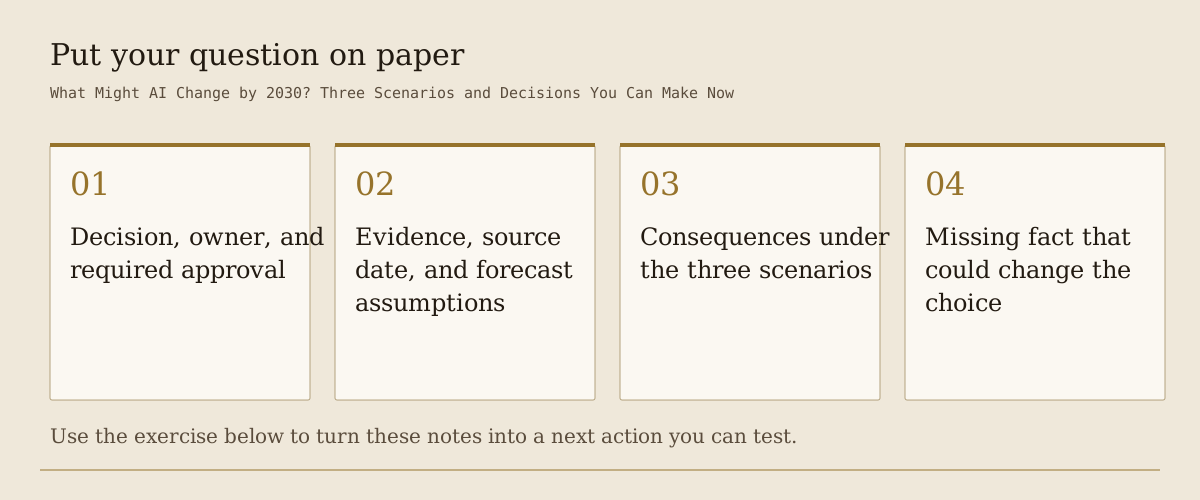
- Test the decision against each of the three scenarios. Write one practical consequence under each: what would still be useful, what could become less useful, and which responsibility would remain yours in the proposed trial.
- Identify one missing fact that could change the decision. State where you can obtain it and what answer would change the scope or lead you to wait. Avoid adding general research questions that have no effect on the action.
- Choose the smallest responsible test. Define permitted information, the expected result, who will evaluate it, and how you will compare preparation, review, correction, and final quality with the existing process.
- Write stopping conditions and a review point before beginning. Stop for unauthorized actions, unapproved data use, an important unverifiable claim, or a correction burden that makes the trial unsuitable. Review after the agreed test, then continue, narrow, or stop.
Completed hypothetical example. An operations director has been postponing a test of AI-assisted internal reporting. Their decision is whether to prepare one draft status report from information already approved for the chosen environment. The director remains responsible for accuracy and agrees the scope with the relevant information owner before beginning.
Evidence and assumptions: The director records the Census diffusion study as evidence that workplace adoption was uneven during its reference period. It doesn't prove the tool will help this report. The local hypothesis is that assistance could reduce preparation effort without increasing total checking and correction enough to make the process less useful.
Three-scenario check: Under uneven assistance, the test could identify a useful drafting aid. Under faster automation, it could reveal whether the reporting inputs are clear enough for a broader process change. Under rapid capability with deployment constraints, it could show which permissions and exceptions need closer attention. None of those possibilities requires letting the system distribute the report.
Missing fact: The director needs confirmation that the proposed input is permitted in the environment. Without that answer, the test waits or uses a narrower, approved input. Another general prediction about 2030 wouldn't resolve the permission question.
Test and acceptance: The draft must accurately represent the approved input, distinguish unresolved issues from confirmed commitments, and make supporting information available for review. The director records the complete preparation, review, and correction effort. The trial still has to establish whether this approach is useful.
Stop and review: The director stops if the tool introduces an unsupported commitment, uses information outside the agreed scope, or produces a material statement they cannot verify. They review after the single report, decide whether another bounded test is warranted, and record the reason. Their immediate action is to request the permission answer and schedule the test, rather than continue comparing predictions.
A scenario can help you prepare. It can't decide what you want your life to be. If the forecasts keep multiplying while your own decision stays untouched, you can bring that question to AI and the Andes Retreat. The five-day seminar in Peru's Sacred Valley centers on examining behavior, identifying what is driving it, and choosing an action to test at home. It gives you room to work toward an answer you can use, with support and accountability afterward.
Your working notes
Use this page while you think. Your notes stay in this browser tab; download them before you close it.
What does this question change for you?
A practical answer can change how you work. It can also leave a personal decision unresolved: what to learn, what to stop postponing, or which responsibility to take next. Name that decision before collecting another prediction.
Work through your next decision. Your notes stay in the browser tab, and the exercise gives you no predictive score.
If a recurring pattern keeps preventing action, AI and the Andes Retreat offers five days of practical inquiry in Peru's Sacred Valley, followed by support and accountability. Read about the seminar and assess whether that work fits your question.
Frequently asked questions
Search research, audience discussions, and the existing seminar FAQ library informed these questions. Some wording has been adapted to this guide.
What will AI be capable of in 2030?
The research reviewed here doesn't establish a definite capability level for 2030. METR's task-horizon research measures selected software tasks at specified success thresholds, rather than dependable whole-job performance. A useful answer is conditional: capabilities could improve substantially, but their significance depends on reliability, task coverage, and deployment. For your decision, identify the particular outcome you need and watch whether systems can deliver it consistently under relevant conditions.
What will AI look like in the next 10 years?
There isn't one supported picture of the next decade. A longer horizon adds uncertainty about technical progress, organizational choices, demand, and institutions. The BLS projection framework explicitly depends on assumptions and acknowledges exceptional technological change as a limitation. Compare several possible futures, then ask which nearer decisions remain useful across them. A learning task or bounded workflow trial can be worthwhile without requiring a complete ten-year forecast.
Can we make a more reliable prediction about AI in 2040 or 2050?
A farther date doesn't make a claim easier to support. The evidence here provides no dependable capability or employment estimate for 2040 or 2050. Use those horizons to explore possibilities, while keeping assumptions visible. BLS's stated projection limits illustrate why a model of future work remains conditional. If you're deciding what to do now, closer evidence about relevant tasks, deployment, and actual opportunities usually answers a more actionable question.
What does AGI mean for these scenarios?
AGI generally refers to artificial general intelligence, but this article doesn't use the label as a measurable deadline. The sources reviewed here don't establish an agreed threshold or arrival date. For practical planning, specify the capabilities and reliability your decision requires instead. A software-task benchmark can inform that assessment within its domain, but it cannot establish general competence across all work. A label alone doesn't settle deployment or responsibility.
How accurate are AI predictions?
Accuracy depends on the prediction, its defined outcome, its horizon, and how it is evaluated. The research reviewed here doesn't support a general accuracy rate for forecasts about AI's future. Ask whether the forecaster recorded assumptions, specified what would count as being wrong, and revisited the result. BLS describes its projections as conditional. Treat similar candor as useful information, rather than assuming that confident wording indicates a more accurate forecast.
Can AI predict the future with 100% accuracy?
The research reviewed here gives no basis for trusting AI to predict an uncertain social or technological future with complete accuracy. A system can generate an explanation that sounds precise without resolving unknown future conditions. Use it to organize scenarios or questions, then verify consequential factual claims. The BLS methodological limits show why even formal projections depend on assumptions. A precise date or percentage needs evidence beyond a persuasive generated answer.
How can AI be evaluated?
Evaluate a specified task under conditions relevant to its intended use. Define correctness, compare an appropriate baseline, and include review, corrections, and recovery in your assessment. METR's productivity update explains why selection and time measurement can complicate results. A benchmark answers a narrower question than an operational trial. For a business decision, the result you need is accepted work with understandable consequences, rather than output generation alone.
Is AI 2027 a real prediction?
Yes. AI 2027 is a published forecasting scenario, released in April 2025, with race and slowdown endings. It describes possible events, rather than events already established. In a November 2025 clarification, its authors said they do not know exactly when AGI will be built and directed readers to newer forecasts. Read the assumptions and revision record before using it in a decision. The year in the title is not a deadline for changing your career.
Which jobs will AI take over by 2030?
The evidence here doesn't support a definitive list of occupations disappearing by 2030. The ILO exposure index concerns potential task change, rather than a replacement calendar. Examine the tasks, responsibilities, and adoption conditions within a role. Some may become easier to automate while others change form or remain within a supervised process. The job-assessment article develops that personal analysis without assigning guaranteed safety scores.
Will AI take over all jobs in the next 10 years?
The sources reviewed here don't establish that all jobs will be taken over within ten years. That claim requires assumptions about every relevant task, deployment conditions, demand, and institutional choices. The ILO's task-exposure research emphasizes potential transformation and continued human input. That doesn't prove work remains unchanged indefinitely. It means the evidence supports examining specific changes, rather than treating universal replacement as an established timetable for your decisions.
What percentage of jobs will be replaced by AI in 2030?
The research reviewed here doesn't support a reliable replacement percentage for 2030. Exposure, reduced hiring, and eliminated jobs are different measures. The ILO's global exposure estimate cannot be converted into a future layoff count, and the Stanford younger-worker gap isn't a causal percentage of jobs lost. Ask what a number measures and which assumptions connect it to replacement before using it to guide a major decision.
What is the future of the workforce?
The useful question is how work may be organized, rather than which single workforce picture must emerge. The Danish study documents reorganization and new oversight and integration work in its observed setting. Faster automation could produce different hiring and training choices. Those outcomes remain conditional. Watch who defines tasks, checks results, learns the underlying work, and owns consequences. An organization can change those arrangements even when its total headcount initially remains similar.
Will AI create more jobs than it replaces?
The research reviewed here doesn't establish a net job-creation outcome for 2030. New responsibilities and changing tasks don't automatically equal additional positions, while reduced hiring doesn't automatically measure layoffs. The Danish evidence and Stanford indicators address different parts of that question. Demand and organizational decisions matter too. For your own plan, investigate real opportunities and requirements instead of relying on a promised economy-wide balance.
What will life in 2030 be like?
The sources here don't describe an entire future way of life. They support narrower discussion of tasks, adoption, organizational constraints, and labor indicators. Your daily experience will also depend on choices about how time and work are organized. One workplace experiment found individual time savings without detecting broad task changes from tool provision alone. That suggests a practical question: if assistance frees attention, what would you choose to do with it?
How could AI affect the economy positively?
A possible positive pathway is improved task productivity and better service, but the research reviewed here doesn't establish a particular economy-wide outcome. Generative AI at Work found improved issues resolved per hour in one customer-support setting, with different effects across workers. That is useful evidence of assistance under those conditions. Whether similar gains spread, expand output, or improve working lives depends on deployment and organizational choices beyond that study.
How could AI affect the economy negatively?
Possible negative pathways include reduced opportunities in particular roles and costly mistakes in poorly controlled workflows. The Stanford analysis gives a descriptive hiring-related concern, while OECD interviews describe deployment problems. Neither establishes a total economic loss or inevitable outcome. Examine the relevant mechanism, population, and alternatives. General concern becomes more useful when it points to a staffing, quality, or responsibility decision someone can actually review.
Why is AI adoption uneven, and what can hinder it?
The premise that adoption is uniformly slow isn't supported. The Census study found differences across firm sizes and sectors during its reference period. OECD practitioners described incorrect actions, traceability, and accountability concerns. In your organization, investigate information quality, task fit, permissions, and review capacity. A company can use AI in one function while limiting another for reasons that a general adoption percentage cannot reveal.
Will AI adoption slow down?
The research reviewed here doesn't establish the future pace of adoption. It could move differently across tasks and organizations as capability, costs, reliability, and operating conditions change. The Census study also warns against casual comparisons across a question-wording change. Before interpreting a slowdown or acceleration, check that the measures are comparable. For a local decision, evidence about repeatable workflow delivery may matter more than the direction of an aggregate adoption chart.
What are the limits of AI agents?
Limits depend on the system, task, information, and permitted actions. The OECD's selected practitioner interviews describe incorrect actions, unpredictable behavior, and difficulty with traceability and accountability. These observations aren't a universal performance rate. For a proposed workflow, test handling of incomplete information and exceptions, and define where the agent must stop. A limitation demonstrated in one setting should be checked again when relevant conditions change, without assuming it has disappeared.
Could AI change the staffing pyramid in professional services?
It could, if firms can change how work is assigned while maintaining quality and developing new talent. The direction and speed are uncertain. Automating some junior tasks may alter hiring or training; it doesn't prove that every firm will remove the same layer of staff. The employment evidence reviewed here is a limited observed pattern, rather than a forecast of an entire industry. Watch hiring, review responsibilities, and training practices in the firms relevant to your decision.
Sources and evidence
These guides were drafted with AI assistance and checked against the linked sources. Examples labeled hypothetical illustrate a decision; they are not participant stories or measured results.
Studies answer specific questions about particular people, tasks, and tools. Their dates and limits matter. A result about task assistance is not a forecast for an entire profession.
- Generative AI and Jobs: A Refined Global Index of Occupational Exposure, May 20, 2025
- Skills in the AI age, July 8, 2026
- The Microstructure of AI Diffusion: Evidence from Firms, Business Functions, and Worker Tasks, April 2026
- Employment Projections and Occupational Outlook Handbook: 2025–2035, August 27, 2026
- Canaries in the Coal Mine? Six Facts about the Recent Employment Effects of Artificial Intelligence, revised August 12, 2026
- Still Waters, Rapid Currents: Early Labor Market Transformation under Generative AI, verified March 13, 2026 version
- Generative AI at Work, published February 4, 2025
- Shifting Work Patterns with Generative AI, arXiv version four, November 13, 2025
- We are Changing our Developer Productivity Experiment Design, February 24, 2026
- Time Horizon 1.1, January 29, 2026, with the supplied March 20 modeling-assumption audit
- Agentic AI in organisations: Early insights from practitioner interviews, September 16, 2026
- How AI Impacts Skill Formation, Anthropic research, arXiv version two, February 1, 2026
- ABA Formal Opinion 512: Generative Artificial Intelligence Tools, July 29, 2024
- Nick Saraev: Here's What I'd Learn Instead of AI Automation in 2027, exact publication date unverified
- Nick Saraev: I Love AI, But GPT-6-Astra Terrifies Me, bounded opinion passages only
- Nick Saraev: What I'd Learn Instead of Automation in 2026, exact publication date unverified
- Nick Saraev: The most important video you'll ever watch in the age of AI, supplied targeted review only
- Observed comment question about whether AI engineering education remains worthwhile
- Observed comment question about subscription versus API access
- Observed comment question about model improvement and error repair
- Observed comment question about requirements and evaluation
- Observed comment question about interpreting a controlled safety demonstration
- Observed comment question about using automation skills within a broader business
- Observed comment question about constructive individual and collective action
- Observed comment question about practical influence over AI's direction
- Observed comment question about human quality control
- Canonical seminar question: When does gathering more information actually help?
- Canonical seminar question: What is the difference between a micro and a macro decision?
- Canonical seminar question: Why do I feel unclear even when I already know all the facts?
- Canonical seminar question: Does mental clarity stay once you have it?
- The SoulSearching Experience, confirmed offer facts dated September 26, 2026
- AI 2027: scenario and later clarification
Where the audience questions came from
These linked discussions and comments supplied questions and wording. They do not establish the truth of the replies, verified professional identities, or how common a concern is.