
You can be comfortable discussing cash flow, challenging a budget, and explaining a difficult quarter, then find yourself hesitating over a much smaller question: should your finance team use AI to draft the monthly variance commentary? The hesitation can have several sensible causes. You may not know where the data will go. You may doubt whether the output can be checked efficiently. You may also wonder what approving the experiment says about the future of the people doing that work, including you.
The question of whether AI will replace CFOs pulls all of those concerns into one dramatic answer. The evidence supports a more useful conversation. Published accounting research describes associations between AI adoption, changed workflows, and more communication and quality-assurance work in small and medium businesses. It does not measure the replacement of public-company CFOs or demonstrate that a model can take responsibility for an organization's financial choices.
That distinction leaves room for real change. A finance function could need less effort for one task, more attention for another, and a different division of work across the team. Your current title does not settle those possibilities. Neither does the speed of a convincing demonstration.
This guide focuses on the decision you can own: how to evaluate a bounded finance workflow while keeping source records, decision authority, and consequences visible. It examines what the research actually found, walks through hypothetical examples, and shows when an attractive automation proposal should be rejected. The purpose is practical management education. Investment recommendations, tax positions, and jurisdiction-specific professional requirements belong with the appropriate expertise and current governing materials.
You don't need a final prediction about your career before investigating one task carefully. You do need to know what the investigation is meant to change.
Can the evidence tell us whether an entire CFO role will disappear?
No study supplied here establishes complete CFO replacement. The strongest answer begins by separating three kinds of evidence: potential task exposure, observed changes in work, and actual employment outcomes. They answer different questions. Combining them into a single replacement claim would give you more certainty than the research provides.
The ILO's 2025 occupational exposure index evaluates potential change across tasks. Exposure means that generative AI may affect some of the work within an occupation. It does not count eliminated positions, establish deployment speed, or estimate your personal prospects. An exposed task could be assisted, redesigned, consolidated, or left largely unchanged because implementation creates other difficulties. Those possibilities matter when your role contains both repeatable reporting work and decisions involving incomplete organizational context.
Accounting workflow evidence is closer to actual use, but still narrower than executive replacement. The 2026 accounting study includes platform records and a survey, with findings about transactions, close processes, communication, and quality assurance. It does not test whether an AI system can replace a finance leader's entire set of responsibilities. A useful finding about classification cannot quietly become evidence about capital allocation, leadership, or board performance.
Employment evidence requires another distinction. The revised Stanford analysis did not find widespread economy-level displacement in its evidence, while identifying different patterns for younger workers in exposed occupations. Experienced workers did not show a comparable gap. That finding does not prove that experience provides permanent protection. It describes a particular observed pattern, with important limitations on causal interpretation.
You might reasonably ask whether official occupational projections settle the matter. The BLS 2025–2035 projections are conditional scenarios under stated assumptions. BLS explains that unusually rapid technological change could weaken the historical relationships used in projections. A projected direction for a broad occupation is useful context, but it cannot promise continued demand for your exact responsibilities in your exact organization.
The practical implication is to avoid treating either reassurance or alarm as a staffing plan. Ask what would have to be demonstrated before your company could remove, combine, or redistribute a responsibility. Who would supply the missing context? Who would check the result? Who would authorize the consequential action? If those questions remain unanswered, you have identified work that a replacement claim has skipped. You have not proved that the work will remain organized forever in its present form.
What are you actually responsible for beyond producing financial output?
Start with the work people expect you to own when the answer is inconvenient. It may be explaining why a proposed expansion depends on optimistic collections, asking an operating leader to revise an assumption, or refusing to treat an unreconciled report as ready for a decision. These responsibilities can be less visible than the spreadsheet or presentation that supports them.
The O*NET financial managers profile describes financial analysis, reports, budgets, cash flow, supervision, controls, and communication. Its underlying task data were updated in 2022. The treasurers and controllers profile, with a 2026 expert task update, includes disbursement authority, financial statements, internal controls, audits, supervision, and training. These are descriptive task profiles. They do not measure AI performance or predict replacement.
The broader chief executives profile includes CFO among reported titles and describes strategic direction, resource allocation, budgets, operations, and stakeholder accountability. Its task data were updated in 2023. The breadth is helpful because it prevents the conversation from reducing executive work to generating a report. It also requires caution: a CFO in a small owner-managed company and a CFO in a complex organization may have very different responsibilities.
For your own inventory, connect each recurring output to the decision it supports. A cash report may support a conversation about timing commitments. A variance explanation may support a request to change spending. A forecast may support a choice between hiring now and waiting. The report is an intermediate product. Define who owns the assumptions, who can challenge them, and who decides what happens next.
Then identify the context that currently lives in people rather than files. Perhaps the sales leader has expressed uncertainty about a renewal. Perhaps an operating manager knows why a supplier's apparent price advantage would create other costs. That information should not become an excuse to keep everything informal. It is a reason to make consequential assumptions accessible and reviewable before expecting a tool to interpret them.
An attractive response is to say that judgment and relationships will always keep the CFO safe. The research reviewed here does not support that promise. It supports examining the whole task bundle instead of one output. Your responsibilities may remain important while the amount of human effort, the tools used, and the number of people involved change.
A stronger description of your role would therefore name the decisions you help make well and the checks you require before making them. This gives you a concrete basis for assessing a workflow proposal. It also gives your team something clearer to develop than the vague instruction to become more strategic.
What does the accounting research actually show?
The most directly relevant empirical source in the research reviewed here is Human + AI in Accounting: Early Evidence from the Field, published in 2026. It combines a survey of 277 accountants with platform records from 79 U.S. small and medium businesses. Those records cover more than 200,000 transactions from January 2023 through March 2025. These details define the setting; they are not a measurement of every finance function today.
The study associates adoption with productivity and a shift from routine entry toward communication and quality assurance. It also describes more granular records and faster close processes. For a finance leader, the important possibility is a redistribution of attention. If a tool proposes classifications or helps prepare records, people may spend different amounts of time entering, checking, explaining, and correcting the work.
That is an association observed in a particular platform setting. It is not a randomized estimate showing that any company can obtain the same full-workflow improvement by purchasing a product. Existing differences between adopters and other users, organizational practices, and the platform itself matter to interpretation. Treat the findings as a reason to investigate a plausible workflow, then establish whether the change helps under your own conditions.
The study also reports that accountants intervened more when AI confidence was low. This is a useful description of behavior, but it does not mean that a confidence display can replace verification. The accompanying framed classification experiment showed average improvement while also identifying possible error from overreliance on nonconsensus recommendations. In ordinary terms, assistance could help overall and still encourage an incorrect choice in a particular case.
That combination deserves attention. A team can become comfortable with a system because most outputs appear reasonable. You would still want to know whether an unusual recommendation is correct, whether an omitted item matters, and whether the reviewer can explain the basis for accepting it. A general impression of helpfulness leaves those questions unresolved.
The study does not measure public-company CFO performance, treasury outcomes, audit outcomes, or board decisions. It does not establish a staffing ratio, a savings promise, or a salary-protection claim. Those limits are especially important if someone presents transaction-level evidence as a justification for reorganizing an entire finance department.
A reasonable editorial application is to test one workflow against checked source records and an existing baseline. Include exception handling and handoff quality in the evaluation. If the work becomes faster but harder to explain, you have learned something different from a clean improvement. If routine preparation becomes easier while reviewers handle more demanding questions, your next management decision concerns competence and capacity as much as software.
Where does assistance end and decision authority begin?
A system that drafts a variance explanation has a different role from a system that changes a record, sends a message, or initiates a payment. Before discussing whether AI can perform a task, describe what it would be allowed to do. The difference is practical: an inaccurate draft waiting for review and an inaccurate action already taken create different recovery problems.
The OECD's September 2026 practitioner report describes deployments, pilots, and varied maturity across 25 organizations involved with agents. Practitioners reported unpredictable behavior, incorrect actions, traceability problems, and accountability questions. Common responses included human checkpoints, domain-expert involvement, and gradual increases in autonomy. The sample is illustrative rather than representative, and the report does not independently validate the economic performance of those systems.
For finance, an editorial application is to define permissions in ordinary verbs. The tool may read a particular approved export. It may draft a proposed explanation. It may flag a discrepancy for a reviewer. It may not change the accounting record, approve the conclusion, or distribute the report. If the task later requires different permissions, that is a new decision with different consequences.
Writing the boundary this way prevents ambiguity hidden inside phrases such as automate the close or run the finance function. Those phrases can describe anything from a drafting aid to a connected system acting across several applications. Ask for the actual sequence of reads, calculations, writes, approvals, and communications. Name the person responsible at each consequential handoff.
Approval also needs content. A reviewer who can only glance at a polished paragraph cannot necessarily assess its financial basis. Specify what the person must check, which source records they need, and what should trigger escalation. If the reviewer lacks access or competence, the presence of an approval button adds less protection than the workflow description suggests.
There may be cases where greater autonomy is worth investigating. The practical question is what evidence supports that expansion and how the organization would contain and recover from an error. Successful drafting does not demonstrate safe posting. Successful posting in a test setting does not demonstrate safe payment authority. Each permission change deserves its own justification.
This is a management recommendation, not a statement of universal accounting law. Your organization's applicable professional requirements and approval arrangements need separate verification. Even without making a legal claim, you can insist on clarity about who is allowed to act. A workflow cannot become accountable merely because everyone assumed someone else would review it.

How do you keep the conclusion connected to the source records?
A readable explanation can conceal a broken connection between the conclusion and the underlying records. Your practical safeguard is to make that connection inspectable. For any pilot, define what source was used, which version or cutoff applies, what transformations occurred, and how the reviewer can reproduce the relevant comparison.
The O*NET treasurers and controllers profile includes financial statements, internal controls, audits, and supervision among its task categories. It does not prescribe an AI control design. The following approach is an editorial way to keep those existing responsibilities visible when testing a new preparation method.
Suppose the candidate workflow explains a change in operating expenses. A reviewer needs more than a paragraph saying the change reflects increased activity. They need the approved comparison periods, the relevant categories, and the records supporting the explanation. They also need to distinguish a numerical difference from a causal explanation. The existence of a larger expense does not, by itself, establish why it happened.
Ask the draft to separate what the records directly show from what requires confirmation. A source-supported statement might identify the category responsible for a change. A proposed explanation might suggest that a timing difference deserves investigation. The latter should remain a question until the appropriate person or record supports it. This makes the output useful without allowing it to convert uncertainty into confident narrative.
Do the arithmetic and reconciliation in a process your reviewer can check. If a proposed workflow uses an AI-generated script, validate that script separately against known inputs and expected outputs. If it uses an existing reporting system, keep the authoritative report identifiable. The fact that an explanation and a calculation were produced together does not make them mutually validating.
Consider omissions as well as incorrect statements. A draft might correctly describe one large movement while ignoring another movement with a different implication. Define the scope of coverage before generation. The reviewer should be able to tell whether all required categories were considered and whether an exclusion was deliberate. A shorter explanation can be helpful, but the shortening needs a basis.
Keep the accepted version and the review decision together in the organization's approved record location. Include unresolved questions and the person assigned to resolve them. This is especially useful when someone later asks why an explanation changed between versions. Reconstructing that answer from a remembered conversation is avoidable work.
The stopping condition is concrete: if you cannot trace a consequential statement to its support, the draft is not ready for its intended use. You can investigate the gap, revise the task, or reject the output. You don't have to reject the entire idea of assistance to reject an unsupported conclusion.
Can AI help with forecasting without choosing the assumptions for you?
Yes, forecasting is a reasonable area to investigate for bounded assistance, but the proposed role matters. Drafting scenario descriptions, organizing supplied assumptions, or highlighting inconsistencies is different from deciding which assumptions your organization should rely on. The research supplied here does not establish that AI can choose the right financial plan for your business.
A useful forecast discussion starts with the operational decision. Are you deciding whether to investigate additional capacity, change the timing of a project, or request more information from sales? Without that question, a tool can produce several polished scenarios that leave the underlying choice untouched. More output is not automatically more decision support.
The distinction between data and interpretation is illustrated by the published consulting field experiment. Its selected task outside the assessed capability frontier asked consultants to recommend which hypothetical-company brand had the greatest growth potential using financial data and company interviews. Interview details changed how the spreadsheet should be interpreted. AI assistance reduced the likelihood of a correct solution on that task. This was one task using GPT-4 in 2023, not a finding about every finance forecast or current system.
The editorial lesson is to inspect the assumptions that make the recommendation work. If a scenario depends on a customer renewal, a collection pattern, or a project milestone, show that dependency explicitly. State where the assumption came from, what remains uncertain, and which change would alter the recommendation. A model's fluent explanation should not become the only record of that reasoning.
Separate an exploratory scenario from an approved planning assumption. You can ask a tool to describe the operational implications if a supplied condition holds. That output remains conditional. Someone still needs to decide whether the condition is plausible enough for the intended use and whether the consequences are acceptable. The right reviewer may need knowledge from operations or commercial leadership as well as finance.
Preserve disagreement. If two managers provide different views of the same assumption, don't resolve the difference by asking AI which one sounds better. Record the competing views and seek the evidence that could distinguish them. A scenario can make the disagreement clearer, but it cannot manufacture missing organizational knowledge.
Set review points around the decision's real dependencies. Revisit the forecast after the next relevant renewal decision, updated source extract, or operating milestone. Put the actual review date in the calendar before using the output. If a key assumption changes sooner, reopen the decision then. This approach gives the forecast a useful life without treating its initial narrative as a durable answer.
What needs to be checked before financial data enters an AI workflow?
The first question is whether the organization has approved this use of this information in this environment. A general statement that a product is secure does not answer that question. Neither does removing a company name from a file while leaving commercially sensitive amounts, contract details, or personal information inside it.
The OECD practitioner report identifies traceability and accountability among deployment challenges. It does not certify any vendor or establish confidentiality for your proposed workflow. The research reviewed here supplies no product-specific contract review or finance-specific legal determination. You need the actual vendor terms, access arrangements, approved data categories, and relevant organizational requirements.
Draw the information route before uploading anything. Identify where the file starts, which service receives it, where an output is stored, and whether connected tools can access other records. Include logs, exports, shared folders, and the people who can see the resulting material. This is a proposed management check, not a claim that one particular architecture provides protection.
Then ask what the task truly needs. A pilot to test explanatory structure may be possible with a hypothetical case. A pilot to assess interpretation of real exceptions may need approved historical records. These are different stages. Choose the least sensitive information that can answer the current question, while acknowledging when artificial material cannot test a live workflow's full requirements.
Permissions should match the agreed task. Read access to one export should not quietly include write access to source systems. A service account should not be treated as harmless because a person created it for convenience. Have the responsible technical and security people explain what the connection can do, how access is revoked, and where actions are recorded.
Check the approval scope when the product or workflow changes. A tool's use in an approved drafting task does not automatically authorize new integrations, a different data category, or an action-taking agent. Ask which changes require another review. Otherwise, the original pilot decision can become a broad permission nobody consciously granted.
Make the rules usable for the team. People need to know which environment is approved, what may be submitted, and who can answer an uncertain case. A prohibition with no workable alternative leaves the operational problem unresolved. An open-ended encouragement to experiment leaves boundaries unresolved. Provide a clear route for requesting a bounded test.
If the data route, permissions, or approval basis cannot be explained, stop before supplying live information. Continue useful preparation with hypothetical material or an already approved process. That stopping condition preserves the possibility of learning while making the missing implementation decision visible to the people who can resolve it.
How should a CFO measure whether the workflow is actually better?
Measure the work from a usable starting point to an accepted result. The time between asking a tool and receiving an answer is only one part of that interval. Preparation, checking, correction, exception handling, and handoff all belong in the comparison. If another person absorbs the new review burden, include their work too.
The METR February 2026 productivity update is useful for its measurement caution. It explains why the original 2025 slowdown result in a specific experienced-developer setting should not be treated as today's general effect. Its follow-up suggested improvement, but selection effects and difficulties measuring concurrent-agent work made the estimates unreliable. This is software research, not finance evidence. It provides a reason to take local measurement seriously rather than import a universal productivity number.
Before a finance pilot, describe the existing process fairly. Record what preparation involves, who reviews it, which exceptions require discussion, and what counts as finished. An unclear or inefficient baseline can still be improved, but don't claim that AI caused a benefit if a simpler change to the template, source export, or review sequence produced it.
Use several measures because they answer different questions. Completion time addresses effort. Review time shows whether checking became easier or harder. Error severity describes consequences more usefully than treating every correction as equivalent. Handoff quality asks whether the recipient understands what is supported, what is uncertain, and what action is requested.
Include costs that would continue after the demonstration. These may include subscription or usage charges, technical maintenance, training, additional controls, and recovery work. Record them from the actual arrangement. A small software bill does not establish a cheap process if a senior reviewer must reconstruct the reasoning each time.
Define success before examining the results. Perhaps the aim is a shorter drafting stage with no increase in correction effort and no unsupported causal explanation in the accepted output. Perhaps the aim is clearer exception routing, even if total time stays similar. Both could be useful decisions, but they should not be confused.
Also record what you have not tested. A pilot using one historical period cannot establish performance under every unusual event. A pilot reviewed by the most experienced person may not demonstrate a process the wider team can operate. These limits help you choose the next test instead of expanding permissions prematurely.
Review after the preselected pilot window and decide among continuing, revising, expanding, or stopping. If quality fails a required check, pause immediately rather than waiting for the scheduled review. The measurement is there to inform your decision. It should remain possible for the evidence to tell you that the proposed change is not worth making.

Hypothetical example: a controller tests monthly variance commentary
This is a hypothetical example, not an observed company result. A controller leads a team that prepares monthly operating-expense commentary. The source report is already available through an approved process, but turning the checked comparison into a concise explanation requires repeated drafting and revision. The controller wants to test whether AI assistance can improve that stage.
She defines the experiment narrowly. The tool will receive an approved historical extract and the team's commentary requirements in an approved environment. It may draft observations and questions. It may not change source records, send the commentary, or assert a business explanation that the extract does not support. The existing preparation method remains available.
Before using the tool, she asks an analyst to document a checked baseline for the selected period. The baseline identifies the required categories, the period comparison, and the operational questions that need confirmation. The controller also records the current preparation and review steps. This prevents the new draft from being judged only by whether it reads well.
The proposed draft describes a change in a spending category and suggests that increased activity caused it. The reviewer can verify the change from the supplied report, but the causal explanation is unsupported. Rather than editing the sentence into something equally confident, the reviewer turns it into a question for the operating manager. The task instructions are revised to require that distinction in future drafts.
The reviewer also notices an omitted category that the existing commentary requirements cover. That omission becomes a coverage check. The controller is learning about the conditions under which the task can be delegated, rather than merely collecting examples of plausible writing. The pilot's usefulness depends on whether those checks make subsequent work easier to accept.
At review, she compares total preparation effort, review effort, correction types, and the clarity of the final handoff. No numerical result is assumed here. The evidence could support several outcomes. The workflow might reduce drafting effort while preserving review quality. It might save little time because verification dominates. Or it might reveal that a better template and clearer category requirements would solve much of the problem without AI.
She sets immediate stopping conditions: an unapproved data submission, an unexplained mismatch with the source report, or a consequential claim that cannot be traced to its support. The scheduled review occurs after two completed reporting cycles, with the calendar date entered before the test starts. If those cycles are unusually quiet, she records that limitation rather than treating them as complete evidence.
The decision at the end concerns this commentary workflow. Even a successful result would not establish that the controller's wider responsibilities can be removed. It could justify a better drafting process and a more explicit definition of the review work her team needs to perform.
Hypothetical example: a CFO examines an expansion recommendation
This is a hypothetical example, not an observed outcome or a recommendation to invest. A CFO is asked to evaluate an expansion proposal. The operating team supplies financial projections and interview notes from commercial managers. The proposal looks attractive under the stated assumptions, but the CFO wants to understand which assumptions deserve further investigation before the organization commits.
He uses an approved AI environment to organize the sources reviewed here into a decision brief. The task requests separate lists of source-supported observations, unresolved assumptions, and questions for the relevant managers. It asks for no final approval recommendation. The purpose is to improve preparation for a discussion the CFO will lead.
A generated brief emphasizes the apparently strongest business line in the spreadsheet. However, an interview note indicates that part of the expected activity depends on a customer decision that has not been confirmed. Another note explains that an operational constraint would affect the timing assumed in the model. Those details change what the spreadsheet can support.
This example reflects a problem illustrated by the published consulting experiment, where interview details altered the interpretation of financial data in the selected outside-frontier task. The research does not establish that the hypothetical CFO's tool would make the same mistake. It establishes why a polished financial recommendation should not be accepted simply because its numerical presentation appears comprehensive.
The CFO reviews the original notes, asks the managers to confirm the dependencies, and preserves the unresolved points in the brief. He requests conditional scenarios using assumptions the team explicitly supplies. One scenario can describe what follows if the customer decision goes one way; another can describe the consequences if timing slips. Neither becomes a claim about what will happen.
The resulting management conversation is more precise. The team can discuss which evidence is needed, what commitments would be hard to reverse, and which preparatory actions could be taken without deciding the entire expansion. The CFO does not ask a model to settle a disagreement between managers who possess different operational information. He asks those people to make their reasoning visible.
A stopping condition applies if the brief omits a consequential dependency or cannot connect its claims to the supplied records. The decision is reviewed after the next relevant customer confirmation and operating update, with the actual calendar dates assigned by the team. An earlier material change triggers an earlier review.
The potential value here is better preparation, clearer assumptions, and less avoidable confusion. The example offers no prediction of profitability or correct capital allocation. If the organization lacks the expertise required to assess the expansion, an AI-generated brief does not supply that expertise. The CFO's next action may be to obtain it.
When would an attractive automation recommendation be wrong?
Consider this hypothetical counterexample. An owner sees a demonstration that turns an invoice into a proposed payment record and wants to automate the process immediately. The existing team spends time obtaining approvals and resolving changes in supplier details. The proposal treats that time as an obvious efficiency problem.
The appealing recommendation is to remove the friction. But the demonstration has not established whether the system can distinguish an authorized instruction from an unresolved request, whether it has the right permissions, or how a mistaken action would be recovered. The owner's real process includes questions the demonstration avoided. A successful extraction step is insufficient evidence for payment authority.
The O*NET treasurers and controllers profile includes disbursement authority and internal controls in its descriptive task bundle. The OECD practitioner interviews describe incorrect actions, unpredictability, traceability, and accountability as deployment concerns. Neither source determines this company's required control arrangement. Together they support keeping the action and its oversight visible when evaluating the proposal.
In this hypothetical case, immediate action-taking automation would be the wrong recommendation. The first useful step is to map the existing authorization process and find out why the exceptions require discussion. Some delays may be avoidable. Others may be necessary checks. The organization cannot tell which is which by labeling all waiting time as waste.
A narrower experiment might test extraction into a draft queue using approved historical material, while keeping existing approval authority intact. It could examine missing fields, ambiguous supplier details, and how exceptions reach the right person. That would answer a preparation question. It would not quietly authorize the tool to execute payments.
There is another reason a pilot might be wrong: the organization may lack review capacity. If the team is already unable to check current work adequately, adding a new stream of proposed outputs could worsen the practical problem. Calling the experiment small does not help if even that experiment cannot be supervised. Resolve the missing capacity or choose a different learning task.
Waiting can therefore be a responsible decision when the missing information is consequential and obtainable. The useful form of waiting has an owner, a question, and a deadline. Someone is assigned to establish permissions, examine the data route, or document the approval process. Waiting indefinitely for the technology to become perfect has no comparable structure.
The counterexample matters because sensible experimentation is conditional. A good recommendation fits the task's consequences and the organization's ability to evaluate it. You can favor learning about AI while rejecting a specific proposal that skips authorization, source checks, or recovery.

How should you think about staffing and the team's development?
A task taking less effort does not, on its own, establish the right staffing decision. You need to understand what work actually disappears, what moves to reviewers, what demand changes, and what capability the team still needs. Otherwise, a preparation improvement can become a premature headcount conclusion.
The accounting field evidence describes a shift toward communication and quality assurance alongside adoption. That is a reason to examine the whole workflow. It does not prove that the same people, the same number of people, or the same training approach will fit every organization. Your local evidence should show who performs the changed work and whether they can perform it well.
Hiring concerns deserve serious treatment. The Stanford analysis revised in August 2026 found that employment among 22–25-year-olds in exposed occupations was below a benchmark based on less-exposed peers, with the divergence primarily involving reduced hiring. The authors describe the findings as indicators rather than causal estimates of jobs lost to AI. Education controls weaken the result, some divergent trends predate generative AI, and the administrative patterns are stronger than national survey benchmarks. The study is not a finance-team staffing model.
For a finance leader, an editorial question follows: if routine preparation changes, how will people develop enough understanding to review the work later? Do not assume that removing a junior task also removes every learning opportunity attached to it. Equally, don't preserve inefficient work solely because it was historically how people learned. Design opportunities to inspect source records, explain classifications, discuss exceptions, and defend conclusions.
Be specific about development. A junior analyst might prepare a brief explaining which records support a conclusion and which facts remain missing. A more experienced reviewer might compare alternative explanations and identify the question that would distinguish them. These are proposed training practices, not research-validated guarantees. Their value should be assessed through actual work and explanation.
Talk with the team before converting a pilot into a broader restructuring story. Explain the workflow being tested, the boundaries, and the review date. If staffing decisions are not yet made, say so. Avoid promising permanent security or suggesting that every successful experiment necessarily implies cuts. Both statements would exceed what you know.
Keep formal employment and organizational decisions in their appropriate processes. Personal reflection can help you notice that you are avoiding a difficult conversation. It cannot substitute for the evidence, consultation, or professional expertise that a consequential staffing decision requires. The management task is to make the change understandable and reviewable, including its effects on the people expected to carry it.
What should an experienced finance leader learn next?
Choose learning that helps you answer a current management question. You may need to understand permissions well enough to assess a connected workflow, evaluation well enough to challenge a vendor demonstration, or prompting well enough to specify a bounded draft. You do not need to treat every new product as your next professional obligation.
The OECD's July 2026 skills synthesis distinguishes foundational skills, ICT skills, and complementary abilities such as problem solving, communication, creativity, and collaboration. It also distinguishes using and critically evaluating AI from advanced AI engineering. This supports a practical learning plan that combines finance knowledge with tool use and evaluation. It does not establish that any combination guarantees employment.
For an experienced reader, a familiar task is a useful starting point because you can examine the output with existing competence. Select a source comparison you already understand. Define what an acceptable explanation would contain. Try the approved tool, inspect its work, and explain your acceptance or rejection in your own words. If you cannot explain the result, investigate before delegating more responsibility.
Technical knowledge still matters when it affects the workflow you intend to approve. You may not need to build an integration yourself, but you should be able to ask what it reads, what it can change, where failures are recorded, and who maintains it. If a generated script performs financial transformations, arrange review by someone able to assess both the code and its intended logic.
Nick Saraev's commentary offers a related perspective. In What I'd Learn Instead of Automation in 2026, he recommends understanding how a business creates and delivers value so knowledge can transfer across tools. In his video framed around learning for 2027, he emphasizes training, guidance, and decisions about what to build. These are his recommendations, discussed here as commentary available in the October 5, 2026 research packet. The exact publication dates are not established by the relative channel labels.
Saraev sells education and implementation services, so his commercial context belongs alongside that framing. His advice is not independent evidence of permanent demand for consulting or a reliable timetable for declining implementation value. You can find a suggestion useful without adopting its forecast.
Before buying a course, name the task you want to perform differently and the demonstration of competence you want afterward. If the course teaches a tool you cannot use within your approved environment, or avoids the evaluation questions you need to answer, it may be the wrong next purchase. Broader learning choices deserve separate depth in what to learn as AI changes.
What if you understand the options but keep postponing the decision?
First, check whether the delay is justified by a missing fact. You may genuinely need a vendor answer, an approval decision, or a clearer source export. Write the missing question and identify what answer would change your choice. Assign an owner and a date. This turns vague caution into work that can be completed.
If the practical requirements are understood and the same small decision keeps returning unchanged, examine the behavior itself. Perhaps you repeatedly request another demonstration instead of deciding whether to authorize a draft-only test. Perhaps you rewrite delegated commentary after agreeing on an adequate standard. Perhaps you postpone telling the team what is being evaluated because you don't yet know how they will react. These are observations to inspect, not diagnoses.
Several explanations may fit. The pilot may be poorly designed. The team may lack competence or capacity. You may have legitimate concerns that have not been written down. You may also dislike making a visible decision under uncertainty. Check the organizational conditions before deciding that the obstacle is entirely personal.
Separate three choices that can become tangled together: the workflow experiment, the team's future structure, and your own career direction. A carefully bounded commentary test does not settle all three. If you treat it as though it does, even a modest next action can feel like an irreversible declaration. Write down what the test will answer and which larger questions remain open.
Choose one action that matches the actual uncertainty. Schedule the permissions review, request the missing source information, or authorize the limited pilot after its conditions are met. If you are considering a significant career move, compare real alternatives before treating an AI headline as a reason to leave. The broader assessment belongs in evaluating what could change in your job, while decisions under uncertainty examines larger personal choices.
Use a review date and a reason to reopen the decision. For a reversible experiment, the next completed reporting cycle may provide useful evidence. For a larger organizational choice, the review may depend on professional input or a specific operating result. Enter the actual calendar date rather than leaving review as a good intention.
Personal reflection has a defined place here. It can help you investigate why your stated intention and repeated action differ. It cannot predict AI, supply missing financial expertise, or determine the right business outcome. If you need a detailed agent operating plan, use the business agent guide. If you are evaluating longer-term assumptions, use the scenario guide. Keep this decision small enough to learn from and serious enough to own.
Compare your options
Use this comparison to define a proposed finance workflow. These are editorial starting points for discussion, not a validated risk score or a universal permission policy. The descriptive task categories draw on O*NET financial managers and treasurers and controllers; the emphasis on checkpoints and staged autonomy reflects the OECD practitioner report.
| Workflow | Bounded assistance to investigate | What the reviewer needs | Decision boundary | Stop or reconsider when |
|---|---|---|---|---|
| Variance commentary | Draft observations and unresolved questions from an approved comparison. | Checked source totals, required category coverage, and support for causal explanations. | The designated person accepts the explanation and decides its distribution. | The draft invents a cause, omits a required category, or cannot be traced to records. |
| Transaction-classification suggestions | Prepare proposed classifications for a review queue. | Source documents, the intended classification basis, exceptions, and an explanation of unusual suggestions. | The organization's approved review and posting arrangement remains explicit. | Reviewers rely on apparent confidence without understanding a consequential item. |
| Forecast scenario preparation | Organize supplied assumptions and describe conditional implications. | Assumption owners, operational context, source versions, and the calculation method. | The organization selects the assumptions and authorizes the resulting plan. | A conditional scenario is presented as a prediction or a dependency is missing. |
| Management decision brief | Summarize approved evidence, disagreements, and questions needing resolution. | Original records and notes, competing explanations, and the decision's actual objective. | The responsible leaders make the choice and explain their reasoning. | The summary smooths over disagreement or recommends action from unsupported premises. |
| Payment preparation | Extract approved information into a draft queue for examination. | The actual authorization process, source instructions, exception handling, and access scope. | Preparation permission does not imply payment authority. | The tool can act beyond its approved role or recovery is unexplained. |
| Finance script or integration | Prepare a proposed transformation or connection in a controlled test setting. | Known expected outputs, technical review, permissions, logs, and maintenance ownership. | Production access requires a separate, justified implementation decision. | No one can explain the transformation or the connection's possible actions. |
| Team development | Generate practice questions or draft learning material using appropriate information. | Trusted subject material and a demonstration that the person can explain the work. | A generated explanation is not evidence of competence by itself. | The learner can reproduce an answer but cannot inspect its basis or handle an exception. |
Read across a row before expanding the task. If the reviewer needs information that the proposed workflow does not preserve, fix that gap first. If the permission boundary changes, evaluate the new action separately. The table is useful when it makes a concrete disagreement easier to resolve; it should not become a substitute for the organization's actual requirements.
Define one finance experiment you can approve, review, or decline
Choose one recurring finance task rather than your entire department. Spend a short working session defining the decision, then involve the people needed to verify permissions and review quality. This exercise is a reflection and planning tool, not a scientifically validated score. Its purpose is to produce a reviewable proposal or a clear reason to wait.
Keep the operating question separate from the personal one. The operating question might be whether an approved drafting workflow improves monthly commentary. The personal question might be why you keep requesting more demonstrations after the conditions for that test are already understood. Both deserve attention, but they need different kinds of evidence.
A reflection tool for planning your next step, rather than a predictive score.
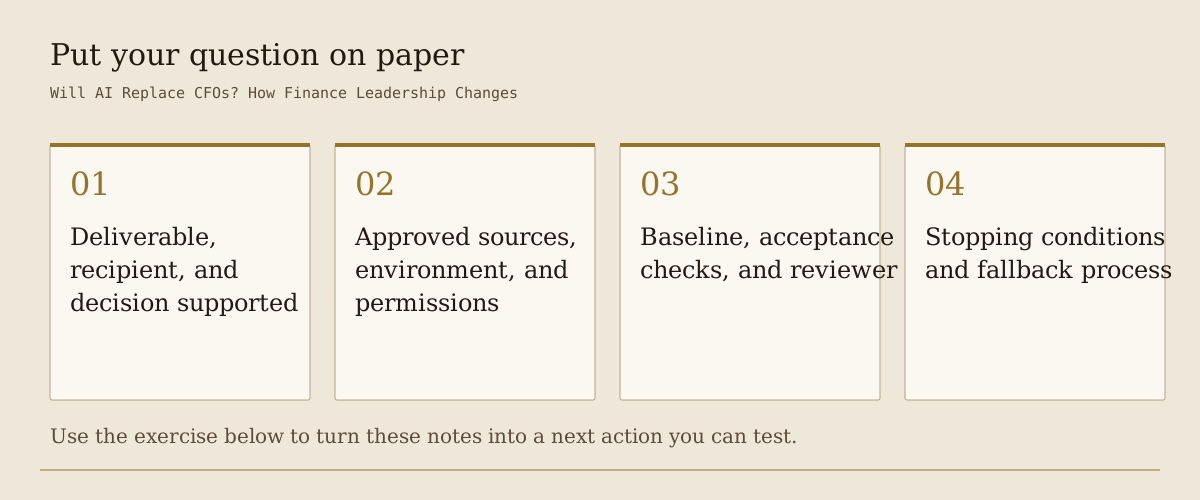
- Name one deliverable and its recipient. Write the decision that the deliverable supports, such as preparing operating-expense commentary for a management meeting.
- Describe the existing process from source preparation through acceptance. Identify who checks it, which exceptions need discussion, and what counts as a finished result.
- List the exact information and permissions the proposed test needs. Verify the approved environment and access scope with the responsible people before using live data; use hypothetical material while unresolved questions are being answered.
- Write the acceptance checks before generating anything. Include reconciliation to source records, required coverage, separation of observations from assumptions, and the reviewer who can assess each check.
- Define immediate stopping conditions and a way to return to the existing process. Include unapproved data use, unexplained source mismatches, and consequential statements without support.
- Set the pilot boundary and enter an actual review date in the calendar. At review, compare total preparation, checking, correction, costs, and handoff quality, then choose to continue, revise, expand, or stop.
- Identify one action you have been delaying. State whether it needs missing professional information or a decision from you, then assign the next action, its owner, and its due date.
Completed hypothetical example. The deliverable is operating-expense commentary for the monthly management meeting. Its purpose is to identify movements requiring discussion and assign unresolved questions. The controller owns acceptance; the analyst prepares the draft; operating managers confirm explanations that depend on their knowledge.
The proposed test uses an approved historical reporting export in an approved environment. The tool can draft observations and questions. It has no write connection to the source system and no permission to distribute the output. If the proposed environment has not yet been approved, the next action is an approval review using hypothetical material rather than an upload of company records.
The baseline is the team's checked commentary for the chosen period, together with the existing preparation and review steps. Acceptance requires agreement with the approved source comparison, coverage of the required categories, and clear separation between numerical observations and causal explanations. An analyst checks source agreement; the controller checks the intended management message.
The test stops immediately if information is submitted outside the approved route, a source mismatch cannot be explained, or a consequential explanation lacks support. The existing drafting process is the fallback. The pilot covers two completed reporting cycles. Before starting, the controller enters a calendar review date following the second cycle and schedules time with the analyst to inspect the results.
At review, they examine preparation effort, review effort, correction types, actual tool costs, and whether the final handoff makes unresolved questions clearer. No outcome is assumed. Expansion requires evidence that the useful improvement survives checking and that the next proposed permission has been evaluated separately.
The delayed action is the controller's conversation with the analyst about what the experiment means. She has been waiting until she can answer every career question. Her next action is to explain the narrow test, its boundaries, and the review process before the pilot begins. She can acknowledge that wider staffing questions remain undecided while still giving an accurate account of the work being evaluated.
A finance leader can be decisive at work and still carry an unresolved question about their own next chapter. If you've understood the options but keep postponing the personal decision, bring that question to AI and the Andes Retreat. The five-day seminar in Peru's Sacred Valley centers on understanding behavior and choosing an action you can test at home. The space may help you work toward your own answer, with support and accountability continuing afterward.
Your working notes
Use this page while you think. Your notes stay in this browser tab; download them before you close it.
What does this question change for you?
A practical answer can change how you work. It can also leave a personal decision unresolved: what to learn, what to stop postponing, or which responsibility to take next. Name that decision before collecting another prediction.
Work through your next decision. Your notes stay in the browser tab, and the exercise gives you no predictive score.
If a recurring pattern keeps preventing action, AI and the Andes Retreat offers five days of practical inquiry in Peru's Sacred Valley, followed by support and accountability. Read about the seminar and assess whether that work fits your question.
Frequently asked questions
Search research, audience discussions, and the existing seminar FAQ library informed these questions. Some wording has been adapted to this guide.
Can AI completely replace a CFO?
The research reviewed here does not establish complete CFO replacement. Accounting research concerns particular workflows, while the executive task profile includes broader resource, strategy, and accountability responsibilities. Those descriptions do not prove human exclusivity. Assess what your organization would need to preserve if work changed: source checks, assumption ownership, decision authority, and recovery. A successful drafting or classification tool answers a narrower question than whether an entire executive role can be removed.
What are practical AI uses for a CFO to investigate?
Candidate tests include variance-commentary drafting, transaction-classification review queues, and organizing supplied assumptions into decision briefs. These are proposed applications, not evidence that every CFO already uses them successfully. The accounting study supports investigating changed preparation and review work in its specific setting. Start with one approved task you understand well, keep the original records available, and compare total effort and accepted quality. Expand only after checking the evidence for that particular workflow.
Will AI take over financial management?
That phrase combines analysis, reporting, supervision, controls, and decision authority. The financial managers task profile describes that broader bundle; it does not predict replacement. A tool might assist one component without demonstrating dependable performance across the rest. Define which actions it would take, which approvals remain, and who handles exceptions. The useful management decision concerns an explicit workflow and its consequences, rather than an undefined transfer of the whole function to AI.
Are financial analysts safe from AI?
No supplied source establishes permanent safety for financial analysts. The ILO index concerns potential task change rather than individual job loss. An analyst should examine actual responsibilities: preparing data, testing explanations, checking assumptions, and communicating implications. For a finance leader, the next question is how those responsibilities change in your team and what competence remains necessary. Avoid converting either an exposure label or a successful tool demonstration into a promise about someone's employment.
Can AI be used for business financial planning?
You can investigate assistance with organizing assumptions, drafting conditional scenarios, and identifying questions for managers. That does not establish that AI can choose the right plan. The consulting experiment illustrates how contextual information can change the interpretation of financial data and how assistance can hurt correctness on a difficult task. Keep assumptions, calculation methods, and decision owners visible. Use the output to improve a management discussion, with appropriate expertise determining the consequential financial choices.
What is the best AI tool for a CFO?
No supplied source supports a current product ranking for CFOs. Choose against the workflow you need, including approved data handling, permissions, traceability, review effort, and actual costs. A good fit for drafting may be a poor fit for connected actions. The OECD practitioner evidence supports examining checkpoints and accountability, not endorsing a vendor. Test the candidate against a checked baseline before treating a polished demonstration or an executive label as evidence of suitability.
Is it safe to put financial information into AI?
There is no universal answer for every tool and data category. Verify your organization's approved environment, the actual vendor terms, access arrangements, storage route, and applicable requirements before submitting information. The OECD report is general governance evidence, not a confidentiality certification. If approval or the information route remains unclear, use hypothetical material for preparation. Removing a company name does not by itself establish that the remaining content is appropriate to share.
What should a finance team check before connecting AI to source systems?
Identify what the connection can read, write, initiate, and distribute. Check who grants access, where actions are recorded, how permissions are revoked, and who maintains the connection. These are editorial implementation questions grounded in the OECD's traceability and accountability findings. Approval for one export or drafting task does not automatically authorize a live integration. If the action scope cannot be explained, resolve it with the responsible technical and security people before connecting financial records.
What are the risks of AI in finance?
For the workflows discussed here, examine unsupported explanations, source mismatches, omitted context, inappropriate permissions, and review effort that overwhelms the apparent benefit. The accounting study identifies possible error from overreliance in its framed experiment, while practitioners describe incorrect actions and accountability concerns. These findings do not provide a universal error percentage. Define which failures matter in your task and stop when required source, permission, or review checks fail.
Will AI replace accounts payable jobs?
The research reviewed here does not establish complete replacement of accounts payable positions. The relevant management question is which preparation tasks could change and what exception, authorization, and review work remains. The controller task profile keeps disbursement authority and controls visible, but is not an AI forecast. Test extraction or draft preparation separately from payment actions. A faster intake stage cannot, by itself, determine staffing or justify granting a tool authority to move money.
Will CPAs become obsolete?
The sources reviewed here do not establish that CPA qualifications will become obsolete. They also do not supply a current review of credential rules or every professional obligation. The accounting evidence describes changing workflows rather than the removal of a professional qualification. If your decision concerns maintaining a credential, verify its actual requirements and relevance to your intended work. Keep that professional question separate from whether AI can assist one classification or drafting task.
Does AI make an MBA in finance pointless?
No supplied finding supports that conclusion. Evaluate what the program would teach, its costs, the roles you want, and whether you can demonstrate the relevant competence another way. The OECD skills synthesis distinguishes domain-relevant and complementary abilities from advanced AI specialization. It does not rank degrees or guarantee returns. A forecast about easier tool operation is insufficient reason to abandon education. Tie the choice to specific professional requirements and a clear learning objective.
How do you preserve decisions across repeated human and AI reviews?
Keep the task definition, approved sources, important assumptions, accepted changes, and unresolved questions in the organization's designated record. Identify versions and the person who accepted each consequential change. This is an editorial practice responding to traceability concerns, not a certified architecture. Before another run, confirm that the system receives the current decision context. A long conversation alone should not be treated as the authoritative record when reviewers cannot inspect or recover the reasoning.
What should happen if a long-running AI finance task loses its context?
Pause consequential actions and reconstruct the task from an approved record of requirements, sources, assumptions, and accepted changes. Confirm what completed successfully before restarting. Do not assume that a new session remembers earlier approvals or that repeated work cannot create duplicate actions. These are proposed recovery checks consistent with the OECD's accountability concerns. The observed question concerns context loss in agent work; this adaptation applies it to finance without claiming a tested recovery design.
What setup is needed before a finance team can use AI agents reliably?
Define the task, approved information route, access permissions, acceptance checks, reviewer, action boundaries, and recovery process. Then investigate whether the implementation can satisfy those requirements. The OECD practitioner report describes human checkpoints and gradual autonomy among responses to deployment problems. It does not establish that this checklist guarantees reliability. A finance leader needs enough technical explanation to understand possible actions and enough domain review capacity to determine whether the resulting work is usable.
What if AI misreads a chart or investor deck?
Return to the source numbers and the chart's labels, units, and time periods. Compare each material statement with the underlying data before allowing it into a board or investor document. A fluent summary can still omit a qualification or misunderstand what a graph shows. Use a controlled sample to find whether the tool handles your document format reliably. A Reddit report prompted this question; it doesn't establish a failure rate for all systems. Keep an accountable human review before external communication.
Do we need AI if Excel formulas and Power Query already do the job?
Keep a reliable method unless a comparison shows a reason to change it. AI might assist with explaining a formula or drafting commentary while the workbook remains the calculation layer. Test on permitted material and check the explanation against the actual model. Include correction time in the comparison. Don't replace a reproducible calculation with a generated answer merely to adopt AI. The useful question is whether a particular addition improves the finance workflow without weakening the team's ability to trace the result.
Should an experienced finance professional learn analytics tools or pursue another qualification?
Identify the role you want and what its employer requires. If a credential is a genuine prerequisite, account for that. If the gap is producing or checking a useful analysis, a supervised project can expose what you need to learn. Speak with hiring managers and examine relevant openings instead of assuming an MBA or an AI course will pay off. The research discussed here does not rank qualifications by career return. Choose the next investment against a specific requirement and a realistic opportunity cost.
How can we choose an AI pilot that helps day-to-day finance work?
Pick a recurring task with accessible, permitted inputs and a result the team knows how to check. For example, test a draft explanation of a variance against the source report and a human-prepared version. Agree on accuracy and review criteria before testing. Keep final calculations and approvals within the established process. The accounting study offers context for investigating workflows, but its observed adoption patterns don't prove a return for your finance team or measure replacement of CFOs.
How can a finance team control variable AI usage costs?
Separate contracted seat fees from metered charges and connected-service costs. Give the pilot an owner, a review date, and a spending limit that the provider actually enforces if available. Check what happens when a limit is reached; alerts and hard limits serve different purposes. Track cost per accepted result, including the review work. Before expanding access, compare that total with the baseline workflow. Ask procurement for current contractual pricing rather than assuming a public subscription price describes your team's requirements.
Sources and evidence
These guides were drafted with AI assistance and checked against the linked sources. Examples labeled hypothetical illustrate a decision; they are not participant stories or measured results.
Studies answer specific questions about particular people, tasks, and tools. Their dates and limits matter. A result about task assistance is not a forecast for an entire profession.
- Generative AI and Jobs: A Refined Global Index of Occupational Exposure
- Skills in the AI age
- Employment Projections and Occupational Outlook Handbook: 2025-2035
- Canaries in the Coal Mine? Six Facts about the Recent Employment Effects of Artificial Intelligence, revised August 12, 2026
- We are Changing our Developer Productivity Experiment Design
- Agentic AI in organisations: Early insights from practitioner interviews
- Navigating the Jagged Technological Frontier: Field Experimental Evidence of the Effects of Artificial Intelligence on Knowledge Worker Productivity and Quality
- Human + AI in Accounting: Early Evidence from the Field
- O*NET 11-1011.00: Chief Executives
- O*NET 11-3031.00: Financial Managers
- O*NET 11-3031.01: Treasurers and Controllers
- Here's What I'd Learn Instead of AI Automation in 2027
- What I'd Learn Instead of Automation in 2026
- The SoulSearching Experience: supplied offer facts confirmed September 26, 2026
Where the audience questions came from
These linked discussions and comments supplied questions and wording. They do not establish the truth of the replies, verified professional identities, or how common a concern is.

