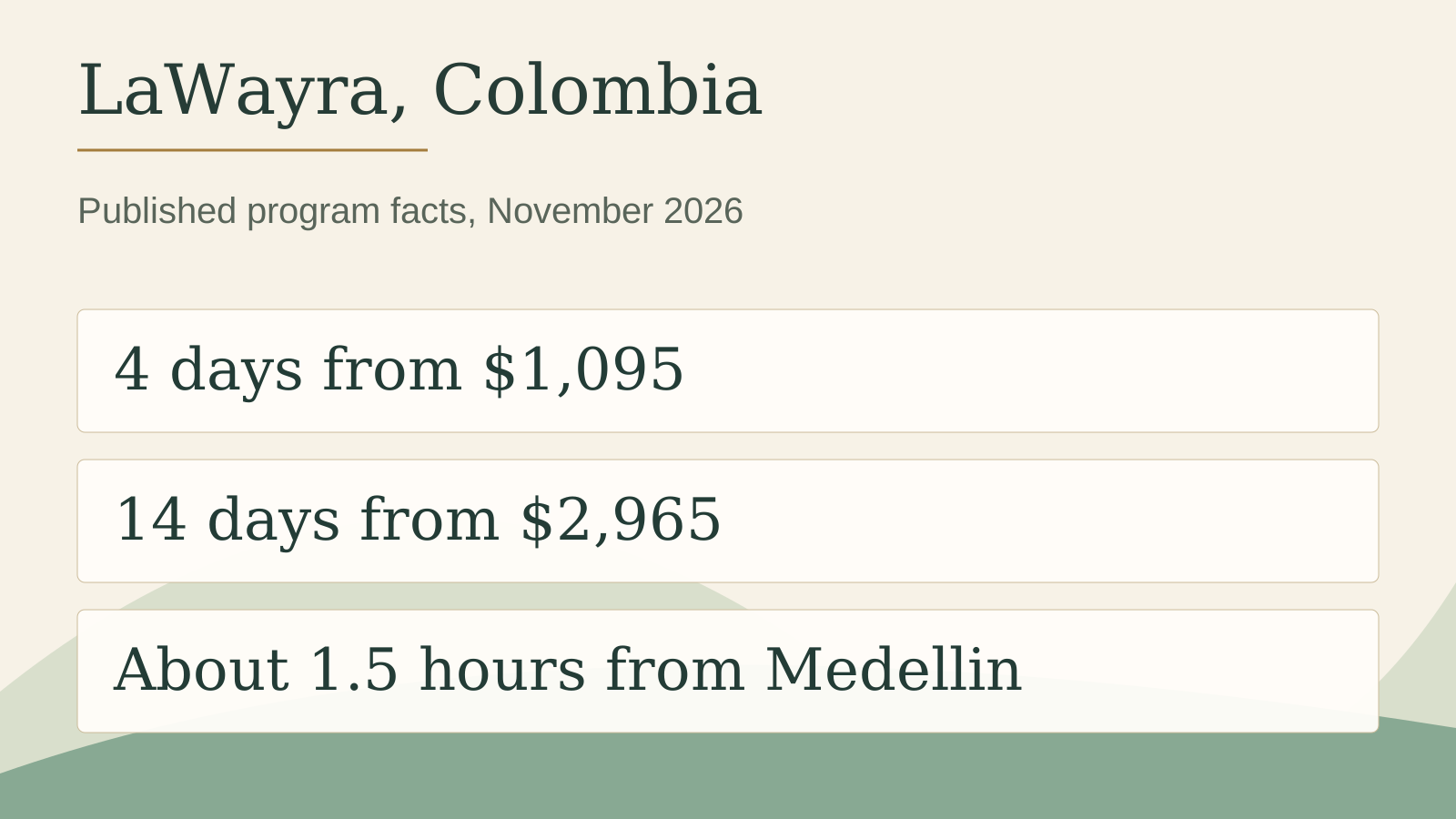
LaWayra ayahuasca retreat in Colombia: cost, program and reviews
LaWayra near Medellin lists retreats from $1,095 for 4 days to $2,965 for 14 days. Independent review of prices, ceremonies, screening and reviews.
Read the profileFind a focused question, compare the practical details, or begin with a core guide.
363 guides
LaWayra near Medellin lists retreats from $1,095 for 4 days to $2,965 for 14 days. Independent review of prices, ceremonies, screening and reviews.
Read the profile
Rythmia in Guanacaste, Costa Rica lists its 7-night program from $4,900. See the program, ceremonies, prices, reviews and what to confirm before paying.
Read the profile
Soltara Costa Rica: published prices for Playa Blanca and Scarlet Valley, ceremonies, screening, travel and what public reviews praise and criticize.
Read the profile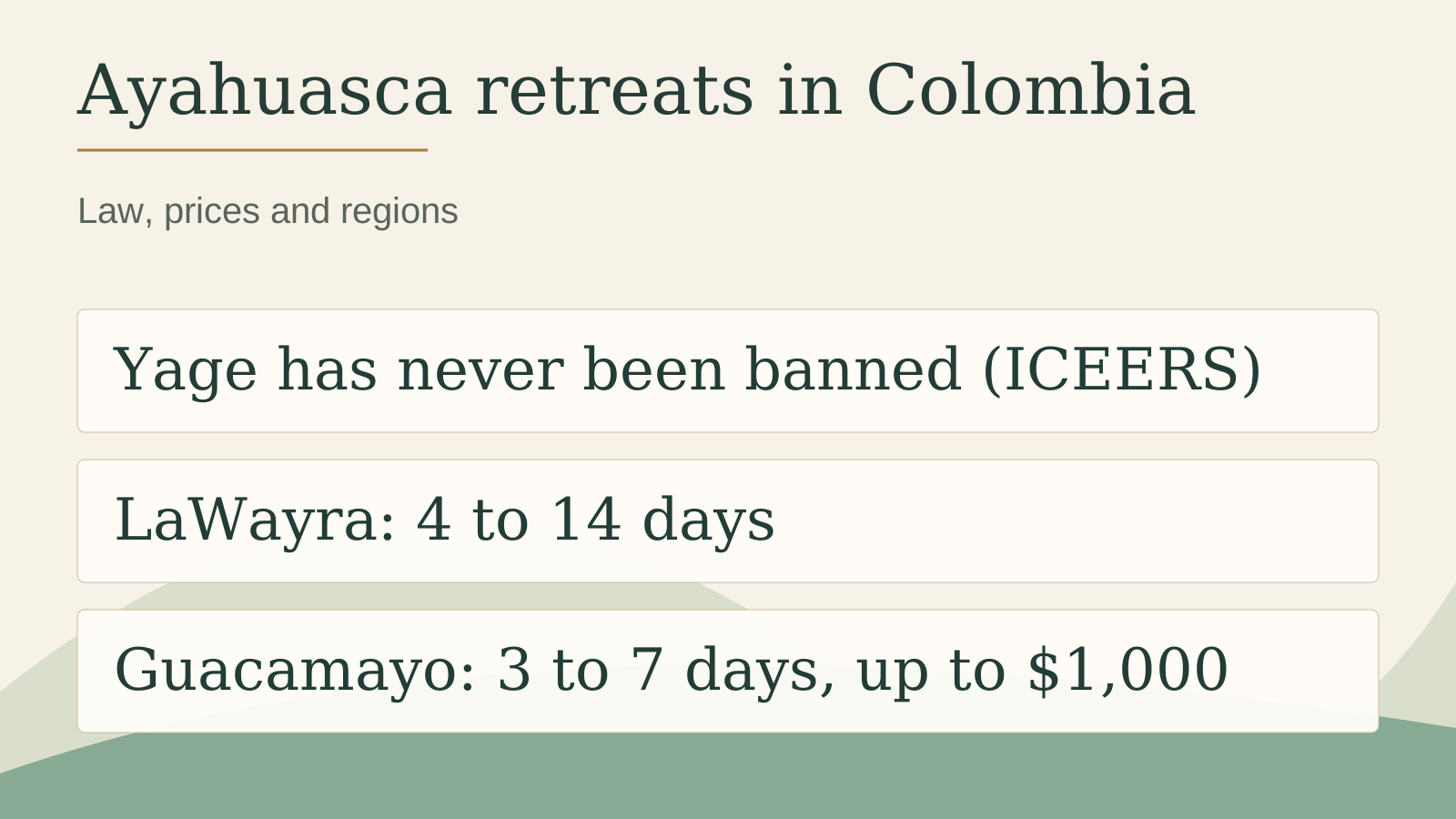
Yagé retreats run across Colombia, where ayahuasca has never been banned. Compare legality, prices, regions, safety screening and how to vet a center.
Read the guide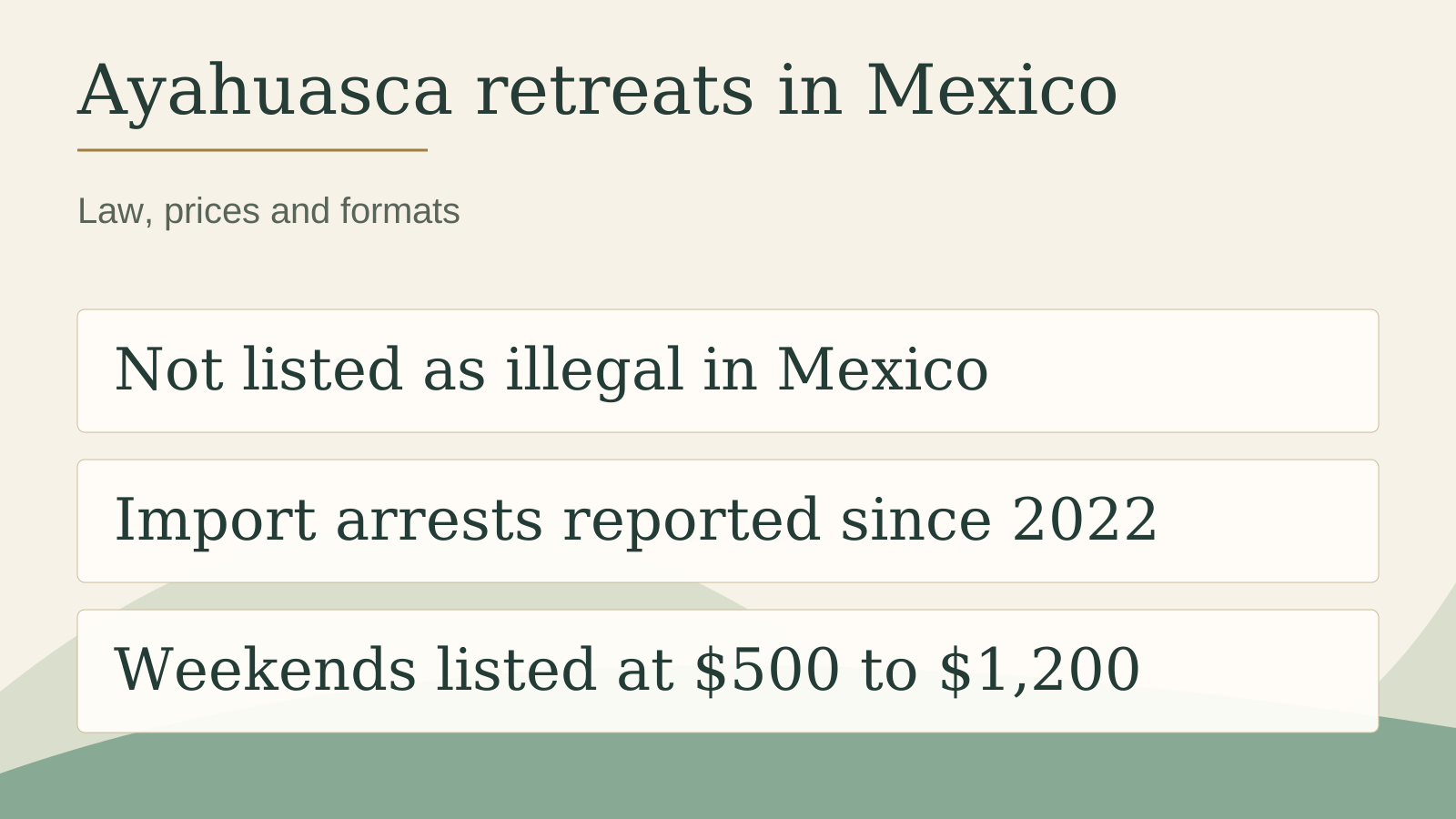
Ayahuasca is not illegal in Mexico, but import arrests have occurred. Compare retreat costs, Tulum and Yucatán options, safety screening and Peru.
Read the guide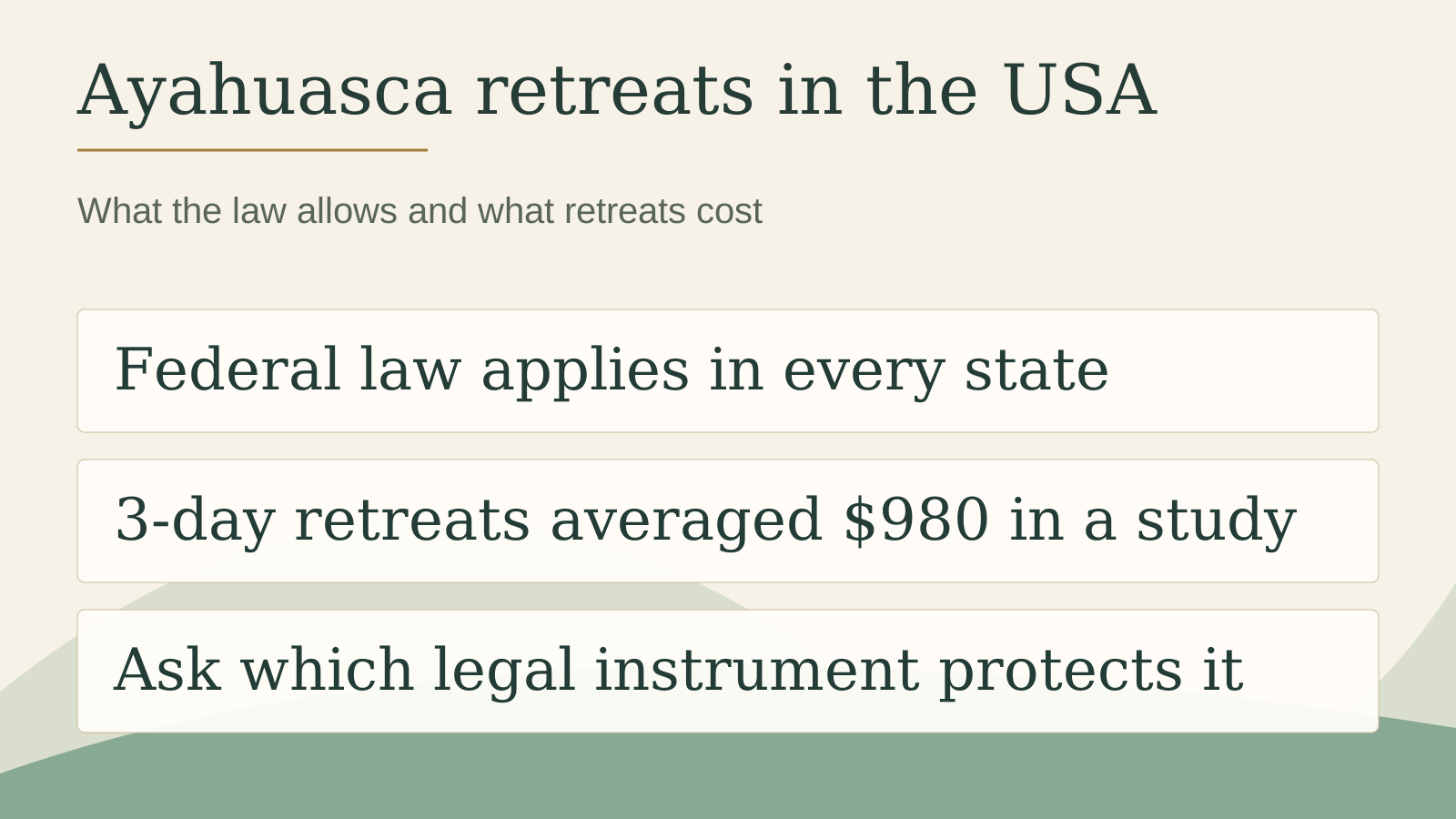
Ayahuasca retreats in the USA: federal law, religious exemptions, prices, state rules, safety screening and how the U.S. compares with Peru and Costa Rica.
Read the guide
Huachuma (San Pedro) is a mescaline cactus taken by day; ayahuasca is a DMT brew taken at night. Compare duration, effects, legality and cost.
Read the guide
Ayahuasca is illegal under U.S. federal law because it contains Schedule I DMT. See which churches hold exemptions, state rules and a country table.
Read the guideA luxury ayahuasca retreat should explain its premium arrangements in terms you can verify: accommodation, privacy, transport, access to the responsible team, preparation and follow-up.
Read the guideThe useful cost is the full amount you may spend, including the quoted retreat, room supplements, flights, transfers, extra nights and any preparation or follow-up billed separately.
Read the guideCompare privacy at several levels: your bedroom, the people attending, the venue, individual team access and handling of personal information.
Read the guideChoose by examining documented responsibilities and arrangements rather than a best-retreat ranking.
Read the guidePreparation should begin with understanding the responsible team's process, its screening requirements and the questions you need answered before committing.
Read the guideIntegration is a term used for understanding an experience and considering how it relates to ordinary life.
Read the guideA retreat review can tell you how one person describes a particular experience.
Read the guideAyahuasca involves physical and psychological risks, and general guidance cannot determine whether a person should participate.
Read the guideCompare the actual region, provider and travel arrangements rather than assume every ayahuasca retreat in Peru offers a similar experience.
Read the guideCompare four retreat destinations through their actual setting, legal questions, travel arrangements and room details.
Read the guideBefore considering a first retreat, understand what is being offered, who is responsible, what assessment is required and which choices remain yours.
Read the guideFlorian's historical writing gives preparation and integration a clear place in his perspective: understand the individual before an experience and consider how reflection relates to ordinary life afterward.
Read the guideStart with the arrangements that affect your actual stay: a room you can use comfortably, clear access to the responsible team, manageable arrival logistics, and documented support.
Read the guideAsk whether the photographs show the room category available for your booking, when they were taken and which features are shared.
Read the guideConfirm whether the bathroom is inside your room, reserved exclusively for you, and accessible throughout the stay.
Read the guideAsk where guests can spend time quietly outside their bedrooms, how those spaces are used, and whether privacy depends on the group schedule.
Read the guideClarify cleaning frequency, room entry, linen changes, and the process for requesting help.
Read the guideDescribe the practical reason for your room preference and ask which available category can meet it.
Read the guideAsk which tasks the concierge handles, when the service is available, and which requests incur extra charges.
Read the guideCompare individual comfort features in words and record whether each is confirmed.
Read the guideAsk when meals are served, where guests eat, which requests the provider can accommodate, and how food-related questions reach the responsible team.
Read the guideConfirm whether laundry is available, its turnaround time, any restrictions, and the charge before relying on it.
Read the guideAsk where internet access is available, how the provider describes ordinary reliability, and what the program expects about devices.
Read the guideAsk who will occupy the property during your dates and which spaces the exclusivity covers.
Read the guideTranslate each room category into the features it includes: occupancy, bathroom, size or layout, location, and any confirmed extras.
Read the guideRequest service hours for arrivals, meals, housekeeping, guest requests, and the contacts responsible outside those hours.
Read the guideAsk how many guests share the accommodation and common spaces during your dates, including people outside your retreat group.
Read the guideDescribe the physical features you need and ask the property to confirm them for your room and the spaces you will use.
Read the guideCheck whether you can keep the same room, which meals and services continue, and which business manages the additional booking.
Read the guideTurn each broad service claim into a question about the actual arrangement.
Read the guideAsk where your booking name appears, who receives it, and whether a preferred name can be used for group introductions.
Read the guideAsk which business issues the invoice, how the service is described and what payment reference or statement descriptor may appear.
Read the guideAsk which roles receive your information, why they need it, and whether the booking team separates ordinary logistics from sensitive screening material.
Read the guideAsk which records the provider retains, for what purposes, and how it handles a request to correct or remove information.
Read the guideUse an initial inquiry to ask about the service, dates, format, and the appropriate private process for personal questions.
Read the guideAsk how photography consent is requested, recorded, and communicated to staff and guests.
Read the guideAsk whether staff and contractors may post images or stories from the retreat on personal accounts, and how guest permission is handled.
Read the guideAsk what agreement guests receive about photographs, recording, and sharing material involving other people.
Read the guideAsk where the testimonial will appear, whether your identity will be attached, and whether you can review the exact text or recording before use.
Read the guideConfirm why the call is arranged, what the other person agreed to discuss, and whether either party will be identified or recorded.
Read the guideDiscuss room arrangements, personal boundaries, publicity, and what each person is comfortable sharing with the group.
Read the guideAsk whether shared accommodation is available, what private space each person can access, and how individual conversations are handled.
Read the guideConfirm whether companions are accepted, where they stay, which services they can use, and what boundaries apply around the retreat group.
Read the guideAsk who can enter your room, for what purposes, how visits are communicated, and how your preferences are recorded.
Read the guideAsk who shares the bathroom, how access is arranged, and which facilities are separated or lockable.
Read the guideAsk where individual conversations take place, whether other people can overhear, and how appointments are arranged.
Read the guideAsk who interprets, what role they hold, how confidentiality is addressed, and whether you can raise concerns privately.
Read the guideIdentify which business holds your booking, which provider runs the retreat, and what information moves between them.
Read the guideAsk whether a suitable room is available, whether conversations can be overheard, and whether the program schedule permits the call.
Read the guideAsk which follow-up messages are part of the service, which are marketing, and how you can choose the relevant channels.
Read the guideDecide which details you want public, obtain permission before identifying others, and check the provider's photography and location rules.
Read the guideAsk what the promise covers, who is bound by it, how it is implemented, and what limits are disclosed.
Read the guideRequest a quote that identifies the supplier, dates, attendees, room category, included services, optional charges, currency, and payment terms.
Read the guideConfirm what the supplement changes, which dates it covers, whether it is priced per person or per room, and how its terms relate to the retreat package.
Read the guideAsk whether the quote includes collection and return transport for your exact arrival and departure arrangements.
Read the guideKeep each source quote in its stated currency and use a clearly dated comparison conversion for your own budget.
Read the guideAsk whether the quoted total includes applicable taxes and mandatory fees, and request any excluded charge by name.
Read the guideAsk what the deposit reserves, whether attendance or room confirmation remains conditional, and which cancellation or change terms apply.
Read the guidePut each payment deadline beside the booking condition it depends on, such as room confirmation or completion of the provider's screening process.
Read the guideAsk what happens financially if the responsible team does not accept your participation, if more information is needed, or if the process is incomplete by a payment deadline.
Read the guideCopy the provider's cancellation schedule exactly, including the date or time rule, the required notification channel, and any separate supplier conditions.
Read the guideConfirm the new dates, provider, venue, room, inclusions, and price, then ask how the change affects existing payments and cancellation terms.
Read the guideAsk whether the retreat requires a minimum number of guests, when that threshold is confirmed, and what happens if it is not met.
Read the guideGive each supplier its own budget line with the service, agreement, currency, payment deadline, and contact.
Read the guideAsk whether the expiry concerns price, availability, or both, and what action confirms the booking.
Read the guideAsk which additions require your approval and request a separate description and price before they are booked.
Read the guideCompare the same number of guests, nights, room arrangement, and included services.
Read the guideAsk whether gratuities are expected, included, optional, or handled through a stated process, and which staff or suppliers the explanation covers.
Read the guideAsk an insurer or qualified adviser how the policy applies to your actual trip, activities, cancellation circumstances, and any relevant exclusions.
Read the guideAsk the supplier which payment methods it accepts and whether its quote includes any processing charge.
Read the guideKeep the accepted terms, quote, payment receipts, booking reference, and a dated record of the request and response.
Read the guideMark unknown charges as unresolved and request the information needed to price them.
Read the guideAsk for a role map that names the operator, ceremony leaders, screening team, guest-services staff, and follow-up contacts.
Read the guideIdentify the legal business offering the service, the operator running the program, and the recipient of your payment.
Read the guideAsk whether the person recommending a retreat receives payment, a discount, free attendance, or another benefit connected to your booking.
Read the guideIt should disclose its commercial relationships, explain its selection method, date its factual checks, and distinguish personal experience from researched descriptions.
Read the guideAsk who owns the brand, who runs your specific program, and what the founder actually does during it.
Read the guideDates help you distinguish a current service description from an older program, review, or quote.
Read the guideA sample schedule can show the kinds of activities and pacing the provider describes, but it should be labeled as an example if details may change.
Read the guideAsk which parts of the program can change, who approves changes, and which parts remain fixed.
Read the guideAsk the caller's role, the purpose of the conversation, what information is needed, and whether the call is recorded.
Read the guideAsk how the provider explains consent, personal boundaries, guest conduct, and reporting concerns.
Read the guideAsk how to raise an ordinary service concern, how a private program concern is handled, and who provides an alternative contact when the issue involves your usual contact.
Read the guideA biography should identify the practitioner's actual role, use descriptions they have approved, and distinguish personal background from the services delivered in this program.
Read the guideAsk which community or organization is involved, what the partnership actually does, and how the parties describe it.
Read the guideAsk whose tradition is being described, who approved the wording, and how the description relates to the actual program.
Read the guideAsk what material or service the claim concerns, which supplier relationship supports it, and what the provider can document publicly.
Read the guideAsk who appears in the images, what context they show, and whether the people involved approved the use.
Read the guideAsk what a stated value changes in the provider's actual practices.
Read the guideSend a short set of specific questions about the arrangement you are considering, and identify the facts that determine your decision.
Read the guideKeep an open-question list with the subject, responsible contact, date asked, and importance to your decision.
Read the guideCompare the website description, quote, agreement, invoice, and confirmation for dates, room, inclusions, supplier names, and terms.
Read the guideLook for the date, program, room category and practical arrangements the reviewer actually experienced.
Read the guideAn average summarizes the ratings included on that platform; it does not explain every guest's circumstances or the current program.
Read the guideTreat it as a dated account of the program the person attended.
Read the guideRead it with the disclosed arrangement in mind: who paid, which benefits were provided, and what editorial control or commercial relationship existed.
Read the guideLook for the platform's explanation of who can post, what verification means, and how it handles moderation or incentives.
Read the guideIdentify the specific issue, its date, the program involved, and the evidence available.
Read the guideIt can show how the business publicly explains an issue, acknowledges a concern, or directs someone to a process.
Read the guideTreat it as the person's account of change over time and ask what context or commercial relationship accompanies it.
Read the guideIt can provide an account whose useful detail depends on the context and evidence available, even when the author keeps their identity private.
Read the guideA provider's testimonial collection shows the accounts it chose to publish, usually within a promotional context.
Read the guideTreat the claim as an account requiring careful interpretation, and bring your own health questions to an appropriately qualified professional.
Read the guideMatch the reviewed room's category, occupancy, bathroom arrangement, dates, and property with the quote you are considering.
Read the guideRecognize that repeated publication may represent one underlying account rather than several independent experiences.
Read the guideRead the article's date, author perspective, sourcing, and any hosted or commercial relationship.
Read the guideIt should state which program the writer attended, when, what they personally observed, and any relevant commercial relationship.
Read the guideIdentify whether the accounts describe the same program, dates, room category, and service before treating them as a direct disagreement.
Read the guideAsk which arrangement the provider actually offers and how responsibility, payment, changes, and records work in each case.
Read the guideRequest the status of the program place and accommodation separately, even when they appear in one package.
Read the guideAsk the transfer coordinator how the driver or greeter is identified, which contact you can use to verify the collection, and what to do if the expected person is absent.
Read the guideAsk who can request and approve changes to accommodation, transport, or optional services, especially when a coordinator or group organizer is involved.
Read the guideDistinguish Iquitos and Peruvian Amazon lodge arrangements from the Sacred Valley, then compare access, actual rooms and the responsible program.
Read the guideRequest the replacement property's identity, room categories, access arrangements, shared spaces, and service differences.
Read the guideIdentify the supplier, itinerary, price, participation choice, and terms before approving the outing.
Read the guideAsk the provider to summarize the accepted arrangement in one current confirmation, including changes agreed through email or messaging.
Read the guideAsk why the device is needed, who else uses it, and what information the activity requires.
Read the guideRecord the room category, occupants, confirmed features, and reservation status for each allocation, using only the practical information guests agree to share.
Read the guideCompare Sacred Valley retreat locations and accommodation, with dated operator examples and practical questions before paying.
Read the guideReview the current dates, room, package, price, team description, and terms as a new concrete offer.
Read the guideAsk why the move is part of the booking, when it occurs, which rooms are used, and how belongings and access are handled.
Read the guideState the exact occupancy and bed arrangement you want, then ask the property to confirm it for your room category and dates.
Read the guideRecord each guest's arrival separately, identify the transfer and room contact for each, and ask who coordinates changes.
Read the guideIdentify the request, the responsible team, and the expected next step, then ask for a clear acknowledgment when it moves between businesses.
Read the guideA written integration support agreement should name the people involved, describe the available contact, and explain the limits of that service.
Read the guideBudget for follow-up support by separating included services from optional appointments and other expenses.
Read the guideAsk each support person to describe their role, qualifications, and the service they are offering.
Read the guidePrepare for an integration support interview by writing down the kind of conversation you want and the practical arrangements you need.
Read the guideFor a first follow-up call, bring the questions you most want answered and any practical arrangements that remain unclear.
Read the guideCheck follow-up availability by asking how appointments are booked, who staffs them, and which dates the service covers.
Read the guideAsk about privacy before you share sensitive details in an integration appointment.
Read the guideCompare group and individual follow-up by looking at the conversation you want to have and the arrangements each format provides.
Read the guideBefore joining an online integration community, ask who moderates it, what its rules cover, and what support it actually offers.
Read the guideAsk for a support appointment summary that distinguishes what you discussed, what you agreed, and what remains uncertain.
Read the guideYou can question follow-up advice and explain which part does not fit your circumstances.
Read the guideArrange remote follow-up with a named time zone, a calendar invitation, and a clear plan for connection problems.
Read the guideYou can bring uncertainty to a follow-up conversation without deciding what an experience means.
Read the guideMake a contact list that identifies who handles each kind of question and how to reach them.
Read the guideReview an ongoing support arrangement by asking whether its purpose, scope, and practical terms still fit your needs.
Read the guideAsk whether messages between appointments are part of the support service and what they are intended for.
Read the guideIf a support person changes after booking, ask who will provide the service and how the change affects your agreement.
Read the guideA referral should explain why another person was suggested and what service they offer.
Read the guideFor remote support across borders, ask which role the person is offering and whether they can provide that service where you will be located.
Read the guideShare context between support providers by deciding what the new person needs to understand and asking how information will be transferred.
Read the guideSend a post-trip administrative question through the operator's appropriate contact route and keep it focused on the practical request.
Read the guideYou can leave an integration discussion group after reviewing its membership terms and deciding what information or contacts you want to retain.
Read the guideSet expectations for integration support by describing the service you want and the questions you hope to discuss.
Read the guideSeparate a support conversation from a future retreat booking by asking which service you are receiving and whether recommendations carry a commercial interest.
Read the guideUnderstand reported emotional and perceptual changes after ayahuasca, the limits of survey evidence, and the distinction between reflection and clinical care.
Read the guideAfter an extended trip, request a clear handoff of the responsibilities other people covered.
Read the guideDiscuss your return-home schedule with your partner in terms of shared commitments and specific requests.
Read the guideAfter returning home, ask the person who provided childcare for a practical update on current routines, events, and responsibilities.
Read the guideReview household tasks by identifying what is time-sensitive, what belongs to someone else, and what can be planned later.
Read the guideProtect the privacy of a return-home conversation by choosing its setting and stating what you want kept private.
Read the guideHandle social invitations by checking the actual commitment and deciding whether you want to attend, decline, or suggest another date.
Read the guideRequest personal space by naming the time, place, and household arrangements involved.
Read the guideSort household correspondence by looking for actual deadlines, required actions and questions needing another person's input.
Read the guideReview existing appointments by confirming their dates, locations, purpose, and any requested preparation.
Read the guideAnswer a friend's question with the level of detail you want to share.
Read the guideAsk for help by naming the task and checking whether the person is willing and able to do it.
Read the guideStore personal retreat notes where access matches your privacy preferences.
Read the guideBefore sharing retreat photos, check whether identifiable people have agreed to that use and whether the image reveals information they might want private.
Read the guideRead ayahuasca duration estimates carefully, distinguish peak effects from completion, and understand why a schedule cannot establish personal readiness.
Read the guideIf your practical plans change while you are away, identify the new facts and the commitments affected before making a decision.
Read the guideYou can say that you do not have an immediate conclusion.
Read the guideAfter arriving home, review the responsibilities you resumed and the arrangements that still need clarification.
Read the guideReview a crowded calendar by distinguishing fixed commitments, optional events, and changes that require someone else's agreement.
Read the guideKeep ideas in a separate record and label them as ideas rather than decisions.
Read the guideAfter returning, arrange a briefing with the colleague who covered your role.
Read the guideAnswer colleagues with the level of detail appropriate to your relationship and workplace obligations.
Read the guideAfter returning to work, check whether absence messages and delegated contact routes still describe the current arrangement.
Read the guideDiscuss a return-to-work arrangement with the responsible manager through your actual duties, availability, and the workplace's procedures.
Read the guideReview delegation by asking which decisions were made, which responsibilities worked as agreed, and where authority remained unclear.
Read the guideTurn a leadership observation into a question about an actual work situation.
Read the guideExamine a career idea by writing the actual change you are considering and the information it requires.
Read the guideEvaluate a business spending idea through the usual facts and approval process: its purpose, total cost, alternatives, obligations, and expected practical use.
Read the guidePropose a meeting change by describing one observable problem and asking participants about it.
Read the guideReview a difficult work email by checking what happened, what you are asking for, and who needs to receive it.
Read the guideConnect a personal value with one work choice you can describe concretely.
Read the guideKeep personal reflection notes separate from official work records and check the rules governing the devices and accounts you use.
Read the guideRespond to a coworker's retreat question by distinguishing your personal account from facts you have verified and questions you cannot assess.
Read the guideAsk your assistant for a return briefing focused on current administrative work, pending requests, and decisions that need your attention.
Read the guideDiscuss a new business priority by explaining the actual proposal and inviting the team's operational perspective.
Read the guideDocument the decision using the business facts, options considered, authority involved, and agreed result.
Read the guideWrite a process proposal around the work problem you want to address, the evidence available, and the change requiring approval.
Read the guideDiscuss a productivity claim by asking what was measured, how the comparison was made, and which other factors changed.
Read the guideSet work availability boundaries through the responsibilities and agreements of your role.
Read the guideRead named Indigenous perspectives and examine cultural authority, representation and benefit sharing before accepting an ayahuasca retreat's ethical claims.
Read the guideDistinguish the actual substances, research, cultural context and services before comparing ayahuasca and psilocybin retreats.
Read the guideSchedule a follow-up appointment by checking the provider's actual availability and the workplace arrangements needed to attend.
Read the guideExplain an observation through an ordinary situation your partner can recognize.
Read the guideYou can state which retreat details you want to keep private while explaining practical matters that affect the relationship.
Read the guideDiscuss different interpretations by stating the observation each person is responding to and asking how they understand it.
Read the guideAfter returning home, ask a friend whether they are willing to listen and explain that you are not seeking advice at that moment.
Read the guideConsider an apology by identifying the action you want to acknowledge and the effect you can accurately describe.
Read the guideDescribe a boundary through the specific situation and the action you are choosing or requesting.
Read the guideDiscuss a new spending idea with the people who share the financial commitment before treating it as a decision.
Read the guideYou can stay connected through the interests and commitments you already share.
Read the guideExplain unfamiliar retreat language through an ordinary example and identify it as the perspective you are considering.
Read the guideExamine a major relationship decision through the actual circumstances, shared responsibilities, and information you need.
Read the guideWrite about family by separating your own observations from claims about other people's motives or private lives.
Read the guideAsk permission by giving a brief description of the topic and checking whether the person wants to discuss it now.
Read the guideDiscuss a group experience through your own observations and the parts you have permission to share.
Read the guideRespond in a family group chat with the information you want that audience to receive.
Read the guidePlan a reconnection conversation at a time that works for both people and leave room for each person's update.
Read the guideRespond to a skeptical question by asking which claim the person wants to examine.
Read the guideClarify the conversation by stating whether you want listening, another person's perspective, practical help, or a shared decision.
Read the guideIf a private detail is repeated, identify what happened and speak to the relevant person about the change you want.
Read the guideAvoid an undefined support role by asking family members for specific help and checking their willingness.
Read the guideAsk which concern your parents want to discuss and answer only what you can state accurately.
Read the guideAsk for another perspective by describing the specific question and inviting disagreement.
Read the guideEnd a personal conversation by identifying what you both understood and what remains unresolved.
Read the guideA one-page reflection note can record an observation, the situation it relates to, and questions you want to consider.
Read the guideSeparate memory from interpretation by writing what you recall and labeling the meaning you are considering as a separate thought.
Read the guidePut an abstract insight into ordinary words by identifying the everyday situation it reminds you of and the question you want to examine.
Read the guideWrite about a symbolic image by describing the details you remember and leaving its meaning open.
Read the guideCreate a topic index by assigning short labels to the questions in your notes and recording where each passage can be found.
Read the guideTurn a broad reflection into a specific question by identifying the situation and the information you want to understand.
Read the guideChoose a practical action by explaining what it is meant to address and checking whether it fits your responsibilities and authority.
Read the guideRecord the result by stating the action, the context and what you actually observed.
Read the guideReread notes selectively and allow the meaning to remain open.
Read the guideYou can choose reflection without a journal.
Read the guideIf you choose to make a voice note, record your own observation and label uncertain memories or interpretations clearly.
Read the guideA simple drawing can be an optional way to label a question or show how practical responsibilities connect.
Read the guideDecide whether to keep old reflection notes by asking what purpose they now serve and what information they contain.
Read the guideRevise an interpretation by stating what you previously thought and what has changed in your understanding.
Read the guideCompare apparently contradictory notes by checking whether they concern the same situation and use the same words in the same way.
Read the guideAsk a useful question by stating what you do not recall and focusing on the practical issue you can describe now.
Read the guideWrite a thank-you by naming the actual help you received and why you appreciated it.
Read the guideReview a values list by connecting each word to an ordinary example and checking how it relates to your actual commitments.
Read the guideAdd context by stating the situation, relevant timing, and information available when the observation arose.
Read the guideCheck reversibility by asking what an action commits you to and what would be required to undo it.
Read the guideLabel an idea by distinguishing what another person said from the meaning you are considering.
Read the guideUse quotation marks only for wording you can verify as exact.
Read the guideConnect a reflection with an existing routine by identifying the actual task and the question it raises.
Read the guideKeep reflection questions in a separate list from actions you have actually chosen.
Read the guideYou can reflect on declining or postponing a retreat by recording your reasons and the practical decisions that follow.
Read the guideUnderstand the ayahuasca brew, its commonly studied plants and compounds, and why the name does not describe a standardized retreat or treatment.
Read the guideGive each stage of your research a clear purpose.
Read the guideYou can describe your interest honestly even when a fixed goal has not emerged.
Read the guideAn intention names something you want to examine.
Read the guideBefore submitting an application, understand who receives it, how the review works, and whether any obligation begins with submission.
Read the guideCompare joint travel with separate participation choices, room arrangements, private conversations and booking terms before choosing a couples ayahuasca retreat.
Read the guideIf you would attend alone, ask how arrival, orientation, and contact with the team actually work.
Read the guideThank your friend for explaining their interest, then make your own inquiry.
Read the guideDecide which practical facts your family needs and which personal details you want to keep private.
Read the guideGive your assistant a research brief with explicit authority limits.
Read the guideYou can prepare written questions and ask for a conversation format that feels manageable.
Read the guideUse skepticism to ask specific questions about claims, evidence, and responsibilities.
Read the guideIf public recognition matters to your decision, ask how the provider handles names, guest information, images, and contact with outside parties.
Read the guideSay what you know, what you are unsure about, and what you need help clarifying.
Read the guideUse a disappointing account to identify questions you can verify, such as what was promised, who responded, and what support was available.
Read the guideRead the orientation packet with a list of decisions you still need to make.
Read the guideReview expected deliveries and mail during your absence and decide which need action.
Read the guideAsk the provider to label activities clearly as required, optional, or separately arranged.
Read the guideRequest the provider’s consent process before deciding to attend.
Read the guideAsk the provider to explain any physical contact included in the advertised activities and how permission is requested.
Read the guideAsk how the provider handles participants who prefer to listen or pass during group sharing.
Read the guideReview your household’s actual waste and recycling routine and arrange any task that would fall during your absence.
Read the guideCheck the actual parking and vehicle arrangements that apply while you are away.
Read the guideReview routine household bill dates and the arrangements you already use.
Read the guideBefore agreeing to share a room, ask how assignments work and what expectations apply to quiet, visitors, personal belongings, and concerns.
Read the guideReview home service appointments already scheduled during your possible absence.
Read the guideShare information according to the purpose of the conversation and the responsible process.
Read the guideStart with the situation that concerns you, identify the missing fact, and ask who can address it.
Read the guideCompare the actual Costa Rican property, room, written quote, transfer and provider claims before considering an ayahuasca retreat.
Read the guideUse your workplace’s current process and explain that the proposed dates remain tentative if that is accurate.
Read the guidePrepare a work handoff around the decisions that may arise while you are away.
Read the guideList the household responsibilities that would continue while you are away and confirm who will handle each one.
Read the guideDecide which messages require contact, who needs the agreed route, and which routine notifications can wait.
Read the guideAgree on who contacts you, which practical information they need, and what responsibilities they can handle if a family emergency occurs while you are away.
Read the guidePlan your return calendar using actual travel times, existing responsibilities, and confirmed support arrangements.
Read the guideGive your assistant the information needed for travel coordination and keep private intake in the designated personal channel.
Read the guideDefine which business issues a delegate can handle and which require your direct involvement.
Read the guideCompare proposed dates with your actual responsibilities and the complete travel sequence.
Read the guideBefore choosing a tightly timed itinerary, confirm the retreat’s arrival window, transfer arrangement, and response to delays.
Read the guideKeep current contact details for the retreat, transport provider, and accommodation with your booked itinerary.
Read the guideA useful transfer confirmation identifies the meeting point, contact person, passenger details, and the arrangement if plans change.
Read the guideAsk a willing person to coordinate practical home updates and explain the limits of the role.
Read the guideAsk about luggage limits at each stage of the actual journey: carrier, transfer, and accommodation.
Read the guideAsk what storage is available, who can access it, and what the provider’s policy says about personal belongings.
Read the guideAgree on a simple update when an assigned household task is complete, and identify who receives it.
Read the guideAsk practical questions about meal times, included service, ingredients, and the provider’s process for discussing personal requirements.
Read the guideUse the provider’s current packing list to identify practical requirements and ask about unclear items.
Read the guideAsk the provider about the conditions at the actual venue and the practical arrangements you will use.
Read the guideAsk who collects each payment, the currency and method used, and the written terms that apply.
Read the guideOrganize practical travel documents separately from private intake and personal reflection notes.
Read the guideIdentify who needs home access for an agreed task and use an appropriate private process to arrange it.
Read the guideReview the ordinary supplies needed by people staying home or helpers covering agreed tasks.
Read the guideAllow enough time to read the actual information, ask questions, and consult the appropriate people before deciding.
Read the guideAgree that each friend makes an independent participation decision and uses the appropriate private process.
Read the guideOrganize research around the decisions you need to make and the sources that can answer them.
Read the guideYou can use private notes to describe why you are interested, what remains uncertain, and which questions you want answered.
Read the guideKeep another guest’s account attached to that person’s experience.
Read the guideDescribe any expectation for intensity, revelation, or dramatic change before making a retreat decision.
Read the guideExamine the small randomized depression trial, retrospective survey findings and newer feasibility research without treating them as retreat treatment evidence.
Read the guideA retreat inquiry can end with a practical answer, a request for more information, a pause, or a decision not to proceed.
Read the guideName the ordinary subject you hope to notice more clearly during time away.
Read the guideDescribe what you mean by rest before deciding which arrangement to research.
Read the guideCompare the social-anxiety pilot, perceived survey outcomes and small feasibility studies, with attention to endpoints, possible distress and uncertainty.
Read the guideList the ordinary conversations already connected to your question before assigning everything to a retreat decision.
Read the guideDescribe the actual career decision and the information you still need.
Read the guideKeep a business-growth goal separate from your personal reasons for investigating a retreat.
Read the guideRead preliminary veteran studies with the published scoring correction, and distinguish posttraumatic symptom change from demonstrated PTSD treatment efficacy.
Read the guideDescribe the leadership responsibility that is changing and the question you want to think about.
Read the guideDistinguish dependence questions from preliminary substance-use treatment research, including an alcohol feasibility trial and limits of combined interventions.
Read the guideCheck who a women-only ayahuasca retreat label covers, who will be present, and how accommodation, access, privacy and conduct are handled.
Read the guideExplain what connection means in your own language before treating it as a retreat outcome.
Read the guideName the activity or explanation you want to understand and ask what participation actually involves.
Read the guideDescribe spiritual interest through the questions or experiences you actually mean.
Read the guideYou can ask about an unfamiliar concept without endorsing it.
Read the guideName what you hope another setting or conversation would add beyond reading.
Read the guideNotice whether you are trying to sound agreeable, experienced, or unusually prepared before you have decided to participate.
Read the guideWrite each intention separately, then identify the question beneath it.
Read the guideAsk whether your main interest is time away, the advertised program, or a specific personal question.
Read the guideClarify any workplace expectation before linking personal retreat travel to a deliverable.
Read the guideName the meaning you attach to a milestone and keep it separate from the travel decision.
Read the guideWrite the belief question you are considering and distinguish curiosity from a demand for certainty.
Read the guideList the everyday responsibilities and practical problems that remain outside the retreat arrangement.
Read the guideDescribe what has changed and reconsider the questions that informed your earlier decision.
Read the guideDescribe prior meditation experience accurately if it is relevant to the conversation, while keeping the new arrangement separate.
Read the guideWrite what you expect from a vacation and what you are investigating about the retreat format.
Read the guideYou can hear another person’s intention respectfully without making it your own.
Read the guideAsk whether an ordinary information request or practical action could clarify the question you are bringing to research.
Read the guideTell the person what kind of conversation would help: listening, practical information, or discussion of an actual decision.
Read the guideDescribe what you notice and what you want to ask without assigning yourself a diagnosis.
Read the guideExplain what a metaphor means in ordinary terms before using it to describe a retreat expectation.
Read the guideDescribe what you mean by reset in concrete terms.
Read the guideAsk whether the next source is meant to answer a specific question or simply make you feel more certain.
Read the guideAgree on who will care for your pet, which dates they cover, and what routine information they need.
Read the guideConfirm who handles each school pickup and use the school’s current authorization process.
Read the guideList the caregiving responsibilities that would continue while you are away and discuss coverage with the relevant people.
Read the guideUse one current calendar to show who covers each household task and when.
Read the guideUse an out-of-office message to explain work availability, current dates, and the appropriate contact for relevant tasks.
Read the guideName the work responsibility that makes you consider bringing a device.
Read the guideDescribe the project’s actual status, including unfinished work and open decisions.
Read the guideIdentify which responsibility is no longer covered, ask the relevant people about alternatives, and update the current plan.
Read the guideDescribe a value through the ordinary choices where it matters to you.
Read the guideSeparate an actual decision deadline from the hoped-for timing of personal clarity.
Read the guideYou can begin with a concrete question when a broad intention does not describe your interest accurately.
Read the guideTell the qualified professional what you are considering and bring accurate information about the actual proposal.
Read the guideDescribe the practice you already use and ask the responsible team how it relates to the actual preparation process.
Read the guideLabel a calendar hold as tentative and tell affected people what has and has not been decided.
Read the guideBring the practical questions you still need answered and tell the responsible contact that the format is unfamiliar.
Read the guideName the instruction you do not understand and ask the responsible person to explain it before you decide about participation.
Read the guideAsk what a shared intention means in the actual activity and whether joining it is optional.
Read the guideAsk the responsible qualified team about any unfamiliar preparation request before acting on it.
Read the guideName the information or advice you want from another person and keep it distinct from asking them to choose for you.
Read the guideState both priorities and the practical requirements each creates.
Read the guideA useful what-if names a specific situation and the information you would need if it arose.
Read the guide
Compare Arkana Sacred Valley's published rooms, suites, privacy and arrival arrangements, with practical questions for your Peru retreat shortlist.
Read the profile
Compare Arkana Amazon's published rooms and Jungle Suites, river access, privacy and stated amenities before requesting a date-specific proposal.
Read the profile
Compare Etnikas' published Sacred Valley programs, shared accommodation and arrival arrangements, with precise questions about the property you would book.
Read the profile
Explore Temple of the Way of Light's published private tambos, offline setting and access from Iquitos when comparing Peru's Amazon retreat options.
Read the profileCompare Andean and Amazon retreat settings in Peru through actual room categories, privacy, arrival arrangements and the conveniences that matter to you.
Read the guideNo matching guide. Try a shorter phrase or select another topic.
If you are considering an ayahuasca experience, ask Florian about the questions on your mind.