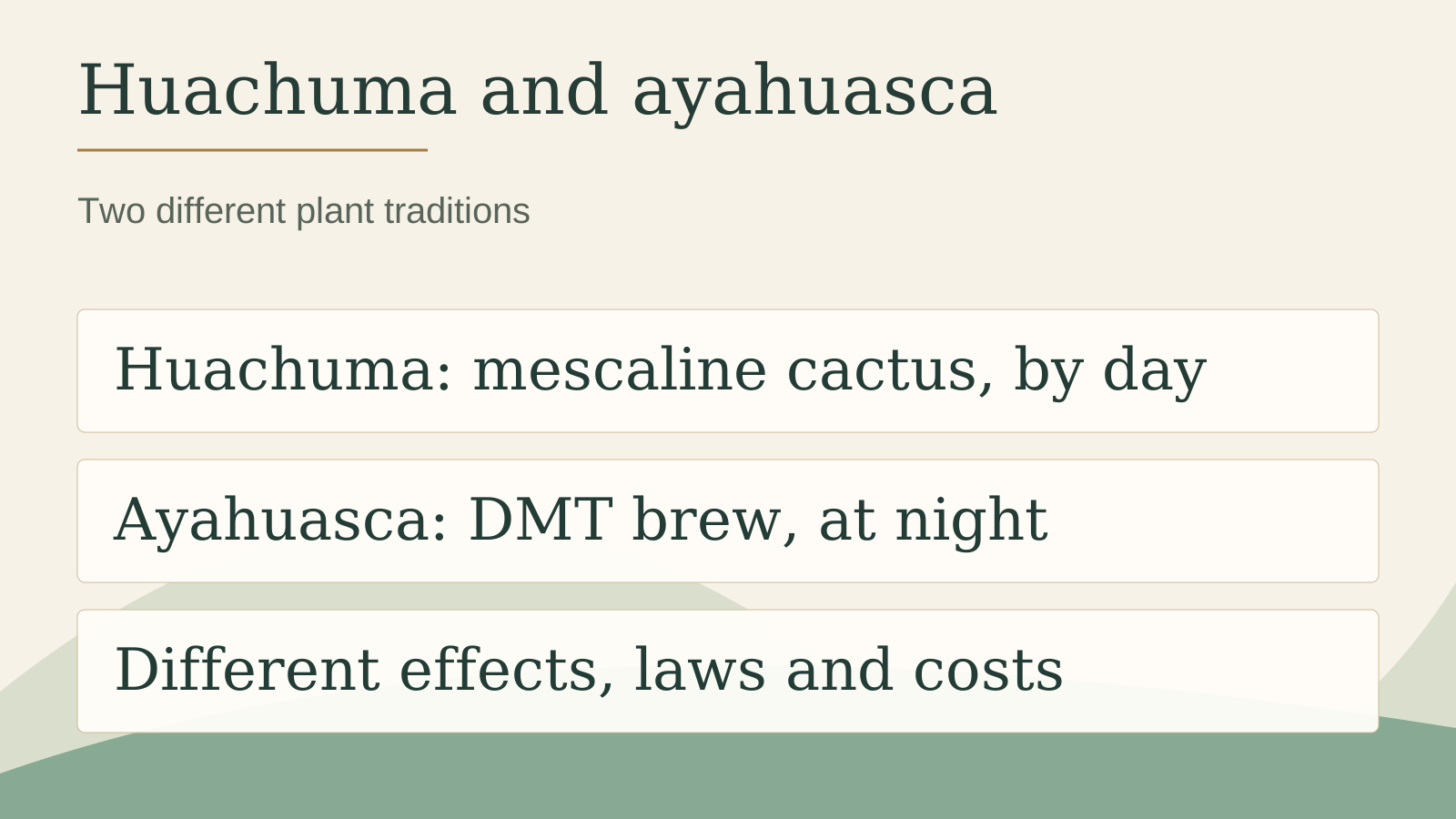
Huachuma is another name for the San Pedro cactus (Echinopsis pachanoi), an Andean cactus native to South America whose main psychoactive compound is mescaline. Ayahuasca is an Amazonian brew that combines the Banisteriopsis caapi vine with a DMT-containing plant, usually Psychotria viridis. The clearest practical differences are the compound, the duration (roughly 8 to 12 hours for San Pedro versus 4 to 6 for ayahuasca) and the setting: day outdoors versus night indoors.
Which has more medication interactions and health risks, San Pedro or ayahuasca?
Ayahuasca carries the higher medication risk, mainly through MAO-A inhibition. San Pedro avoids the MAO-inhibition issue, but mescaline raises heart rate and blood pressure and is not advised for people with cardiovascular conditions, certain psychiatric histories or on some medications, so cardiac and psychiatric screening is still required for both.
- Ayahuasca has major contraindications with serotonergic agents such as SSRIs, MDMA and dextromethorphan because of the risk of serotonin syndrome (Wikipedia, citing the medical literature).
- Ayahuasca also interacts with sympathomimetics like amphetamines and cocaine, with risk of hypertensive crisis.
- Alma Healing Center rates ayahuasca's medication risk as high, mainly through MAO-A inhibition, and states San Pedro works by a different mechanism but many medications and conditions still need review.
- The Alcohol and Drug Foundation advises not taking mescaline with high blood pressure or heart problems, and warns that combining mescaline with stimulants increases blood pressure and heart rate.
- Camino al Sol lists ayahuasca screening concerns including antidepressants, psychiatric medications, stimulants, seizure history, psychosis history, bipolar mania history and pregnancy.
- For San Pedro, Camino al Sol notes physical stamina and cardiovascular screening can matter because ceremonies may involve walking or extended time outdoors.
Purging also differs. Wikipedia lists nausea, vomiting and diarrhea as common short-term effects of ayahuasca, part of what traditions call purging. ICEERS notes the San Pedro decoction can also produce vomiting and diarrhea, and operators such as PumAdventures describe San Pedro nausea as typically milder. Bring every medication and diagnosis question to a licensed clinician before either ceremony. This is general information, not medical advice.
Sources, checked November 15, 2026: Ayahuasca vs San Pedro (Huachuma): Which to Choose, Huachuma, the Andean psychedelic cactus, is drawing Western seekers..., Ayahuasca, Mescaline - Alcohol and Drug Foundation, Ayahuasca vs San Pedro: Effects, Duration & Safety
How do San Pedro and ayahuasca differ in chemistry, duration and ceremony?
San Pedro is an Andean cactus whose psychoactive compound is mescaline, a phenethylamine, taken in daytime ceremonies lasting 8 to 12 hours. Ayahuasca is an Amazonian brew whose effect comes from DMT, made orally active by MAO-inhibiting beta-carboline alkaloids in the caapi vine, and it is drunk at night in ceremonies lasting 4 to 6 hours.
| Aspect | San Pedro (huachuma) | Ayahuasca |
|---|---|---|
| Plant source | Cactus | Banisteriopsis caapi vine plus DMT plant |
| Active compound | Mescaline, a phenethylamine | DMT plus MAOIs |
| Onset | Gradual, 45 to 90 minutes | 30 to 60 minutes |
| Duration | 8 to 12 hours per operators | 4 to 6 hours |
| Typical setting | Daytime, sometimes outdoors | Often at night |
| Medication risk | Different mechanism, but cardiac and other screening still needed | High, MAO-A inhibition |
| U.S. legal status | Mescaline Schedule I, cactus legal to grow | DMT Schedule I, some religious groups permitted |
A 2024 controlled study found mescaline's acute effects ranged from roughly 6 to 14 hours depending on dose, confirming the long day participants should expect. The Huachuma Project notes that because ayahuasca involves MAO-A inhibition, screening requirements for the two medicines are not identical. For ayahuasca's time course, see how long ayahuasca effects last.
Sources, checked November 15, 2026: Huachuma and Ayahuasca: Different Medicines, Different Approaches, Ayahuasca vs San Pedro (Wachuma), Ayahuasca vs San Pedro: Effects, Duration & Safety, New Insights into the Chemical Composition of Ayahuasca - PMC, Mescaline - Alcohol and Drug Foundation
What is huachuma?
Huachuma is the traditional Andean name for the San Pedro cactus, whose botanical name is Echinopsis pachanoi, a columnar cactus native to the Andes of South America. It contains mescaline, a naturally occurring psychedelic, as its main psychoactive compound, along with other alkaloids such as hordenine and tyramine. People sometimes spell it wachuma, and other regional names include achuma and aguacolla. For more on the ayahuasca side of the comparison, see what is ayahuasca.
The cactus grows in columns and is normally 3 to 6 meters tall. It has been used for healing and religious purposes in the Andes for more than 3,000 years, and cactus remains found in Peru's Guitarrero cave date from 6800 to 6200 BCE. In 2022 Peru's Ministry of Culture declared traditional San Pedro use in northern Peru to be cultural heritage. It is usually prepared as a bitter boiled drink, sometimes called cimora in the mesa norteña tradition, and taken during the day.
Sources: Gut, Mind Interactions in Psychedelic Healing, San Pedro: Basic Info, Echinopsis pachanoi, Huachuma, the Andean psychedelic cactus, is drawing Western seekers...
Is San Pedro the same as huachuma?
Yes. San Pedro, huachuma, wachuma, achuma and aguacolla are all names for the same cactus, Echinopsis pachanoi, used in traditional Andean cultures. There is no botanical or chemical difference between them.
Sources: Echinopsis pachanoi, San Pedro: Basic Info, Gut, Mind Interactions in Psychedelic Healing
What is the difference between ayahuasca and San Pedro?
The main difference is chemistry and ceremony form: ayahuasca is a two-plant Amazonian brew whose psychedelic effect comes from DMT made orally active by MAO-inhibiting compounds in the caapi vine, while San Pedro is a single Andean cactus whose effect comes from mescaline. Ayahuasca is usually drunk at night and lasts 4 to 6 hours; San Pedro is usually taken in the morning and lasts most of the day. The table below compares them side by side.
| Aspect | Huachuma (San Pedro) | Ayahuasca |
|---|---|---|
| Plant | Echinopsis pachanoi cactus, native to the Andes | Banisteriopsis caapi vine boiled with a DMT plant, usually Psychotria viridis |
| Active compound | Mescaline, a phenethylamine | DMT, a tryptamine, made orally active by beta-carboline MAO inhibitors in the vine |
| Onset | Gradual, about 45 to 90 minutes per anecdotal reports | Effects begin around 15 to 20 minutes, peaking between 1.5 and 2 hours in trials |
| Duration | 8 to 12 hours per retreat operators; 6 to 14 hours in a 2024 controlled study | 4 to 6 hours |
| Typical setting | Daylight ceremony | Night ceremony |
| Cultural origin | Andean curanderismo, the mesa tradition of northern Peru | Amazonian traditions |
| Legal status (as cited) | Mescaline is Schedule I under the 1971 Vienna Convention and U.S. Schedule I; the cactus itself is not internationally controlled and is legal to grow ornamentally in the U.S. | DMT is Schedule I; ayahuasca preparations are not under international control per a 2001 INCB statement; U.S. legality varies |
| Main cited risks | Long stimulating day, heart and blood pressure concerns, medication interactions | Purging in about 70% of users (Global Ayahuasca Survey), MAOI medication interactions, transient blood pressure and heart rate increases, rare psychotic reactions |
Sources: New Insights into the Chemical Composition of Ayahuasca - PMC, Ayahuasca - Alcohol and Drug Foundation, Ayahuasca Therapy Information- UC Berkeley BCSP, San Pedro: Basic Info
Is huachuma a psychedelic?
Yes. Huachuma contains mescaline, which controlled human research published in 2024 found produces dose-dependent psychedelic effects largely mediated through the serotonin 5-HT2A receptor. That same study found a gradual onset with acute effects ranging from roughly 6 to 14 hours depending on dose. A 2024 study also showed for the first time in humans that ketanserin, a 5-HT2A antagonist, blocks mescaline's psychedelic effects. ICEERS notes that traditional preparations analyzed contained 34 to 159 mg of total alkaloids, a barely psychoactive amount, while neo-shamanic groups use higher doses with effects similar to LSD or psilocybin.
Sources: Huachuma, the Andean psychedelic cactus, is drawing Western seekers..., Huachuma and Ayahuasca: Different Medicines, Different Approaches, Mescaline, San Pedro: Basic Info
How long does huachuma last?
Expect most of a day. Retreat operators state San Pedro effects last 8 to 12 hours, and a 2024 controlled trial found mescaline's acute effects lasted about 11 hours on average, ranging from roughly 6 to 14 hours depending on dose. Anecdotal reports cited by the Alcohol and Drug Foundation put onset at 45 to 90 minutes. By comparison, the ADF states ayahuasca effects begin around 15 to 20 minutes and last 4 to 6 hours.
Sources: San Pedro vs Ayahuasca: Key Differences, and Effects, Huachuma, the Andean psychedelic cactus, is drawing Western seekers..., Huachuma and Ayahuasca: Different Medicines, Different Approaches, Mescaline - Alcohol and Drug Foundation
What is a San Pedro ceremony and what should you expect?
A San Pedro ceremony is a daytime ritual led by a curandero in Andean tradition, called a mesa. The bitter cactus tea is drunk in the morning, and effects arrive slowly over an hour or two, then build through the afternoon. In one documented 2024 example, a ceremony began at 8:30 AM in a gazebo on a farm with a curandero, an assistant and seven attendees, and participants stayed within eyesight of the curandero on a roughly 20-acre property.
- A morning start, at 8:30 AM in documented examples
- Drinking a bitter tea, with gradual onset over one to two hours
- A duration that can be 8 to 12 hours
- A curandero and assistant supervising a small group
Sources: San Pedro: Basic Info, Huachuma, the Andean psychedelic cactus, is drawing Western seekers..., Gut, Mind Interactions in Psychedelic Healing, San Pedro vs Ayahuasca: Key Differences, and Effects
Is San Pedro like ayahuasca in effect?
Both are psychedelics taken in ceremony, but participant accounts and operator descriptions frame them differently. One retreat operator summarizes ayahuasca as tending to be more inward, visionary, purgative and night-based, and San Pedro as longer, more spacious and connected with daytime nature. Ayaterra Center states San Pedro is regarded locally as a medicine of the heart. Treat these as operator and community characterizations, not guarantees. Note also that mescaline produces a tolerance period of 3 to 4 days in which repeat use has reduced effects. Neither medicine should be presented as a guaranteed emotional healing tool; some people need therapy or medical care instead.
Sources: Ayahuasca vs San Pedro: Effects, Duration & Safety, San Pedro vs Ayahuasca: Key Differences, and Effects, Huachuma, the Andean psychedelic cactus, is drawing Western seekers..., Mescaline - Alcohol and Drug Foundation
Is ayahuasca grandmother or grandfather?
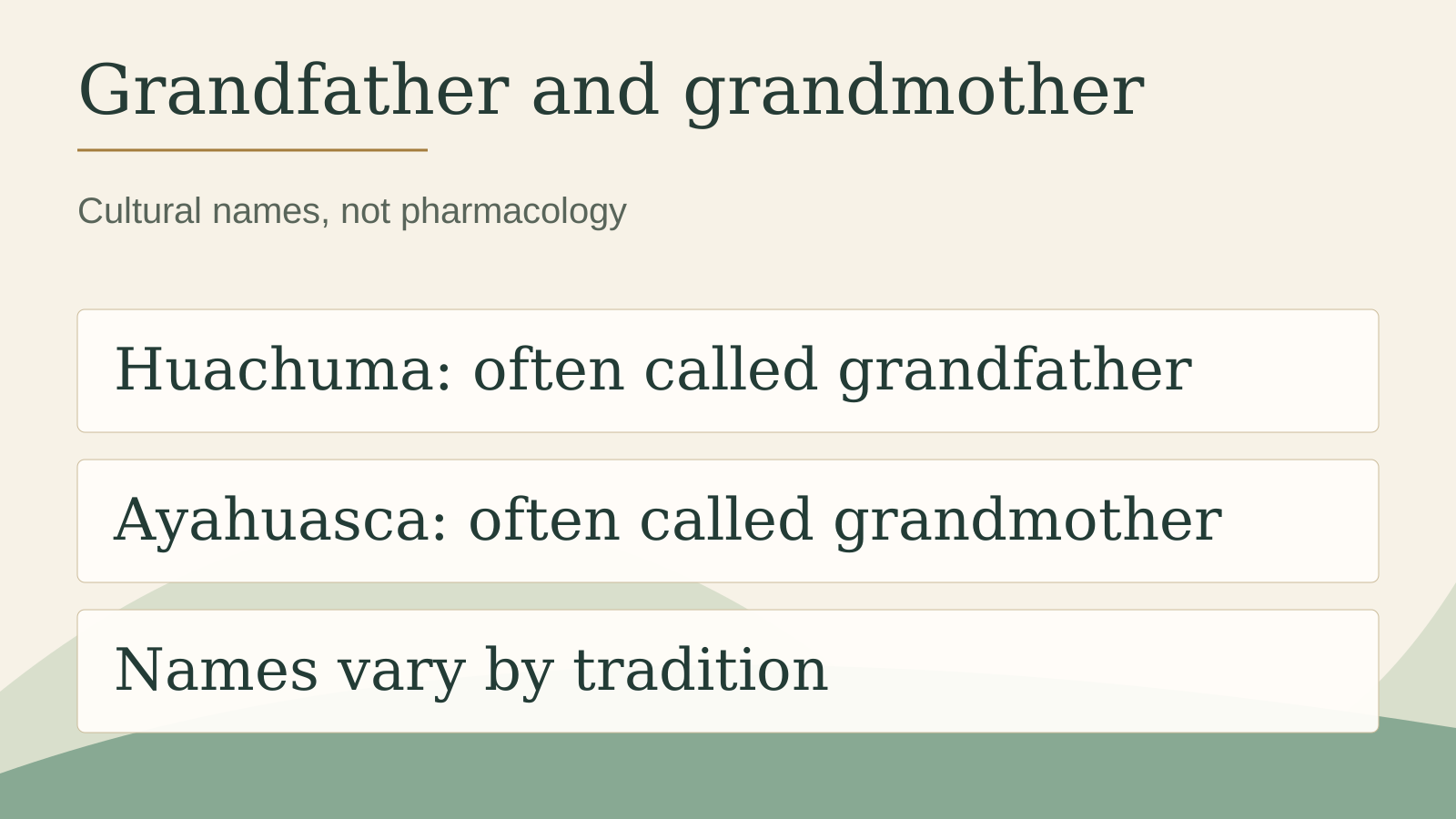
Ayahuasca is commonly called the grandmother, and huachuma is often called the grandfather. Restorativemedicine.org describes huachuma as the grandfather medicine, and The Conversation notes huachuma is often called the grandfather in ceremony circles. These are cultural framings, not pharmacology, and they vary by tradition.
Sources: Gut, Mind Interactions in Psychedelic Healing, Huachuma, the Andean psychedelic cactus, is drawing Western seekers...
How to prepare for a San Pedro ceremony?
Preparation depends on the facilitator, but one published case study documents a common pattern: dietary changes starting 1 to 2 weeks before, eliminating red meat, salt, sugar, dairy, alcohol and recreational drugs including cannabis, plus a 4 to 8 hour fast before the ceremony. Confirm the exact protocol with your facilitator, and confirm screening requirements: operators state mescaline preparations may not suit people with certain heart, blood pressure, psychiatric or medication-related risks. Ask medication and diagnosis questions of a licensed clinician before you commit. Our page on retreat preparation covers the ayahuasca equivalent.
Sources: Gut, Mind Interactions in Psychedelic Healing, Ayahuasca vs San Pedro: Effects, Duration & Safety
How much does a huachuma ceremony or ayahuasca ceremony cost?
Single-ceremony prices vary widely. One operator, Alma Healing Center, lists San Pedro day experiences at $350 solo, $250 each as a couple, or $150 each in groups of three or more, and ayahuasca formats from $200 to $1,000. Multi-day retreats cost more across the market. For a fuller picture, see how much an ayahuasca retreat costs.
Market data helps set expectations: a 2025 study of 298 psychedelic retreat organizations found 73.8 percent offered ayahuasca and 20.1 percent offered San Pedro, making ayahuasca far easier to find. ICEERS estimated at least 232 ayahuasca retreat centers operated in Amazonian countries and Costa Rica in 2019.
Sources: Ayahuasca vs San Pedro (Huachuma): Which to Choose, A landscape analysis of psychedelic retreat organizations advertising..., Ayahuasca Tourism In-Depth: Revealing the Who, How, and Where, Huachuma and Ayahuasca: Different Medicines, Different Approaches
Is it illegal to own a San Pedro cactus?
In the United States, mescaline is a Schedule I controlled substance, but the San Pedro cactus itself is legal to grow for ornamental purposes, not for consumption. Wikipedia states this is also the case in Australia, Canada, Sweden, Germany and New Zealand, while Switzerland considers San Pedro illegal. Internationally, mescaline is in Schedule I of the 1971 Vienna Convention, but the cactus itself is not on the list of scheduled substances and regulation depends on each country. This is general information, not legal advice; confirm current law where you live.
Sources: Huachuma, the Andean psychedelic cactus, is drawing Western seekers..., Echinopsis pachanoi, San Pedro: Basic Info, Mescaline
Is San Pedro or ayahuasca better for a first ceremony?
There is no evidence that one is better, and we do not recommend either. One tour operator, PumAdventures, states San Pedro is often more suitable for first-time participants, while ayahuasca suits people with prior inner-work experience; that is the operator's view, not established evidence. A safer approach is to compare screening, facilitator training, group size and medical protocols at specific centers. Use our guide to choosing a retreat and the questions to ask a provider.
Some people do both on one trip. Alma Healing Center advises space between the two medicines and time for integration if doing both.
Sources: Ayahuasca vs San Pedro (Wachuma), Ayahuasca Tourism In-Depth: Revealing the Who, How, and Where, Ayahuasca vs San Pedro (Huachuma): Which to Choose
What should you do next?
- Write down what you want from a ceremony and any medical or psychiatric history you would disclose in screening.
- Ask any center you consider about facilitator lineage, screening criteria, group size, emergency protocols and refund terms.
- Talk to a licensed clinician about medications, heart conditions or psychiatric history before either medicine.
- Compare the total trip cost rather than the ceremony fee alone with the retreat budget worksheet.
- Read reviews critically using our review reading guide.
Sources: Ayahuasca Tourism In-Depth: Revealing the Who, How, and Where, Ayahuasca vs San Pedro: Effects, Duration & Safety
What else should you ask?
Do SSRIs interact with ayahuasca or San Pedro?
SSRIs interact dangerously with ayahuasca because its harmala alkaloids inhibit MAO-A, and the medical literature lists serotonin syndrome risk with SSRIs, MDMA and dextromethorphan. San Pedro contains no MAO inhibitors, but medications and psychiatric history still require screening. Ask a licensed clinician.
Is purging as common with San Pedro as with ayahuasca?
No, purging is more strongly associated with ayahuasca, where Wikipedia lists nausea, vomiting and diarrhea as common short-term effects. ICEERS states the San Pedro decoction can also produce vomiting and diarrhea, and PumAdventures describes San Pedro nausea as typically milder.
Why does San Pedro last longer than ayahuasca?
They are different compounds. Mescaline is a phenethylamine whose effects lasted about 11 hours on average in one controlled trial. Ayahuasca's DMT produces a 4 to 6 hour experience once the vine's harmala alkaloids inhibit MAO-A and make it orally active.
Is San Pedro legal like ayahuasca in the United States?
Mescaline and DMT-containing preparations are both Schedule I federally, so neither is legal to consume in the U.S. The San Pedro cactus itself is legal to grow, and ICEERS notes the ayahuasca plants B. caapi and P. viridis are likewise legal to grow, buy and sell but illegal to prepare and consume. This is general information, not legal advice.
Is huachuma a psychedelic?
Yes. Its main compound, mescaline, produced dose-dependent psychedelic effects mediated through the 5-HT2A receptor in controlled human research published in 2024. Effects lasted roughly 6 to 14 hours depending on dose.
What is huachuma good for?
Traditionally, Andean healers use the San Pedro mesa ritual to heal someone for whom normal treatment has not worked, among other purposes. One published case study of a single patient found depression and connectedness scores improved after a huachuma ceremony, but that is one person and proves nothing in general. It is not a substitute for medical care.
How long does huachuma last?
Operators state 8 to 12 hours. A 2024 controlled trial found acute mescaline effects averaged about 11 hours, ranging from roughly 6 to 14 hours by dose. Onset is gradual, often 45 to 90 minutes.
Is San Pedro the same as huachuma?
Yes. San Pedro, huachuma, wachuma, achuma and aguacolla all name the same cactus, Echinopsis pachanoi.
What is the difference between ayahuasca and San Pedro?
Ayahuasca is an Amazonian two-plant brew whose effect comes from DMT plus vine MAOIs, taken at night and lasting 4 to 6 hours. San Pedro is a single Andean cactus containing mescaline, taken by day and lasting about 8 to 12 hours.
Is San Pedro like ayahuasca?
They overlap as ceremony-based psychedelics but differ in chemistry and format. Ayahuasca is night-based, inward and purgative for most users, while San Pedro is a long daytime experience often held outdoors, per operator summaries and participant accounts.
What to expect in a San Pedro ceremony?
A morning start, a bitter tea, gradual onset over one to two hours, and a long day outdoors with a curandero and assistant supervising a group. One documented ceremony ran from 8:30 AM with seven attendees.
Is ayahuasca grandmother or grandfather?
Ayahuasca is commonly called the grandmother, while huachuma (San Pedro) is often called the grandfather in ceremony circles. These are cultural framings that vary by tradition and have no pharmacological meaning.
How much does a huachuma ceremony cost?
One operator lists $350 solo, $250 each as a couple, or $150 each in groups of three or more for a San Pedro day experience. Prices vary by country and operator, so confirm what is included.
How much does an ayahuasca ceremony cost?
Single ceremonies at one operator run from $200 to $1,000. In a 2025 study, retreats longer than two weeks averaged $7,179, ranging from $850 to $150,000.
Is it illegal to own a San Pedro cactus?
In the U.S., mescaline is Schedule I but the cactus is legal to grow for ornamental purposes, not consumption. Switzerland considers San Pedro illegal. This is general information, not legal advice.
Is San Pedro endangered like peyote?
No. ICEERS states that unlike peyote, San Pedro grows rapidly, is not an endangered species, and self-cultivation is much easier. Ethical growers replant a cutting for every arm harvested.
Can you do San Pedro and ayahuasca on the same trip?
Some people do. Alma Healing Center advises space between the two medicines and time for integration if doing both on one trip. Confirm spacing and screening with your provider.
Where is huachuma used traditionally?
In Andean medicine by groups in Peru and Ecuador, such as the Saraguro, a Kichwa people in Ecuador whose plant healers are called Yachakkuna. Peru declared traditional San Pedro use in northern Peru cultural heritage in 2022.
Where does this guidance come from?
- Gut, Mind Interactions in Psychedelic HealingChecked November 15, 2026.
- New Insights into the Chemical Composition of Ayahuasca - PMCOfficial government source, checked November 15, 2026.
- San Pedro vs Ayahuasca: Key Differences, and EffectsChecked November 15, 2026.
- Ayahuasca vs San Pedro (Wachuma)Checked November 15, 2026.
- Huachuma, the Andean psychedelic cactus, is drawing Western seekers and raising ethical questionsChecked November 15, 2026.
- San Pedro: Basic InfoChecked November 15, 2026.
- Echinopsis pachanoiChecked November 15, 2026.
- San Pedro: Basic InfoChecked November 15, 2026.
- Ayahuasca vs San Pedro (Huachuma): Which to ChooseChecked November 15, 2026.
- Ayahuasca - Alcohol and Drug FoundationChecked November 15, 2026.
- Ayahuasca Therapy Information- UC Berkeley BCSPChecked November 15, 2026.
- Huachuma and Ayahuasca: Different Medicines, Different ApproachesChecked November 15, 2026.
- Mescaline - Alcohol and Drug FoundationChecked November 15, 2026.
- Ayahuasca and Dimethyltryptamine Adverse Events and Toxicity Analysis: A Systematic Thematic Review - PMCOfficial government source, checked November 15, 2026.
- PeruChecked November 15, 2026.
- AyahuascaChecked November 15, 2026.
- Ayahuasca vs San Pedro: Effects, Duration & SafetyChecked November 15, 2026.
- Ayahuasca: What It Is and RisksChecked November 15, 2026.
- Ayahuasca: pharmacology, safety, and therapeutic effects - PMCOfficial government source, checked November 15, 2026.
- MescalineChecked November 15, 2026.
- A landscape analysis of psychedelic retreat organizations advertising online - PMCOfficial government source, checked November 15, 2026.
- Ayahuasca Tourism In-Depth: Revealing the Who, How, and WhereChecked November 15, 2026.
- Ayahuasca: An ancient sacrament for treatment of contemporary psychiatric illness? - PMCOfficial government source, checked November 15, 2026.
- United States of AmericaChecked November 15, 2026.
Read our editorial standards and the risk and screening guide.