Home › Sacred Valley & Beyond › Maca and Cacao Drinks: Ingredients, Origin and Unsweetened Choices
Maca and Cacao Drinks: Ingredients, Origin and Unsweetened Choices
The short answer
Explore maca and cacao as ingredients in drinks whose preparation you actually enjoy. Ask about sweetness, milk, alcohol, provenance and the amount served. Official Peruvian product sources include maca and cacao, while clinical research does not justify promising fertility benefits from a restaurant maca drink. A pairing can be sophisticated without an exaggerated health claim.

On this page
- How should you choose the drink you want?
- What should you ask about a maca drink?
- Does maca improve fertility?
- How do you give cacao a thoughtful place in the stay?
- What can coffee and cacao reveal about a producer?
- What makes a beverage pairing interesting?
- Honey: flavor before a fertility story
- How should you explain sweetness and ingredient preferences?
- A warm cup or a composed evening drink?
- Plan a tasting without overloading the day
- How can food fit into a broader Valley stay?
- Sources
- Continue exploring the table
- Frequently asked questions
A cacao drink can be a quiet afternoon appointment; a composed nonalcoholic pairing can give dinner its own rhythm. Maca, coffee and local fruit offer other questions for the host: origin, preparation, sweetness and what the drink is meant to accompany. Choose the cup for its flavor and occasion. The ingredient story is more interesting when it leads back to what you are served.
This guide helps you discuss the cup, preparation and pairing. Use the Valley dining guide to choose the appointment and the Quillabamba extension guide if coffee and cacao origins are part of your route.
How should you choose the drink you want?
Choose the moment first: an afternoon cup, a savory meal pairing, a longer culinary experience or a nonalcoholic drink with dinner. Then ask what the venue actually offers. A product's place in Peruvian agriculture does not establish a universally available restaurant recipe or a particular serving style.
The official Super Foods Peru list includes maca and cacao. It places them in a promotional category, rather than certifying every health effect attributed to them. This guide focuses on ingredients, preparation and provenance, keeping clinical claims separate from the pleasure of a well-made beverage.
What should you ask about a maca drink?
Ask whether maca is part of a freshly prepared drink, a packaged product or another format. Request the full ingredient list when it matters: milk or another base, sweetener, flavorings and any other additions. There is no single recipe established by the product list, and the word maca does not describe the entire cup.
If the menu uses phrases such as energy, hormonal balance or fertility, ask what specifically is being claimed. This guide does not turn those phrases into proven effects. A drink can be appreciated for its preparation without being described as a treatment, and a culinary amount should not be equated with a research supplement.
Does maca improve fertility?
A randomized study in infertile men discussed a particular maca intervention over sixteen weeks. Its findings do not establish a reliable fertility benefit that can be promised to travelers. That study concerns a defined research setting, not the effect of a restaurant beverage on every person who drinks it.
Do not present a maca drink as a substitute for fertility care or infer a dose from the name on a menu. Questions about supplements, medication interactions or a personal condition belong with a qualified clinician. This article supplies no treatment regimen or promise about hormones, libido or pregnancy outcomes.
How do you give cacao a thoughtful place in the stay?
Ask about the cacao's origin and the form used in the drink. A prepared beverage can include different proportions of cacao, milk, sugar and other ingredients. If you prefer no added sugar, honey or syrup, ask whether the venue can prepare the cup that way and whether the cacao base is already sweetened. Confirm your preferred milk or water base as well; the recipe may not be adjustable.
The ingredient's quality is best discussed through the actual product and preparation. A high cacao percentage alone does not describe the flavor or the complete beverage. Ask about the maker, growing area and any added ingredients. This guide does not claim that a cacao drink has a demonstrated cardiovascular, fertility or detoxification effect.

What can coffee and cacao reveal about a producer?
The MINCETUR inventory for COCLA identifies coffee, cacao, tea and honey in the cooperative's activities. It provides a verified starting point for asking about the Quillabamba production context. It does not establish that a visitor tasting or processing demonstration is operating at every moment.
If you want to go beyond a restaurant drink, arrange a named host and the actual visitor format. Ask whether the appointment involves finished products, processing or a growing area. The Quillabamba coffee and cacao guide treats that as a separate extension, with accommodation and transfers kept clear.
What makes a beverage pairing interesting?
MIL's Botanical Path gives beverages a role within a wider immersion and tasting experience. It provides a first-party example of a dining format in which the drink can be part of the explanation rather than an afterthought. Ask what pairing is offered in your actual reservation.
If you want an alcohol-free experience, request the current alternative and its inclusion or supplement. This guide does not guarantee that every pairing contains maca, cacao or the same ingredients on every date. A thoughtful pairing responds to the actual food and format; the ingredient names alone do not establish the quality of the combination.
Honey: flavor before a fertility story
COCLA's official inventory includes honey. That supports a conversation about a regional product and its origin, not a medical effect. Ask for the producer, ingredient label and the story behind the actual jar or serving. Honey can contribute flavor to a drink without needing an aphrodisiac claim.
If a honey is sold with a fertility claim, obtain the product's exact name and the evidence offered for that claim. A story about a local tradition is different from a clinical finding about an identified preparation. If you prefer an unsweetened drink, ask for honey to be omitted and confirm whether it has already been mixed into the base. Its regional story does not make it a necessary addition.
How should you explain sweetness and ingredient preferences?
Ask how sweet the drink is prepared and whether the portion is adjustable. A concentrated tasting, a full cup and a beverage served alongside a meal are different experiences. This article does not calculate nutrition for an unknown recipe or presume that a promotional superfood ingredient makes every sweetened drink suitable for every diet.
State allergies, restrictions and preferences before the drink is prepared. Ask about the base and additions, not only the ingredient featured in the title. The provider's actual response matters more than the broad product category. When a personal dietary question is medical, seek individual guidance rather than relying on a travel article.
A warm cup or a composed evening drink?
Either can be a refined choice when its preparation suits the setting. A warm cacao may belong after an outdoor visit; a carefully served nonalcoholic pairing may suit a longer dinner. Those are suggested occasions, not verified venue menus. Confirm what the restaurant currently makes and how it can accommodate your preferences.
The elegance can come from a well-chosen vessel, attentive service and a host who explains the ingredient well. Notice the drink before reaching for a second cup: its aroma, sweetness, temperature and the food beside it. Ask for a smaller tasting or a preparation without added sugar if that is how you would most enjoy the occasion.

Plan a tasting without overloading the day
| Interest | Ask for | Keep distinct |
|---|---|---|
| Maca drink | Full preparation and ingredients | Culinary beverage versus research supplement |
| Cacao | Origin, maker, sweetness and base | Flavor interest versus medical promise |
| Coffee | Actual lot, preparation and producer | Restaurant cup versus farm appointment |
| Pairing | Current format and alcohol-free alternative | Provider offer versus assumed inclusion |
| Honey | Identified product and origin | Traditional story versus clinical evidence |
Choose one experience that particularly interests you and give it time. A series of hurried tastings can obscure the differences you wanted to notice. If the drink is part of a larger meal, use the Sacred Valley dining comparison to settle the format first.
Related regional drink choices
For a bright fruit accent, explore aguaje and aguajina or camu camu drinks and pairings. For a breakfast choice, compare coconut water with green vegetable juice and blended greens. The individual guides explain format, ingredients and what to ask before choosing.
Coca tea deserves a separate decision. Its guide covers the leaf infusion, the limits of altitude claims, drug-test evidence and U.S. import considerations. Read it before choosing or packing a coca product.
How can food fit into a broader Valley stay?
Leave room for a meal and a conversation without expecting a particular ingredient to be in stock. This publication is connected to Florian Rolke and The SoulSearching Experience, a five-day Sacred Valley seminar for 8-15 participants with no plant medicine. The retreat planning guide explains how that stay may fit around Machu Picchu. Specific meals, tastings and cooking activities remain unconfirmed inclusions; the food choices here are independent travel interests.
Maca in a savory sauce
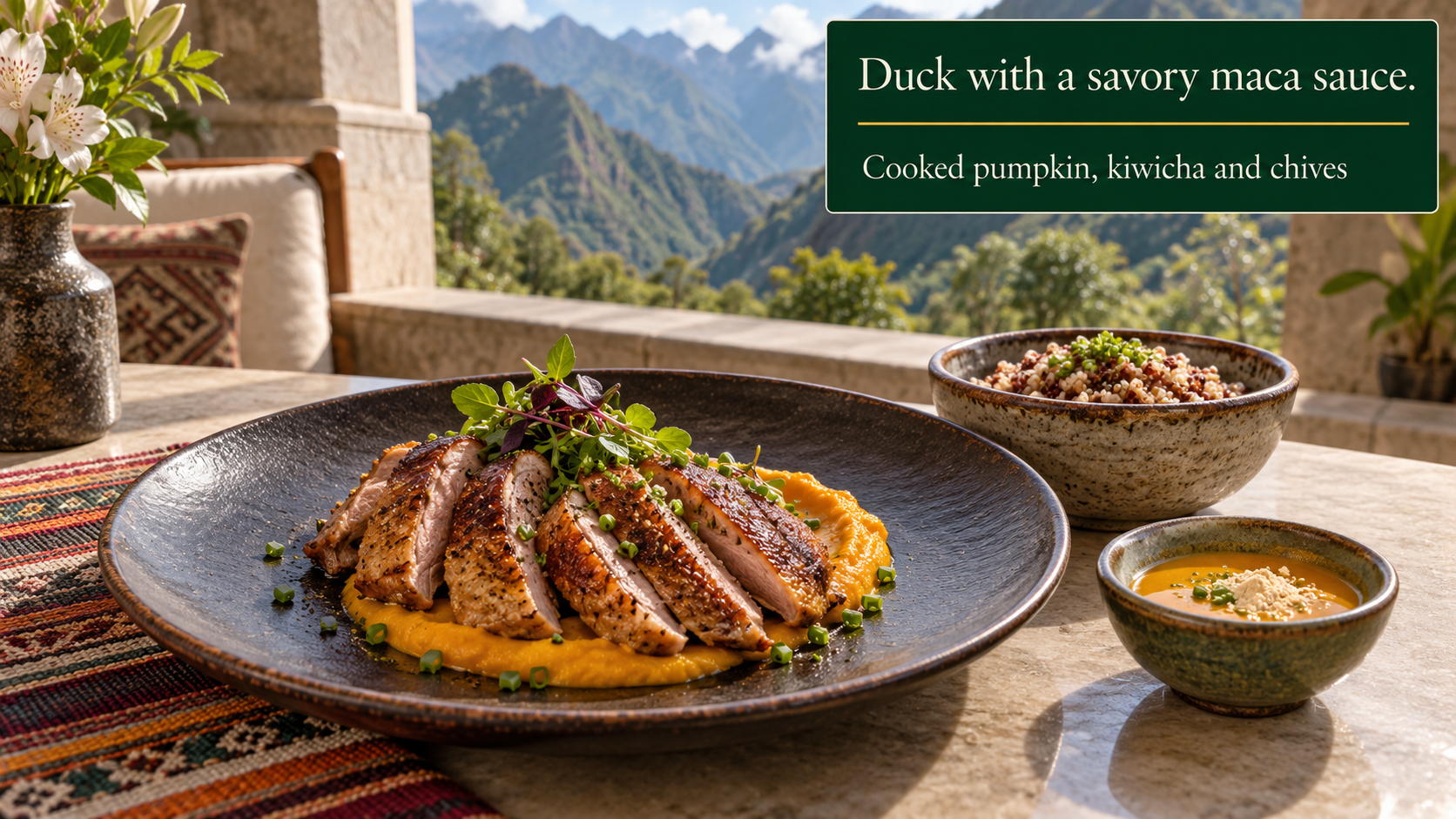
Maca flour can add food energy and fiber
Food-grade maca flour can contribute energy and dietary fiber as well as flavor to a savory sauce. INS lists 328 calories, 8.7 grams of protein and 8.6 grams of fiber per 100 grams of maca flour. Carbohydrate supplies fuel for the body, while dietary fiber helps support regular bowel movements. A little flour distributed through a sauce contributes a correspondingly modest amount. That gives maca a straightforward nutritional role as part of the recipe, with the chicken, fish or legume course supplying the meal's more substantial protein portion.
Maca can enter a savory conversation
A maca drink is only one way to think about this food. A small amount of food-grade maca flour could also be considered within a savory sauce, where the cook can judge the flavor and consistency. That is a contemporary serving proposal, not a claim that maca sauce is an established Sacred Valley classic or a confirmed hotel specialty.
A savory maca sauce could be offered beside roast chicken, with cooked quinoa and tender vegetables. It should taste like a considered part of the meal rather than a supplement added for its label. The kitchen would need to develop the recipe, identify its maca product and confirm the final preparation before presenting it as something guests can order.
Name the product before describing what it does
PROMPERU's export profile distinguishes the edible maca hypocotyl from processed flour and describes a flour made from roasted, milled material. Commercial products may use other processing terms. Those names should remain attached to the actual package; fresh maca, roasted flour, gelatinized powder and concentrated extract are not interchangeable descriptions of one preparation.
Ask which food-grade product goes into a sauce or beverage and whether it contains other ingredients. A pure flour is different from a sweetened drink mix. Likewise, an extract capsule is not a culinary ingredient simply because it carries the same plant name. The host can give a more useful answer by showing the product description than by repeating a broad energy claim.
A sauce should be judged beside the food it accompanies
One imagined serving uses a little maca flour within a pale, savory vegetable sauce for chicken. Another places a small bowl of sauce beside roasted squash and quinoa, so the guest can compare the food with and without it. These are exploratory dining ideas. Neither is a tested measured recipe, and no particular quantity is established here.
Ask the cook how the maca is incorporated and what else makes up the sauce. Dairy, nuts, stock, starch and seasoning may matter more to your dietary choice than the featured ingredient. If you prefer a preparation without added sweetener, say so explicitly and confirm that the base mixture has not already been sweetened.
Food composition does not assign a supplement dose to dinner
INS includes maca flour as a distinct entry in its food-composition tables. The values describe a weight of flour. They do not describe the contribution from an unspecified spoonful diluted across several portions of sauce, and they do not establish a treatment amount. The full dish also contains its other ingredients and its actual serving size.
Maca flour can be discussed as food that contributes energy and nutrients. A small sauce portion should not be introduced as a high-protein meal in its own right. If the desired dinner includes substantial protein, discuss the actual main course, such as fish, chicken or a suitable legume preparation, rather than expecting a minor sauce ingredient to supply it.
Keep fertility research separate from culinary pleasure
A published randomized trial in infertile men studied a defined maca intervention over sixteen weeks. That research setting cannot be translated into a promise that a restaurant drink or sauce improves fertility. The food form, amount, participants and outcome measured all matter when interpreting a study. A culinary serving is not the same intervention.
The same boundary applies to claims about hormone balance, libido or exercise performance. The pleasure of a warm drink or a carefully made sauce does not require those claims. If a product is promoted as a supplement, ask about that exact product and discuss personal treatment questions with an appropriate clinician. A dining guide cannot turn an unmeasured recipe into a medical regimen.
The growing plant has a quieter form than the product display
Maca belongs to the mustard family, Brassicaceae. Its edible swollen hypocotyl sits at the base of the plant, connected to a low leafy rosette, rather than hanging like fruit from a tall decorative stalk. A food portrait should distinguish the harvested edible part from a bowl of flour. Each tells a different part of the ingredient's story.
For a dining illustration, let the prepared sauce lead, with a small separate ingredient study if helpful. An imagined garden view should show a low plant and the edible part at soil level, without suggesting that a hotel actually grows maca. The actual origin and processor belong in the host's sourcing explanation, where they can be checked.
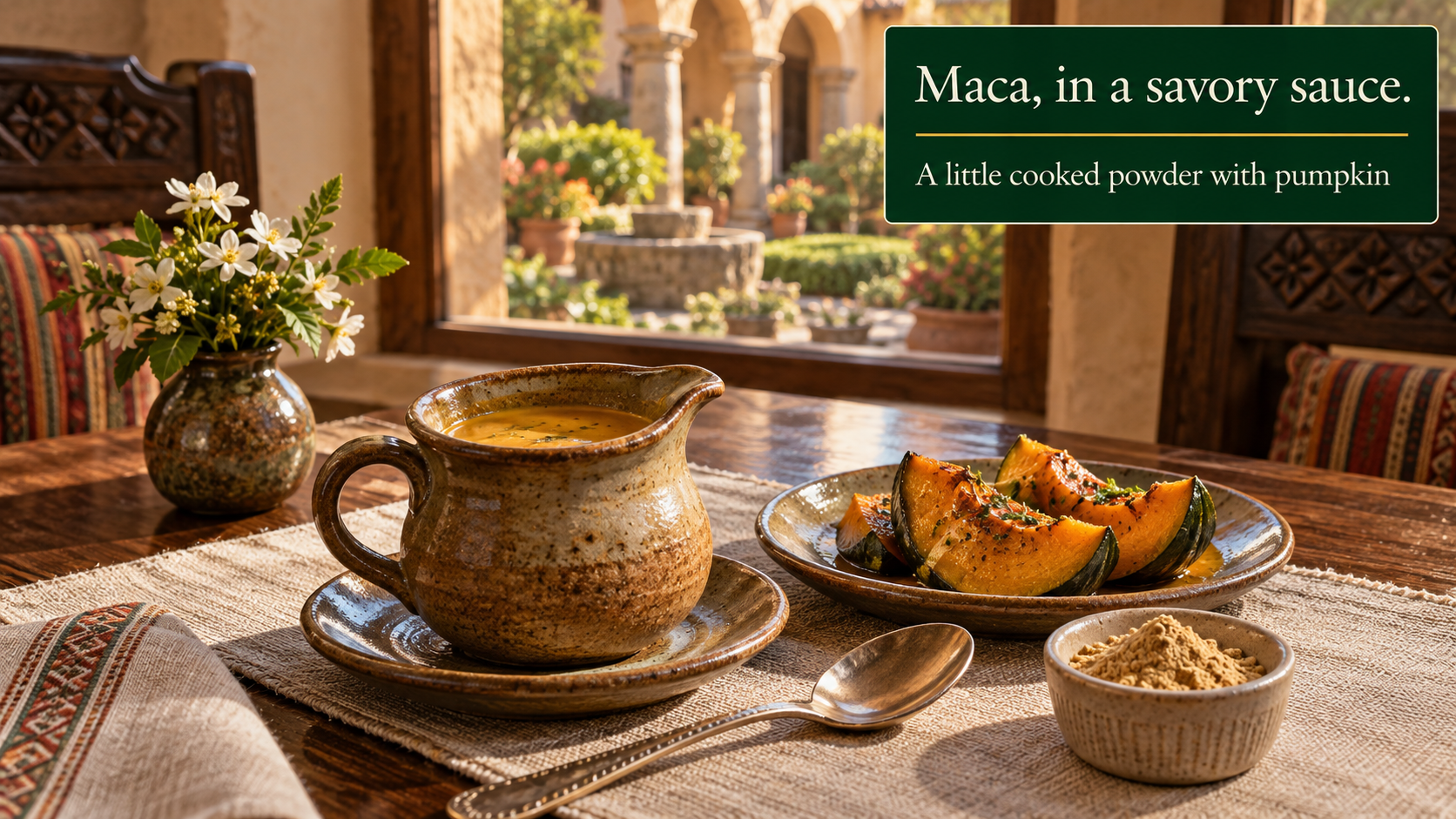
Prepared-food and plant illustrations. No current restaurant dish, harvest or seminar inclusion is established.
Sources
The official Peruvian product list and cooperative inventory support ingredient and production context. The cited maca trial addresses a defined research intervention, not the effect of a restaurant drink. Published product descriptions and recipes remain identified examples rather than universal cafe formulations.
Continue exploring the table
Compare noni juice forms, ingredients and evidence. Choose the ingredient or preparation that interests you, and use its guide for the details before ordering.
Frequently Asked Questions
Does maca really balance hormones?
No such universal effect is established by the product list or the fertility study used here. Avoid turning a menu slogan into a demonstrated outcome. Enjoy an identified beverage for its preparation, and obtain individual medical guidance if the claim relates to a condition or treatment.
Sources: Official Super Foods Peru product list; Maca trial in infertile men.
What should you look for when buying honey?
Ask for the producer, product name, origin and ingredient label. The official COCLA inventory includes honey among its regional products, without establishing a fertility effect. If a seller makes a medical claim, request evidence for that identified product and keep it separate from its culinary appeal.
Sources: COCLA cooperative tourism inventory.
What are the benefits of maca and cacao powder?
Maca and cacao can be explored as culinary ingredients, but a mixed powder or restaurant drink does not come with a demonstrated fertility or hormone benefit. The reviewed maca trial found insufficient evidence of efficacy for male fertility. Its defined study preparation also cannot validate an unspecified beverage. Ask what is in the drink and choose it for the flavor you enjoy.
Sources: Official Super Foods Peru product list; Maca trial in infertile men.
Does maca make you more fertile?
The reviewed randomized trial found insufficient evidence to establish maca’s efficacy for male fertility. That is not proof that a restaurant maca drink improves fertility, and it does not establish a benefit for women. Choose a beverage for flavor and its confirmed ingredients rather than treating a menu description as a fertility intervention.
Sources: Maca trial in infertile men.
What are the ingredients in chicha morada?
PROMPERU describes chicha morada as a drink made with cooked purple corn, pineapple, cinnamon, and sugar. That gives you a useful starting point when reading a drinks menu. Ask the cafe what goes into its own version, especially if you want to adjust the sweetness. PROMPERU: purple corn and chicha morada
Sources: Chicha.
Can I mix maca powder with coffee?
Yes. The Maca Team describes adding maca powder to brewed coffee as one meaning of maca coffee. Its guide also distinguishes that combination from a maca drink made instead of coffee. Check which version a cafe serves; a drink containing ordinary coffee still contains that coffee's caffeine. The Maca Team: maca coffee
Sources: Maca Coffee.
Does cacao have a bitter taste?
It can. Navitas describes its unsweetened cacao nibs as slightly bitter, with the flavor of unsweetened dark chocolate. That is a useful product example, rather than a promise that every cacao drink tastes the same. For a cafe drink, ask whether it includes sweetener or milk. Navitas Organics: cacao nibs
Sources: Cacao Flavor.
How do I make a cacao latte?
Use the directions for your actual cacao product and chosen base. One published latte example includes added sweetener and sweetened cacao components, so it is not automatically an unsweetened cup. If that is your preference, select an appropriate unsweetened product and ask the kitchen what has already been added. Published product example
Sources: Cacao Latte.
What does Peruvian maca actually taste like?
The Maca Team describes maca as earthy, nutty, or malty, sometimes with a little bitterness or spice depending on the variety and preparation. Treat that as a producer's tasting description. If you are trying it for the first time, ask how the cafe combines it with other ingredients. The Maca Team: the flavor of maca
Sources: Maca Flavor.
What's the difference between chicha morada and chicha de jora?
PROMPERU describes chicha morada as a purple-corn drink prepared with fruit and spices, while chicha de jora uses germinated maize and fermentation and contains alcohol. The shared word chicha does not make them interchangeable. When ordering, name the version you want and ask how that establishment prepares it. PROMPERU: traditional Peruvian drinks
Sources: PROMPERU: traditional Peruvian drinks.
How do I prepare a cacao block for a drink?
Follow the instructions for the cacao block you actually buy; products and bases can differ. Ask whether the block contains sweetener and which ingredients will be added to the cup. A supplier's preparation example does not establish a universal dose or a restaurant recipe. Producer directions
Sources: Cacao Adventures: Tropical Desert cacao block preparation.
How to make maca powder taste better?
A producer describes maca as earthy, nutty or malty, sometimes with bitterness or spice. For a drink, start by asking what else is in the cup: the base, sweetener and flavorings can change the result considerably. If you are ordering at a cafe, ask for a small taste or a preparation you already enjoy rather than choosing it for a promised health effect.
Sources: Maca Flavor.
How to make a maca drink?
Identify the actual maca product, then follow its preparation directions and choose the drink base you want. The producer's latte is a named example, not a required recipe. If you prefer no added sugar, ask about the complete preparation and any sweetened base, and keep culinary use separate from a research supplement. Producer example
Sources: Maca Coffee; Maca trial in infertile men.
Is Chicha Morada a healthy drink?
Its name alone cannot answer that. PROMPERU describes chicha morada made with cooked purple corn, pineapple, cinnamon and sugar, while a cafe may use its own proportions. Ask how sweet the serving is and whether it can be adjusted. This is a useful way to choose a drink you enjoy without assigning a health benefit to an unknown recipe.
Sources: Chicha.
How could camu camu fit into an Andean drinks tasting?
Ask whether the host is serving camu camu fruit, juice or powder. A documented refresco uses fruit juice and water, with sugar optional; powder is a different product. Its tartness can make a small tasting interesting beside sweeter drinks. The camu camu guide explains those formats in more detail.
Sources: Refresco de camu camu; Comunidades amazónicas conservan los bosques aprovechando sosteniblemente el camu camu.
Should I order an extracted juice or a blended drink?
Ask what remains in the glass. Extraction separates juice from much of the pulp, while a whole-produce blend retains the material that is blended unless strained. MedlinePlus notes that fruit juice lacks the fiber of whole fruit. Ask how the kitchen prepares its drink; the green juice guide explores the distinction.
Sources: MedlinePlus: fruit nutrition quiz.
Should I choose coca tea if a drug test is coming up?
Choose another clearly identified beverage if testing matters to you. Controlled studies found positive urine tests for cocaine metabolites after coca tea, but their results do not provide a guaranteed waiting period for every product or person. The coca tea guide covers the evidence and travel considerations before you order or pack it.
Sources: coca assay 2006; coca assay 2020.
Is a beverage pairing included with a Sacred Valley tasting menu?
Ask about the specific reservation. MIL's published Botanical Path pairs a guided experience with eight tasting moments and describes a beverage pairing as optional. That does not establish the pairing's current ingredients, price or inclusion with another meal. Confirm the offer you are booking, including an alcohol-free choice, and use the fine-dining guide to compare meal formats.
Sources: MIL Botanical Path and tasting menu.
What might aguaje add to a fruit-drink tasting?
Aguaje brings a distinct flavor from maca or cacao. INACAL describes its pulp as acidic or sweet-sour, with a texture that may feel smooth or sandy. Ask whether the serving uses plain pulp or a sweetened preparation before judging the fruit itself. The aguaje guide explains its Amazonian origin and other serving formats.
Sources: Aguaje commercialization requirements.
Is alcohol bad for altitude sickness?
If you are choosing drinks soon after arriving at altitude, CDC advises avoiding alcohol during the first 48 hours. Ask for a nonalcoholic pairing if that fits your arrival schedule, and confirm what the reservation includes. A maca, cacao or coca drink is not a substitute for altitude planning. The altitude guide explains how sleeping elevation and ascent affect the wider itinerary.
Sources: High-Altitude Travel and Altitude Illness, Yellow Book 2026.
Put the plan in one place
Save the route, admission time, station names, and transfer details before you book the next part.
Open the trip-planning checklist