Root parsley brings the parsley plant into dinner in a different form. Its pale root makes a distinctive roasted vegetable, while the leaves supply a fresh herbal finish. Pair it with alpaca and quinoa, keeping the root visible and the seasoning restrained enough to show what it contributes. Native potatoes offer a softer companion when a plate calls for another familiar root.
Vegetables at the Andean table
Hamburg Parsley Root with Alpaca and Quinoa
Hamburg Rooted parsley provides an enlarged edible root as well as usable leaves. Roast the cleaned root in even pieces and serve it with properly cooked alpaca, quinoa, and a light herb finish. It is distinct from parsnip and celeriac, although it can occupy a similar place on the plate. A little savory liquid keeps the meal moist without covering the roasted vegetable.
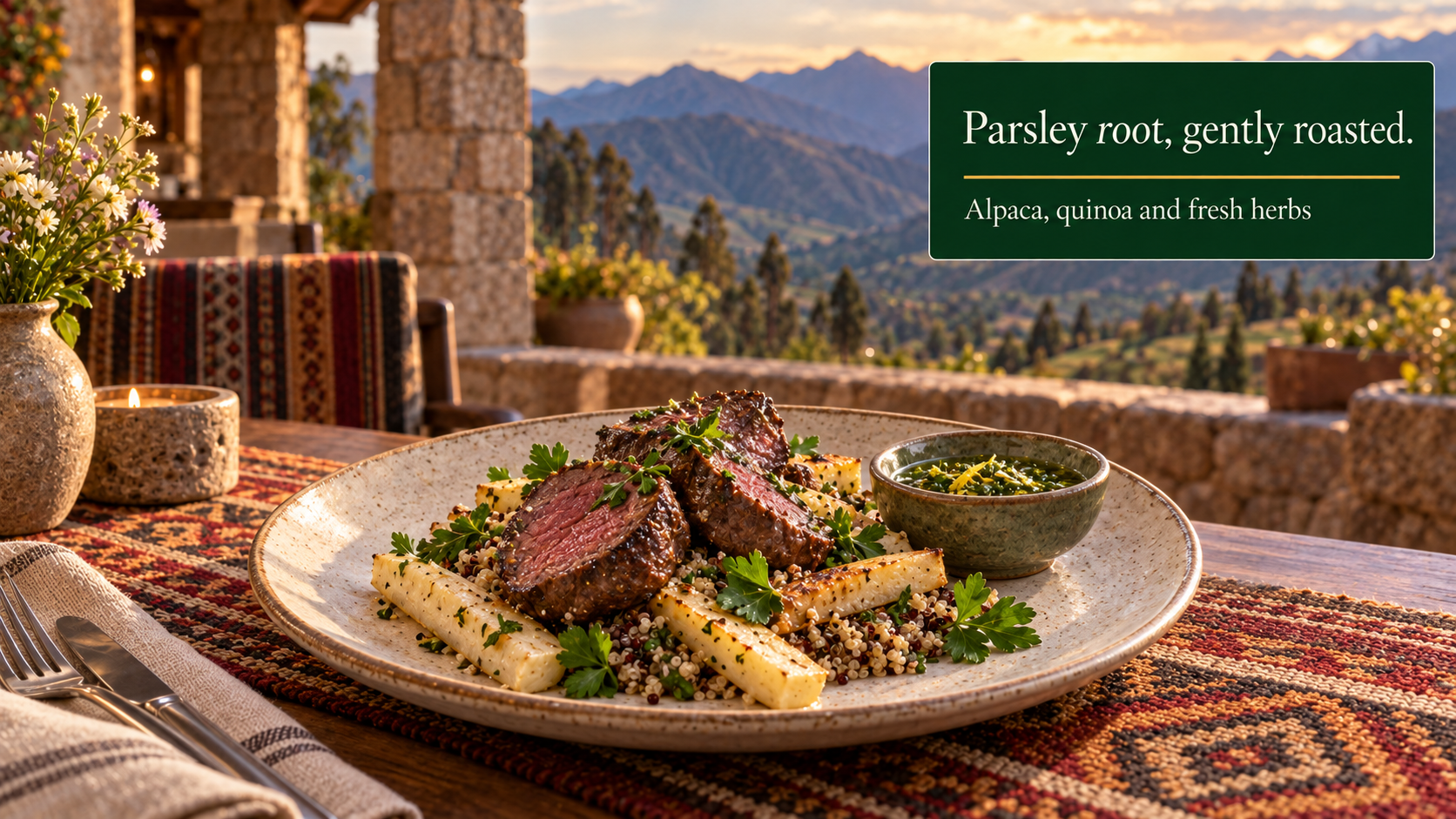
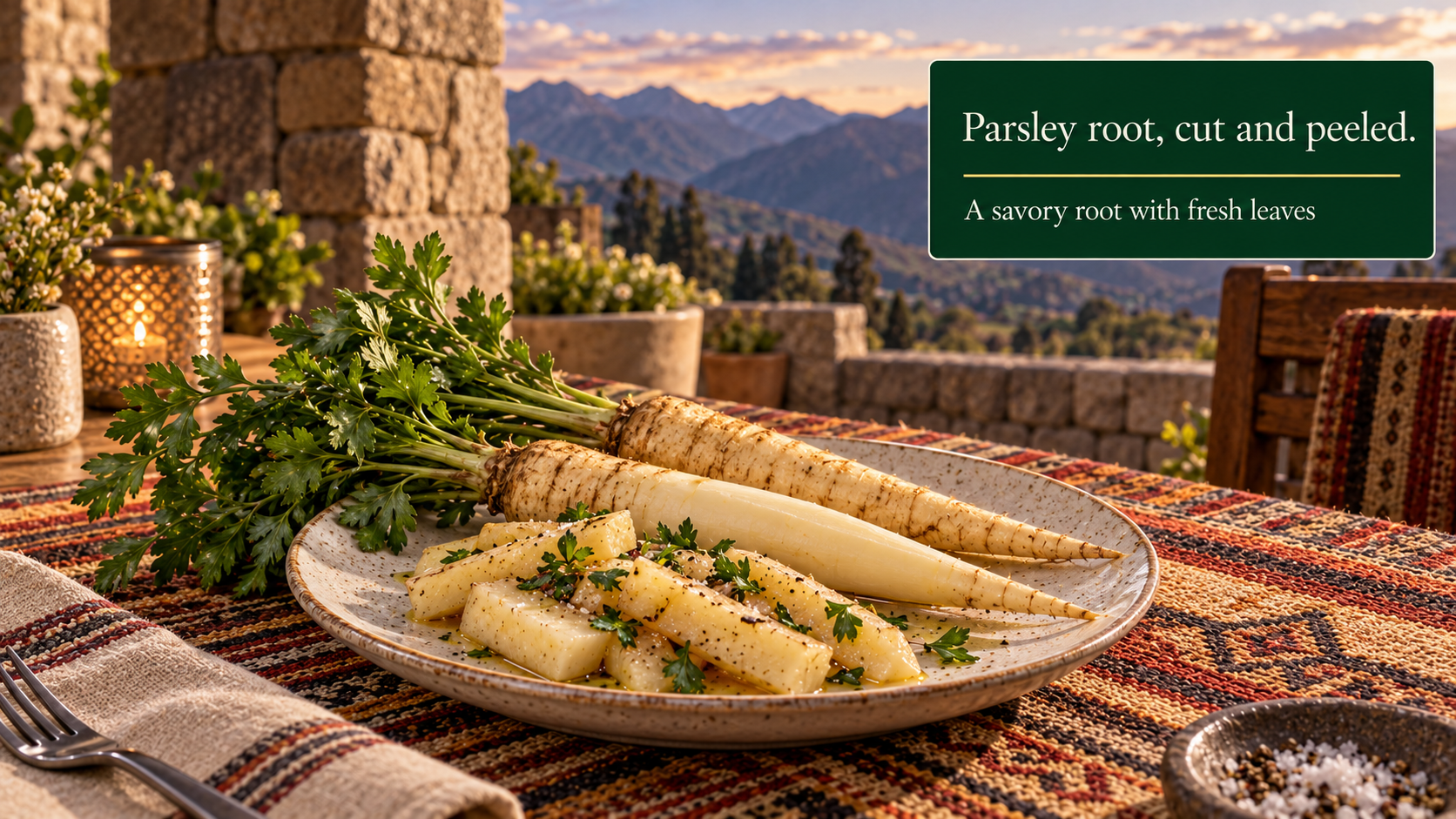
Roasted Hamburg Rooted parsley with alpaca, quinoa, and herbs
Wash and trim roots, cut evenly, and roast until tender with light surface color. Serve with separately cooked alpaca and quinoa; finish with culinary herbs.
An identifiable roasted root gives the plate a distinct vegetable component, while grain and meat retain separate roles.
Variety reference: Eden Brothers: Hamburg Rooted. Heirloom; open pollinated.
Understand what Hamburg Rooted means
Eden Brothers lists Hamburg Rooted as root parsley. Purdue Extension distinguishes Hamburg or turnip-rooted parsley from parsley grown chiefly for foliage: it develops an enlarged edible root. UF/IFAS also notes that the root and leaves are usable. This does not mean that an ordinary bunch of supermarket parsley will provide the same substantial cooking roots.
Root parsley resembles other pale roots, so ask for its name when sourcing it. Parsnip and celeriac are different vegetables. They can offer useful substitutions in a meal, but they should be labeled honestly and will change its flavor and appearance. Do not identify a loose root from a photograph alone or assume that every pale tapered vegetable is Hamburg parsley.
Roasted roots with a tender center
Scrub the roots under running water, trim damaged parts, and peel if the surface or eating quality calls for it. Cut the thicker ends and thinner tips into pieces that can cook evenly. A lengthwise wedge makes the root recognizable; a thick section may need a smaller cut so the center becomes tender before the outside is overdone.
Roast the prepared pieces on a tray with room between them, checking the thicker ones for tenderness. The result to aim for is a cooked root with some surface color and a center that yields easily to a fork. Exact timing depends on size, equipment, and the actual roots. Turn or rearrange pieces if one area of the tray colors faster than another.
Alpaca and quinoa provide the rest of the meal
Place a small bed of cooked quinoa on the plate and add a separately prepared, properly cooked alpaca portion. Arrange the roasted parsley root where its shape remains visible rather than burying it beneath the meat. Add a little appropriate savory cooking liquid if the plate needs moisture. A few chopped parsley leaves can connect the root and herb without making the finish resemble a salad piled over the main dish.
Use lemon or a restrained herb accompaniment at service. If using sacha inchi oil, add a little only as a cold finish after cooking. It does not belong on the roasting tray or in a hot pan here. Taste the meat, root, and grain together before adding a second sauce; the meal already contains several distinct textures.
Change the companion without hiding the root
The same roasted-root idea could sit beside duck and a few native-potato pieces. That creates a richer plate with two recognizable roots rather than a mixed mash. With cuy, a small portion of cooked quinoa and an herb relish can keep the parsley root in a supporting role. With high-altitude Andean trout, use a lighter sauce so the root does not overwhelm the fish.
Each protein changes the balance of the plate. Rich duck welcomes a sharper herb accompaniment; delicate high-altitude Andean trout benefits from a lighter finish. A useful first tasting would compare the root plain, with a little savory liquid, and alongside the protein. That makes it easier to decide whether the seasoning is helping the ingredient or simply covering it.
Soup is a second useful form
UF/IFAS describes cooking the roots in ways similar to carrots. A modest parsley-root soup is therefore a practical alternate direction: cut the cleaned roots evenly, simmer with an appropriate stock, and blend or leave pieces according to the desired meal. Native potato can add body. Add the chopped herb near the end if a fresher leaf flavor is wanted.
For a complete serving, offer a separate cooked high-altitude Andean trout portion or a bowl with suitable cooked legumes and quinoa. Do not turn every leftover roasted piece into the same soup; use only produce that has been handled and stored appropriately. Nor should a soup be sold as a medicinal preparation. Its role is ordinary food with a distinct root and herb flavor.
Make sourcing more precise than appearance
Ask a vegetable supplier for parsley root, Hamburg parsley, or root parsley and confirm what they mean. Naming the Eden cultivar requires more specific records than finding an edible root of the same crop. An ordinary food-grade parsley root can be used for the dish, with the supplier confirming the exact cultivar if it is named. A parsnip substitution should be described as parsnip, even when it looks similar after roasting.
Buy sound produce and keep it separate from raw meat and its utensils during preparation. FDA advice to wash produce before peeling is particularly relevant to soil-grown roots. A clean exterior is the starting point, not proof of a particular farm, an organic production method, or a guaranteed shelf life. The final quality still has to be assessed on the roots actually obtained.
Order by texture, flavor, and appetite
Choose roasted parsley root with alpaca and quinoa when you want a plate with separate textures: tender meat, small grains, and root pieces with some surface color. Choose a parsley-root soup when a smoother, lighter first course is more appealing. With duck, native potatoes make the plate more substantial, so a smaller grain portion may be enough.
When the name is unfamiliar, ask whether the dish uses parsley leaves, parsley root, or both. That is more useful than assuming a parsley soup is green or a pale roasted root is parsnip. A thoughtfully chosen meal adds another layer to a Sacred Valley visit, while the ingredients themselves may come from several different Peruvian growing regions.
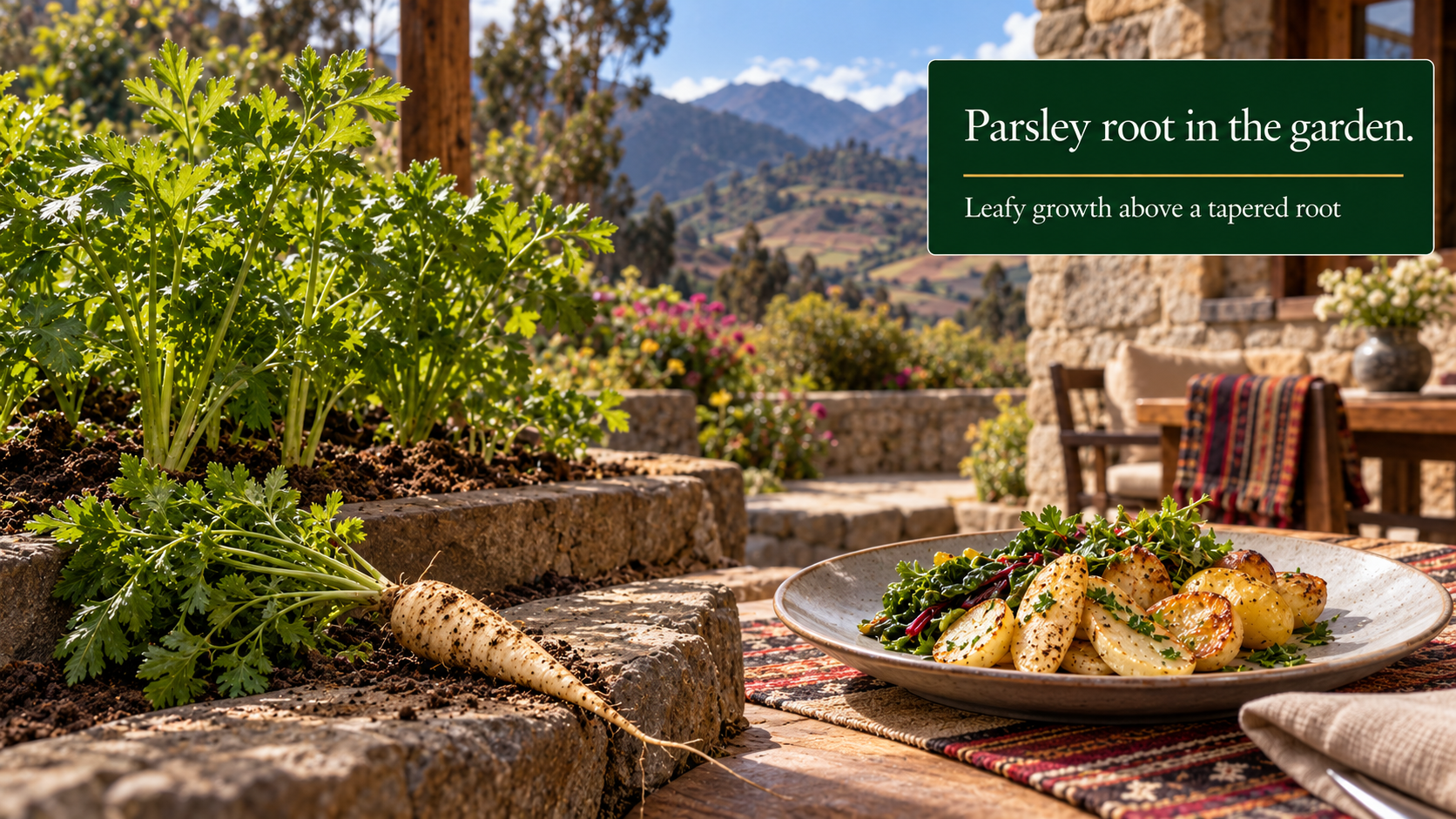
These dishes are serving ideas. Images illustrate the ingredients and preparations; they do not document a restaurant menu, a tested recipe or a current property harvest. The exact Eden Brothers catalog varieties remain research candidates.
Give the Sacred Valley a little more time
A trip built around Machu Picchu can also leave room for a good meal and a less hurried stay. Ask Florian about The SoulSearching Experience, his five-day Sacred Valley seminar for 8-15 participants. Discuss dates, venue and meal arrangements directly as you plan.
Questions readers ask
Is parsley root the same as a small parsnip?
No. Hamburg or root parsley is a parsley type with an enlarged edible root; parsnip is a different vegetable. Both can look pale and tapered. Ask the supplier for the name, and do not use size alone to identify a loose root.
Where should I look for parsley root?
Ask vegetable suppliers for root parsley, Hamburg parsley, or parsley root, then confirm what they sell. Specialty produce sellers may be more useful than searching among bunches of leaf parsley. This does not verify supply in Peru or the availability of the exact Eden cultivar.
What can I make with parsley root?
Roast even pieces and serve them beside alpaca and quinoa, or simmer them into a savory soup. Keep a few pieces plainly seasoned for a first taste. These are proposed meal forms, and the final balance should follow the actual roots obtained.
Can parsley root go into a poultry soup?
Yes. UF/IFAS describes cooking the roots in ways similar to carrots. Add even pieces to an appropriate savory poultry broth and cook until tender. In this food plan, a duck broth is one possible interpretation, with parsley leaves added as an herb finish.
Are the leaves of Hamburg root parsley also edible?
Yes. UF/IFAS describes both the roots and leaves of Hamburg parsley as usable. Wash sound leaves and use them as a culinary herb, for example as a restrained finish on the alpaca and quinoa plate. Their use does not establish that an unidentified root is Hamburg parsley.
Can parsley root take the place of celeriac in soup?
It can be considered as a different root ingredient, but it will not reproduce celeriac exactly. Start with a modest amount and taste the broth. Name the actual vegetable in the finished soup; the similarity of two pale roots does not make their flavors interchangeable.
Could parsley root replace parsnip in a cooked meal?
It can fill a similar root-vegetable position on a plate, but expect a change in flavor. Roast or simmer food-grade parsley root until tender and taste it with the rest of the meal. If making the featured plate, call it parsley root rather than parsnip.
What is a practical way to peel and trim a knobbly root?
Wash first, then use a stable board and remove only the rough or damaged areas needed for good eating quality. For Hamburg parsley, follow the root's shape rather than trying to create a perfect cylinder. Uniform cooking pieces matter more than an ornamental peeled shape.
Must root parsley be parboiled before roasting?
It is an optional method choice, not a requirement of the ingredient. Smaller even pieces can roast directly. For thicker pieces, partial cooking may help the center soften before the surface becomes too dark. Check tenderness and adjust the cut rather than assuming all roots need identical treatment.
Why might roasted root pieces be tough in the center?
Pieces may be too large for the cooking time, or the outside may color before the center softens. Cut thick portions more evenly and check a center with a fork. For the alpaca plate, tenderness is more useful than a dark exterior on a still-firm root.
Can I choose a softer cooked root instead of an oily crisp finish?
Yes. Simmer the cleaned root in a suitable broth until tender, or use it in a savory soup. UF/IFAS describes Hamburg roots as usable in cooked preparations like carrots or parsnips. A soft root beside alpaca and quinoa can be satisfying without a crisp crust.
Can several different vegetables share one roasting tray?
Yes, if their cuts and cooking needs are considered. Keep the tray uncrowded and check each vegetable rather than waiting for one common timer. Roast dense root pieces separately when they need longer, then combine them at serving so tender components do not burn while waiting.
How should quinoa be rinsed for the alpaca and root-parsley plate?
Check whether the package is pre-rinsed. If not, rinse using a fine-mesh strainer and drain before cooking. Utah State explains that washing removes the bitter surface coating. This small step helps keep the grain a pleasant companion to the savory meat and roasted root.
What helps keep quinoa from turning into a wet mound?
Measure the liquid, use a covered simmer, and include an off-heat resting stage instead of continually boiling the grain. Drain the roasted roots before plating if they carry extra liquid. The result should give separate forkfuls of grain, meat, and vegetable rather than a pooled mixture.
Does the quinoa side replace the protein contribution of alpaca?
Not in a one-for-one way. Quinoa contributes protein, but a small side portion supplies less than a full cooked cup. Keep the meal's protein choice deliberate. A vegetarian version can pair the quinoa and root with a suitable cooked legume rather than simply removing the meat.
Can the cooked quinoa be kept for tomorrow?
Refrigerate it promptly rather than leaving it on the counter overnight. Cooked grains are perishable, like other cooked meal components. Store in shallow portions so they cool efficiently, then use appropriate reheating or cold serving. Keeping the root and sauce separate also preserves more serving options.
Can tender parsley stems join the meal, or should only leaves be used?
Tender stems can flavor a broth; Rouxbe specifically suggests parsley stems for stocks, broths, or stews. For a raw finishing sprinkle, choose fine leaves or very finely cut tender material so the plate does not acquire tough strings. Keep root pieces and herb garnish as separate components.
Can dried parsley be used when fresh leaves are unavailable?
It can season the broth, but it will not provide the same fresh leaf texture on top of the plate. Use a modest amount and taste. A clean-looking plate with no garnish is preferable to a heavy scattering of dry herb that overwhelms the root.
Can root-parsley soup be made without a stock cube?
Yes. Use an appropriate vegetable or meat broth, or build a vegetable base and season it deliberately. Choose the liquid according to the meal and dietary preference. Add salt after tasting, particularly when using prepared broth, so the root's flavor stays noticeable.
When should fresh herbs be added to the finished dish?
Add a delicate herb finish near the end or just before serving so its flavor remains distinct. Stronger dried herbs can season a longer-cooked broth earlier. For this plate, a little chopped fresh parsley after cooking connects the root and quinoa without burying them.