Home › Patterns › Self Sabotage
Why do I sabotage myself?
The short answer
You sabotage yourself because the behavior is doing a job. Pulling away, quitting early, and quietly wrecking something that started working all remove you from an exposure you have decided you cannot survive: being seen, being judged, or being cared for without having earned it. Name the job the behavior is doing and it stops looking like weakness and starts looking like a strategy you can retire.
You will recognize this pattern faster from its sentences than from any description of it, so start here.
- "I'd rather live with a known problem than risk the unknowns of trying to solve it."
- "If I start unraveling this thread, I'm afraid of what might come undone."
- "Admitting there's a problem means admitting failure."
- "I'm not worthy of having my problems resolved."
- "I'm avoiding this because I'm scared of the personal growth it might require."
Each of those sentences buys you a few more days without a verdict, and the bill lands on whatever had just started going well.
How the seminar works with the part of you that undoes a good week
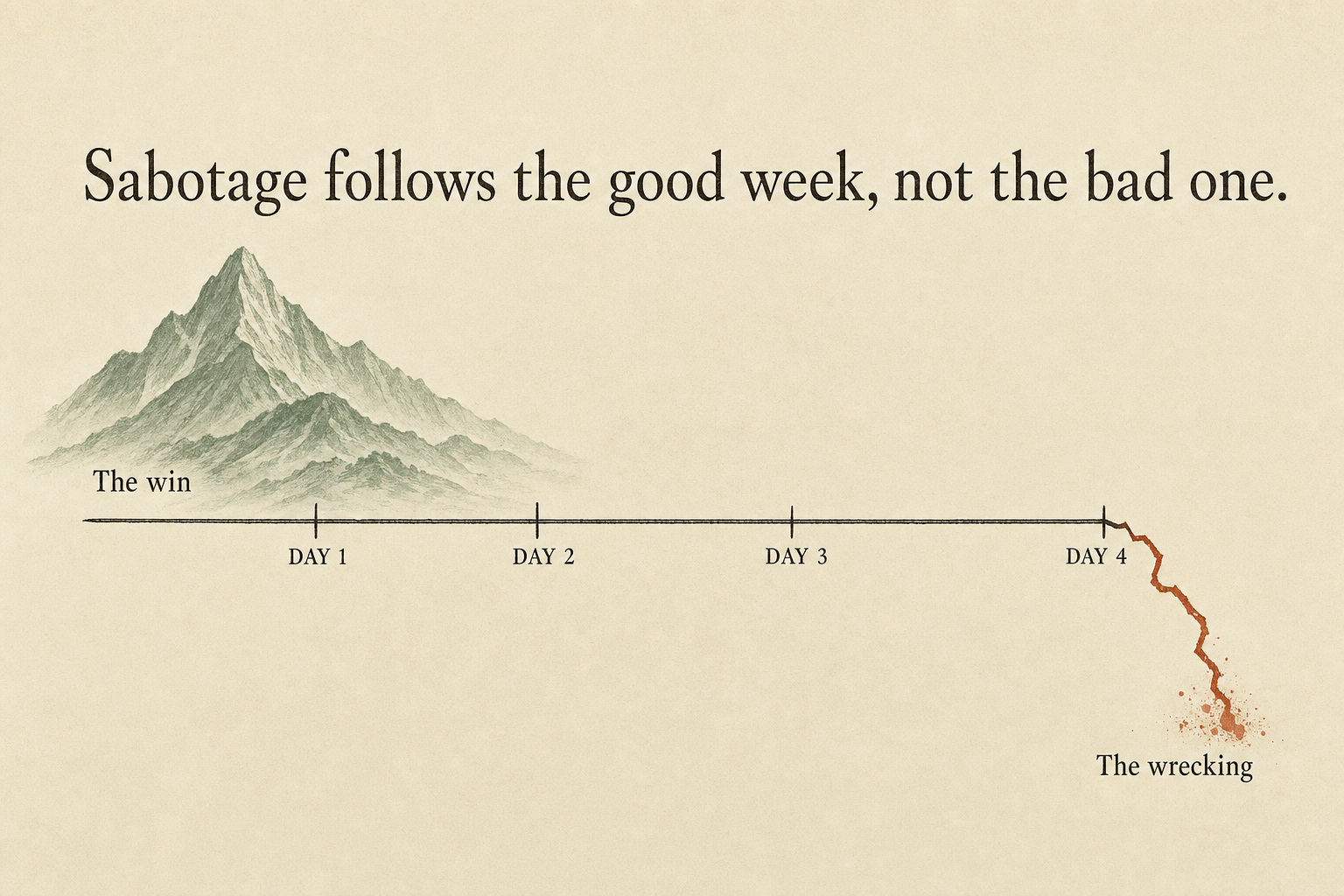
There is a particular week that most people searching this phrase already know by heart. Something goes right. A second date better than the first, an offer, a stretch of work you were genuinely proud of. Somewhere around day four or five you miss the deadline, pick a fight about nothing, drink more than you meant to, or send the message that puts a small crack in the good thing. Nobody made you. You watched yourself do it.
That week is where the whole pattern lives, and it is also the only place it can be changed. Everything below is about what happens inside it.
What Does Self Sabotage Sound Like From the Inside?
It sounds reasonable. That is the first thing worth saying, because almost nobody hears a voice announcing a plan to wreck something good.
The sentences below are the exact lines people run in their own heads, in the phrasing they use when nobody is listening. Avoidance generates a great many of them, and what surprises people who read a list like this for the first time is how little the wording varies from one person to the next. These are the ones that belong to the self-sabotaging version specifically:
- "I'd rather keep things as they are than risk making them worse."
- "I'm scared of failing to resolve the issue, so it's better not to try."
- "It feels safer to just stay in my current state than to risk change."
- "Dealing with this feels like opening a door I can never close again."
- "I'm afraid that trying to solve this problem will only reveal my incompetence."
- "I don't deserve to get help with this issue."
Read them slowly. What matters is the small physical jolt when one of them turns out to be yours word for word, in your own phrasing, with no translation required.
Notice how few of them mention failure as a wish. Every one is a risk calculation, run quietly by a part of you trying to keep something safe. That is why the word sabotage misleads people. From the inside there is no saboteur, only a series of small sensible-feeling decisions that happen to point the same direction.
When Does This Belong With a Professional Rather Than a Practice?
Right here, before any of the practice below, because this boundary matters more than every technique on the page put together.
Some of what gets called self sabotage is dangerous rather than merely costly. If what you do to yourself in the bad weeks involves drinking or using in a way that has started running you, spending or driving or sex that puts you at genuine risk, deliberate harm to your own body, or any thought of ending your life, however quickly it passes through, that belongs with a licensed professional starting now. The same holds alongside a diagnosed condition you are currently managing, or a hopelessness that has not lifted for months.
Practices you run on your own are built for the everyday version of this pattern, the project abandoned at eighty percent and the good relationship you got restless in on purpose. Reaching for help early costs far less than reaching for it after the damage has compounded, and nobody has ever regretted the early version.
What Job Is the Sabotage Actually Doing?
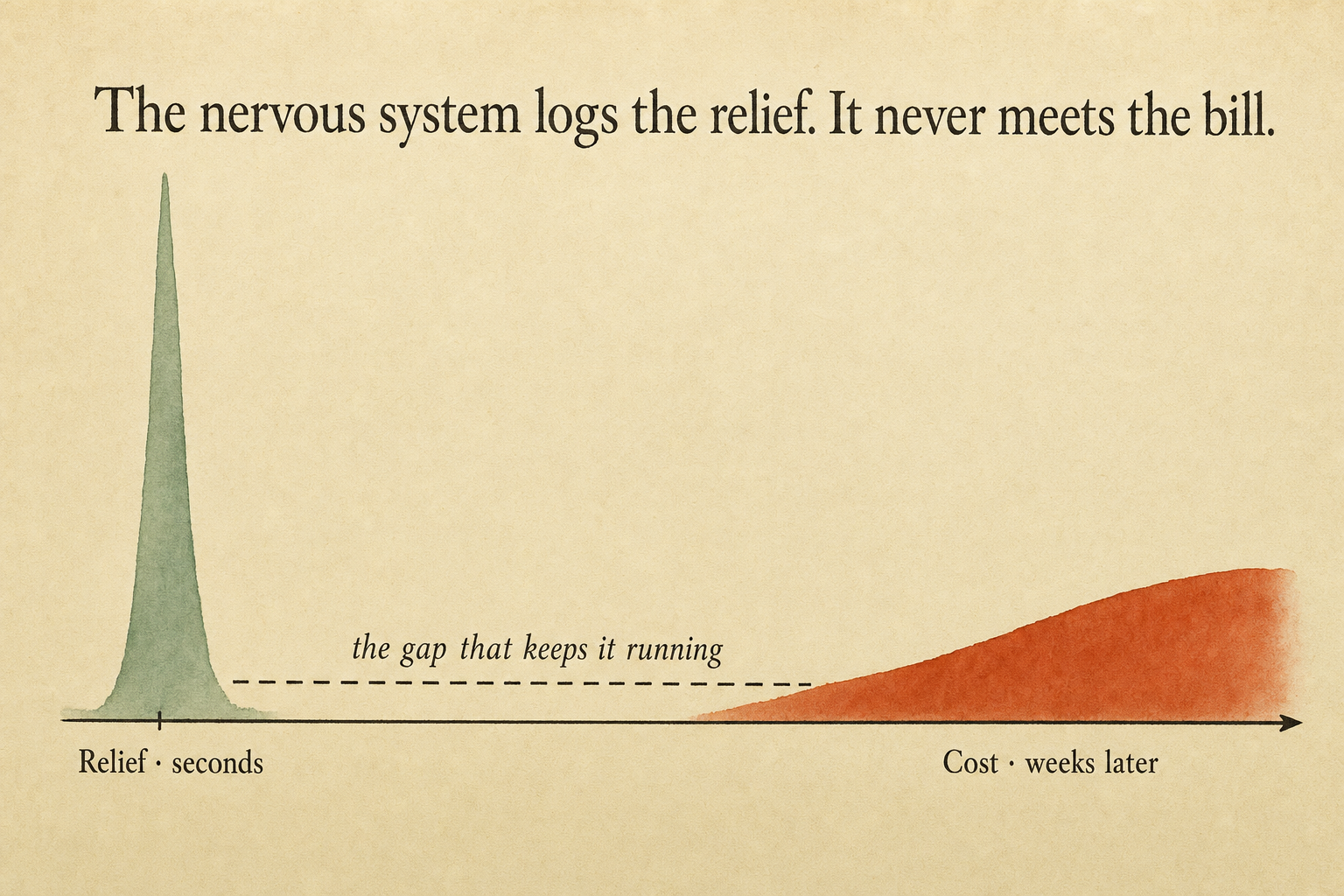
It is buying you an exit from an exposure, and it is buying it within seconds.
Each of these behaviors removes you from a situation where something about you was about to be found out or found wanting. The fear underneath takes one shape more reliably than any other, and that shape is chain reaction. People in this pattern say it in almost identical language: "If I start dealing with this, I'll have to face other issues too." "What if resolving this problem opens up a Pandora's box?" A problem touched refuses to stay a single problem, so the safest number of problems to touch is zero.
Underneath that sits a fear that fits in a single line: the persistent fear that the authentic self is not good enough or worthy of acceptance. While nothing you make is finished, nothing you made can be judged. While nobody is fully let in, nobody can conclude anything about the person they would have met. Sabotage keeps the verdict permanently pending, and a pending verdict is easier to carry than a bad one.
There is a second job, and it surprises people. The sabotage protects your explanation of yourself. Someone who did not really try has not really failed, which means the potential stays intact and untested. This runs under two polite labels, over-identification with failures and justification of stagnation, and both describe a very old trade: give up the result, keep the story that you could have had it.
The third job is the one almost nobody predicts. Some of the sabotage is defending you against what success would demand. It works by subtly undermining your own success in order to avoid the new challenges and responsibilities that success would bring, and by shying away from anything that could lead to recognition because of the expectations that would arrive with it. A person who has spent thirty years managing a small, known amount of pressure has good reason to be wary of a larger one.
Why Does the Thing That Would Help You Feel Like the Thing That Hurt You?
Because your brain assigned a cause to an old pain, and the cause it picked was frequently the wrong one.
Something goes badly. In the seconds while it is landing, your nervous system runs a fast attribution and decides what did this. It weighs three things: what was unique about that situation, what had happened most recently, and what had been happening consistently. The call takes no time at all, which is the whole point of it, and it is wrong often enough to matter. Whatever gets tagged as the source of the pain then gets avoided for the next thirty years, whether or not it had anything to do with the damage.
The version that produces sabotage is the one where the thing that got tagged is the thing you want. Picture someone who used to make work of her own and stopped, and who describes it as the interest simply leaving. Years earlier something ended badly, and the stretch immediately before it was the most alive she had ever been. Her brain, hunting for a source at the moment the pain arrived, tagged what was recent and unique, which was the aliveness itself. Since then every approach to full absorption produces a shutdown before it can complete. She reads that as talent leaving, and she has confirmed the reading once a year for a decade.
A second failure mode runs on nothing being misfiled at all. Pain and pleasure both get attached to the same choice, and both attachments are accurate. Finishing the thing would be a genuine pleasure and would also hand somebody a verdict to deliver. Getting the relationship you say you want would be real relief and would also mean being seen at close range on ordinary days. Where a choice carries both, pain wins by default, because avoidance outranks approach in the part of you that decides. That is why you can want something sincerely, describe it accurately, and still find yourself sitting perfectly still.
The most durable of these sits directly on success. In some houses the care that flows toward a person is quietly conditioned on them staying smaller, needier, or more obviously in need of help. Becoming fully capable would change the character of that care or end it altogether, and a part of you priced that out long ago. So the win arrives carrying a reward and a loss in the same envelope, and the loss is the older of the two. No amount of arguing with yourself touches this, because there is nothing inaccurate in it.
What comes apart here is a link, rather than your character. That distinction does more work than it looks like it does. A verdict about who you are has to be defended, so you will defend it, including against yourself. A misfiled link is a piece of wiring with parts, and parts can be walked apart.
The walking apart is slow and it is done by feel. In the case above, the work was separating sensations that had been fused: the ending was painful, the anger was painful, the anticipation of it happening again was painful, and the absorption itself never hurt at all, not once, not for a second. Read that as a sentence and you agree with it and nothing shifts. Go through it slowly, more than once, until the difference is felt rather than conceded, and the link loosens. Then the returning capacity gets a fixed hour in the week, so that it stops depending on inspiration and starts depending on the calendar.
Don't judge yourself for not having caught the misfiling. It was made at speed, under pain, by a system built to make exactly that kind of fast call, and it was never once presented to you for review.
Why Do I Pull Away Exactly When Somebody Gets Close?
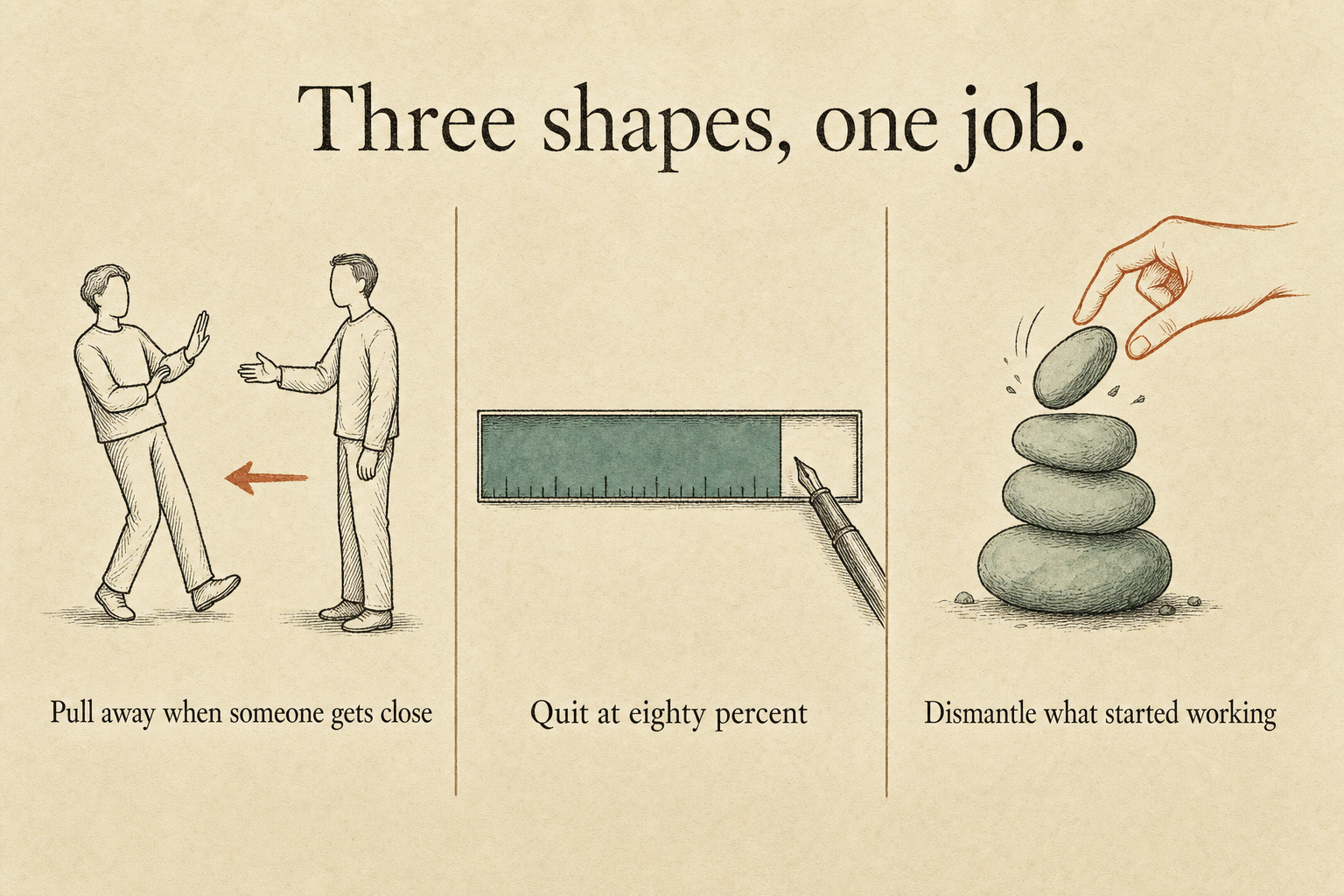
Because closeness is where the exposure becomes real, so the withdrawal follows the good night rather than the argument.
The sequence is almost always the same. Something honest gets said, or a weekend goes better than either of you expected, or they tell you plainly how they see you. Within a day or two you are less available, busier, flatter, quicker to find something irritating. It runs as pulling away from friends and family who are supportive, often out of a feeling of being unworthy of their support, and as actively avoiding emotional attachment in order to prevent potential pain. There is a related move, using emotional withdrawal not only as protection but as a way to control the temperature of a room.
Watch for the manufactured version too. A fight picked over something small, a few days after the closest evening, restores a distance that nobody has to admit wanting. Creating unnecessary drama is an avoidance behavior in its own right, and it is far easier to justify than saying out loud that being loved at close range is frightening.
The quietest form of it never looks like withdrawal at all. Keeping an exit route open. Non-committal language that leaves everything reversible. A preference for ambiguity in a relationship, because a defined thing carries expectations that an undefined one does not. It looks like hesitating to invest seriously in hobbies, relationships or careers precisely in order to keep an easy way out available. Where this hardens into a fixed distance from feeling has its own page.
The tell that catches most people off guard is discomfort at being cared for. Being looked after, with nothing asked in return, reads as either a mistake somebody is about to correct or a bill quietly accruing out of sight. Don't judge yourself if you cannot find the moment you decided to pull back. Most people cannot, because no decision was made anywhere you could point to.
Why Do I Quit Right Before Anybody Can Judge the Work?
Because an unfinished thing cannot be marked.
At eighty percent the work still exists as potential, and potential is undefeated. Submitting it, publishing it, showing it to the one person whose opinion actually lands, converts potential into a verdict. The same escape comes in several versions: withdrawing from a personal project at the first sign of difficulty, using the desire to do something perfectly as an excuse for not doing it at all, remaining in a perpetual state of research and preparation while claiming to need more information, and assuming failure before even starting.
People running the achievement version of this are blunt about the stakes, and they phrase it in strikingly similar ways. "I'm afraid of failing in front of others." "If I'm not perfect, people will judge or reject me." "I'm terrified of failing and being seen as not good enough." Held against sentences like those, quitting at eighty percent stops looking irrational and starts looking cheap. Ten hours of wasted work against a permanent record of not being good enough is an easy trade for a nervous system doing arithmetic.
The variants matter, because people only recognize their own. The application submitted an hour after it closed. The late withdrawal from a commitment, arriving too late to be discussed. The goal quietly replaced by a different goal every six weeks, so nothing is ever pursued long enough to be missed. The promotion nobody applied for. Perfectionism is the more socially acceptable face of the same equation, and the delay version has its own page too.
- Group
- 8–15 people
- Length
- Five days
- Where
- Sacred Valley, Peru
- You leave with
- Action steps
- The pattern
- Protection, not weakness
- The timing
- Days after a win
- The job
- Keeping the verdict open
- The tell
- Willpower changes nothing

If the timing you just read is your timing, this is the room where we find the job your sabotage is doing.
Why Do I Dismantle Things Right After They Start Working?
Because arriving is its own exposure, and the machinery you built for not-arriving has no instructions for it.
Two mechanisms run underneath this one. The first is identity. People say it in the plainest possible terms: "I don't know who I am outside of striving for success," and "If I step off this path of constant achievement, I don't know who I'd be." Somebody assembled entirely out of reaching has no role available in a finished thing, so a finished thing produces a very specific disorientation that gets resolved by starting a new fire.
The second is arithmetic about worth. Where worth was made conditional early, a good outcome that has not been fully earned creates a debt rather than a pleasure. This one arrives as a whole cluster of habits at once: feeling undeserving of positive emotional experiences, resistance to positive experiences out of fear that they will not last or are not deserved, an inability to enjoy accomplishments, attributing every success to luck or timing, and a straightforward skepticism toward praise. "I am only as good as my last success." "I don't deserve to relax or enjoy myself when there's more to achieve."
Dismantling settles the debt. So does the softer version, which is discounting: the win gets one evening at most, then gets reclassified as smaller than it looked, then gets replaced by a target that makes it retrospectively inadequate. The extreme end of that has a name of its own, a subconscious avoidance of experiences that bring joy, on the grounds that joy might surface whatever is sitting underneath it.
The version I know best is the achievement one. I spent five years and more than five thousand hours doing this kind of work on myself before I built anything around it, and more than fifty thousand dollars on seminars, therapy, books, and teachers, some found in the jungles of Vanuatu, some in the jungles of Peru. What took me longest to see was that the wrecking ran on a schedule. It arrived after good months, not bad ones. I had assumed for years that I fell apart under pressure, when what actually happened was that I fell apart under relief.
Where this sits for me today is worth stating plainly. The pull to interfere with a good stretch has dropped a great deal across the years of doing this work. It has not dropped to zero, and I would rather tell you that than sell a finished version of something nobody finishes.
Where Does Self Sabotage Hide When You Would Not Call It Sabotage?
In six separate arenas, and most people recognize themselves in only two or three of them at first.
| Where it shows up | What it looks like from outside | The sentence underneath |
|---|---|---|
| Work and projects | Endless research, the good idea abandoned at eighty percent, the application sent an hour late, the promotion nobody applied for | "I'm afraid that trying to solve this problem will only reveal my incompetence." |
| Money | Unopened statements, a bill left until it becomes a letter, no budget, a vague sense of the number rather than the number | "I'll deal with it when it becomes absolutely unavoidable." |
| Close relationships | The fight picked after the best weekend, the slow fade following something kind, an exit route kept open on purpose | "I'm afraid that confronting this problem might lead to loss or rejection." |
| Health and the body | Postponed appointments, sleep pushed later each night, the training stopped in the week it started working | "I don't deserve to get help with this issue." |
| Success and recognition | Praise deflected, goalposts moved within a day, the win reclassified as luck before the week is out | "I am only as good as my last success." |
| Time and commitments | Chronic lateness, late withdrawals, language so non-committal that everything stays reversible | "I'd rather keep things as they are than risk making them worse." |
The money row is the one people most often skip past, and it is frequently the loudest. An unopened bank account is avoidance in its purest observable form, since the balance exists whether or not anyone looks at it, and the only thing looking changes is that you now know.
The health row is the most carefully reframed. Canceled appointments and abandoned training get filed under busyness rather than under this pattern, which is convenient, because busyness is respectable. Compulsive busyness is an avoidance behavior in its own right, and it works by filling the time so completely that no time is left in which to reflect on any of it.
What Separates Self Sabotage From a Sensible Change of Direction?
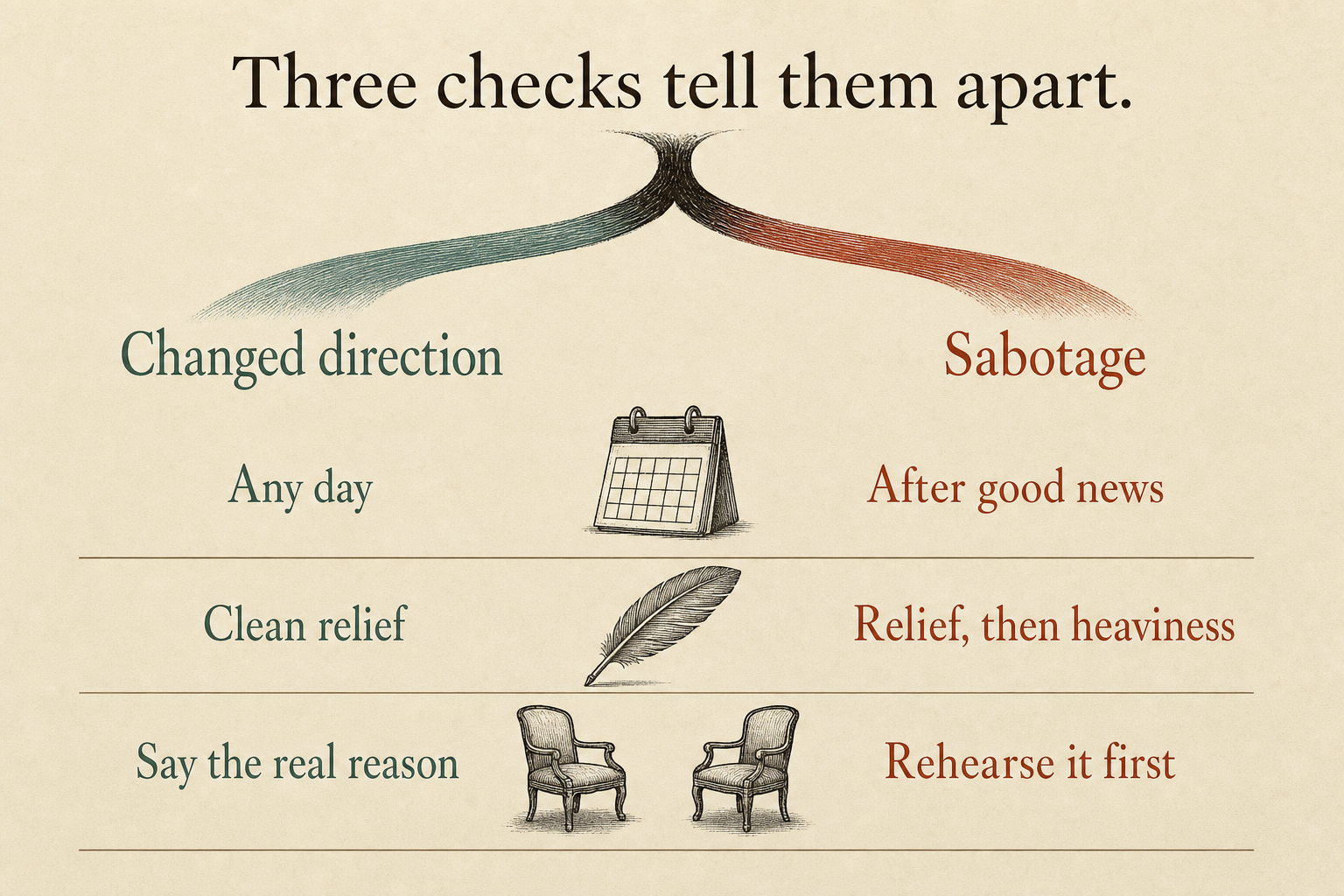
Three checks, and you can run all of them in about ten minutes.
- Timing. A genuine decision to stop can arrive on any day of any month. Sabotage clusters, and it clusters after good news. Lay the last five endings on a timeline and mark the last good thing that happened inside each one. If the good thing sits three to ten days before the ending, you have your answer.
- The residue. Leaving something you honestly outgrew leaves a clean relief that stays clean. Sabotage leaves relief with a floor under it, followed within a day or two by a familiar heaviness and a well-constructed story about why it was never going to work anyway.
- The sayable test. You can tell a friend the real reason you left a job that was making you ill, in one sentence, without preparing it. Sabotage tends to come with a reason you would rather not test out loud, which is exactly why the explanation gets rehearsed in the car.
Plenty of endings are not sabotage. Leaving a company that was grinding you down, ending a relationship that had been over for a year, dropping a goal you inherited from somebody else and never actually wanted: those are corrections, and treating every ending as pathology is its own trap. The three checks exist so you can tell the difference on your own, without needing anyone to rule on it.
Where Did This Get Installed?
Usually somewhere that trying, or being seen trying, carried a real price.
It runs back along two main routes. The first is a home where the standard was high and, more importantly, unmeetable. The formation fits in one line: it develops out of environments with high and often unrealistic expectations, producing a continuous pursuit of external validation alongside a self-imposed pressure that never switches off. A child who can never reach the point where approval arrives and stays does not learn a skill. They learn an equation, and then they learn to protect themselves from ever losing visibly.
The second route runs through problems rather than performance. In some homes, looking at something cost more than the thing itself. Naming a problem meant admitting failure. Needing help exposed weakness. Having a feeling burdened somebody. A child in that house does not learn to solve. They learn not to look, and that habit generalizes quietly across thirty years until it applies to bank statements, lumps, drafts, and conversations with equal force.
Not every case traces back to a parent. A teacher who made one visible mistake expensive, a humiliating year at fourteen, a first job where being wrong in public cost somebody their standing, a relationship where being fully known ended badly and taught the obvious lesson. The mechanism holds across all of them: exposure carried a price, and a person intelligent enough to notice built a system to avoid paying it again. The original conclusion underneath all of these has its own page.
There is nothing weak or foolish in any of it. The strategy worked. That is the entire reason it is still installed.
What Does the Resolved Side of This Actually Look Like?
Concrete enough that you could film it, and considerably less dramatic than most people expect.
Every one of these patterns is a polarity with two ends. Describing only the wounded end leaves you with an excellent account of your problem and nowhere to walk, so here is the other end, translated out of abstraction and into an ordinary Thursday.
| The wounded end | The resolved end | What it looks like on an ordinary Thursday |
|---|---|---|
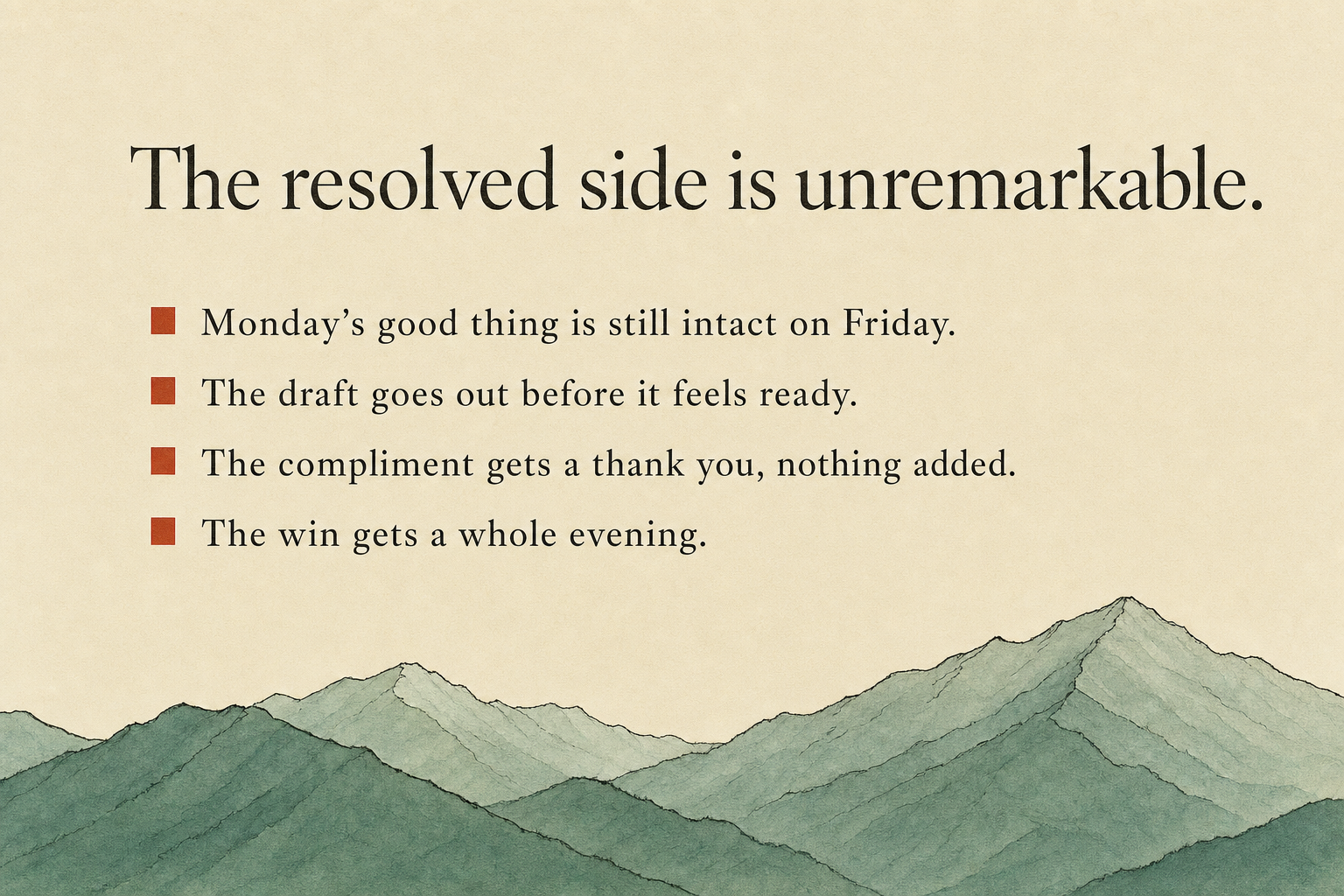
| Self-sabotage | Self-enhancement | The good thing that happened on Monday is still intact on Friday |
| Fear of failure | Learning from failure | You send the draft while you still think it could be better |
| Avoidance of risk | Considered risk-taking | You apply for the thing that is one size too big for you |
| Feeling stuck | Moving forward | One small step taken on the day you noticed it was needed |
| Perpetual research | Practical application | You start with what you already know and correct it later |
| Inability to celebrate successes | Acknowledgment of achievements | A win gets a whole evening before the next goal is allowed in |
| Conditional self-worth | Unconditional self-worth | A bad quarter changes your plans without changing your verdict on yourself |
| Feeling undeserving | Feeling deserving | You accept the compliment and add nothing to it |
| Avoidance of depth | Seeking depth | You stay in the room for the twenty minutes after something honest is said |
| Maintaining the status quo | Seeking transformation | You have the conversation you have been rehearsing since spring |
| Externalizing blame | Taking accountability | You name your own part in it out loud, in one sentence, with no speech attached |
| Seeking perpetual comfort | Accepting discomfort for growth | You feel the pull to cancel, and you go |
| Avoidance of reflection | Valuing reflection | Ten quiet minutes before bed, spent looking at what you actually did |
| Feeling caged | Feeling free | A Thursday that ends without a private plan for getting out of something |
Read the right-hand column carefully, because it is deliberately unimpressive. Nobody in it is confronting anybody or announcing anything. The resolved end of this pattern is mostly a person whose good week survives contact with the following one.
Don't judge yourself if that column reads as slightly out of reach right now. The distance between the two columns took decades to build, and nobody crosses it in an afternoon.
How Do You Move Toward It Without Blowing Up Your Life?
By running repetitions small enough that the protective part of you does not feel the need to intervene.
- Guard the five-day window. After anything goes well, put a note in your calendar four days out that says one word: watch. The pattern needs that window, and it works best unobserved. Naming it in advance shrinks it more than any amount of willpower applied on the day.
- Say the job out loud before you act. "If I cancel this, I get out of being seen tomorrow." "If I pick this fight tonight, I do not have to be close to them this week." Sabotage runs on the reason staying unexamined, and it loses a surprising amount of power the moment the reason is spoken in a normal voice.
- Finish one small thing badly, on purpose. Ship the version you can already do. A short piece of work, sent, at a quality you would call adequate. The point is collecting evidence that a verdict can land on something of yours and the world continues, which no amount of reasoning will ever produce.
- Feel what rises when the good thing stays. Something arrives in the days after a success, and it is usually closer to dread than to joy. Let it sit in your chest without acting on it, negotiating with it, or deciding what it says about you. There is a separate page on how to actually feel a feeling rather than think about it.
- Remove the exit routes before you need them. Tell one person the date. Pay in advance. Put the draft in a shared folder. Every removed exit is one fewer decision to make on the day your protective machinery is running at full strength.
- Treat the explanation as the tell. When you catch yourself rehearsing a justification nobody has asked for, that is the sabotage arriving with its paperwork already filled in. The rehearsal is available to you several hours before the action is.
- Accept one thing without balancing it. Let somebody help, say thank you, add nothing. No immediate favor in return, no self-deprecating remark to level the exchange. For anyone whose good things have always felt borrowed, this repetition is harder than any refusal and it works on the same root.
- Keep the evidence. One line at the end of each day for the good thing you did not interfere with. The pattern survives partly on a memory that only stores the collapses, and a written record is the cheapest possible correction to that.
Is any of this dramatic? No. It is unglamorous and freaking slow, and that is precisely why it holds when a weekend of resolve does not.
Does the pull disappear once you get good at this? Honestly, no. It shows up on the same schedule it always did, a few days after something goes right. What grows with practice is your ability to notice it arriving and let the good thing stand anyway. After enough repetitions the pull quiets down on its own, mostly because nothing bad kept happening.
What Happens Right Before You Quit?
The fear arrives near the finish rather than at the beginning, and it arrives roughly on schedule.
Knowing that in advance matters, because the timing is exactly what makes the fear convincing. At the start of anything, failing costs you almost nothing. There was nothing there yet and nobody had been told. Close to the end, the same failure would be dated, visible, and watched. The stake of the failure rises as the goal comes into range, so the quiet arithmetic underneath starts preferring a partial result. Stalling somewhere short of the summit leaves you at a height people can get used to, with nothing much to fall from.
Picture a man in his fifties who has lost the same weight and regained it every time for thirty years, and who arrives treating it as a strategy problem he has already researched thoroughly. Asked what he associates with losing it, he produces a long sensory list of what it would cost him and a short list of what it would give him, disqualifying each item on the short list as he says it by noting that he has that already. More pain sits on the change than on staying the same, which is precisely the oscillation he has been living inside. Under that, failing means being incompetent, and incompetence is a conclusion about himself he treats as worse than dying.
What he got at the moment he committed was a forecast. As you approach this, you will get frightened, and the safest move available to you will be to stall at a partial result where people can get used to you. That is the whole intervention, delivered before anything went wrong.
Naming the plateau in advance does something specific to it. When the fear turns up in the predicted week, its meaning has already been assigned, so it reads as the stage you were warned about rather than as proof that the attempt was misconceived. That second reading is the one that normally ends things. The fear has not become any weaker. What it means has changed, and what it means is the part that was doing the damage.
There is a second effect, and it is the reason to write the forecast down rather than think it once. Picture the specific situations where the new behavior will be tested, in detail, before they arrive. The Sunday evening. The message from the person who always gets a reply. The week the numbers dip for reasons that have nothing to do with you. The compliment you will not know where to put. Running those in advance conditions a response, so on the day the new behavior gets retrieved under pressure rather than invented under pressure. Nobody invents anything useful under pressure.
A plainer version of the same trap costs people years. Most single actions do not visibly move anything on their own, so the stretch just before results appear looks identical from the inside to a stretch that is going nowhere. A direction held steadily is the thing that eventually arrives somewhere, and people commonly stop in the gap between the effort and the first visible payoff. Quitting there feels like reading the evidence honestly. What is being read is the absence of a result that was never due yet.
One more thing about the resistance, because how you meet it decides whether it grows. Going at the behavior head-on gets it defended as though it were your worth, since the behavior and your sense of who you are were never separated in the first place. What works instead is dull and slightly embarrassing. Treat the part of you that wants to stop as something with an original job, acknowledge out loud what that job was, and hand the decision back to the rest of you. Fighting a part of yourself recruits more of it, and thanking it is what lets it stand down without the release feeling like losing a piece of who you are.
So write the forecast before you need it. Three lines in the same note: the week you expect the pull to arrive, the two situations most likely to carry it, and the one sentence you will say to yourself when it does. Fifteen minutes now, and the thing turns up already labeled.
Does the forecast stop the plateau from arriving? No, and any version of this that promised otherwise would be selling you something. It arrives on time either way. What changes is that you recognize it while you are standing in it.
How Long Does This Take, Honestly?
Longer than a week, and the honest answer runs at two speeds.
Recognition arrives quickly. Most people can catch the pattern mid-flight within a few weeks of deliberate attention, and catching it counts even on the days you fail to change anything. Watching yourself compose the excuse while knowing exactly what the excuse is for feels terrible, and it is a genuine step forward.
The reflex takes far longer. Your body's response to holding something good was rehearsed across years, and it fades at the pace of accumulated experience rather than insight. Understanding the mechanism as thoroughly as you now roughly do changes remarkably little on its own. Twenty good outcomes held intact, each one genuinely uncomfortable to sit through, change a great deal.
Is that frustrating? Yes, and I would rather say so than sell you a faster route that does not exist. The people who actually shift this are the ones who kept running unglamorous repetitions months after the insight stopped being interesting.
- Group
- 8–15 people
- Length
- Five days
- Where
- Sacred Valley, Peru
- You leave with
- Action steps
- The question
- What became possible?
- The practice
- Let one good thing stand
- The shift
- Investigate, not punish
- You leave with
- The job, named
You have the question now. Five days in the Sacred Valley is where it gets answered, with dates on it.
What Is Worth Doing Tonight, Before Any Bigger Decision?
Build a sabotage timeline, which takes about fifteen minutes and costs you nothing. Open a note and list the last five things that mattered to you and ended early or ended badly: a job, a relationship, a project, a training block, a friendship. Beside each one, write the date of the last genuinely good thing that happened inside it. The offer, the compliment, the weekend that went well, the week the work finally came together.
Then look at the gaps. Most people find the same interval showing up again and again, somewhere between three and ten days, and finding it changes what you are dealing with. A pattern with a clock on it is something you can prepare for. Put a note in your calendar for four days after the next good thing, and you have already done more than any amount of resolving to try harder ever managed.
If the pull you feel is toward this pattern itself rather than toward a location or a ceremony, our Sacred Valley seminar works directly on this kind of material. Everybody is screened before arriving, the group stays small enough that somebody quietly heading for the exit gets noticed rather than lost, and the weeks after the flight home are built into the design rather than left to you. The honest limitation: exact dates, the price, and the final cap on group size are still being finalized, so anybody comparing programs on those numbers this week cannot yet compare ours. Put these same questions to every program you are weighing, this one included. Feel into it and find out for yourself. A week spent looking at the thing you have been arranging your life around is rarely wasted, whatever you decide afterward.
Self Sabotage Questions
Why do I sabotage myself?
Because the behavior is doing a protective job. Pulling away, quitting early, or wrecking a good thing all remove you from an exposure that once carried a real price: being judged, being found wanting, or being cared for without having earned it. The move is efficient and it works within seconds, which is why arguing with it logically has never worked for anybody. Naming the specific job it does is where change starts.
What is self sabotage, exactly?
Any repeated behavior that undermines something you say you want, run by a part of you protecting you from what getting it would expose. In practice it looks like a steady undermining of your own success or your own relationships, carried out as a subconscious attempt to avoid dealing with the deeper thing that succeeding would raise. The outward behavior varies enormously from person to person. The function underneath stays remarkably constant.
Why does self sabotage happen right after something goes well?
Because the good outcome raises the exposure. A finished project can be judged, a partner who has moved closer can see you properly, and a success sets a level you now have to hold. Watch the timing across a few months and the clustering shows up clearly, with the wrecking following the good week rather than the bad one. That timing is the most reliable tell available to you.
Why do I pull away when someone gets close?
Because closeness is the moment the old expectation arrives that being fully known ends badly. It takes two recognizable forms: pulling away from supportive people out of a sense of being unworthy of their support, and a plain discomfort at being cared for at all. From the inside it registers as needing space or losing interest, and it almost never registers as fear. The withdrawal usually follows the good evening.
Why do I quit right before I finish?
Because an unfinished thing cannot be marked. At eighty percent the work still exists as potential, and potential is safe from a verdict. Submitting converts it into something people can rate. It shows up as withdrawing from a personal project at the first sign of difficulty, and as using the need to do something perfectly as a reason for not doing it at all. Perfectionism and quitting early are frequently the same move.
Is procrastination the same as self sabotage?
Often, though it depends on what the delay is buying you. Delay that protects you from a verdict works exactly like the other forms, which is why procrastination and self-sabotage sit side by side as expressions of the same avoidance. Delay caused by a badly designed week, a task you genuinely lack information for, or plain exhaustion is a scheduling problem. Check whether the postponed task is one where you could be judged.
What is the difference between self sabotage and changing your mind?
Three checks separate them. Timing: a genuine change of direction can arrive on any day, while sabotage clusters after good news. Residue: leaving something you outgrew leaves clean relief, while sabotage leaves relief followed by a familiar heaviness within a day or two. The sayable test: you can tell a friend the real reason you left something that was wrong for you, without rehearsing it first.
Is self sabotage conscious or subconscious?
Mostly it runs below the level where decisions get made, which is why people describe watching themselves do it. What stays available to you is the second before the move and the explanation that arrives afterward. That explanation has a name of its own, internal rationalization, the quiet crafting of narratives that make avoidance seem reasonable. Catching the rationalization while it is still being written tends to be easier than catching the impulse itself.
What does the opposite of self sabotage look like day to day?
Unremarkable, which is why anyone scanning for a dramatic version walks straight past it. The good thing that happened on Monday is still intact on Friday. A draft goes out while you still think it could be better. A compliment gets a thank you with nothing added to it. A win gets a whole evening before the next goal is allowed into the room. Nobody in that description is confronting anybody.
How do I stop sabotaging my relationships?
Start by watching the timing rather than the content of the fights. If the distance reliably follows the closest evenings, the argument is a delivery mechanism rather than the actual issue. Then practice staying in the room for the twenty minutes after something honest is said, and accepting care without balancing the exchange. Those two repetitions work on the root, and both feel considerably worse than arguing does.
How will I know this is shifting, before it has fully changed?
The first sign is timing rather than outcome. The urge to dismantle something still arrives, and the gap between the urge and the action gets longer. Later the action still happens and you notice it the same day instead of three weeks on. Periods come last. Judging progress by whether the impulse showed up tells you almost nothing. Judging it by what you did in the twenty minutes afterward tells you a lot.
When should this be worked on with a professional instead of alone?
When the sabotage has become physically or financially dangerous. Drinking or using that has started running you, spending or driving or sex that puts you at real risk, deliberate harm to your own body, or any thought of ending your life belongs with a licensed professional now rather than later. The same holds alongside a diagnosed condition you are currently managing, or a hopelessness that has not lifted for months.
What does it mean when someone says they self-sabotaged?
They mean they did something that undermined a thing they actually wanted, and they can see it clearly now. The word almost always arrives in the past tense, because the recognition turns up after the damage: the message sent at midnight, the deadline missed by an hour, the offer declined for reasons that no longer sound convincing. Saying it plainly is a real step, and it is worth considerably more than the shame that usually follows it.
What is a self-sabotager?
A term people use for someone whose own behavior reliably undoes what they say they want, across areas of life that otherwise have nothing in common. It describes a pattern rather than a personality, which matters, because the behavior lifts once the exposure underneath it gets addressed. Anyone applying the word to themselves is usually already partway to seeing the pattern clearly, and that recognition is the part of it that moves.
Is it written self sabotage or self-sabotage?
Both forms are in common use. The hyphenated spelling, self-sabotage, is the more standard one in edited writing and the version most dictionaries carry, while the open form turns up constantly in everyday writing and in what people type into a search box. As a verb it is self-sabotage or self-sabotaging, and for a person, self-sabotager. The spelling changes nothing about how the pattern works.
What is self-sabotage a symptom of?
Usually of a conclusion formed early, that being seen fully, judged, or cared for carries a price you cannot afford to pay again. It travels with conditional self-worth, fear of failure, and a fear that touching one problem will drag several others into the room. It signals a protective strategy that outlived its usefulness, which points you toward what you are guarding rather than toward anything wrong with you.
What is the psychology behind self-sabotage?
Relief arrives within seconds and the cost arrives weeks later, and that arrangement is exactly what trains a behavior into a reflex. Canceling, delaying, or picking a fight removes an exposure immediately, and your nervous system logs that as a success worth repeating. The price surfaces much later as an unfinished project or a relationship gone quietly flat, far enough away that the two never get connected. That gap keeps the whole thing running.
What is emotional self-sabotage?
The version that runs in feeling rather than in behavior. It looks like discounting a win within hours of getting it, refusing comfort that was freely offered, treating a good stretch as a bill quietly accruing, or going flat in the week after somebody said something kind. Nothing visible gets wrecked. The good experience simply gets drained of value before it has a chance to settle, and the result matches the louder forms.
What are the most common self-sabotaging behaviors?
Delaying the tasks where you could be judged, quitting a project at around eighty percent, picking a fight after an unusually good weekend, drinking or spending in the week something went right, leaving statements unopened, canceling appointments, chronic lateness, and deflecting praise until people stop offering it. From outside the list looks scattered. Every item on it removes you from a moment where something about you was about to be evaluated.
How do I know if I'm self-sabotaging?
Three signals together make it fairly clear. The behavior repeats across areas that share nothing else, so work, money, and closeness all show the same shape. You can name what you would have had to face if you had carried on. And somebody who knows you well saw it before you did, probably more than once. A single instance proves nothing at all. The repetition is what counts as evidence.
Is it self-sabotage or am I just exhausted?
Exhaustion is indiscriminate and sabotage is selective. Real tiredness flattens everything at once, including the parts of your week that carry no risk whatsoever. Sabotage picks its targets: the task where a verdict is possible, the person who moved closer, the win you would have to keep holding. If the low-stakes parts of your week still get done and only the exposed ones collapse, look further. Rest first, then check again.
Why do I keep doing this when I already understand why I do it?
Because the understanding sits in one system and the reflex sits in another. The part that fires four days after good news was trained by years of lived experience, and it updates through experience rather than through explanation. What insight buys you is the second before the move, which is genuinely valuable. It takes a great many repetitions before that second turns into a different decision instead of a clearer view of the same one.
How do I stop sabotaging myself?
Work on the timing before you work on willpower. Put a note in your calendar four days after anything good happens, since the pattern needs that window and it needs it unwatched. Name what the impulse is buying you, out loud, in a normal voice, before you act on it. Then take away the exits ahead of time by telling one person the date, paying in advance, or putting the work somewhere visible.
How do I answer a self-sabotaging thought when I catch one?
Leave the content alone, because the content is usually reasonable and arguing with it is a fight you will lose. Answer the function instead. Ask what this particular thought is getting you out of, and answer honestly: a verdict on your work, an evening of being close to someone, a number you would rather not see. Then do the smallest possible version of the thing anyway. Evidence shifts this where reasoning never does.
How do I stop self-sabotaging at work?
Send something small at a quality you would honestly call adequate, this week, and watch what happens when it lands. The work version runs mostly on preparation that never ends, so the repetition worth building is finishing rather than polishing. Decide the send time before you start, tell one colleague it is coming, and let it go out before you feel ready. The discomfort you feel doing that is the whole point.
How do I stop self-sabotaging with money?
Open the account and look at the number. That is the entire first step, and it is the one people skip for years at a time. Money avoidance works by keeping the figure unknown, which changes nothing about the figure and a great deal about how much room it occupies in your head. Write the real number down, then book fifteen minutes each week to look again. The discomfort fades much faster than the dread does.
Do people who self-sabotage a relationship come back?
Often, and the return tends to run on the same rhythm as the leaving. Distance restores the safety that closeness removed, and once it feels safe again the pull toward the person comes back with it. Whether the return changes anything depends on whether the pattern got looked at during the gap. Left unexamined, the second attempt usually ends the way the first one did, on roughly the same timeline.
Can self-sabotage be overcome for good?
The pull quiets down a great deal with practice, and expecting it to disappear entirely sets you up to read an ordinary flare as failure. What changes is who is driving. The impulse still shows up a few days after something goes well, and it stops being the thing that decides. Most people describe noticing the urge, feeling it fully, and finding the good thing still standing a week later.
Is self-sabotage a form of mental illness?
No. It describes a behavior pattern rather than a diagnosis, and most people running it function perfectly well everywhere nothing is at stake. It can sit alongside a diagnosed condition, and it can become dangerous in its own right when the wrecking involves substances, money, or your own body. Those versions belong with a licensed professional. The everyday version responds well to attention, timing, and unglamorous repetition.
Is self-sabotage a form of self-harm?
They overlap at the edges, and separating them is worth the trouble. Most self-sabotage costs you opportunities, money, and closeness with no intention of hurting yourself anywhere in it. Some of it does cross into genuine danger: drinking or using that has started running you, risk taken deliberately, harm done to your own body. That version needs a licensed professional starting now rather than a practice you run alone.
Why do I get scared when I am close to finishing something good?
Because the stake of failing rises as you approach. At the start there was nothing to lose and nobody had been told. Near the end the same failure would be dated, visible, and watched, so the quiet arithmetic underneath starts preferring a partial result you can stall at safely. Expect the fear in the last stretch and write that expectation down, and it turns up already labeled as a stage rather than a verdict.
Why do I avoid the exact thing I say I want?
Usually because your brain filed it as the source of an old pain. When something hurts, the attribution gets made fast, weighing what was unique to that situation, what had happened most recently, and what had been happening consistently. That call is quick by design and wrong often enough to matter. Whatever got tagged then gets avoided for years, whether or not it had anything to do with the damage that arrived.
Do I have to understand where this came from before I can change it?
No, and waiting for the explanation is one of the more expensive ways to stall. People spend years trying to work out why they shut down, never land an answer, and then move within a week of deciding the reason no longer matters and only the next action does. Where a pattern came from is genuinely interesting. What shifts it is what your body, your attention, and your language are doing right now.
Why do I quit right when something is about to start working?
Because most single actions do not visibly move anything on their own, so the stretch just before results appear looks identical from the inside to a stretch going nowhere. A direction held steadily is what eventually arrives somewhere, and people commonly stop in the gap between the effort and the first visible payoff. Quitting there feels like reading the evidence honestly, when what is being read is the absence of a result that was never due yet.
Why would getting what I want ever feel like a loss?
Because in some houses the care that flows toward a person is quietly conditioned on them staying smaller or more obviously in need of help. Becoming fully capable would change the character of that care or end it, and a part of you priced that out long ago. So the win arrives carrying a reward and a loss in the same envelope, and the loss is older. Arguing with it fails because nothing in it is inaccurate.
Want the part most retreats skip?
Join the list for the next Sacred Valley seminar: integration-first deep inner work, an intentionally small group, and tools you actually take home.
See the seminar florian@florianrolke.com